
Andrew Kitchenman

State Government Reporter, Alaska Public Media & KTOO

State government plays an outsized role in the life of Alaskans. As the state continues to go through the painful process of deciding what its priorities are, I bring Alaskans to the scene of a government in transition.
Senate OKs bill to factor credit scores into home and car insurance premiums

Car insurance illustration
(Creative Commons image by Pictures of Money/CheapFullCoverageAutoInsurance.com)

When Alaskans renew their car or homeowners insurance policy, insurers can’t use their credit history to determine their rate without their approval. That’s unlike all other states, where good credit means lower premiums and bad credit means higher premiums.

But the state Senate passed a bill this week that would bring Alaska in line.

Supporters of Senate Bill 127 said this will benefit most people in the state; opponents are concerned about the impact on low-income residents, rural Alaskans and minorities.

Sen. Charlie Huggins, R-Wasilla, discusses House Bill 75, the Marijuana use and regulation bill in the Alaska Senate, Feb. 24, 2016. He was explaining changes to the bill that were made in committee shortly before it passed the Senate. (Photo by Skip Gray/360 North).
Sen. Charlie Huggins, R-Wasilla, sponsored a bill allowing credit histories to be used in auto and homeowner’s insurance. (Photo by Skip Gray/360 North)

Bill sponsor Sen. Charlie Huggins, a Wasilla Republican, said it’s a no-brainer.

“This is a simple bill,” he said. “Very simply, we become one of 50 states that allow, when you’re renewing your auto or your home insurance, credit scoring to be used. And the overwhelming majority of Alaskans will benefit.”

But Anchorage Democratic Sen. Bill Wielechowski noted that those with worse scores could see their rates more than double.

“The people on the lower end of the income scale who can least afford it will see their rates increase under this bill,” he said. “Insurance is not an option in this state. You can’t drive a car without it. You can’t get a mortgage without it. Our economy is sputtering. Lots of people will suffer if this bill passes.”

Wielechowski pointed to studies showing that bad credit scores can increase car insurance premiums more than bad driving.

He added that a 2003 state report raised concerns about the effect of using credit scores on rural and older Alaskans, as well as minorities.

But Sitka Republican Sen. Bert Stedman said the bill would benefit many rural residents.

“I’d like to benefit from this, for a lot of my constituents — the ones that have good credit, that work hard, play … the economic game squarely,” Stedman said. “I don’t think they should be paying for people that don’t.”

The bill wouldn’t apply to health insurance. And the bill protects residents whose credit is harmed by family deaths, divorces, military deployments and catastrophic events.

The Senate passed the bill 15-5. The House will now consider it.

Legislative houses near votes on different budget versions

The path to setting Alaska’s state government budget enters a new phase this week, as both legislative chambers prepare to vote on different versions of the spending plan.

As the House heads into a debate on the budget Thursday, it’s eyeing a proposal that includes a $280 million reduction from last year.

Senate Finance Committee Co-Chairpeople Anna MacKinnon and Pete Kelly discuss the budget. (Photo by Andrew Kitchenman)
Senate Finance Committee Co-Chairpeople Anna MacKinnon and Pete Kelly discuss the budget. (Photo by Andrew Kitchenman/KTOO)

The Senate Finance Committee’s current budget includes $215 million in cuts. But Committee Co-Chairman Fairbanks Republican Sen. Pete Kelly said he’s aiming for a total of $500 million in reductions.
How the committee will get to those deeper cuts isn’t clear. But Kelly said structural changes to Medicaid, criminal justice, and oil and gas tax changes are target areas.

“At this time, if we didn’t make the appropriate reductions, and make government smaller, and better – with the systemic changes built into it – then what we would be offering the people of Alaska is sustainable spending, not a sustainable budget,” Kelly said.

Kelly said the Finance Committee will also propose changes to the Teachers’ Retirement System.

And co-chairwoman, Eagle River Republican Sen. Anna MacKinnon said senators are considering overhauling community revenue sharing. Some rural communities depend on the money from the state to provide basic services.

“Should we let it ramp down as proposed in current Alaska state statute, should we recharge it given the current financial difficulties that we’re facing, or should it be repurposed and totally taken apart and done differently?” she said.

Funding for the Alaska LNG pipeline is an area where there’s a difference between the House and Senate. The House included $10 million for it, but MacKinnon is skeptical. She said the state has enough money to complete the preparations for front-end engineering and design work, known as pre-FEED.

“At this time, I am really not interested in additional funding for that purpose, when we’ve already deployed those assets, and they should be able to reach the completion of pre-FEED,” she said.

The House expects to pass its version of the budget tomorrow, and the Senate could be done with its spending plan on Monday.

That will leave the two chambers a month to iron out their differences before the scheduled end of the session on April 17.

In that time, legislators will discuss new revenue to cover the budget. They will consider a cut to Permanent Fund dividend payments, and adding broad-based taxes like an income tax.


Walker orders effort to streamline public authorities

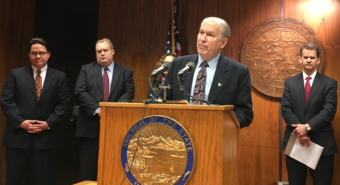
Gov. Bill Walker announces an administrative order on streamlining agencies. AIDEA Executive Director John Springsteen, AHFC CEO/Executive Director Bryan Butcher, Alaska Energy Authority Executive Director Sarah Fisher-Goad (partially obscured) and Administration Commissioner Sheldon Fisher are behind him. (Photo by Andrew Kitchenman)

Gov. Bill Walker is seeking to streamline state agencies responsible for financing economic development, housing and renewable energy.

He signed an administrative order Thursday requiring the Alaska Housing Finance Corporation, Alaska Energy Authority and Alaska Industrial Development and Export Authority to find opportunities to become more efficient or consolidate.

The agencies have more than $3 billion in assets and employ 440 people.

Walker said the state hasn’t pre-determined what the outcome will be.

“This is a process that will be inclusive, not exclusive,” Walker said. “It’s not going to be a process where we come up with an edict on the third floor and say, ‘This is the way it’s going to be.’ We invite them – no one knows their agencies better than them. So they have been doing this a bit internally themselves. So we just have expanded that a bit.”

The housing finance corporation finances low-cost mortgages and provides public and special needs housing. The energy authority administers the Renewable Energy Grant Fund and provides assistance to rural communities. The development and export authority finances business development.

Commissioner of Administration Sheldon Fisher will lead the effort. Walker said he expects the recommendations will require new state laws next legislative session.


Victims’ rights advocates push for changes to criminal justice bill

Blind Lady Justice with scales
(Creative Commons photo by Marc Treble)

Victim’s rights advocates and some legislators have raised concerns about a bill that would overhaul Alaska’s criminal justice system.

The measure would reduce arrests and prison time for nonviolent offenses. It also would help prisoners re-enter society.

The bill has a lot of bipartisan support. It draws on recommendations from the 13-member Alaska Criminal Justice Commission. It spent more than a year considering ways to reduce recidivism and take pressure off of the need to build more prisons.
North Pole Republican Sen. John Coghill sponsored the bill. He said the legislation would reduce the state’s prison population by 21 percent over the next 10 years, saving the state more than $400 million.

Coghill also has worked to include input from victim’s rights advocates, who are worried the the reforms benefit offenders at victims’ expense.

Emily Haynes testified in Juneau that a man who sexually assaulted her could be released soon due to the bill. That’s because he accepted a plea bargain that reduced the severity of his conviction.

“I oppose this bill. It’s going to have a direct impact on my life,” Haynes said. “Five years ago I was a victim of a violent sexual assault and the offender will be eligible for release immediately under your proposal. For the past five years, I’ve been fighting this case.”

And Butch Moore of Anchorage asked that the bill require those convicted of murder to have minimum sentences at least as long as those convicted of rapes. His daughter was killed in 2014.

The bill prevents those convicted of sex crimes and domestic violence offenses from being released early.

Sen. Bill Stoltze
Sen. Bill Stoltze, R-Chugiak, chairs the Senate State Affairs Committee. (Photo by Kyle Schmitz/360 North)

Chugiak Republican Sen. Bill Stoltze supported more changes to the bill at a recent hearing.

While the commission included a police officer and heard testimony from victims’ rights advocates and corrections officers, Stoltze said law enforcement and victims didn’t have enough input on the legislation. He chairs the Senate State Affairs Committee.

“Well, I think the rights of victims have been improved,” Stoltze said. “I don’t think they were really that well considered through the commission process. I think they were invited but not that welcomed there. And the Office of Victim Rights, which has very in-depth expertise, really didn’t get meaningful input until the bill got to this committee.”

The Senate State Affairs Committee amended the bill to require the Department of Corrections notify victims of offenders who are eligible for release under the bill. The committee made a series of amendments and voted to advance the bill.

Supporters of the legislation have credited the Pew Charitable Trusts with providing much of the research and national expertise that supported the commission’s work.

But Stoltze said the nonprofit foundation has had too much influence over the bill.

“I haven’t fallen under the talismanic influences of the Pew Charitable Trusts,” he said. “I am interested in the fiscal savings. But I think the public has not been well enough informed of the details about that crime bill.”

But supporters of reform are concerned that some of the changes are weakening the bill.

Grace Singh, assistant to the president at the Central Council Tlingit and Haida Indian Tribes of Alaska, criticizes a provision that requires that those who’ve had their convictions suspended still have their charges listed on the CourtView website.

“This significantly discourages self-sufficiency, and it puts them in a more desperate position, which will not discourage crime or recidivism,” Singh said.

The Senate Judiciary Committee will hear the bill next.

State budget bill with $280 million in cuts due for House vote

The House Finance Committee sent its budget proposal to the full House of Representatives on Wednesday. The budget, with some late changes, would cut spending by $280 million. It also spends $225 million in funds left from the current budget.

There were some intense exchanges between committee members before the final vote.

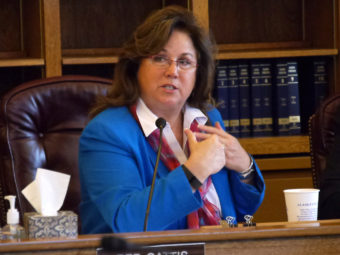
Rep. Lynn Gattis, R-Wasilla, during discussions about the state operating budget shortly before it was passed out of the House Finance Committee, March 9, 2016. (Photo by Skip Gray/360 North)

Wasilla Republican Rep. Lynn Gattis questioned why the leftover funds from the current budget only emerged recently.

“Folks in my district are saying, ‘Why in the heck would I trust you to go and tax me or take my Permanent Fund dividend, when you guys are playing these shell games?’” she said.

But Eagle River Republican Rep. Dan Saddler said spending the savings was a legitimate budget strategy.

On Tuesday, the committee added $30 million for an addiction treatment program, and restored $2.7 million for public broadcasting and $1.7 million dollars for the Nome Youth Facility.

But it didn’t vote to restore $25 million for the University of Alaska.

Anchorage Democratic Rep. Les Gara said the budget shortchanged vulnerable Alaskans. He noted the spending plan cuts all state funding for pre-kindergarten.

Rep. Les Gara, D-Anchorage
Rep. Les Gara, D-Anchorage, during discussions about the state operating budget shortly before the House Finance Committee passed it on Wednesday. (Photo by Skip Gray/360 North)

“I understand we have to cut waste. But we don’t have to cut the things that make a difference in people’s lives,” he said. “That’s where I draw the line. And we crossed that line over and over and over yesterday. I don’t believe we have to cut things that senior citizens rely on. Three hundred and fifty thousand dollars got cut from senior citizen help for people who need emergency housing.”

But Committee Co-Chairman Mark Neuman said that as the state considers cutting Permanent Fund dividends and raising taxes, it must cut spending.

“I’ve had to tell every group, every person that’s walked into my office that has approached me on the street – wherever they talk to me – no. I can tell you, look you straight into the eye that everybody that has walked into my office was told no, we don’t have the money.”

The House is scheduled to discuss the budget — and potentially vote on it — on Thursday. The Senate may vote on its version of the budget on Saturday. Then the two houses will work to resolve the differences.

Gov. Walker picks Spohnholz to fill Gruenberg’s House seat

Ivy Spohnholz, Gov. Bill Walker's pick to fill the House District 16 vacancy caused by the death of Rep. Max Gruenberg (photo courtesy of Governor's Office)
Ivy Spohnholz, Gov. Bill Walker’s pick to fill the House District 16 vacancy caused by the death of Rep. Max Gruenberg (photo courtesy of Governor’s Office)

Gov. Bill Walker named Ivy Spohnholz on Tuesday as his choice to fill the vacancy caused by the death of Rep. Max Gruenberg in February.

Spohnholz is the development director for Salvation Army Alaska and is the vice chairwoman of the Alaska Children’s Trust, which aims to eliminate childhood abuse and neglect throughout the state.

Spohnholz said she wanted the job to address the state’s budget shortfall. Her goal is to avoid economic problems the state experienced in the 1980s. She said when she was a teenager, her parents divorced, and her family faced financial strains.

“I don’t want ever to go through that again and I wanted to be a part of the conversation, in hopes that we can start thinking about the Alaska that we want to have,” she said, “not just the Alaska that, you know, is convenient for us to pay for.”

Spohnholz was one of the three people nominated by Anchorage Democrats for the position.

The House Democrats are scheduled to vote on her appointment either Tuesday night or Wednesday morning. A spokesman for the caucus said she’s unlikely to face any opposition.

She said her first job is to learn about the budget proposals put forward by Walker and legislators.

She’ll also put her experience to work.

“Right now, I work for the Salvation Army, and we see those that are most vulnerable,” she said. “I’m going to be able to bring that experience and the knowledge of what are our most vulnerable elders and youth are facing every day, when we’re making decisions about, you know, how to chart a course forward.”

Walker said he was impressed with the choices that Spohnholz has made, including her founding the organization Foster Kids First, and her family’s decision to adopt a child who has fetal alcohol syndrome.

Walker said he also chose here because of “the life experiences of going through … what Alaska experienced during the ’80s and the downturn in oil.”

He added: “In many respects, that was somewhat similar, although without the loss of life, to what I had been through after the ’64 earthquake.”

Walker said it was a difficult choice. He praised the other nominees – scientist Taylor Brelsford and legislative staff member Kendra Kloster. While he said he could have taken more time, he wanted to make sure District 16 was represented.

Republican Don Hadley also has announced plans to run for the seat this fall. The filing deadline for the primaries is June 1.

Site notifications
Update notification options
Subscribe to notifications