Andrew Kitchenman

State Government Reporter, Alaska Public Media & KTOO

State government plays an outsized role in the life of Alaskans. As the state continues to go through the painful process of deciding what its priorities are, I bring Alaskans to the scene of a government in transition.

House subcommittees cut state operating budget deeper

The Legislature completed the first stage of its annual budget process today. House Finance Subcommittees recommended more than $120 million more in cuts on top of the $100 million that Gov. Bill Walker proposed.

Health and Social Services was the department that received the deepest cuts. They include eliminating $5.18 million in cash assistance to seniors, and $3 million in behavioral health grants.

Rep. David Guttenberg, a Fairbanks Democrat, opposed the cuts. He said reducing treatment of people with addictions will cost the state more in the long run.

“These grants will clearly prevent increases in costs in other places, in the courts, in the Department of Law, in our prisons, in our various higher-end costs,” Guttenberg said. “Dealing with folks that have issues and troubles at the most efficient place to touch them, is something that we need to do.”

Overall recommended cuts to Health and Social Services total $41 million, roughly one-third of all cuts that finance subcommittees recommend.

Rep. Dan Saddler, an Eagle River Republican, compared the difficulties faced by those with addictions to the choices the Legislature faces.

“There are many unfortunate and difficult challenges we face in life and running away from them in a bottle or a needle is not the way to solve them,” Saddler said.

“The way to get through problems is to face the difficult choices and to make difficult choices. And I think that is what we’re doing in this budget, and that’s what we’re doing in this particular allocation. In addition to a heroin crisis in Alaska, we have a fiscal crisis in Alaska. And I think we are making the difficult, but responsible decisions to scale our resources to meet our needs the best way we can.”

Health Commissioner Valerie Davidson during a discussion on Medicaid reform in Senate Finance Feb. 24, 2016. (Photo by Skip Gray/360 North)

Health and Social Services Commissioner Valerie Davidson said she’ll be working to inform legislators about the exact effects of the proposed cuts before the entire Legislature finishes its work on the budget this spring.

“We’ll definitely continue to work with members of the Legislature,” she said. “We realize that cuts have to be made. And our job is to make sure that everybody understands the implications of the cuts that are being made.”

Institute of Social and Economic Research economist Gunnar Knapp said that budget cuts will have broader impacts on Alaska’s economy, along with the direct effect on services.

Institute of Social and Economic Research Director Gunnar Knapp presents possible economic effects of state budget proposals to the Houses Finance Committee, Feb. 25, 2016. (Photo by Skip Gray/360 North)

Knapp told the budget committee on Thursday that for every $100 million  in broad-based cuts to state government, the state will lose 1,260 jobs and $115 million in income.

In comparison, introducing a similar amount in income taxes would impact fewer jobs, but could mean 20 percent more lost income.

Knapp urged legislators to close the state’s $3.5 billion dollar budget shortfall.

 “The smoothest transition is to make a significant start on reducing the deficit this year,” Knapp said. “Not making major progress this year would have a big impact. The rating companies have promised that they would further downgrade our credit ratings and then there would be impacts due to a loss of business confidence and reduced private investment.”

The Legislature will hear public testimony on the budget next week (Feb. 29 to March 3) at locations across the state.


Subcommittee looks for $35 million cut to University of Alaska

The House Finance University of Alaska Subcommittee recommends cutting $35 million from the university’s budget for the upcoming year.

Combined with Gov. Bill Walker’s proposed $15 million cut, the university would lose one in seven dollars in state funding.
The subcommittee also voted to support consolidating the university’s three campus administrations by the end of the year.

The Board of Regents has nominated Jim Johnsen for UA president. (Photo courtesy of University of Alaska)
University of Alaska President James Johnsen (Photo courtesy of University of Alaska)

University President James Johnsen has proposed cutting administrative costs and streamlining programs, but the subcommittee’s cuts go much further.

“I don’t have a problem reducing administrative costs and generating – getting those revenues over into our academic programs,” Johnsen said

But to combine the accreditations of all three campus this — formally merging them into one institution — in 10 months would be impossible, he said.

“That’s a big deal. That’s not going to happen in 2016,” he said. “But to reduce administrative costs across the system, we can definitely do that.”

The subcommittee voted for the cuts five-to-two Wednesday. Supporters of the cut noted that including federal and other funds, the university’s budget is $875 million.

Johnsen said he’s glad the cuts didn’t go even deeper. Subcommittee Chairwoman Tammie Wilson, a North Pole Republican, had initially wanted a $47 million cut but scaled it back after hearing from university leaders.

Johnsen said he’ll fight for more money before the Legislature completes the budget.

“I appreciate the move the committee made” to restore $12 million, he said, adding that subcommittee members said the recommendations are the beginning of the budget process.

“I’m still disappointed, however, in the outcome of this proceeding,” he said. “But knowing there’s a process to move forward with, we’ll continue to press it.”

The House Finance Committee will vote on the recommendations before the full House votes. The university regents ultimately decide how the budget will be spent.

As first legislative budget cuts emerge, some question rural impact

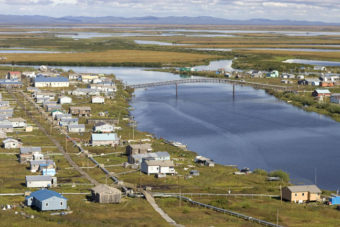
The community of Selawik, near the mouth of the Selawik River, is home to over 800 people. The site of the village, spread between riverbanks and an island, is also called Akuligaq, meaning "a river fork." (Photo by Steve Hillebrand/USFWS)
The community of Selawik, near the mouth of the Selawik River, is home to over 800 people. The site of the village, spread between riverbanks and an island, is also called Akuligaq, meaning “a river fork.”
(Photo by Steve Hillebrand/USFWS)

Legislators are looking to cut the state budget deeper than Gov. Bill Walker’s proposal to reduce spending by $100 million.

But some lawmakers – especially those from rural areas — are raising concerns about where these cuts will fall.

More than five weeks into the legislative session, House finance subcommittees recommended the first cuts to the budget for the fiscal year that starts July 1.

They include $9.8 million in cuts to education programs, as well as cutting all $2.7 million in state funding for public broadcasting.
Rep. Daniel Ortiz, a Ketchikan independent, says eliminating the $2 million for a prekindergarten program is a mistake.

“It’s about investing now so that you don’t have higher costs later,” Ortiz said. “And it just makes good economic sense to do this. Yeah, we get the $2 million reduction but, you know, it’s going to be hard for anybody to chart the costs to the state later on down the road.”

Other proposed cuts include eliminating state funding for rural schools and libraries to increase broadband internet access. As well as a state program to fund mentors for teachers, which is aimed at retaining new teachers in rural Alaska.

Wasilla Republican Rep. Lynn Gattis says none of the cuts are easy, but they’re necessary. That’s because the state has a $3.5 billion budget shortfall.

“There’s nobody sitting here, and I suspect nobody in the audience, that’s very comfortable with any of these cuts,” Gattis said at an education subcommittee hearing. “Somebody said to me, ‘You’re making me make a choice: the right arm or the left arm. And the unfortunate part is — which arm do you write with — is where we’re at in making these cuts.”

Juneau Democratic Rep. Sam Kito says the state should be looking for new revenue, like Walker has proposed, before cutting programs that disproportionately benefit rural areas.

“The libraries in many of these communities become the focal point in trying to maintain connections with the outside world to try and engage students with technology,” Kito said.

For Anchorage Republican Rep. Mike Hawker, the debated education cuts are a small fraction of the overall cuts that are needed to close the state’s budget gap. He contends that the state expanded programs during oil boom years that it can no longer afford.

“The decisions that I want to see coming out of this Legislature are the difficult decisions to reduce our spending to a level that is sustainable,” Hawker said. “To do that, there is no question that we are going to have to be reducing programs in areas across the state that are good, that are desirable that people want but that respectfully we just can’t afford these days.”

Nome Democratic Representative Neal Foster says he hopes, before the budget is completed, the effects of the cuts are geographically balanced.

“I agree that cuts have to be made,” Foster said. “I’m sad to see that so many of these cuts are being made out of rural Alaskan programs. And so, I know it’s the beginning of the process, so I’m hopeful.”

Subcommittees are completing their work on the budget over the next week.

State trims $7 million from gas pipeline budget

State officials have put a number on how much they will trim from next year’s budget for marketing liquefied natural gas from the proposed pipeline: $7 million.

That’s the cut Governor Bill Walker’s administration will make to its budget request. It reduces the number of companies marketing gas to customers in Asia from three to one.

Deputy Commissioner of the Dept. of Natural Resources, Marty Rutherford, gives an overview of the Alaska Liquefied Natural Gas Project in House Finance, Feb. 23, 2016. (Photo by Skip Gray/360 North)

State Deputy Natural Resources Commissioner Marty Rutherford told the House Finance Committee Tuesday the change reflects slow negotiations with the state’s three pipeline partners, as well as the low price of gas.
“The commercial negotiations have not moved as expeditiously as we would have wished, um, and recognizing the reality of the environment we all are living in,” the state made the budget change, she said.

The state originally asked for $35.7 million for the AK LNG project in the coming budget year. Now it’s asking for $28.7 million.

While negotiations are slow, the state still faces a tight window for completing the project.

Between seven and nine years from now, many contracts in Asian countries will be up for renewal.

Rutherford said some of these contracts won’t be renewed because the current suppliers are tapped out.

“And growth for LNG demand is fairly flat,” she said. “It’s not forecast to grow at a very strong rate over the next 10 years. So trying to respond to that market window, if you will, is a very critical issue for the state of Alaska.”

Walker and leaders of ExxonMobil, BP and ConocoPhillips announced last week that they’re exploring options to advance the pipeline. They said they’ll provide more details next month.

Legislators hear more about Permanent Fund proposals

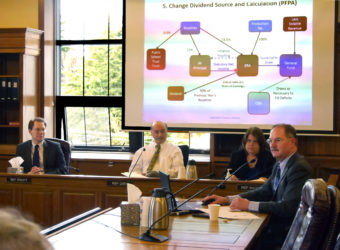
Legislative Finance Director David Teal presents an overview Feb. 22, 2016 comparing three different bills in the House Finance Committee (HB 224, 245, 305) that would affect the Permanent Fund and its dividends. (Photo by Skip Gray/360 North)

There are three proposals to help close the state’s budget shortfall using the Permanent Fund. Legislators are weighing which — if any — to support.
On Monday, they heard from their own nonpartisan budget expert on what makes each plan unique.

David Teal, the director of the Legislative Finance Division, noted these proposals would all change the source of Alaskans’ annual dividends.

“Essentially, the money appears to just fall out of the sky,” Teal said. “The truth is that the dividend is a government check, just like any other government check. And that it’s very protected now.”

Anchorage Republican Rep. Mike Hawker’s bill would essentially put dividends on hold – potentially for multiple years – until the state eliminated its deficit.

Gov. Bill Walker’s plan would put $3.3 billion annually into the budget – providing a less volatile source of revenue than oil production taxes.

Anchorage Republican Sen. Lesil McGuire has proposed the third proposal.

All three plans would likely reduce the amount available for dividends.

Big Lake Republican Rep. Mark Neuman said he’d like to see voters have a direct say in how much the government spends.

Teal responded that just cutting dividend checks may catch the public’s attention.

“Every expenditure means there’s less money for my dividend,” Teal said. “And if that happens, you may have the public looking over your shoulder a little more than they do now, as you prepare the budget. So, I guess, fair warning: Be careful what you ask for.”

It’s not yet clear when the House will vote on legislation that would affect the Permanent Fund.


House wants details on impacts of oil, gas tax changes

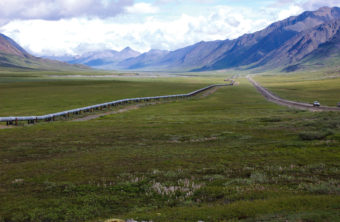
Trans-Alaska Pipeline
The trans-Alaska pipeline in the northern Brooks Range of Alaska in June 2007. (Public domain photo by U.S. Geological Survey)

As Alaska’s Legislature digs through Gov. Bill Walker’s budget proposal, a prime focus is the overhaul Walker put forward for oil and gas taxes.

By reducing tax credits and increasing minimum production taxes, Walker aims to shave $500 million off the state’s budget shortfall.

House members question whether Walker’s administration has done enough analysis of the oil and gas tax changes – as well as other tax increases the governor has proposed.

Speaker of the House Mike Chenault, a Nikiski Republican, said it’s important for legislators to study economic models showing how the changes will affect the state.

Rep. Mike Chenault, R-Nikiski, at a House Majority press availability, Feb. 18, 2016. (Photo by Skip Gray/360 North)
Rep. Mike Chenault, R-Nikiski, at a House Majority press availability Feb. 18, 2016. (Photo by Skip Gray/360 North)

“They were told basically they have no modeling – or that they were working on modeling. Well, it’s hard to put together a tax bill if you don’t have modeling,” Chenault said.

The state didn’t conduct statistical modeling before Walker proposed the tax changes.

State Revenue Commissioner Randall Hoffbeck said officials focused on the fact that the state is committed to paying oil and gas companies more in tax credits than it has to spend.

But state officials did talk with oil and gas company executives about which tax credits were most effective.

Hoffbeck said the process of deciding how to change tax credits had three steps.

“One is, you know, which credits didn’t necessarily work the way they were intended. Either they didn’t get used or really the return on the credits weren’t all that we had hoped that they would be,” Hoffbeck said. “And secondly, you know, which credits worked really well, and may have accomplished their purpose. And then, of course, the remaining is the credits that are still seen as critical moving forward.”

Speaker Chenault is not convinced. He said the fate of Walker’s proposed tax increases depends on the information the House receives.

“How those come out – which ones  pass or not I can’t tell you until we at least hear them, understand them, make sure the administration understands the consequences of the actions that we take as far as public policy for the state of Alaska — and that’s going to take time,” Chenault said.

Hoffbeck said more information will be available next week on the economic effects of the tax changes.

Site notifications
Update notification options
Subscribe to notifications