Andrew Kitchenman

State Government Reporter, Alaska Public Media & KTOO

State government plays an outsized role in the life of Alaskans. As the state continues to go through the painful process of deciding what its priorities are, I bring Alaskans to the scene of a government in transition.

Overdose antidote bill is one of few minority-sponsored bills that passes

The House passed a bill Monday that provides civil immunity to those who give an antidote to reverse overdoses from heroin and other opioid drugs.

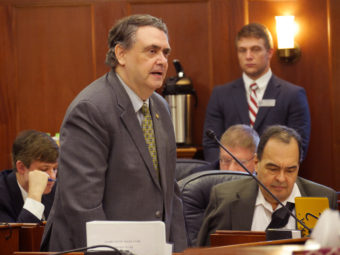
Sen. Johnny Ellis in the Alaska Senate chambers, March, 7, 2016. (Photo by Skip Gray/360 North)

Anchorage Democratic Sen. Johnny Ellis sponsored the bill. This made it unusual, since few bills sponsored by members of the minority party ever come up for votes.

The passage of Senate Bill 23 received unanimous support, with every representative present voting for it.

If the Senate – which already passed an earlier version – approves of the current bill, and Gov. Bill Walker signs it – the bill would join a small group of minority Democratic bills that become law.

Ellis said the urgency to pass the law came in part from the rising number of overdose deaths both in Alaska and nationally. The bill allows doctors and pharmacists to provide naloxone, or Narcan, a drug that reverses the effects of overdoses.

“We have a heroin addiction overdose epidemic in the state of Alaska,” Ellis said. “And I knew that we had achieved a breakthrough when I heard Hillary Clinton talk about Narcan, this life-saving miracle drug to reverse opioid overdoses. And heard (New Jersey Gov.) Chris Christie, who was vying for the Republican nomination for president, speak up in favor of the legislation.”

The urgency over the issue was cited by Wasilla Republican Representative Lynn Gattis, who worked with Ellis on the bill. Gattis notes that the House has focused on budget bills recently, but leaders allowed the overdose antidote bill to advance.

“I also applaud leadership for recognizing that this is a life and death issue, for making an exception to this incredibly unique and critically important bill,” Gattis said.

Since 2013, only nine of 180 bills — or 5 percent — passed by the Legislature had minority-caucus sponsors. That’s because the Republican-led majority controls which bills receive votes.

Ellis recalled that a similar pattern held when Democrats have controlled the majority.

He said that over time, the minority bills that did advance had broad support, including backing from important groups. The overdose antidote bill was supported by the Alaska State Medical Association.

“It really did help that the original idea for the bill, the original support was the State Medical Association,” he said. “And Republican majority members often listen to medical doctors, and (doctors) wanted a release from civil liability.”

While minority-supported bills that become laws have very different subjects, one thing they have in common is support from a broad coalition — one that has the attention of the majority.

For example Rep. Jonathan Kreiss-Tomkins, a Sitka Democrat, was the sponsor of another prominent minority-sponsored bill. It made Alaska Native languages official languages in the state.

He said that it helps when bills can draw on broad coalitions of supporters, rather than narrow support.

“If you focus on ideological legislation that isn’t shared by a majority of a body, it’s less likely to pass, whether it’s extreme to the right or extreme to the left,” Kreiss-Tomkins said. “I think if you look at deeply conservative or deeply liberal legislation, the rates of passage for that kind of legislation is pretty low.”

House Minority Leader Rep. Chris Tuck, an Anchorage Democrat, said it can be frustrating that relatively few minority bills become law. He says he’d do it differently if he ever has the power to change it. Democrats haven’t had a majority in the House in 22 years.

“People ask me, well, Democrats are going to do the same thing when they’re in power,” Tuck said. “No, not initially. But if they reigned as long as this majority has control of everything, then things start becoming more heavy handed and more heavy handed and more heavy handed. So I think it’s a really good idea to have the power flip back and forth.”

Ellis noted that Walker has signaled support for the bill, and he’s hopeful that it will become law soon.

Senate considers requiring prescription database checks to combat opioid abuse

The Senate Finance Committee has been weighing a wide-ranging bill to overhaul Medicaid in Alaska, and one provision is aimed at curbing the abuse of opioid drugs.

Senate Bill 74 would require doctors check a database before prescribing opioids. The sponsors want to make sure patients aren’t going from doctor to doctor seeking pills.
The bill would also require pharmacists to check the Alaska Prescription Database Monitoring Program.

Soldotna Republican Sen. Peter Micciche said he became interested in the prescription database when many of his constituents were burglarized. The culprits had addictions.

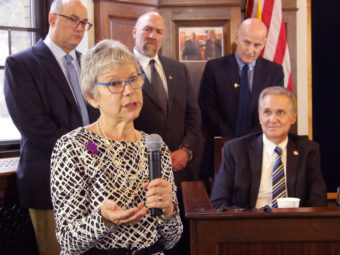
Sen. Pete Micciche chairs a Senate Finance Health and Social Services Subcommittee during discussions about the close-out of that department’s budget, March 4, 2016. (Photo by Skip Gray/360 North)
Sen. Pete Micciche chairs a subcommittee meeting on the Department of Health and Social Services budget on Friday. (Photo by Skip Gray/360 North)

He attended court-ordered group therapy sessions so he could better understand the issue.

“These were folks that in some cases, had a very successful path through life, like mine or any other Alaskan, that was diverted to a very unsuccessful path,” Micciche said.

Eagle River Republican Sen. Anna MacKinnon supports making doctors check the database.

“Someone is providing access to a variety of opioids – and then when they can’t get the prescription any longer, they’re turning to heroin, and young men, older women, female, male, are losing their lives,” MacKinnon said.

But the proposal has drawn concern from doctors groups. While the Alaska State Medical Association supports doctors using the database, it doesn’t support requiring it for every controlled drug.

Association leaders say removing doctors’ discretion would create an unnecessary burden and increase costs.

Emergency doctors have voiced concerns. Dr. Carlton Heine of Juneau said he agrees with 90 percent of what the legislators want to do.

But he said doctors aren’t solely to blame. He noted that beginning in the 1990s, organizations that accredit hospitals – and federal programs that pay doctors – encouraged doctors to prescribe more pain meds.

“It’s not that we’re trying to do it to create addicts,” Heine said. “There are other situations that are pressuring the behavior that you’re seeing. I do think we need to find some way to identify the providers that are over-prescribing. I think that is a problem, and I get frustrated with that personally, when I see patients coming in, knowing who their provider might be.”

The committee made changes to address some of the doctors’ concerns. It provided exemptions from checking the database to doctors whose patients are in emergencies and inpatient settings, and on the day of surgeries.

The Senate Finance Committee could vote on the bill as soon as Monday.

House committee may quintuple Gov. Walker’s state budget cuts

As legislators make cuts to the state’s budget, they’re looking to draw money from various state funds to cover costs. But changes drawing money from the fund to help rural Alaskans pay utility bills – and cutting money to local governments — are raising concerns.

The House Finance Committee is considering a budget bill that would cut state government spending $418 million more than the $100 million in cuts Gov. Bill Walker proposed.
House Bill 256 would change the source of funding for two budget items. A $76.7 million payment to the Teachers’ Retirement System would be paid from a fund for college scholarships and grants.

And $24.7 million for the University of Alaska would come from the Power Cost Equalization Fund, rather than the operating budget.

Big Lake Republican Rep. Mark Neuman said the proposal draws on available funds to meet the committee’s priority: balancing the state’s budget. Neuman is the committee’s co-chairman.

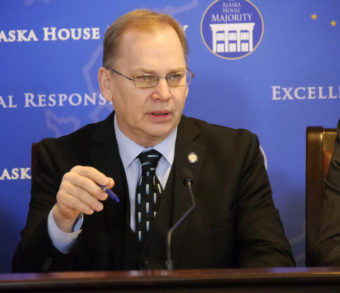
Rep. Mark Neuman, R-Big Lake, at a House Majority press availability, Jan. 22, 2016. (Photo by Skip Gray/360 North)
Rep. Mark Neuman, R-Big Lake, at a House Majority press availability, Jan. 22. (Photo by Skip Gray/360 North)

“We’re still in the first innings here,” Neuman said. “We’re trying to make sure we’re setting up the budget for the final decisions that we have to do.”

The Teachers’ Retirement System would receive money from the Higher Education Investment Fund, which was started four years ago with $400 million. It was launched to fund Alaska Education Grants, which are for post-secondary students with unmet financial needs and Alaska Performance Scholarships for students with high grades.

If the state draws out similar amounts annually to the proposed $76.7 million, the fund would be exhausted in a few years. Neuman said he expects all current grant and scholarship recipients to continue to receive the money.

The $24.7 million for the university is a small share of the overall $900 million Power Cost Equalization Fund.

But the proposal concerns Newhalen resident Evelynn Trefon. She’s a board member for a small regional electric co-op, whose customers benefit roughly $90 per month from cost equalization.

“Power cost equalization was set aside as a fund to help rural Alaskans and it wasn’t designed to help the University of Alaska,” Trefon said. “They need to look at the budget situation and figure out their own source of revenue funding. And power cost equalization is essential for rural Alaskans.”

Neuman said drawing money for the university this year shouldn’t have any effect on PCE payments.

“This was excess funds. It’s funds that weren’t needed to make the mandatory, statutory payment for power cost equalization,” he said. “It has no effect on paying PCE or any future payments.”

The House Finance Committee also cut a $35 million payment that Walker planned for community revenue sharing. If this change is kept, it would be the second straight year that the state didn’t add money to the revenue sharing program.

Without more money, the program fund would be so low that there could be no revenue sharing in two years.

Alaska Municipal League Executive Director Kathie Wasserman is concerned about the issue. She noted that rural areas depend on the money to provide basic services.

“The large communities – it will impact them. The small communities, it could devastate,” Wasserman said. “And then, when you look at the other cost shifting that is going on, due to the budget crunch that we have, I’m not sure how some municipalities are going to make it through.”

Neuman said he’s aware of the concern, and the committee would like to make changes that would make revenue sharing more secure.

“Everything is on the table right now,” he said. “I’m certainly cognizant of the needs of a lot of the communities in the state of Alaska, particularly the small, rural villages across Alaska, and their ability to do their governmental functions. And, yes, we’re certainly taking those under consideration.”

The committee also cut $25 million from the Public Employee Retirement System. That money could be restored in the next week based on the details of a state actuarial analysis of the pension obligations.

And it proposed a cut of roughly $25 million for the AKLNG pipeline project. Committee members want more details about how the money would be spent before budgeting it. Walker asked for the money to prepare the pipeline’s front-end engineering and design work.

This week, the committee has been hearing public testimony on the budget from residents statewide, ahead of a vote on the budget. It would then head to a vote by the full House before being considered by the Senate.

Gruenberg widow continues fight for husband’s legislative records

Kayla Epstein, widow of Rep. Max Gruenberg
Kayla Epstein, widow of Rep. Max Gruenberg, shares memories of her husband during a memorial at the state Capitol on Feb. 17. (Photo by Skip Gray/360 North)

Since Rep. Max Gruenberg died in mid-February, a committee room’s been named after him. It’s part of his legacy. But his legacy is being contested in one area — the legislative records he left behind.

Kayla Epstein, his widow, wants control of his records, but she’s been blocked. She hopes the documents help the bills Gruenberg was working on become law.

“He was working on a lot of legislation that he was not even intending to follow through with himself, but (planned on) giving to other legislators on both sides of the aisle,” Epstein said. “And I’d like to find those. That’s part of his legacy, too, making sure that those get into the right hands.”

However, lawyer Doug Gardner wrote in a memo that Gruenberg’s papers were protected by legislative immunity. Gardner directs the nonpartisan Legislative Services Agency’s Legal Services office.

Anchorage Republican Rep. Craig Johnson cited Gardner’s opinion in denying Epstein access to the records.

The state followed the same rules when Palmer Republican Rep. Carl Gatto died in 2012.

But Epstein disagrees with that interpretation. She notes legislative immunity in Alaska is based on a similar provision in the U.S. Constitution.

“In the federal government, when a legislator dies, their papers are sent to their heirs within 90 days,” she said. “That is their rules. Our rules are based on the federal rules. There really is no reason that I haven’t gotten Max’s papers.”

Legislators are talking about changing the rules, so that they will indicate what they want to happen to their records if they die in office.

Ohio State University law professor Steven Huefner has studied the issue of legislative immunity. He said the precedent for how to handle records after a legislator dies in office isn’t clear.

“What I think is important is to give members, before they pass on, an opportunity to decide what their wishes are,” Huefner said. “Obviously, you’ve got a problem here, because that didn’t happen, so in this instance, it’s tricky. But I think members ought to be able to decide ahead of time that they want their papers to become public.”

Epstein said she plans to file a request for the records soon.

Public pushes back against House’s proposed budget cuts

A crowd representing a variety of interests gathered in the House Finance Committee room during public testimony on the state budget, Feb, 29, 2016. (Photo by Skip Gray/360 North)

Alaskans giving public testimony this week on the House’s budget proposal oppose cuts to many areas.

The Republican-led majority released a budget proposal this week that included $145 million more in cuts than Gov. Bill Walker’s budget. It would reduce spending on everything from public libraries to senior benefits.

Roughly 100 people testified Monday and Tuesday on the budget.

The cuts include reduced grants to mental health and addiction treatment programs.

Residents also opposed cuts to prekindergarten, public libraries and the University of Alaska. And they said they want the House to avoid cuts to senior benefits and public broadcasting.

Juneau resident Kara Nelson directs Haven House, a faith-based home for women leaving prison. She opposed cuts to behavioral health grants.

“There are over 120 people today alone that died from an accidental overdose in our nation,” Nelson said. “That is an Alaska Airlines flight that died every single day, and that was in 2015. And so I urge you that we are trying to lessen the beds in our prisons, but we have no supports already to support the well-being of our people.”

Elizabeth Ripley, executive director of the Mat-Su Health Foundation, shared her concerns over behavioral health cuts.

“Cutting behavioral health grants will only reinforce the current system that drives people to seek care in the emergency room,” Ripley said. “A 2013 data analysis shows that Mat-Su Regional Emergency Department had five times the number of visits than our community mental health center. These visits to one hospital cost Alaskans $23 million in 2013, not including doctor, EMS or police costs.”

Kodiak Public Library Director Katie Baxter urged House Finance Committee members to restore funding for the Online With Libraries, or OWL, program. It funds high-speed internet connections and receives federal funds — known as E-Rate — that match state contributions.

“I am here to urge you to restore the governor’s funding of $761,800 to restore the OWL internet connectivity program,” Baxter said. “This program is an intricate system that is cost efficient that involves local and federal funding. By eliminating the OWL program as the house subcommittee has done, now we are leaving federal E-Rate dollars on the table. And I for one really don’t want to do that.”

The House Finance Committee will hear more public testimony Wednesday and Thursday.

Energy industry leaders reject oil and gas tax hikes

The top energy industry lobbyist in Alaska denounced Gov. Bill Walker’s proposed oil and gas tax changes on Monday.

Alaska Oil and Gas Association President Kara Moriarty told the House Resources Committee that companies can’t afford higher costs when oil prices are low.

“If you want the policy of Alaska to be to raise taxes on an industry that has negative cash flow, then that’s your prerogative, but what we’re saying is that that policy will impact their investment and production,” Moriarty said.

Walker proposed raising the minimum oil and gas tax from 4 to 5 percent. He also wants to eliminate some tax credits for drilling and exploration.

The changes would reduce the state government’s $3.5 billion deficit by $500 million.

Rep. Geran Tarr, an Anchorage Democrat, asked Moriarty to reconcile industry concerns with the actions of some companies, such as Hilcorp, which gave employees $100,000 bonuses last year.

“How can you expect the Alaska public to react to information like that?” she asked.

Moriarty said Hilcorp honored a long-term commitment to their workers with the bonuses. She added that other major employers have been laying off workers in Alaska.

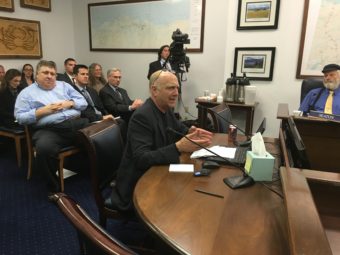
Armstrong Oil & Gas Inc. Chairman Bill Armstrong testifies (Photo by Andrew Kitchenman)
Armstrong Oil & Gas Inc. Chairman Bill Armstrong testifies on Feb. 29, 2016 (Photo by Andrew Kitchenman)

Armstrong Oil and Gas Chairman Bill Armstrong said other states have had stable oil and gas taxes. But Alaska has made several changes over the past decade, making it more difficult to invest.

He said most countries have been cutting taxes on energy companies.

“They’re all making things better, with the exception of three countries that I could find: Congo, Madagascar, and Tanzania. And Alaska,” Armstrong said. “Three countries and a state. So, to make things worse when things are bad is, you’re kind of in rare company.”

The committee will hear testimony from more industry executives on Tuesday.

Site notifications
Update notification options
Subscribe to notifications