Andrew Kitchenman

State Government Reporter, Alaska Public Media & KTOO

State government plays an outsized role in the life of Alaskans. As the state continues to go through the painful process of deciding what its priorities are, I bring Alaskans to the scene of a government in transition.
Health care officials pitch transformative mental health, addiction treatment reforms

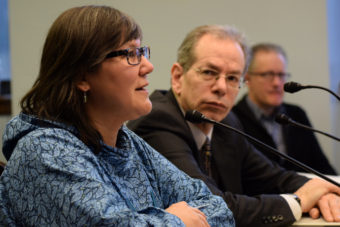
Valerie Davidson and John Sherwood in committee
Health Commissioner Valerie Davidson testifies on a Medicaid reform bill in committee, April 15, 2015. Also pictured: Deputy Commissioner Jon Sherwood. (Photo by Skip Gray/360 North)

Medicaid is one of the biggest drivers of Alaska’s state spending.

At the same time, Alaska has the nation’s highest suicide rate and a growing problem with opioid addiction.

State leaders believe they can lower the long-term growth in Medicaid costs and make Alaskans healthier mentally and physically. They plan to do that by better coordinating  behavioral health care — the treatment of mental health and addiction.

At a recent Senate Medicaid Reform Subcommittee hearing, Health Commissioner Valerie Davidson said it will be a challenge.

“This is hard stuff. If it was easy, Alaska would have done it long ago,” Davidson said. “And the great news is we have folks who have come together who are really interested in really changing the way that we deliver behavioral health services in our state, so that Alaskans can get the care that they need.”

In practice, it means more Alaskans will be screened for behavioral health issues in primary care settings, and a wider range of licensed counselors and therapists would be able to treat Medicaid recipients in a wider range of settings, like in a doctor’s office.

Davidson said current gaps in behavioral health care lead to other problems.

“We are seeing it in the number of children who experience child maltreatment,” she said. “And unfortunately, when we’re dealing with children, what we know is to the extent that that occurs, that can become a multigenerational issue. That if we don’t provide resources to family members who are in crisis, where we have places where they can actually go to receive help, we are never going to get ahead of this problem.”

A recent state-commissioned report recommended the state hire an organization that would increase the state’s capacity to provide behavioral health care, and manage a coordinated system.

While that organization would cost more than $5 million per year starting in 2018, the state projects that it would save a larger amount in future years.

Despite the state’s massive budget deficit, Anchorage Republican Sen. Cathy Giessel was on board.

“I appreciate the encouragement to invest in behavioral health and frankly I view it in the same way as investing in oil and gas credits for exploration. It pays off in the long run, though it costs a bit upfront,” Giessel said.

This coordinated approach is already practiced in some areas.

For example, Southcentral Foundation serves Alaska Natives with psychologists and social workers who treat patients in the same health centers as primary care providers.

The Alaska Mental Health Trust Authority board supports better integration of behavioral health care into the rest of the health care system.

Chief Executive Jeff Jessee said state leaders and providers will have to work together like a baseball team.

“The trustees believe this is the single biggest thing that the trust will encounter in our 20 years of history, this is an opportunity to truly transform our behavioral health and health care system,” Jessee said. “So, it’s the bottom of the ninth, we’re five runs down, we’re not bunting, and we’re not going to get one big swing either. We’re going to have to chunk away at this.”

While the groundwork for statewide behavioral health changes would happen over the next year under Gov. Bill Walker’s proposed budget, the bulk of the changes wouldn’t occur until 2018.

State, partners mum on possible changes to massive gasline project

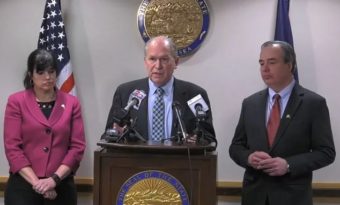
BP Alaska President Janet Weiss, Gov. Bill Walker and ConocoPhillips Alaska President Joe Marushack announced Wednesday that they're exploring options on the Alaska Liquefied Natural Gas Pipeline, but declined to give specifics. (Screenshot)
BP Alaska President Janet Weiss, Gov. Bill Walker and ConocoPhillips Alaska President Joe Marushack announced Wednesday that they’re exploring options on the Alaska Liquefied Natural Gas Pipeline, but declined to give specifics. (Screenshot)

Changes are coming to state plans for a liquefied natural gas pipeline, but the governor and the state’s three pipeline partners aren’t ready to say what those changes will be.
At a news conference Wednesday in Anchorage, executives with ExxonMobil, BP and ConocoPhillips joined Gov. Bill Walker to announce that they are “exploring options” to advance the pipeline.

Walker emphasized the importance of keeping the project on track.

“We know that most likely there needs to be some modifications in some way and so we sort of come back to the drawing board a bit on how to look at this project a bit differently,” Walker said.

The executives said they would complete preparations for front-end engineering and design work — also known as “pre-FEED” — on schedule by this fall.

But ConocoPhillips Alaska President Joe Marushack didn’t offer assurances beyond a commitment to explore options.

“What we’re trying to do is get through the pre-FEED process,” Marushack said. “Clearly the economic headwinds are pretty tough right now, but we’ve got to see what the project costs before we can make a statement if we should participate and go forward or not.”

Energy industry experts have said the project doesn’t make economic sense at today’s natural-gas prices.

The announcement put into doubt the state’s timeline for the project.

State Natural Resources Deputy Commissioner Marty Rutherford says everything is on the table ahead of another pipeline announcement next month.

“It’s sort of a nexus of problems that have happened — this economic situation on the value of oil and gas as well as slow negotiations — which has caused everybody to begin to discuss: ‘Well, as we continue forward on AKLNG as currently envisioned, are there other alternatives we should be looking at so we don’t have a delayed feed decision?’ ”

Walker earlier said he would seek a state constitutional amendment to lock in tax rates for the energy companies who are working with the state on the project.

The governor said Wednesday he isn’t ruling out the amendment, but the state may be able to provide cost certainty without an amendment.

The project has an estimated cost of $45 billion to $65 billion.

Speaker of the House Mike Chenault said he wished there was something more concrete from the announcement.

The Nikiski Republican added that he welcomes greater scrutiny of the cost of the project, which is the largest proposed infrastructure project in the world.

“I don’t know whether to take it as a sign of good or bad,” Chenault said. “I think we take it as a time that they’re still talking and, you know, in the economic times that we’re in, with the price of a barrel of oil, I think that it might do us well to step back and look at it and make sure that we haven’t missed something that may cost us in the future.”

Kenai Peninsula Borough oil and gas adviser Larry Persily said the options may include changing the percentage ownership each partner has in the pipeline.

Persily previously was the federal coordinator for natural gas projects in the state. He said if some of the partners decide to scale back their participation in the project, it will present a dilemma for the state.

“Right now, the state, I think, wants it more than the others, but when it comes down to it, the state is not in a position to take on more risk than the companies can afford,” Persily said. “We have enough of a financial hole in our budget.”

Persily said if the state wants to borrow money, it will have to show lenders it can pay the bills it already has. He said the announcement is a reminder that the state must be financially self-supporting before it can think of new options for the gas line.

Myers announces retirement, third Walker cabinet change in three weeks

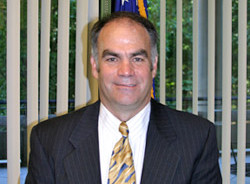
Mark Myers announced Tuesday he will retire as commissioner of the state Department of Natural Resources. Myers once served as head of the U.S. Geological Survey in Alaska. (Public Domain photo from USGS)

Alaska Department of Natural Resources Commissioner Mark Myers announced Tuesday that he’s retiring.

Myers wrote in an email to department staff members that he’s retiring for personal reasons. His resignation is effective March 1.

Deputy Commissioner Marty Rutherford will serve as acting commissioner.

It’s the third change in Gov. Bill Walker’s cabinet in three weeks, following changes in the commissioners of corrections and education.

Myers had only been commissioner since early 2015, but has a total of 18 years of service in the department.

Myers worked as a geologist for the state and for private companies. He was the head of the U.S. Geological Survey from 2006 to 2009. And he was the vice chancellor of research for University of Alaska Fairbanks before Walker named him commissioner.

Walker said Myers told him he wanted to retire in October, but Walker gave him time to reconsider.
Myers said, “Retiring is not difficult, but leaving DNR is.”

A spokeswoman for Walker said the governor hasn’t set a timeline for permanently replacing Myers.

Longtime Anchorage Rep. Max Gruenberg dead

Rep. Max Gruenberg
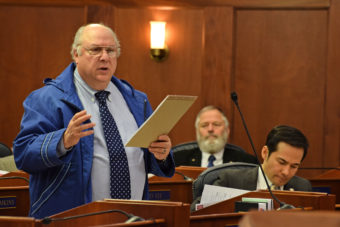
Rep. Max Gruenberg, D- Anchorage, addresses the Alaska House of Representatives, Feb. 2, 2015. (Photo by Skip Gray/360 North)

Longtime Rep. Max Gruenberg died Sunday in Juneau. The Anchorage Democrat was 72.

Gruenberg gained bipartisan respect for his skill in crafting legislation.

He was the senior member of the House. He served during two separate periods, from 1985 to 1992 and again since 2003.

Gruenberg was born and raised in San Francisco. He was an Eagle Scout. And he served in the U.S. Navy in Vietnam.

A retired family lawyer, Gruenberg sponsored the law that provides Silver Alerts to locate missing, vulnerable adults. Another Gruenberg law requires the removal of asbestos from schools and public buildings.

Gruenberg served twice as the House majority leader. He was the minority whip in the current session.

Gov. Bill Walker ordered that flags by lowered for both Gruenberg and U.S. Supreme Court Justice Antonin Scalia.

Walker said Gruenberg’s death is a significant loss for all of Alaska.

Anchorage Democrats will submit three potential replacements to Walker, who will choose one. House Democrats will then accept or reject the choice.

How and when do Alaskans get to weigh in on presidential candidates?

Republican elephant Democratic Donkey
(Creative Commons photo by DonkeyHotey)

As the presidential primary season plays out across the country, Alaskans have to wait until next month to have their say. But Republicans and Democrats in the state use different procedures for choosing delegates.

For Republicans, it’s a more traditional ballot. The Democrats will gather in groups, like in the recent Iowa caucus.

Alaska’s major parties will pick their candidates on different days.

The Republicans will choose theirs on March 1, also known as Super Tuesday. Their election, known as a presidential preference poll, will be conducted much like other elections. Each voter will be given a piece of paper with the candidates’ names. They’ll mark their preferred candidate, and place the paper in a ballot box.

Alaska will have the same number of delegates as much more populous states, like Oregon, because Alaska has voted heavily Republican in previous federal and state elections.

Party Chairman Peter Goldberg said the combination of voting early and being heavily Republican gives the party outsized sway.

“Even though by population we are a tiny state, we have disproportionately large influence upon the ultimate selection,” he said.

Alaska Democrats will hold their caucuses across the state on March 26, the same day as Hawaii and Washington. In the caucuses, voters who support each candidate will gather in a corner of their local polling place before casting ballots.

Alaska Democratic Party Executive Director Kay Brown said the party has been energized by having a competitive nominating process, between Hillary Clinton and Bernie Sanders.

“I think that it makes it more interesting to people – the fact that there’s a contest and it certainly will generate interest by the campaigns in turning people out to take part in the caucuses,” Brown said.

For Republicans, the large field of candidates has drawn interest.

Goldberg said Republicans also are capitalizing on a competitive primary season by increasing their registrations.

“People in Alaska — Republicans in Alaska — are very excited, and I’m finding that just on the phone calls that come to me that people are switching to the Republican Party,” Goldberg said. “It’s at least once a day that some Democrat is calling me and saying, ‘How do I switch?’”

But while there is early excitement about the election in the state, few national campaigns have invested resources to build up campaign organizations in the state. On the Republican side, Ben Carson and Marco Rubio have state campaign coordinators.

Sanders also has a coordinator based at the University of Alaska Anchorage.

Matt Dean, a Republican activist, said the state will always struggle to receive large investments from presidential campaigns.

“It does take a little bit of a time to get your base spread out to every state … and Alaska only has three electoral votes,” he said. “I mean, I do understand from a strategic standpoint, I did use to work on campaigns.  But it is very nice to see when people at least make the effort to get up here.”

Each party’s rules determine how many delegates states have.

Just as Republicans’ performance in previous elections increased their delegate count, the Democrats’ count is lower than other states with similar populations. The Republican preference poll and Democratic caucuses determine the share of the state’s delegates who are pledged to each candidate in the parties’ national conventions.

However, the actual individuals who serve as the delegates will be chosen in local party conventions that also begin in March. Both parties require that poll or caucus voters be registered with the party.

Representative seeks new business tax

Rep. Les Gara, D-Anchorage, has introduced a new business tax. (Photo by Skip Gray/360 North)

Most Alaska lawmakers have focused on cutting the budget during the first three weeks of the legislative session.

But Anchorage Democratic Rep. Les Gara wants to make sure such cuts don’t fall too heavily on working-class and low-income people.

Gara has instead proposed a bill that would apply a 6 percent tax on the owners of businesses that aren’t currently taxed by the state.

These businesses are called S-corporations, named after a section of the federal tax code. Their owners report the business income as personal income.

“Most corporations in the state pay no tax whatsoever,” Gara said. “They pay a $100 license fee, even if they make $10 million a year in profits. That doesn’t make sense.”

Gov. Bill Walker’s proposed budget would affect these business owners. That’s because they would be required to pay a personal income tax of between 1 and 2 percent.

Gara said the rate isn’t high enough.

“That doesn’t work,” he said, noting that the corporate tax is 9.4 percent. “Two percent is almost nothing for a corporation that makes over $200,000 a year, or over a $1 million a year or over $5 million a year.”

House Speaker Mike Chenault, a Nikiski Republican, agreed the Legislature could consider taxing S-corporations, along with other ideas to close the $3.5 billion budget shortfall.

But he added that the burden of state taxation has rested on certain businesses – especially the oil industry – for more than 35 years.

Anchorage Republican Rep. Lance Pruitt said most legislators want to focus their efforts on finding savings in government spending. Finance subcommittees have been analyzing each section of the budget.

“That’s the difference in philosophy,” Pruitt said. “I think Rep. Gara believes we can tax our way out of this, and we can’t tax our way out of this. That’s why it’s so important, the job that the subcommittees are doing right now.”

Gara said even if his particular bill isn’t enacted, he hopes the idea of taxing S-corporations becomes a part of the budget, even if it’s sponsored by a different legislator.

Site notifications
Update notification options
Subscribe to notifications