Andrew Kitchenman

State Government Reporter, Alaska Public Media & KTOO

State government plays an outsized role in the life of Alaskans. As the state continues to go through the painful process of deciding what its priorities are, I bring Alaskans to the scene of a government in transition.
Legislative Council seeks advice on downtown Anchorage office

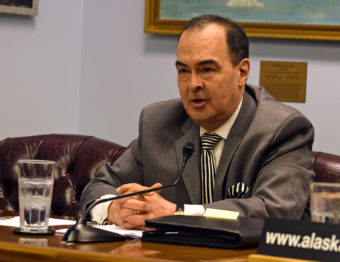
Sen. Gary Stevens addresses a joint session of the Alaska Legislature during debate about confirmations of the governor's appointees, April 17, 2014. (Photo by Skip Gray/Gavel Alaska)
Sen. Gary Stevens addresses a joint session of the Alaska Legislature during debate about confirmations of the governor’s appointees, April 17, 2014. (Photo by Skip Gray/Gavel Alaska)

The Legislative Council is seeking advice from an independent finance expert on what to do about the controversial lease on the Legislative Information Office in downtown Anchorage.

Council Chairman Sen. Gary Stevens, a Kodiak Republican, said Thursday the council would benefit from a fresh perspective.

The council has been weighing whether to break a 10-year lease with the building’s owner. The state also could opt to buy the building.

Council lawyer Serena Carlsen is providing Stevens with names of potential experts. Stevens expects the analysis to be completed within a month.

Another Democrat joins Republican-led Senate majority

Sen. Donny Olson joined the the Alaska Senate’s Republican-led majority caucus on Wednesday. The move by the Golovin Democrat means that 16 of the 20 senators now caucus together.

Sen. Donny Olson, D-Nome, at a Senate minority press availability, March 4, 2015. (Photo by Skip Gray/360 North)
Sen. Donny Olson, D-Golovin, at a Senate Democrats press availability in March 2015. (Photo by Skip Gray/360 North)

Olson said he’s honored to join the majority and will lend a strong voice for rural Alaskans.

He joins Sen. Lyman Hoffman of Bethel, another Democrat, in the Republican-led majority.

Senate Minority Leader Berta Gardner, an Anchorage Democrat, said her caucus members were disappointed.

But she said they’re pleased the majority will benefit from a member with progressive values, who supports public education and Medicaid expansion.

Olson represents District T, which covers much of the state. It stretches from Fort Yukon to Nome, and includes the North Slope and Northwest Arctic boroughs.

Rural Democrats have joined Republican-led majorities for many years. All six Democratic legislators who represent areas outside of Anchorage, Fairbanks and Southeast Alaska caucus with the majority.

Chief justice: Court system cuts ‘will have direct, negative effect’

Alaska Chief Justice Craig Stowers delivers the 2016 State of the Judiciary Address, Feb. 10, 2016. (Photo by Mircea Brown/360 North)

Alaska Supreme Court Chief Justice Craig Stowers said the court system has taken steps to cut costs.

In the annual State of the Judiciary Address to a joint session of the legislature Wednesday, he said the courts plan on more cuts.

But Stowers also gave legislators some advice as they shape the budget. He said if leaders act in the interest of Alaskans, their constituents will support them.

“My friends, do not be afraid: Fear is the mind-killer,” he said, quoting a phrase from the Frank Herbert novel “Dune.” “Be bold. Also, be selfless and look to the greater good. You are our elected leaders, and leaders sometimes have to make hard decisions their constituents don’t immediately understand or agree with.”

Stowers also urged legislators to ensure the state’s budget problems don’t fall too heavily on any one group.

The court system cut its budget by 3.5 percent this year, equal to $3.8 million.

The chief justice said all levels of court employees, from Supreme Court justices down to lower paid staff members, agreed to voluntary unpaid time off this year.

The Supreme Court has proposed another 3.5-percent budget cut for the fiscal year starting on July 1.

That plan includes not filling the jobs of those who retire or leave the courts.

“Additional loss of positions will have a direct, negative effect, on the public services we are able to provide,” Stowers said.

The Supreme Court has decided to close courts statewide in the upcoming fiscal year each Friday afternoon, beginning at noon on July 1, Stowers said. All nonjudicial court staff will be furloughed every Friday afternoon.

“No court proceedings apart from emergency proceedings will be allowed,” he said.

Stowers said if the legislature further cuts the courts’ budget, some court locations may have to close.

He said this would hit rural Alaska — where the courts serve as the face of state government — the hardest.

“It would be a terrible travesty to have to reduce those efforts that you and we have made to reach out to rural Alaska and rural Alaskans … including our Native brothers and sisters out there,” Stowers said.

Gov. Bill Walker proposed a total cut of $100 million to the state budget. Legislators have been seeking deeper cuts.

House suspends almost all nonbudget business

Suspension of the Rules press availability, Feb. 8, 2016.
Alaska House leaders hold an impromptu press availability on Monday. The House had just voted to suspend legislative rules to suspend its nonbudget business so legislators can focus on the state’s budget crisis. Facing the press from left to right: House Majority Leader Charisse Millett, R- Anchorage, House Rules Chairman Craig Johnson, R- Anchorage, and House Speaker Mike Chenault, R- Nikiski. (Photo by Skip Gray/360 North)

Legislators have talked about focusing on the state budget since their session began three weeks ago. But today, they took action to make it official.

The House passed House Concurrent Resolution 23 that limits committees to working on bills that raise or spend state revenue. This new rule will remain in place until the House passes a budget.

House Speaker Mike Chenault, a Nikiski Republican, said putting a focus on the budget will allow legislators to be better informed about its details.

“My hope is that our members have times to actually going into the budget and actually look at programs that work, those that may not work,” Chenault said, adding that this would give legislators “more time to talk with people in the departments to find out … more about that budget and be able to make better decisions based on the information that they have, versus what they think they might have.”

House Democrats raised concerns that the rule change would reduce transparency. HCR 23 lowers the minimum advance public notice to 24 hours, down from several days.
But only one House member, Anchorage Democratic Rep. Andy Josephson, voted against the resolution.

The Senate is unlikely to make a similar change, according to Senate President Kevin Meyer, an Anchorage Republican. Meyer noted that it’s a small chamber with only 20 members instead of 40. He added the House will pass the budget first, giving the Senate time to consider other legislation.

In addition to the rule changes, there was another proposal to revise how the legislature functions this session.

Democratic members from both houses proposed that all legislators meet as a “Caucus of the Whole.” They said this would allow them to provide input before the Republicans in the majority advance the budget.

Members of the Alaska House and Senate minorities propose a single caucus system for the legislature, Feb. 8, 2016. They hope the change would overcome the divisiveness of the current two-caucus system made up of the majority and the minority and smooth efforts to deal with the state’s budget woes. From left to right: Rep. Chris Tuck, D- Anchorage, Sen. Berta Gardner, D-Anchorage, Rep. David Guttenberg, D- Fairbanks, Rep. Geran Tarr, D-Anchorage, Rep. Sam Kito III, D-Juneau, and Rep. Scott Kawasaki, D-Fairbanks. (Photo by Skip Gray/360 North)
Members of the Alaska House and Senate minorities propose a single caucus system for the legislature on Monday. They hope the change would overcome the divisiveness of the two-caucus system and smooth efforts to deal with the state’s budget woes.
From left to right: Rep. Chris Tuck, D- Anchorage, Sen. Berta Gardner, D-Anchorage, Rep. David Guttenberg, D- Fairbanks, Rep. Geran Tarr, D-Anchorage, Rep. Sam Kito III, D-Juneau, and Rep. Scott Kawasaki, D-Fairbanks. (Photo by Skip Gray/360 North)

Senate Minority Leader Berta Gardner, an Anchorage Democrat, said the change would encourage all legislators to work together.

“When the chips are down and the situation is urgent, we’ve always come through, shedding our identities as Republicans or Democrats, and remembering in our core, we are Alaskans first, we are Alaskans together,” she said.

Meyer said he’d consider the proposal, but wants more details about what the Democrats are looking for.

“We are going to need bipartisan support on passing any tax bills, and that’s true, but also we are going to need their help on budget reductions,” Meyer said, adding that budget cuts haven’t come up in discussions with Democrats.

The House canceled hearings on bills that weren’t related to the budget today. There was one exception for a bill that would make it easier for an antidote to opioid overdoses to be given to overdose victims.

Public testimony: Keep state hands off of dividends

Update | Feb. 5, 11:04 p.m.

Dozens of people who testified asked lawmakers to cut spending to balance the budget. While spending cuts are popular in general, the public is less certain about which specific programs should be cut.

That’s according to the Rasmuson Foundation’s Plan4Alaska survey.

Foundation President and CEO Diane Kaplan said last month the foundation is making a new online tool. It will allow residents to develop their own version of the state budget.

Kaplan says when when people propose cuts, they’ll learn the potential effect on services.

“When you work to put together your own balanced budget, and you say I want to cut a hundred million, we’re going to list what could be in that as much as we can,” Kaplan said. “So we’re hoping to provide a little bit more detail when people say $500 million, $100 million, $1 billion, what that really means. Because those are big numbers for people and they have a hard time with what that exactly means to them.”

The House Majority launched its own effort to solicit public comment on the budget Friday. Representatives set up a toll free call-in line for residents to weigh in on ways to save the state money. Rep. Charisse Millett encouraged people to call this month.

“Good ideas come from  those that use state government the most. So we’re open to criticisms, we’re open to suggestions, and the next three weeks are critical for Alaskans to get their voices heard,” she said.

The number is 1-844-414-5949.

Original post | Feb. 5, 2:16 a.m.

Martin Stepetin Sr.
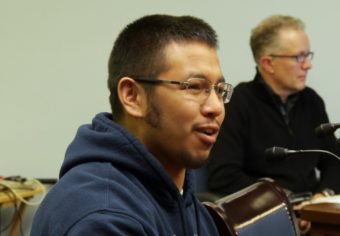
Martin Stepetin Sr. of Juneau testifies on Senate Bill 128 in the Senate State Affairs Committee. The bill is the governor’s plan for reshaping the Permanent Fund to make state government fiscally sustainable. (Photo by John Kelly/360 North)

Alaskans don’t want to see large cuts to their annual Permanent Fund dividends. At least, that was the message most people delivered Thursday night about Gov. Bill Walker’s plan for the fund.

The Senate State Affairs Committee heard public testimony from across Alaska on Senate Bill 128.
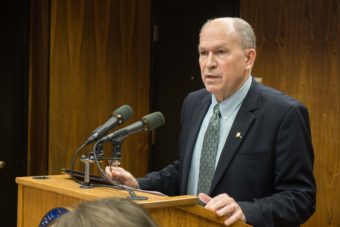
Deering resident Kevin Moto said local businesses allow residents to make payments based on future dividends.

“In rural Alaska, the dividend contributes to the economy,” Moto said. “And I think by reducing the distributions, we’re creating a bigger rural-urban divide.”

Walker proposed using Permanent Fund earnings to pay for much of the state’s budget.

He would draw $3.3 billion  from the fund’s earnings, as well as other state reserves.

The governor has also proposed $100 million in spending cuts.

Under Walker’s plan, the source of dividends would shift to oil and gas royalties. They’re expected to decline.

More than 100 people spoke. Another 200 submitted written comments.

Beth Fread of Palmer asked legislators to balance the budget through spending cuts.

“Some of the cuts you could make would be to eliminate the positions that are currently frozen,” Fread said. “You could utilize the tools that we used in the ‘80s, which was a wage freeze, to which the unions agreed for the good of the state. There are many ways to make cuts.”

Others who oppose cutting Permanent Fund dividends supported drawing new revenue from other sources.

Anchorage resident Tom Lakosh said he would like to spare children from dividend reductions.

“It’s clear to me that the preferred method of revenue generation would be from corporate and/or personal income so that we can spread most of this cost of our state government on those who actually make money in the state,” he said.

A minority of speakers expressed a willingness to see changes to how the state spends Permanent Fund earnings.

Kodiak resident Erin Harrington said it’s imperative that legislators act this year on the budget shortfall.

Erin Harrington
Erin Harrington of Kodiak testifies on Senate Bill 128 in the Senate State Affairs Committee. (Photo by John Kelly/360 North)

“I certainly see places for efficiency in government,” Harrington said. “But I believe that first we have to take action to stabilize our revenue sources and I think that using the Permanent Fund and adding new revenue sources is completely reasonable.”

Sen. Bill Stoltze, a Chugiak Republican and the committee chairman, said the committee would take the testimony into account as it considers what to do with the bill.

Senate takes public testimony on Walker’s Permanent Fund bill

Gov. Bill Walker - Special Session 2015
Gov. Bill Walker’s plan to fund state operations with Permanent Fund earnings is up for public comment before the Senate State Affairs Committee. (Photo by Jeremy Hsieh/KTOO)

Alaskans get their first chance today to tell legislators what they think of the centerpiece of Gov. Bill Walker’s fiscal plan for the state.

The Senate State Affairs Committee will begin hearing public testimony at 5:30 p.m. on Senate Bill 128. It would direct $3.3 billion annually in Alaska Permanent Fund earnings and other state funds to the state budget.

It also would change the source of annual dividends from the Permanent Fund to oil royalties.

The bill requires dividends to be at least $1,000 this year. Dividends could be lower in future years.

An aide said the committee has received more than 100 emails on the subject.

Site notifications
Update notification options
Subscribe to notifications