State Government Reporter, Alaska Public Media & KTOO
State government plays an outsized role in the life of Alaskans. As the state continues to go through the painful process of deciding what its priorities are, I bring Alaskans to the scene of a government in transition.
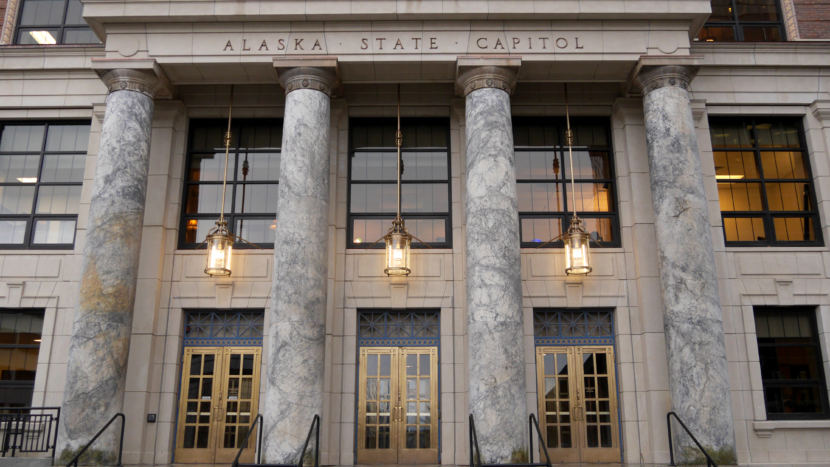
The Alaska State Capitol in Juneau in 2017. Since Rep. Mike Cronk, R-Tok, tested positive for COVID-19 on Wednesday, three staff members have tested positive. Two were close contacts of Cronk, while the other was unrelated, according to Legislative Affairs Agency. (Photo by Skip Gray/360 North)
Update — March 1, 1:32 p.m.
Another House staff member received a positive COVID-19 test result on Monday, raising the total number of legislative staff with positive test results since last week to four.
Information about whether the person had close contact with any of the others who had tested positive wasn’t immediately available.
Original story — March 1, 10:47 a.m.
Two close contacts of Rep. Mike Cronk and one Alaska Senate staff member have tested positive for COVID-19 since Cronk tested positive on Wednesday. All three new positive cases are quarantining away from the Capitol.
Fifteen people have been identified as close contacts of Cronk, a Tok Republican, and are currently quarantining, according to an email from Jessica Geary to legislators and legislative staff. Geary is the executive director of the Legislative Affairs Agency, a nonpartisan office that supports the Legislature, including on personnel and Capitol maintenance issues.
The Senate staff case is unrelated to Cronk, according to Geary. That person was free of symptoms through Saturday morning.
Those quarantining who remain free of symptoms will be tested after seven days. If the tests are negative, they will be released from quarantine on the eighth day. The quarantine rules follow guides from the federal Centers for Disease Control and Prevention.
The Legislature requires that everyone who works in the Capitol — including all legislators, staff members and news reporters — undergo rapid tests for the coronavirus every four or five days.
Cronk tested positive after attending an Alaska Outdoor Council banquet on Feb. 20 that other Republican legislators and Gov. Mike Dunleavy also attended. Dunleavy also tested positive last week.
The House didn’t hold any in-person committee meetings from Thursday through Sunday. House Speaker Louise Stutes has announced that the House will work through weekends for the time being, and asked House members and staff to avoid travelling outside of Juneau. In-person House committee meetings resumed on Monday. The Senate didn’t formally stop in-person meetings, but some were canceled late last week.
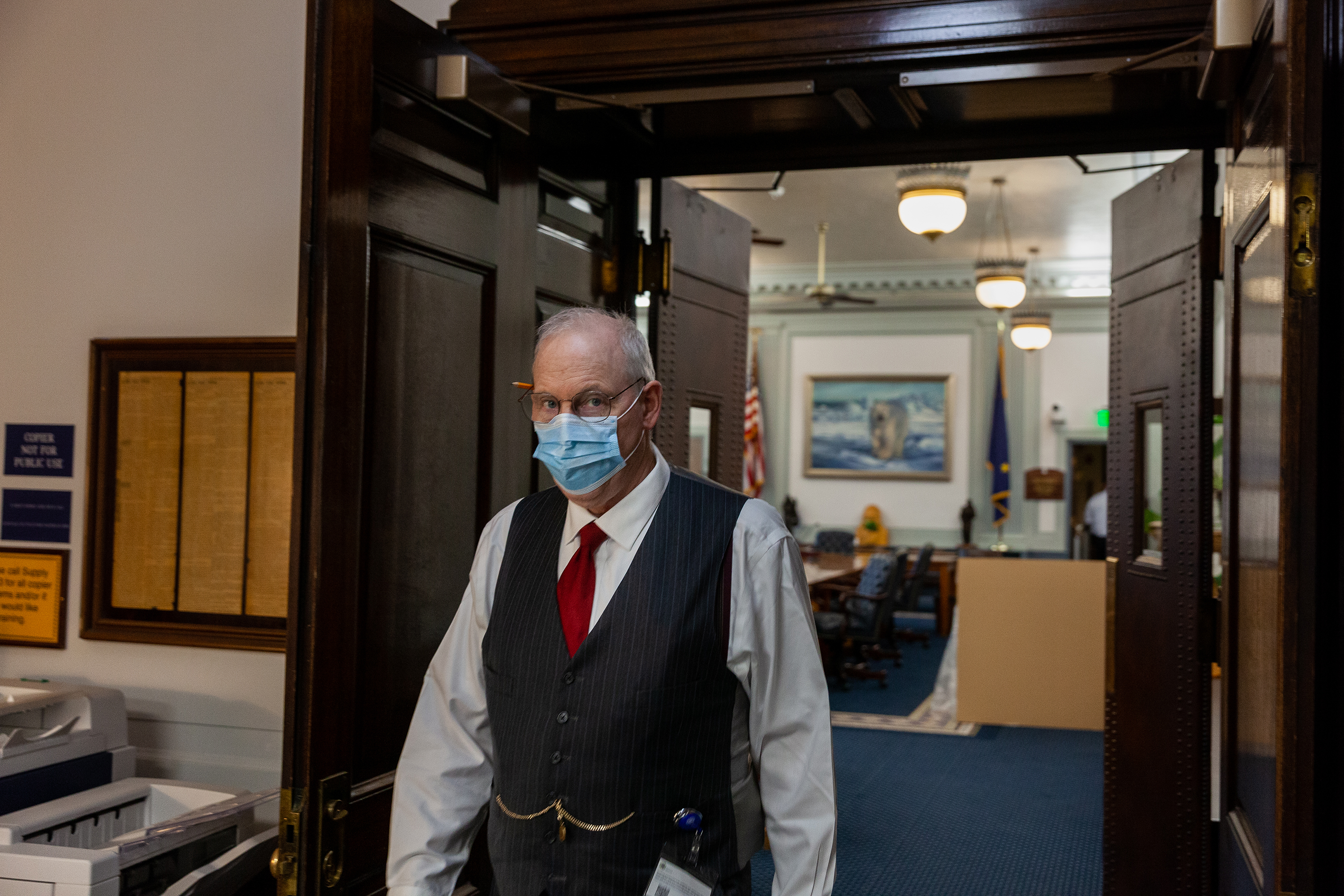
Sen. Bert Stedman walks out of the Senate Finance room at the State capitol during the first day of the 32nd Legislative Session on Tuesday, Jan. 19, 2021 in Juneau, Alaska. The Senate organized in a Republican-led majority on Tuesday, announcing that Stedman and fellow Republican Senator Click Bishop will chair the powerful committee. (Photo by Rashah McChesney/KTOO)
The Legislature must decide this year whether to engage in unplanned spending from the Alaska Permanent Fund for the first time. Some lawmakers are raising concerns that once the state starts unplanned spending of billions of dollars, it won’t stop until there are no fund earnings left.
The Legislature faces a familiar problem. For the seventh straight year, since oil price plummeted, Alaska’s state government is spending more than it’s taking in.
But there’s a new issue. There isn’t enough left in the piggy bank the state has used for decades to cover deficits — the Constitutional Budget Reserve — to both manage the state’s cashflow and pay even the roughly $1,000 permanent fund dividends Alaskans received last year.
Some — most prominently, Gov. Mike Dunleavy — have called for spending much more from the permanent fund than the state planned. He wants the state to follow the formula in a 1982 state law to pay out nearly $5,000 in permanent fund dividends. That amount would cover this year’s dividend, plus the amount that wasn’t paid out last year under the traditional formula.
Dunleavy explained why in a short video posted on social media late last year.
“I couldn’t think of a better time to follow the PFD law,” he said. “I can’t think of a better time for Alaskans to get $5,000. This pandemic has done a lot of damage in Alaska, across this country, across this world.”
The Republican governor has proposed drawing it from permanent fund earnings, the traditional source for PFDs. But that means the state would take $6.3 billion this year out of the $14.9 billion that was in earnings reserve as of Jan. 31. There’s another $57.8 billion in the unspendable principal. That’s much more than is outlined in a law passed three years ago intended to limit draws from fund earnings to roughly 5 percent of the total in the principal and earnings reserve. That level was projected to be low enough to allow the fund to keep growing.
Angela Rodell is responsible for overseeing how the fund is invested as the CEO of the Alaska Permanent Fund Corp. She noted that the corporation’s board supported a predictable draw, which is based on what’s known as the percent of market value, or POMV. And if the state spends more than what the law says it should this year, she’s concerned that it won’t stop.
“And so, yes, I do worry that if we don’t follow a POMV spending rule, it will open floodgates,” she said.
Rodell noted that the annual draw to the state is now paying for the majority of state spending that the legislature controls. She added that there could be short-term benefits from increasing state spending to help the economy.
“And, yet, I wonder, what are we creating for ourselves in three, four, five years, in 10 years?” she asked in a recent House Finance Committee meeting. “And do we have a place for your 2-year-old or your 5-year-old to grow up in? So we really have to ask ourselves: What do we want Alaska to be?”
Dunleavy has said another reason for spending more this year is that the permanent fund has grown a lot — more than $7 billion from June to January. But the permanent fund trustees and legislators who passed the law limiting draws have said that the annual spending from the fund shouldn’t go up and down with the market. By maintaining a predictable draw, fund managers can focus their investing decisions on growing the fund, without worrying about losing large amounts in a bad market.
Sen. Bert Stedman walks out of the Senate Finance room at the State Capitol during the first day of the 32nd Legislative Session on Jan. 19 in Juneau. Stedman is concerned that once lawmakers begin to spend down Alaska Permanent Fund earnings, they won’t stop. (Photo by Rashah McChesney/KTOO)
Sitka Republican Sen. Bert Stedman wants the Legislature to make changes this year to bring the budget into balance over the next two or three years. Without changes, he sees a scenario where the state will have high taxes in the future and no dividends.
“Do you want to have two or three good years of big dividends, and then no dividends for your grandkids? I think not,” he said. “You know, this generation has been very, very fortunate. We’ve rode through the oil boom for the last 40 years, reaped enormous amounts of wealth and benefits. Let’s leave some of it for our kids.”
Stedman said spending down the permanent fund’s earnings would force the fund to take fewer investment risks, which would limit its growth and hurt it in the long run.
“They won’t know what the Legislature is going to do in any given year,” he said of fund managers. “Therefore, they’re forced into a very liquid position. It is a foolish, foolish thing to do.”
Stedman is concerned that once the Legislature starts spending more than is planned, it won’t stop until there’s nothing left in fund earnings. He said that under that scenario lawmakers could then consider amending the state constitution to spend from the permanent fund’s constitutionally protected principal.
“Once the Legislature basically kicks the door in … it’s going to be a lot easier the following year,” he said. “And then within a couple of years, they won’t even think about it.”
There is one factor that could make the budget less painful this year — the amount the state is receiving from the federal government in pandemic relief.
The Senate Finance Committee will be examining the size of the state’s annual future deficits in upcoming hearings. Dunleavy’s administration has estimated their size as roughly $1 billion. But, without major changes, budget experts have said amount would be closer to $2 billion.
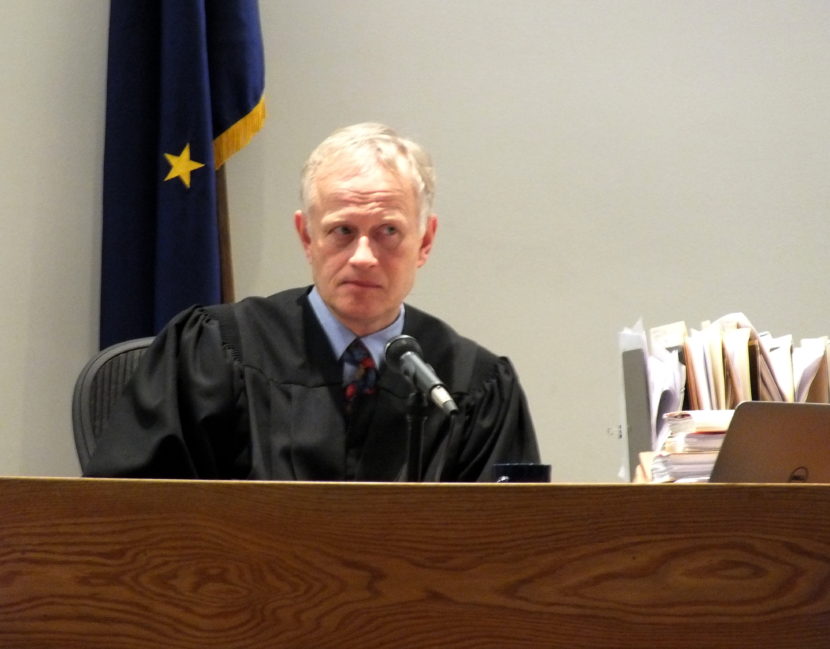
Superior Court Judge Philip Pallenberg closely watches an attorney during opening arguments in a civil trial. Pallenberg ruled in favor of the Alaska Legislative Council in a lawsuit against Gov. Mike Dunleavy over whether the governor had the power to extend 94 appointees’ terms late last year. (Photo by Matt Miller/KTOO)
A Juneau Superior Court judge has ruled that Gov. Mike Dunleavy didn’t have the power to extend many of his appointees’ terms late last year after the Legislature failed to meet to confirm them.
The decision stems from a lawsuit the Alaska Legislative Council filed against Dunleavy, saying that he didn’t have the power to keep 94 appointees after a Dec. 15 legal deadline because they weren’t confirmed by the Legislature during the pandemic. The administration argued that the Legislature had a constitutional duty to meet to consider the appointments. On Thursday, Judge Philip Pallenberg ruled in favor of the Legislative Council.
The decision doesn’t affect whether the appointees can serve now. Dunleavy reappointed them when the new Legislature reconvened on Jan. 19.
The council didn’t ask the court to invalidate the actions taken by the appointees between Dec. 16 and Jan. 18.
Kodiak Republican Sen. Gary Stevens, the former council chair, said in a statement that the decision affirms the Legislature’s confirmation power.
The Department of Law says it’s disappointed in the ruling.
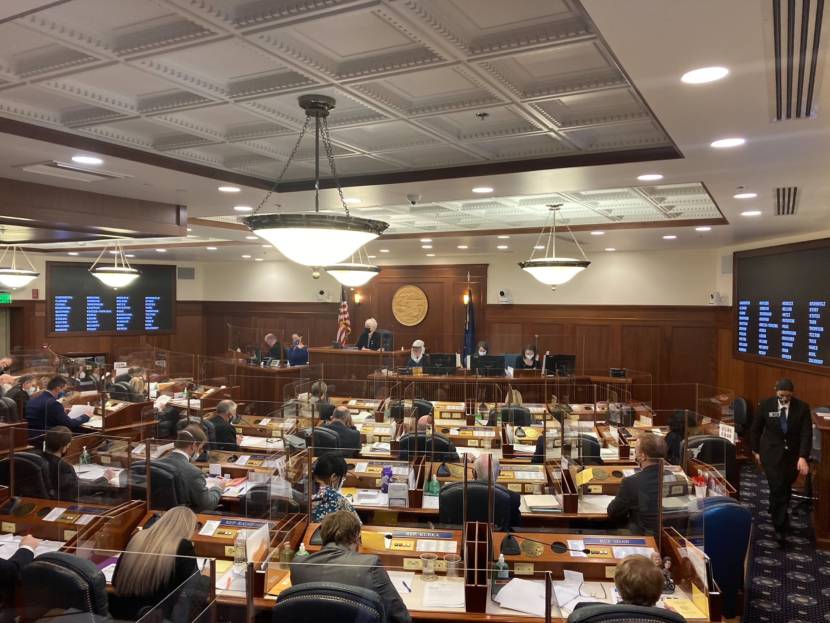
Alaska House Speaker Louise Stutes, on the dais in the center, presides over the House floor session on Thursday in the Alaska State Capitol in Juneau. The House organized, including naming committee members of its standing committees, during the session. (Photo by Andrew Kitchenman/KTOO and Alaska Public Media)
The Alaska House of Representatives organized on Thursday, but without either caucus able to claim most of the members.
The committee membership was approved in a 22-17 vote. This allows the House to begin doing legislative business — 31 days into the session. But two of those who voted for the committees say they won’t caucus with the coalition that has been the majority over the last two years.
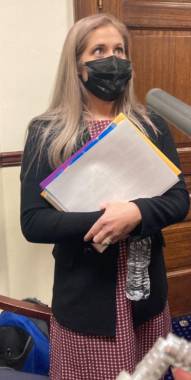
Rep. Sara Rasmussen, R-Anchorage, talks to reporters after voting to form House committees on Thursday in the Alaska State Capitol. She will be a House Finance Committee member, but isn’t joining either caucus. (Photo by Andrew Kitchenman/KTOO & Alaska Public Media)
Anchorage Republican Rep. Sara Rasmussen said she won’t caucus with either side. Rasmussen said it will be unusual to not have a caucus with a majority of members.
“I think it’s kind of unprecedented, but it gives us an opportunity to have my voice — my district has a voice at the table,” she said. “And I’m hoping that … with compromise, we’ll be able to get some good policy moved forward.”
She said she’ll stick to her conservative principles and what she campaigned on. She opposes any income tax or large increase to the taxes paid by oil companies. She said she would support changing the permanent fund dividend formula to make it more sustainable.
She will hold one of the majority seats on the influential House Finance Committee.
Anchorage Democratic Rep. Geran Tarr also said she won’t join a caucus. Tarr was in the same caucus as the other Democrats in her first eight years in the House. She wrote in a letter to House Speaker Louise Stutes that members became leaders by threatening to join the Republican caucus and that joining Stutes’ group would violate her “commitment to honorable public service.”
Tarr was co-chair of the House Resources Committee for the last four years. But she was not named to the position again. Utqiagvik independent Rep. Josiah Aullaqsruaq Patkotak will be the chair. It’s the first time the committee will not have co-chairs in 26 years.
Stutes, a Kodiak Republican, said she’s confident she will have the 21 votes needed for procedural matters necessary for the House to function. She declined to say who the 21st vote would be.
“I would rather talk people than numbers,” she said, adding: “We are open. We are working to create a good bridge between House members. And so I’m hoping as time goes by, we’ll all come together.”
Stutes said most members in her caucus are aligned on not drawing more than is planned from the permanent fund’s earnings reserve. While the majority over the last two years was committed to not do that, Stutes was less definitive. She said the House Finance Committee will have a major say in it.
“I think that that would probably like to be the hope of most people,” she said. “Whether it’s within the realm of possibility, I guess we’ll have to wait and see what Finance comes up with.”
Anchorage Democratic Rep. Chris Tuck will be the majority leader, while Wasilla Republican Rep. Cathy Tilton will be the minority leader.
Nome Democratic Rep. Neal Foster and Eagle River Republican Rep. Kelly Merrick were named the co-chairs of the House Finance Committee. Dillingham Rep. Bryce Edgmon, an independent nominated by the Democrats, will chair the Rules Committee, which determines which bills receive floor votes.
House committees are expected to start their work in the coming days.
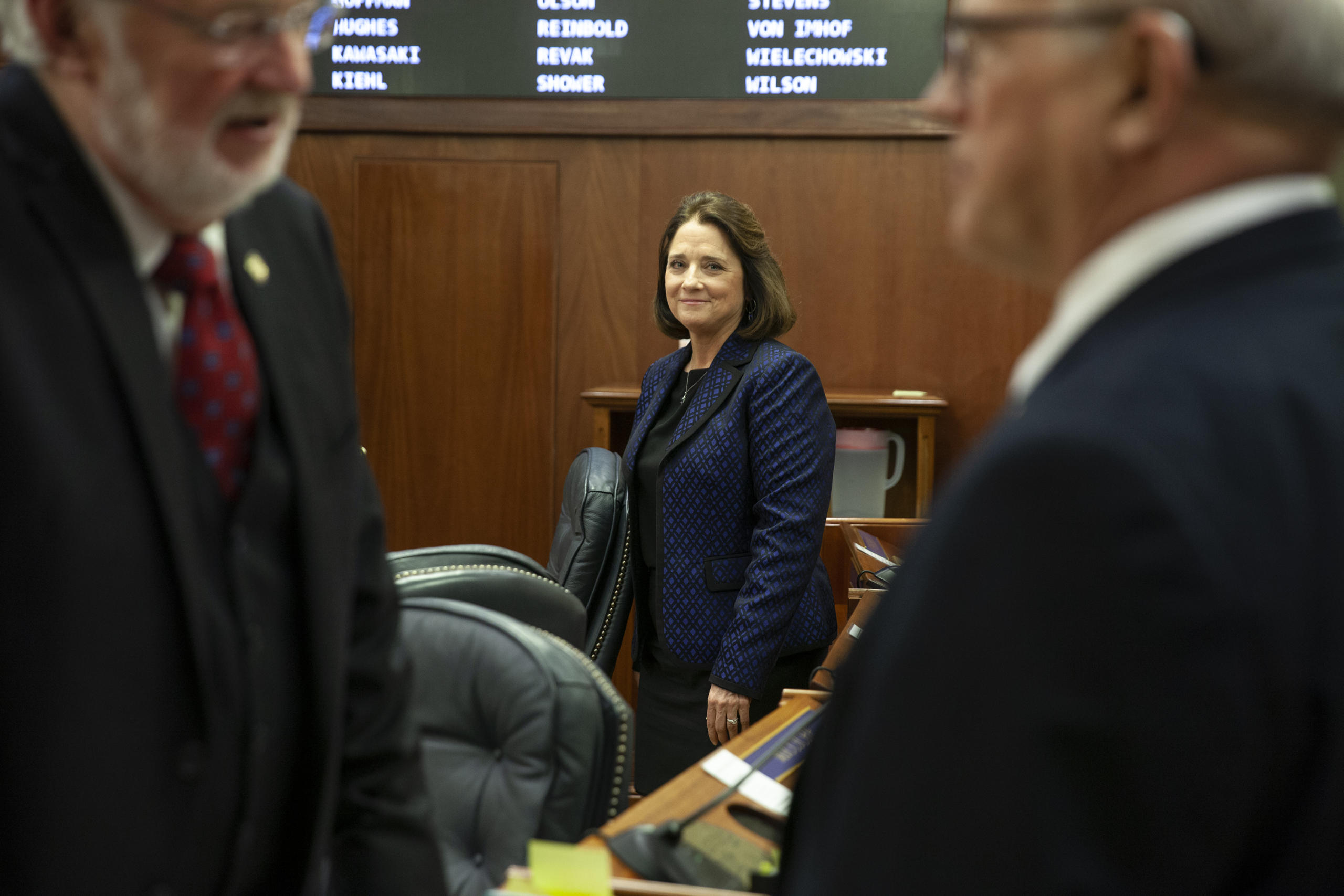
Sen. Lora Reinbold, R-Eagle River, smiles before taking her seat on the Senate floor on Tuesday, January 21, 2020 in Juneau, Alaska. (Photo by Rashah McChesney/KTOO)
Gov. Mike Dunleavy has told Senator Lora Reinbold that his administration will no longer respond to her as the chair of the Senate Judiciary Committee.
Dunleavy wrote Reinbold a letter on Thursday saying she has “abdicated the tenets” of her oath of office. Reinbold has attacked his administration’s response to the COVID-19 pandemic. Both Dunleavy and Reinbold are Republicans.
In his letter, Dunleavy wrote, “I will not continue to subject the public resources of the State of Alaska to the mockery of a charade, disguised as public purpose.”
Reinbold has compared the state response to living under martial law. She has described state mandates in response to the pandemic as unconstitutional. She also has questioned the safety of the COVID-19 vaccines and whether all residents who have received the vaccines had consented to it.
Reinbold criticized the administration’s response to health commissioner Adam Crum’s face in a Judiciary Committee hearing and had planned to call health officials back for more grilling.
Dunleavy wrote in the letter that Reinbold had deceived Alaskans about the government health response and betrayed the public trust by repeating inaccurate information. He added that he never imposed martial law or forced vaccinations. He said the state has some of the best health outcomes with some of the least restrictive measures of any state.
“Your baseless, deleterious, and self-serving demands on government resources amounts to an abuse of public services and will no longer be endured,” the letter said.
Dunleavy said Reinbold’s constituents in Eagle River and Chugiak are “deprived of meaningful representation.”
A spokesman for the governor said he had nothing further to say on the matter. An aide to Reinbold said she wasn’t available. She faces re-election next year.
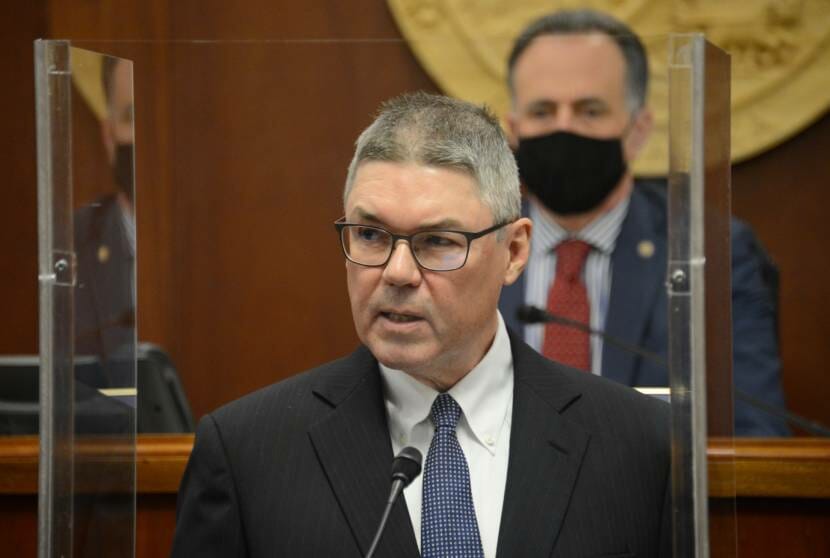
Alaska Chief Justice Joel Bolger delivers the annual State of the Judiciary address to the Alaska Legislature on Wednesday, Feb. 17, 2021 in the Alaska State Capitol at Juneau, Alaska. Because of COVID-19 precautions, Bolger stood behind a plexiglass screen and delivered the address to only the Alaska Senate, instead of a joint session of the Senate and House. All but one House member watched the address remotely. (James Brooks/Anchorage Daily News via AP, Pool)
Shortly after delivering the State of the Judiciary address on Wednesday, Alaska Supreme Court Chief Justice Joel Bolger defended Alaska’s process for picking judges — as well as the judges themselves.
State senators have criticized the current judicial selection process, as well as specific rulings, during recent hearings.
Bolger said it’s important to keep politics out of picking judges.
“I’ve come into contact with many judges and justices from other states over the past 24 years. And I feel that we have the best judicial selection process in the country,” Bolger said.
Wasilla Republican Sen. Mike Shower has introduced a bill that would give the governor the power to directly appoint district and appeals court judges. The independent Alaska Judicial Council currently has a large role in the process by selecting nominees that the governor must choose from.
Sen. Lora Reinbold, an Eagle River Republican, chairs her chamber’s judiciary committee. She recently said Anchorage Superior Court Judge Dani Crosby should appear before the committee regarding her decision that absentee voters didn’t need a witness to their ballot signatures during the COVID-19 pandemic.
Bolger described calls for judges to appear before state legislative committees like this as “ridiculous.”
He noted that judges write opinions that explain their rulings.
“So if somebody wants to know the basis for a court decision, they should read the decision,” he said.
He said the court system was determined to stay open to the fullest extent possible, while not putting the public at risk from the disease. But he noted an exception.
“The courts suspended nearly all jury trials beginning last spring, reluctantly, because we could see that bringing all these Alaskans into a courtroom was — and continues to be — just too risky to the public’s health,” he said. Some jury trials will restart in March.
Bolger said the courts took steps to ensure that other judicial business continued, including hearings related to mental health and domestic violence.
Bolger noted that the judiciary proposed a slight increase in its budget. But he added that this follows budget cuts over the past six years, and said that the courts have been a careful steward of state funding.
Close
Update notification options
Subscribe to notifications
Subscribe
Get notifications about news related to the topics you care about. You can unsubscribe anytime.