State Government Reporter, Alaska Public Media & KTOO
State government plays an outsized role in the life of Alaskans. As the state continues to go through the painful process of deciding what its priorities are, I bring Alaskans to the scene of a government in transition.
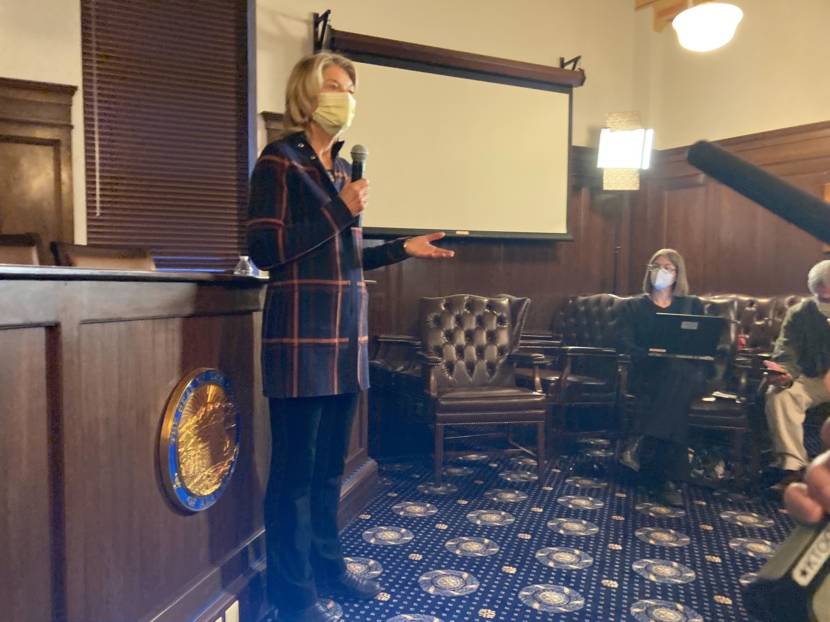
U.S. Sen. Lisa Murkowski speaks to reporters during her annual visit to the Alaska State Capitol in Juneau, on Feb. 16, 2021. (Photo by Andrew Kitchenman/KTOO and Alaska Public Media)
U.S. Sen. Lisa Murkowski said during her annual trip to the Alaska State Capitol that the Republican Party has to decide whether it is the party of one man — former President Donald Trump — or of principles.
“The Republican Party, in my view, was a pretty good party before Donald Trump and I believe we can be a good party after Donald Trump,” she said. “Right now, I think we’re still trying to figure out who we are.”
Murkowski acknowledged that the Alaska Republican Party may censure her for her vote to convict Trump of inciting the Jan. 6 storming of the U.S. Capitol. She said she put her obligation to support the Constitution first.
Due to COVID-19 and the delayed organization of the Alaska House, Murkowski did not give her annual address to a joint session of the Legislature. But she met with small groups of lawmakers and answered questions from news reporters.
Murkowski said it would be a challenge for her if the Republicans became the party of Trump, but she would never switch to another party.
“There is no way that I would go to the Democrats,” she said. “I’m not a Democrat. And so I continue to be a Republican, but I am not a Trump Republican.”
Murkowski also said states must ensure that elections are secure, but she emphasized that they shouldn’t inhibit voter participation.
“We should be doing everything we can to make voting easier for everybody,” she said. “Not easier for Republicans, not easier for Democrats, not easier for this minority or that. Everybody. And so when we put limitations in place, either intentionally or unintentionally, that’s not who we are. We want the participation.”
Murkowski declined to announce whether she’s running for re-election next year, but she suggested a campaign launch was in her future.
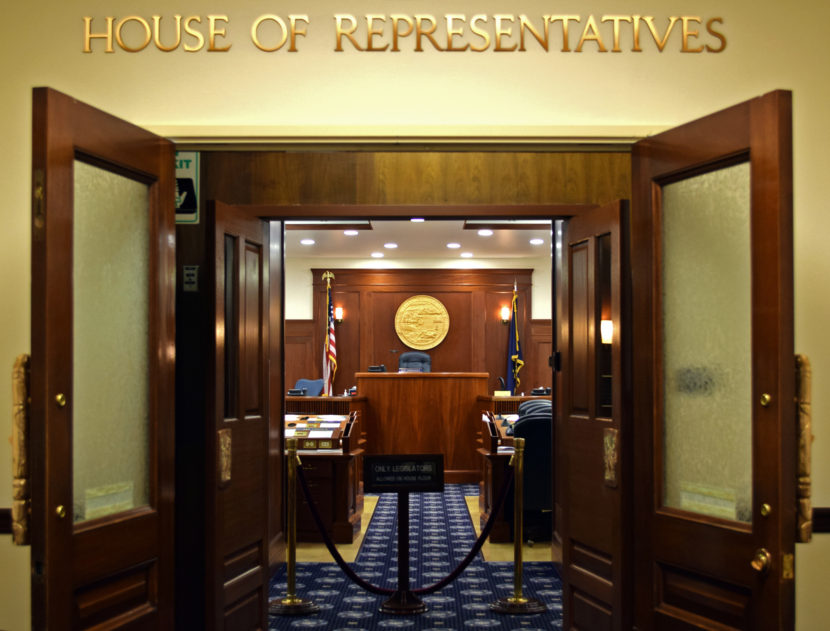
The Alaska House of Representatives entrance in the Capitol in Juneau in 2015. On Monday, (Photo by Skip Gray/360 North)
The Alaska House reached a majority caucus that’s mostly made of Democrats on Monday when Republican Rep. Kelly Merrick of Eagle River joined the coalition, giving it 21 members. The new majority is seeking to add Republican members.
Merrick said she had wanted to have a Republican majority, but with the close division in the House, it will be necessary for people to work across party lines.
“I am working closely with Republican Speaker Louise Stutes to form a functional, diverse caucus with many Republicans in key leadership positions,” Merrick said of the caucus, which currently has two Republicans: Merrick and Stutes.
Merrick voted for Stutes to become speaker on Thursday, but it wasn’t until Monday that she said she had joined the caucus that included the other 20 people who voted for Stutes.
Stutes, who is from Kodiak, said she wants people from different parties to shape the majority.
“The intent is to have a bipartisan coalition where everyone has an opportunity to participate,” she said. “It’s open to members from both sides, and I’m happy about that.”
While the 21 Republicans elected in November could have been enough to form a majority, Stutes stayed with the mostly Democratic majority she has been with for four years. She has differed with other Republicans on policy issues, including funding for the Alaska Marine Highway System. Her decision not to caucus with Republicans led to a deadlock that’s prevented other leadership positions from being filled in the first 28 days of the legislative session.
While Stutes said all committee positions are open, she added that under current discussions, Merrick and Rep. Bryce Edgmon of Dillingham would serve as the co-chairs of the House Finance Committee, which works on the state government budget. She also said that Democratic Rep. Chris Tuck of Anchorage would serve as the majority leader, based on what’s currently being discussed.
Stutes named seven members to the House Committee on Committees, which will nominate committee members and chairs for the House to vote on. That includes Republicans Mike Cronk of Tok, Sara Rasmussen of Anchorage, Merrick and Stutes; Democrats Neal Foster and Chris Tuck; and the Democratic-nominated independent Edgmon.
Merrick said she doesn’t know how long it will take for the Committee on Committees to complete its work.
“I know that Alaskans have asked us to get to work, so the sooner, the better,” she said.
The committees won’t be finalized until the majority of the House votes to approve them.
Cronk and Rasmussen are currently members of the Republican caucus.
But Wasilla Republican Rep. Cathy Tilton, a senior caucus member, said Stutes didn’t consult with the caucus in choosing the Committee on Committees’ members. She said she wanted to improve the communication between the caucuses.
“We can definitely have better communications and be better organized,” Tilton said.
It’s not clear when the Committee on Committees will meet.
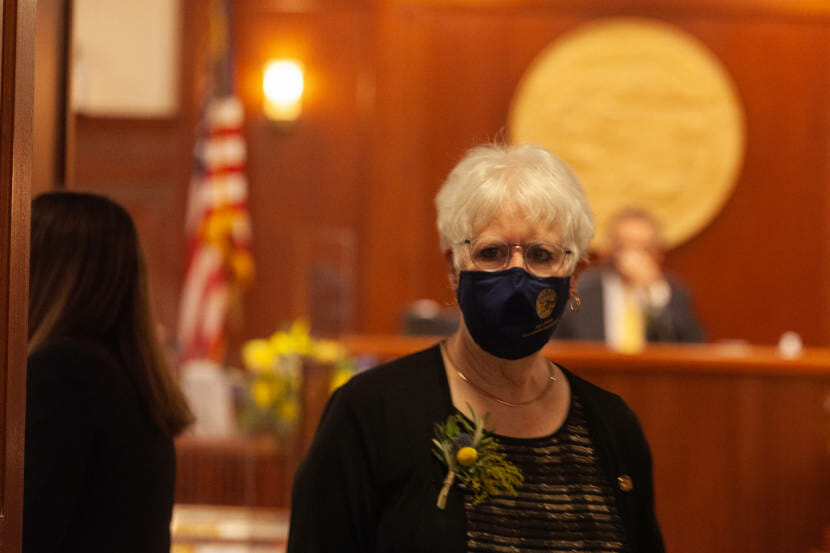
State Rep. Louise Stutes, R-Kodiak, leaves the House floor after being sworn in during the first day of the 32nd Legislative Session on Tuesday, Jan. 19, 2021 in Juneau, Alaska. Stutes was elected House speaker on Thursday. (Photo by Rashah McChesney/KTOO)
Kodiak Republican Rep. Louise Stutes was elected Alaska House speaker on Thursday, breaking a deadlock on the 24th day of the legislative session.
Eagle River Republican Rep. Kelly Merrick broke the deadlock by voting for Stutes.
The vote was 21-19.
Stutes briefly addressed the chamber after taking the gavel from temporary speaker Rep. Josiah Patkotak, an Utqiagvik independent. She said she wanted to thank members for the trust they put in her.
“I look forward to uniting this House of Representatives,” she said. “We all need to … walk down the same side of the street. And I am very excited to be instrumental in bringing this House back together.”
But the vote didn’t resolve control over the House.
Merrick announced that she had not joined the coalition that includes the other 20 people who voted for Stutes, leaving the House without a functioning majority caucus on Thursday.
Merrick said she felt the House could no longer delay extending Gov. Mike Dunleavy’s disaster declaration. She also said she supported a fiscally conservative budget and passing a construction jobs bill.
However, until there’s a majority, the House won’t have committees and won’t be able to work on legislation
In November, 21 Republicans were elected to the House. Stutes announced shortly after that she didn’t plan to caucus with the other Republicans. She has caucused with a mostly Democratic majority since 2017.
House members expressed uncertainty about what would happen next. Members who voted for Stutes say they’re optimistic.
Anchorage Democratic Representative Chris Tuck praised both Stutes — who he described as straight-talking — and Dillingham independent Representative Bryce Edgmon (EDGE-mon), who stepped aside after four years as speaker.
Merrick and Stutes were the only Republicans to vote for Stutes, along with 15 Democrats, two Democratic-nominated independents and two independents nominated without party nominations. All of the no votes were Republicans.
Tuck said that Merrick’s decision to vote differently than the other Republicans was courageous.
“Not only is it a leap of faith in who you’re supporting, but it’s also stepping out. And I think that just shows her desire to move Alaska forward,” he said.
Under the Legislature’s rules, Stutes must appoint members by Friday to a committee that will recommend the members of all of the other committees. The entire House will then vote on the recommendations. It’s not clear when that will happen.
Merrick and Stutes were the only Republicans to vote for Stutes, along with 15 Democrats, two Democratic-nominated independents and two independents nominated without party nominations. All of the no votes were Republicans.
Editor’s note and correction: This story has been updated with a statement from Rep. Kelly Merrick. An earlier version of this story said Rep. Merrick’s vote will allow a Democratic majority to retain control of the chamber. This is not accurate and has been amended.
Sen. Lora Reinbold, R-Eagle River, left, chats with Sen. Roger Holland, R-Anchorage, and Sen. Gary Stevens, R-Kodiak, before the start of the floor session of the Alaska State Senate on Friday, Jan. 22, 2021. (Peter Segall/Juneau Empire via AP, Pool)
Gov. Mike Dunleavy warned Alaskans away from “misinformation” regarding the pandemic and his administration’s response to it. He encouraged people to challenge those making allegations.
“Ask them to show you the data. Ask them to show you a memo, a letter that we are contemplating martial law — that’s ridiculous,” he said. “It’s never happened. Ask the individual, or individuals, that are spreading this misinformation.”
Dunleavy first addressed the issue during a news briefing on Wednesday after Jeff Landfield of The Alaska Landmine asked about comments by Sen. Lora Reinbold, an Eagle River Republican. Reinbold has likened the state’s COVID-19 response to living under martial law.
The governor said his administration would work with all legislators. After a pause, he added: “We have no intention of declaring martial law.”
The governor circled back to the topic of martial law toward the end of the briefing. He then launched into his comments about misinformation.
“For those who say and continue to say that we are contemplating things like martial law, that we are contemplating things like forced vaccination, that we’re making this out to be a police state, or some type of Stalinist state — they’re just completely wrong,” Dunleavy said. “And I think they’re doing all of us a disservice.”
He asked Alaskans to critically examine their information sources.
“I would ask all Alaskans — it doesn’t matter what side of the political spectrum you’re on — do a little homework, a little more homework,” he said. “I think in some cases you’re being misled, to the detriment of Alaska.”
Dunleavy has taken criticism from public health advocates who urged him to impose a statewide mask mandate, which he declined to do. But in Senate Judiciary Committee hearings chaired by Reinbold, the administration’s pandemic response has been criticized for going too far.
Dunleavy compared his administration’s approach to “threading the needle” in responding to the threat to public health, while minimizing the harm from government action on businesses and people’s lives.
Dr. Anne Zink, Alaska’s Chief Medical Officer, watches Gov. Mike Dunleavy during a press conference on the COVID-19 pandemic on April 2, 2020, in Anchorage, Alaska. (Creative Commons photo courtesy Alaska Governor’s Office)
State officials are scrambling to determine if they’ll still be able to allocate vaccines and determine who’s eligible if the state’s COVID-19 disaster declaration expires at 12 a.m. on Monday. Gov. Mike Dunleavy said the state will lose legal tools that it has relied on. But, the governor also said his administration will continue to manage the pandemic response.
“It’s something we are rapidly working with, with our federal partners and the Department of Law, to make a determination,” said Department of Health and Social Services Commission Adam Crum, adding “this is something that throws the response into question,” without the authority the disaster declaration provides.
Dunleavy said in a news briefing Wednesday that the state is preparing for the expiration, as a deadlock in the Legislature may prevent an extension. Dunleavy expressed optimism, but also uncertainty.
“Would a declaration assist us? Yes. If there is no declaration, is it going to throw us into chaos? We don’t know; we don’t think so,” Dunleavy said. “But certainly an extension would help the cause.”
Dunleavy proposed a bill to extend the declaration. The Senate is moving quickly on the bill. But lawmakers say it’s unlikely to pass in time. That’s because the House has been deadlocked for the first 23 days of the legislative session. The chamber has been split between two caucuses, preventing it from forming committees or working on any bills.
The governor issued three disaster declarations while the Legislature wasn’t in session, after the initial declaration expired in November. But he said he won’t do it again with lawmakers in the Capitol.
“As long as they’re in session, it’s in their hands. It’s in their ballpark,” he said. “When they weren’t in session, when we had those other issues, it was a different deal. Many people have questioned that, and I understand that. But right now, this is the Legislature’s purview.”
Dunleavy declined to call on the House to organize. “The organization of the Legislature really is a concern of the Legislature,” Dunleavy said. “It is a concern for all of us, obviously, and we’ve all been having discussions, hoping that the House forms up sooner than later.”
Dunleavy said the expiration will cause some 200 regulations that have been suspended to go back into effect.
Correction: The declaration expired at 12 a.m. on Monday, not Sunday.
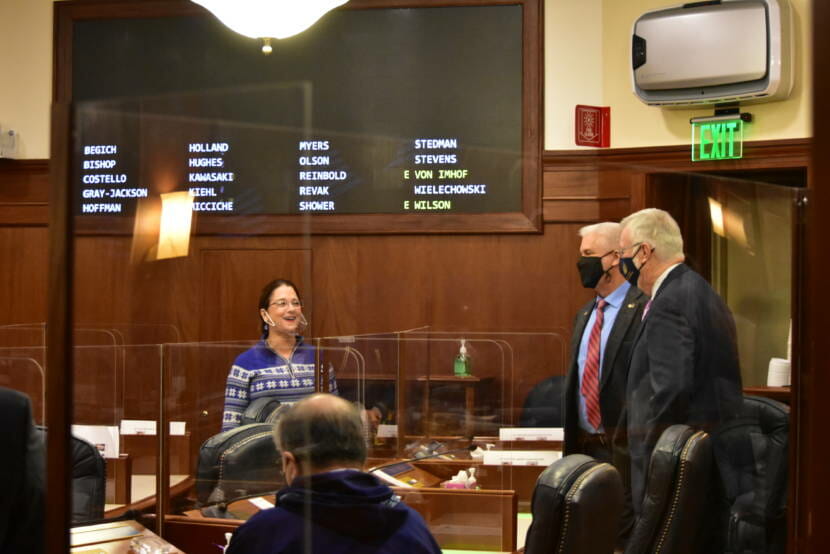
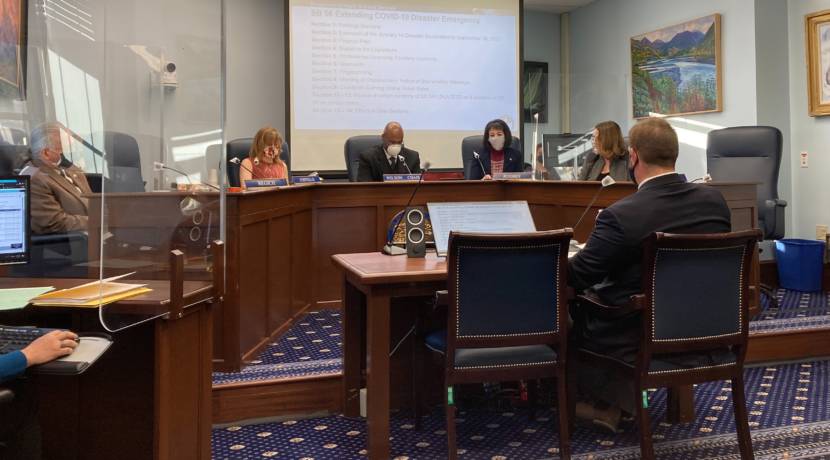
Members of the Senate Health and Social Services Committee hear details about a bill to extend the state’s COVID-19 disaster declaration on Feb. 2 in the Capitol. The members, from left, are Sen. Tom Begich, D-Anchorage, behind the plexiglass; Sen. Mia Costello, R-Anchorage; Sen. David Wilson, R-Wasilla; Sen. Shelley Hughes, R-Palmer; Sen. Lora Reinbold, R-Eagle River; and Adam Crum, the commissioner of the Department of Health and Social Services. (Photo by Andrew Kitchenman/KTOO and Alaska Public Media)
When Gov. Mike Dunleavy’s pandemic disaster declaration expires this weekend, the state will lose a wide range of special powers to respond to COVID-19. At stake is everything from the state’s plan for distributing vaccines to the state requirement for many air travelers to be tested for the coronavirus. Legislative leaders want to avoid harming the state’s response to the pandemic, but they face obstacles to resolving the dilemma.
Dunleavy has issued four disaster declarations for the COVID-19 public health emergency since last March — and the last is set to expire at the end of the day on Sunday. But his office said he can’t extend it this time without approval from the Legislature, which is in session for the first time since the original declaration came out.
So his administration has put forward Senate Bill 56, which includes the extension.
Heidi Hedberg, the director of the state Division of Public Health, said the disaster declaration gives the state the legal authority to distribute the vaccines, as well as some medical treatments for COVID-19.
“We need the authorities from the public health emergency to allocate to the communities,” she said. “Without that authority, we are in a very precarious situation when the public health emergency expires.”
She said the state’s authority to prioritize vaccines for at-risk groups would also end if the declaration ends. She also said communities that do not have health powers will be left behind.
Some consequences of the declaration ending are unclear. State health officials are still determining exactly what the state could legally do to distribute vaccines without the order. But they anticipate that without statewide mandates for testing related to air travel, there would be a patchwork of local restrictions.
But even with high stakes, the declaration could expire. There are a couple of obstacles in the way. The most immediate is that the House cannot consider any legislation right now, because it hasn’t organized. It’s split 20-20 between two caucuses. There isn’t a permanent speaker to refer bills to committees. And there are no committees to refer bills to.
Fairbanks Rep. Steve Thompson is the House Republicans’ pick to become speaker. He said the House may have to pass the measure after the declaration expires, and apply it retroactively to the expiration date.
“But there is pressure that it needs to be done,” he said on Friday. “That’s part of the reasons we were elected to come down here, was to do the state’s work. We have to address things, and that’s one of the items that I think is pretty important to everybody. And that’s another reason that we should get organized and do our work — what we were elected for.”
Dillingham independent Representative Bryce Edgmon is a leader of the other House caucus, which includes 15 Democrats, four independents and one Republican. On Tuesday afternoon, he said he and other legislative leaders were working with legal experts on an alternative to a bill. They were writing a document that Edgmon hopes a majority of House members would sign that would support the governor’s ability to extend the disaster.
“Even if we were organized, at this point, we would be very challenged to get a bill through in time to meet the Feb. 14 deadline,” he said. “So we’re having to look at other avenues. And I think we’re going to be successful, at least to temporarily continue the disaster declaration.”
The unorganized House is just one obstacle to the extension. Another is that some legislators don’t agree with it. They’ve been hearing from constituents who are opposed to local mask mandates, school closures and restrictions on businesses, and who see the end of the state declaration as a step to returning things to normal.
Anchorage resident Dean Cannon said he opposed extending the declaration at a recent Senate Health and Social Services Committee meeting.
“The public are losing control over their lives and democracy under these emergency orders,” he said. “And many of us feel too much authority is collecting in unelected bodies.”
Cannon gave the state Department of Health and Social Services as an example.
State officials said that the state declaration is a separate issue from what Anchorage or other municipalities have done.
The potential problems extend beyond the state government.
Along with giving the state specific powers spelled out in state law, the declaration also frees up hospitals and other health care providers to respond, according to Jared Kosin, the president of the Alaska State Hospital and Nursing Home Association. He said federal waivers that allow hospitals to change emergency room procedures and make other changes due to the pandemic would end without the declaration.
“If we lose the federal blanket waivers, the consequences will be real, and they will be significant,” he said.
Kosin gave examples of hospital responses that are only possible because of the declaration.
“We have a hospital that constructed temporary walls around a COVID unit, altered entrances and egresses, has power supplies and cords in place,” he said. “All of these would be federal violations without the waivers being in place.”
Sharing hospitals’ concerns about the expiration are health care providers in rural Alaska. Alaska Native Health Board President Verné Boerner noted that Alaska Natives make up a disproportionate share of the COVID-19 cases and deaths. Contributing to the problem, she said, are crowded, multigenerational homes; a lack of running water and sanitation; and the distance from advanced medical care contribute. And she said ending the disaster declaration would add to that list.
“The public health emergency has been critical for helping us respond to and provide care to our members,” she said.
In addition, municipal leaders across the state are scrambling to understand the impact on their residents if the declaration expires.
The arguments for the extension appear to be having an impact. Despite a majority of the Senate Health and Social Services Committee initially expressing skepticism, the committee voted to move the bill forward on Tuesday. The committee amended it so that the extension would end on March 15, rather than Sept. 30 as the governor had asked.
Senate President Peter Micciche, a Soldotna Republican, wants to limit the bill’s provisions.
“We don’t want the people of Alaska thinking that the Senate is not going to support something that requires passage, because those tools are necessary,” he said. “It just may be far more narrow.”
The entire Senate could vote on the bill by the end of the week.
Close
Update notification options
Subscribe to notifications
Subscribe
Get notifications about news related to the topics you care about. You can unsubscribe anytime.