Andrew Kitchenman

State Government Reporter, Alaska Public Media & KTOO

State government plays an outsized role in the life of Alaskans. As the state continues to go through the painful process of deciding what its priorities are, I bring Alaskans to the scene of a government in transition.

How many Alaskans died last year in the pandemic? ‘Excess death’ count sheds some light

A mostly empty hospital hallway
A nearly empty critical care unit at Bartlett Hospital on April 7, 2020, in Juneau, Alaska.  (Photo by Rashah McChesney/KTOO)

Alaska had more than 5,000 deaths last year. And of those, at least 529 were above what could be expected in a normal year — what’s known as excess deaths.

The global pandemic ensured last year wasn’t a normal year. Public health experts across the country are examining excess deaths as they study whether significantly more people are dying from COVID-19 than what’s being recorded.

The 2020 excess death numbers are still coming in and will likely go up. But, the 529 excess deaths in a new report were already more than twice as many as the 255 deaths Alaska doctors have determined the coronavirus disease caused in 2020. 

Rebecca Topol compiles Alaska’s excess deaths reports for the state’s Division of Public Health. She emphasized in early January that the state’s numbers are preliminary. And she said it’s too soon to draw conclusions. 

“Some of those might be unidentified COVID cases, but we don’t really know the answer to that — how many of those other ones that are not attributed to COVID might be COVID-related,” Topol said. 

There are specific conditions and causes related to Alaska’s excess deaths in 2020, including elevated levels of diabetes, cancer and heart disease. But the excess death figures are especially important to public health experts to understand the effect of pandemics and other disasters. 

With COVID-19, some of the excess deaths could have come indirectly from the pandemic — from things like health care capacity shortages or patients putting off medical care because they were afraid to go to the doctor during the pandemic. But public health experts nationally have been concerned that people who haven’t been tested for or diagnosed with the virus are dying from it

For example, a recent study published in the Journal of the American Medical Association said inadequate testing for the coronavirus likely contributed to the difference between the number of excess deaths of otherwise healthy young people, and the recorded COVID-19 count. 

Alaska State Epidemiologist Dr. Joe McLaughlin said this may reflect a broader issue. 

“I suspect this is happening throughout the country, here in Alaska and in other states as well,” he said in mid-January. “A number of these excess deaths are probably attributable … at some level to the epidemic, whether or not the person had actually had COVID-19 and it was not detected, they actually weren’t tested, or some other potential factors.”

Part of the challenge is that even highly skilled doctors may not be certain of all of the causes of death when they fill out death certificates. State Chief Medical Officer Dr. Anne Zink said there are limitations to what doctors can know. 

 “I think that as a clinician, it can be hard, right?” she said. “Someone comes in and they’re sick and you’re trying to figure out what’s going on. And maybe they’re older and they have underlying heart disease. And maybe they test positive for COVID or they don’t test positive for COVID, or they had COVID previously, but now they’ve had a heart attack.”

Zink said the patient’s records don’t automatically give the person writing the death certificate everything they need to know.

“And so, it’s not like you just open up a flap or a note and you can see exactly what their cause of death was and what happened and all of the causes,” she said. “You’re trying to put this together clinically.”

Nationally, there were 471,000 excess deaths between March 15, 2020, and Jan. 16, 2021, which is 75,000 more the reported COVID-19 count, according to The New York Times

Zink said it will take time to better understand the true number of people who died from COVID-19, or the other causes of excess deaths related to the pandemic. 

“I think there will be hundreds of papers coming out for the next multiple years looking back on this pandemic and trying to understand this virus and how much to attribute of that was to COVID or to other things,” she said of the excess deaths.

Alaska’s excess death count for December doesn’t include all deaths for the month, since it takes time to report deaths. If December’s final count goes up like it has in recent months, the final number of excess deaths for 2020 could reach 600 or more.

A final state report on 2020 excess deaths is expected later this year. 
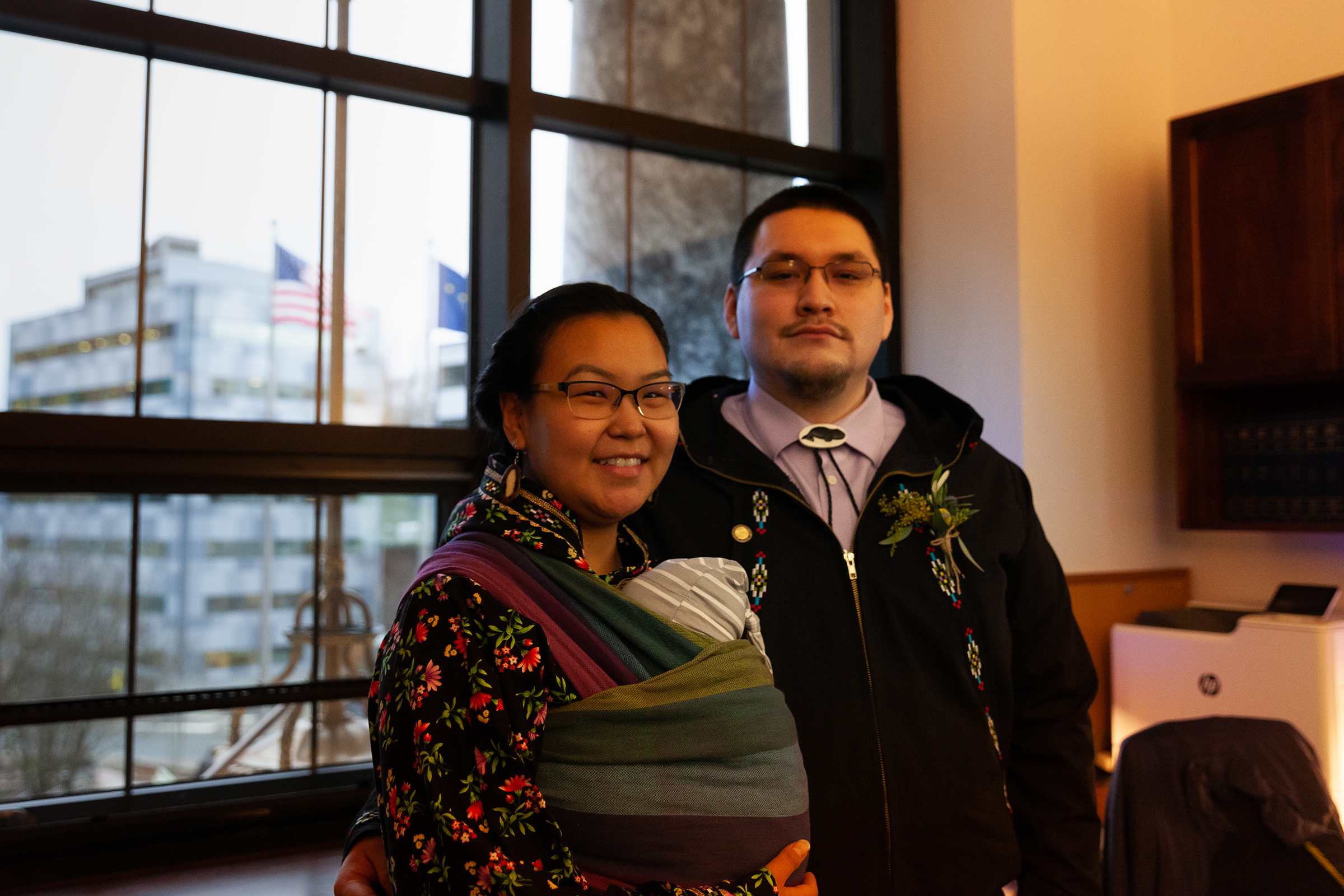
Rep. Josiah Patkotak elected temporary speaker in unorganized Alaska House of Representatives

(left) Flora Atqaqsaaq Patkotak holds Elijah Moses Patkotak as she visits her husband, Rep. Josiah Patkotak, on his first day in office as the Representative for House District 40 on Tuesday, Jan. 19, 2021, in Juneau, Alaska. (Photo by Rashah McChesney/KTOO)

The Alaska House of Representatives elected a temporary speaker on Thursday. Independent Representative Josiah Patkotak from Utqiagvik will preside over the House until there’s a permanent speaker.

Seventeen days into the legislative session, this is the first action the House has successfully taken.

The step doesn’t resolve the divide that has prevented the chamber from picking a permanent speaker and organizing committees or from considering legislation.

Patkotak was elected in November at the age of 26, and is the second-youngest member of the House.

He expressed optimism in his first words after taking the gavel.

“First off, I’d like to say thank you for the vote of confidence, and we’ll get through whatever we’re getting through right now,” he said.

The vote for Patkotak was 39 to zero. Anchorage Democratic Rep. Geran Tarr was absent.

There were no nominations for permanent speaker.

As an independent, Patkotak has been seen as a potentially important vote in determining the House majority. On previous votes for temporary speaker, he has joined the members of the former House majority coalition, which includes 15 Democrats, three other independents and Kodiak Republican Representative Louise Stutes. Patkotak’s fellow “bush caucus” members — representing predominantly rural districts in northern and western Alaska — are members of the coalition.

Tok Republican Representative Mike Cronk nominated Patkotak, who was the only nominee on Thursday. Anchorage Democratic Representative Matt Claman moved for a vote.

During a recess in the floor session, Claman said, “It’s a positive step… But it doesn’t get us to a speaker.”

Patkotak is one of only two independents who were elected without winning a party nomination, along with Ketchikan Rep. Daniel Ortiz.

Over the previous 16 days, the House split 20-20 on all nominees for temporary speaker, including Fairbanks Republican Bart LeBon, Anchorage Republican Laddie Shaw and Nome Democrat Neal Foster.

The House is scheduled to hold another floor session on Friday morning.

11 days after appointment, Alaska Attorney General Ed Sniffen leaving job

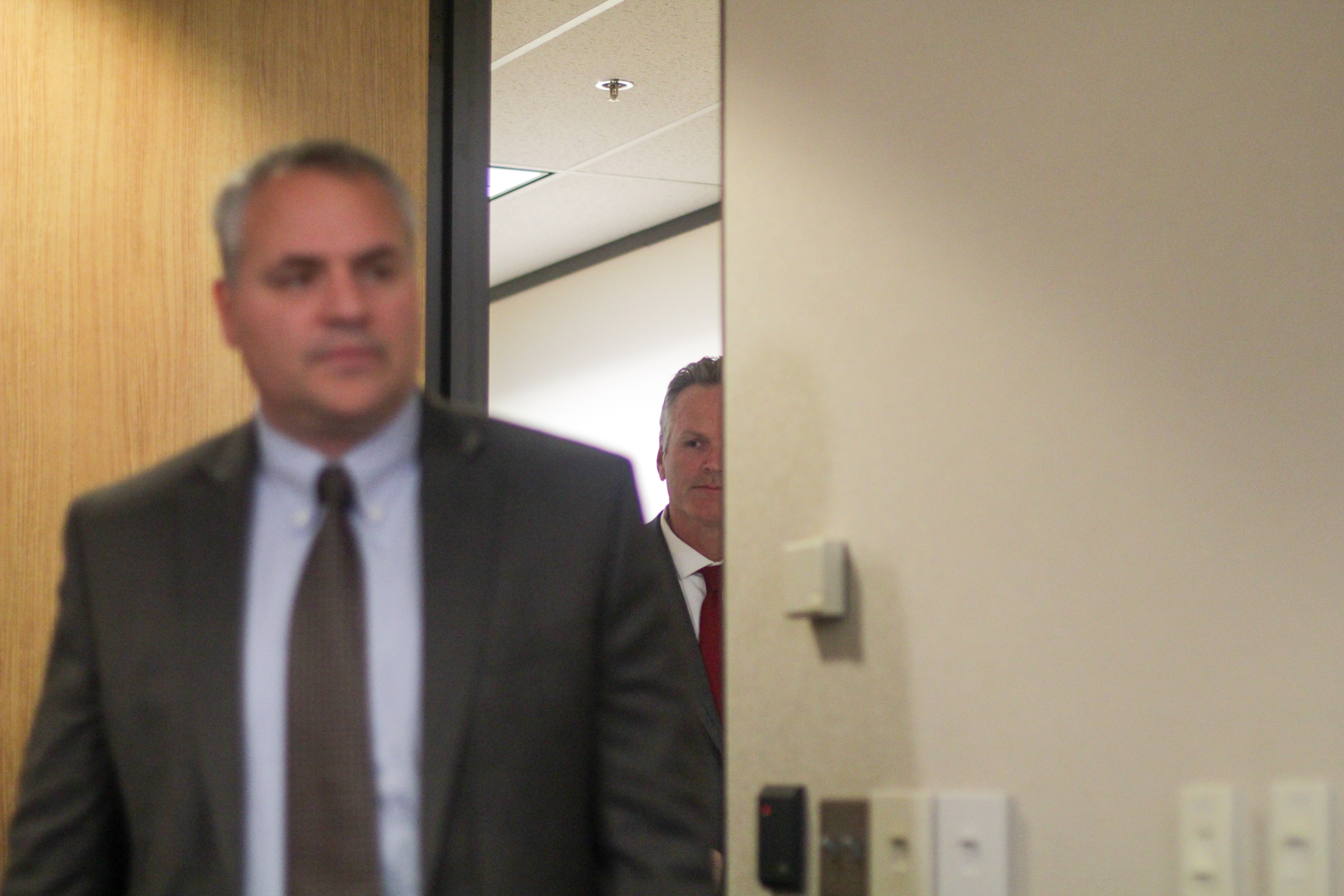
Alaska Gov. Mike Dunleavy follows Deputy Attorney General Treg Taylor into a news conference at the governor's Anchorage office on Friday, Sept. 27, 2019.
Alaska Gov. Mike Dunleavy follows Treg Taylor into a news conference at the governor’s Anchorage office on Friday, Sept. 27, 2019. (Photo by Nat Herz/Alaska Public Media)

Alaska Attorney General Ed Sniffen is leaving his position 11 days after Gov. Mike Dunleavy appointed him.

The governor accepted Sniffen’s resignation “for personal reasons,” according to a spokesperson for the governor. The announcement of the change on Friday said Sniffen is leaving state government.

On Saturday, the Anchorage Daily News reported that sexual misconduct allegations prompted the resignation.

Dunleavy’s office said Treg Taylor would replace Sniffen as the attorney general.

Taylor joined the Department of Law as deputy attorney general for the Civil Division after Dunleavy became governor.

He previously served as a lawyer for Arctic Slope Regional Corporation, and for McKinley Capital Management, an Anchorage-based investment firm. He lives in Anchorage.

Dunleavy said Taylor brings a wealth of legal experience. Taylor said in the announcement that he was honored by the appointment and hopes the department will continue to provide outstanding legal service.

Dunleavy thanked Sniffen and said he wished him well in his future endeavors.

Sniffen had become acting attorney general in August, when former Attorney General Kevin Clarkson resigned.

Sniffen began working for the Department of Law in 2000 and served as senior attorney general in the consumer protection unit, as well as deputy attorney general and other senior positions.

When Dunleavy announced Sniffen as attorney general on Jan. 18, the governor said he had a long and proven record of leadership.

Taylor’s appointment is subject to confirmation in a joint session of the Legislature.

This story has been updated with a link to additional reporting from the Anchorage Daily News.

Dunleavy talks pandemic, big dividends and resource development in virtual State of the State address

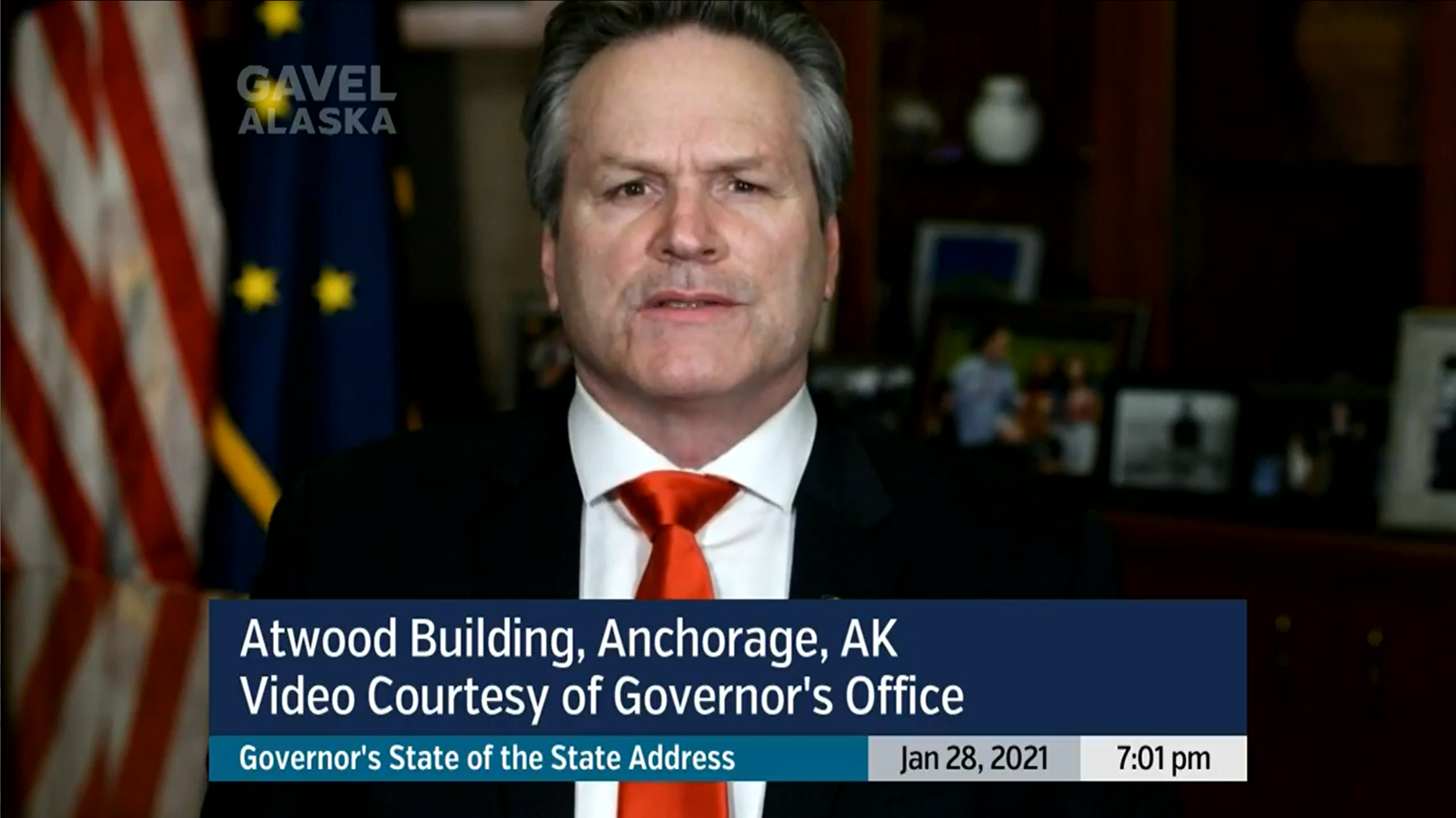
Gov. Mike Dunleavy delivers his State of the State address from the Robert B. Atwood Building in Anchorage on January 28, 2021. (Screenshot from KTOO)

Gov. Mike Dunleavy explained his approach to the COVID-19 pandemic and called for large permanent fund dividend payments and developing Alaska’s resources in his third State of the State address on Thursday.

Dunleavy thanked state health leaders, public servants and “frontline heroes” for their work on the pandemic. He also recalled his years living in rural Alaska.

“I would be lying if I said the tragedy of 1918 didn’t weigh deeply on me,” Dunleavy said of the worldwide flu that devastated Alaska. “I lived in those villages and was forever changed by the stories of elders who survived. These stories compelled me to ensure there would be no repeat of 1918 on my watch.”

The conditions around the speech may be the most unusual in the state’s history. Dunleavy spoke by video through a livestream rather than in the traditional venue of a joint session in the Capitol. The governor’s office cited the complications from COVID-19 for the changed format. In addition, The Alaska House hasn’t chosen a temporary speaker and couldn’t invite the governor, as is customary.

Dunleavy pitched his plan to pay roughly $5,000 in dividends this year as a way to help Alaska’s economy. Roughly $2,000 would pay for the difference between last year’s dividend and what it would have been under the formula in state law, and roughly $3,000 would be for this year’s dividend.

“If we cannot find it within ourselves to put to use less than one year’s worth of fund growth, so that the thousands of Alaskans and businesses impacted can get back on their feet, then we have to question our priorities as leaders in Alaska during its time of need,” he said.

And Dunleavy talked about how the state was nearly cut off from shipping at a point early in the pandemic, and said his administration would plan to be more self-reliant in food, energy and other areas.

He also called for developing the state’s natural resources.

“When our history is written, will it be that we forced our children to look beyond Alaska’s shores for the American Dream, that we stood by until Alaska was nothing more than a handful of holdouts fighting to be the last park ranger?” he said. “Or will it be said that this was our finest hour, that we ignored the calls of divisiveness and pulled together like Alaskans always have?”

Dunleavy called for introducing gaming in Alaska; $4 million to defend what he called the state’s sovereignty against “an overreaching federal government”; and increased funding for homeschooling.

In the speech, he didn’t put forward any large taxes to pay for the dividends and other plans. That’s consistent with his previous addresses to the state.

This year’s State of the State by the Republican governor was met with praise by many Republican lawmakers, and skepticism from at least some Democrats and independents.

Senate President Peter Micciche, a Soldotna Republican, praised the governor’s approach to the economy. He was among those who talked about how Dunleavy’s plans fit into the long-term gap between what the state spends and what it raises.

While Dunleavy has opposed large revenue measures in the past, Micciche said the governor may be open to new, broad-based tax. Micciche said Alaskans who supported larger permanent fund dividends feel that PFDs have been cut without others being asked to pay more.

“It’s the fairness issue, I think, is giving us the biggest political amount of resistance,” Micciche said. “So I think if we honestly discuss that with the governor, who I think now is talking about broad-based options — I mean, he’d like to see it go to a vote of the people — whether or not that occurs is yet to be seen, but at least he’s willing to have those discussions.”

Dillingham Rep. Bryce Edgmon, a Democratic-nominated independent, said the speech didn’t include a plan that would balance the state’s budget without spending down the Alaska Permanent Fund’s earnings.

“The dividing issue down here in Juneau right now is the fiscal plan and what to do in an environment where we’ve exhausted our savings accounts, and we have to turn to other sources in order to make ends meet and provide a sustainable dividend, and I heard nothing about that tonight,” he said.

Anchorage Democratic Sen. Tom Begich also expressed disappointment at how the address relates to the state’s budget problems.

“The only real revenue measure he talked about was a gambling measure. And I think we’ve gambled on our future more than enough,” he said. “What we need to do is have a real plan.”

Edgmon and Begich both praised the parts of the address that highlighted the state’s COVID-19 response.

In a news conference afterward, 14 House Republicans took turns uniformly praising the governor’s speech..

Wasilla Republican Rep. Cathy Tilton likes Dunleavy’s plan to lower the state’s constitutional limit on spending.

“I enjoyed the optimism that the governor put forward for how he sees our state moving forward, and our economy,” she said.

Gov. Dunleavy proposes bill to extend Alaska’s COVID-19 disaster declaration through September

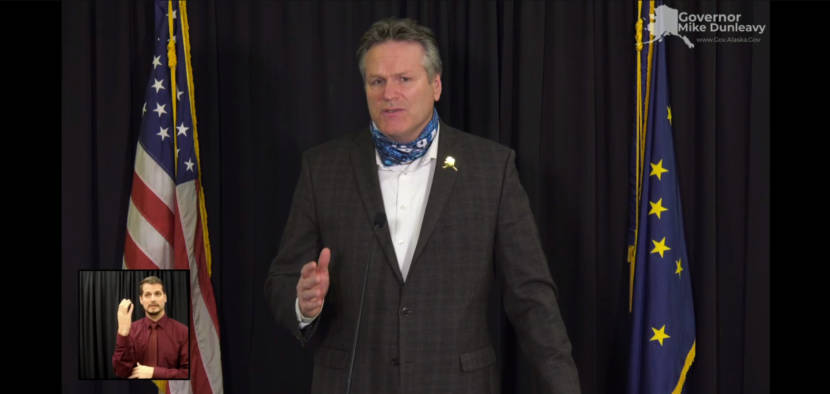
Alaska Gov. Mike Dunleavy appeals to Alaskans to support neighbors, businesses and charities affected by COVID-19 this holiday season. He made the appeal during a news conference, Dec. 15, 2020. A sign language interpreter is on the lower left. (Screen capture of news conference)
Alaska Gov. Mike Dunleavy appeals to Alaskans to support neighbors, businesses and charities affected by COVID-19 this holiday season. He made the appeal during a news conference, Dec. 15, 2020. On Monday, he proposed a bill that would extend Alaska’s COVID-19 disaster declaration through September. (Screen capture of news conference)

Gov. Mike Dunleavy proposed a bill to Alaska’s legislature on Monday that would extend the state’s  COVID-19 public health disaster declaration through September. 

The bill would extend Dunleavy’s fourth declaration of the pandemic, which began on Jan. 15. It’s currently set to expire on Feb. 14.

Dunleavy issued the state’s initial declaration on March 11, 2020 and lawmakers later voted to extend it until Nov. 15.  State law requires that the Legislature vote to extend any disaster that lasts more than 30 days. 

However, the Legislature did not meet before the first declaration expired. Since then, Dunleavy has issued three more declarations, in the middle of the months of November, December and January.

These later declarations are not as wide-ranging as the first declaration — for example, they do not include a state moratorium on house foreclosures. But Alaska hospitals and municipal governments have said that maintaining a disaster declaration is necessary to give them the legal authority to respond to the pandemic. 

Across the country, state legislators have raised concerns about governors’ authority to issue long-lasting disaster declarations. Some lawmakers in other states have introduced bills to curb governors’ emergency powers. 

The measure, Senate Bill 56, was introduced by the Senate Rules Committee on Monday at Dunleavy’s request. It was referred to the Senate Health and Social Services Committee. 

The House can’t consider legislation until the chamber approves a speaker and organizes committees. That didn’t happen on Monday, as the chamber remains deadlocked, with 20 Republicans on one side and 15 Democrats, four independents and Kodiak Republican Rep. Louise Stutes on the other.

Concern about Alaska’s foster care future under Dunleavy plan to split state health department

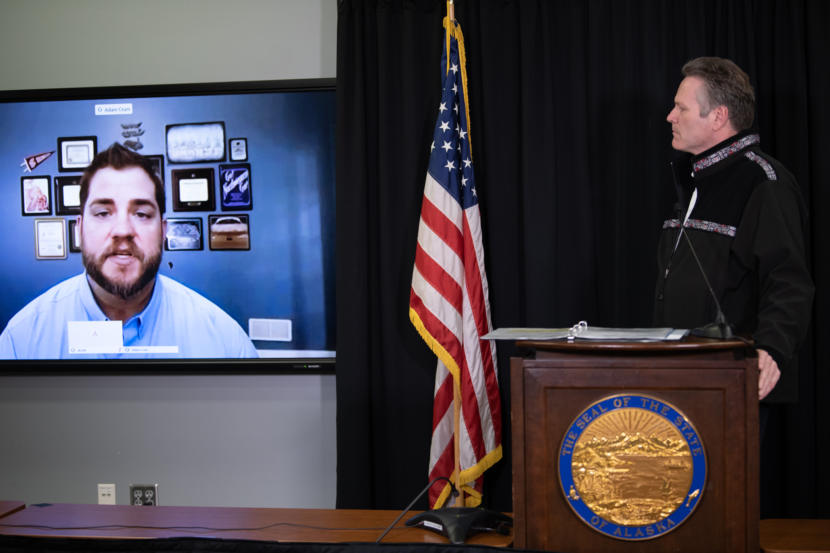
Alaska Department of Health and Social Services Commissioner Adam Crum, left, speaks at a news conference with Gov. Mike Dunleavy on April 9, 2020. In December, Dunleavy announced a plan to split the department into two. Some groups are concerned about the impact on the state’s foster care system. (Creative Commons photo by Alaska Governor’s Office)

Gov. Mike Dunleavy announced in December that his administration plans to split Alaska’s Department of Health and Social Services into two. Among many other impacts, that move would put the state’s foster care system in a new department. 

Tribal organizations, advocates for foster children and the largest state worker union are all voicing their concerns. 

The administration has emphasized that it’s aiming to improve outcomes for children and families by having two, more focused departments to provide oversight. The plan to separate a new Department of Family and Community Services from the Department of Health may also divide the Office of Children’s Services, which oversees foster care, into two offices. 

Several groups expressed concerns about the split to lawmakers at a mid-January hearing

Among these groups are Tribes that have been working with the state to implement a compact that gives Tribes more responsibility for child welfare. 

Richard Peterson is the president of the Central Council of the Tlingit and Haida Indian Tribes of Alaska, which has been working on the compact. 

“The time to find a new commissioner, directors and staff will be a challenge,” he said. “The state struggles to fill the vacancies currently, leaving many of our programs and families not receiving the attention they deserve.”

He said Tribes should have been consulted before the state rolled out the proposal, not after. He notes that most children in Alaska’s foster system are Alaska Native. 

“I think that will only get worse if we’re not involved,” he said.

Amanda Metivier advocates for foster children as the co-founder and director of the nonprofit Facing Foster Care in Alaska.  She said the state hasn’t provided evidence as to why children and families should have to deal with two offices. 

She said that the system is already confusing, and it’s hard to know which office will play what role. 

“And to then have to deal with multiple systems, I think could just be absolutely daunting,” she said.

Metivier said the plan wasn’t prepared in a spirit of collaboration with those involved in foster care. 

“There hasn’t been any effort to directly engage young people, the youth in that process,” she said.

A Department of Health and Social Services spokesperson said the idea for splitting the Office of Children’s Services into two offices “was brought forward as a potential way to build trust and begin to improve outcomes for the families and children” who receive state services.  

“The department is committed to working with our Tribal partners, community partners, advocacy groups, and those Alaskans that we serve directly to find solutions for improving our child welfare system in Alaska and better ways that we can assist and support families,” the department said in an email response to questions.

State officials have emphasized that they’re currently engaging with stakeholders and will consult with Tribes on potential changes to the Office of Children’s Services. They also said that splitting the department will not substantively change or impact the state-Tribal compact. 

Jake Metcalfe, executive director of the Alaska State Employees Association, said his union is concerned that the state is laying the groundwork for outsourcing children’s services jobs. 

“If this were to happen, this work would leave Alaska,” he said. “It would undoubtedly impact the quality of services, which are sensitive and nature and require local-based knowledge for the administration of services.”

Dunleavy could split the Department of Health and Social Services using an executive order. But an executive order can’t be used to privatize or outsource any state services. 

The executive order is expected  during the legislative session, with the goal of having it going into effect on July 1. 

Site notifications
Update notification options
Subscribe to notifications