State Government Reporter, Alaska Public Media & KTOO
State government plays an outsized role in the life of Alaskans. As the state continues to go through the painful process of deciding what its priorities are, I bring Alaskans to the scene of a government in transition.
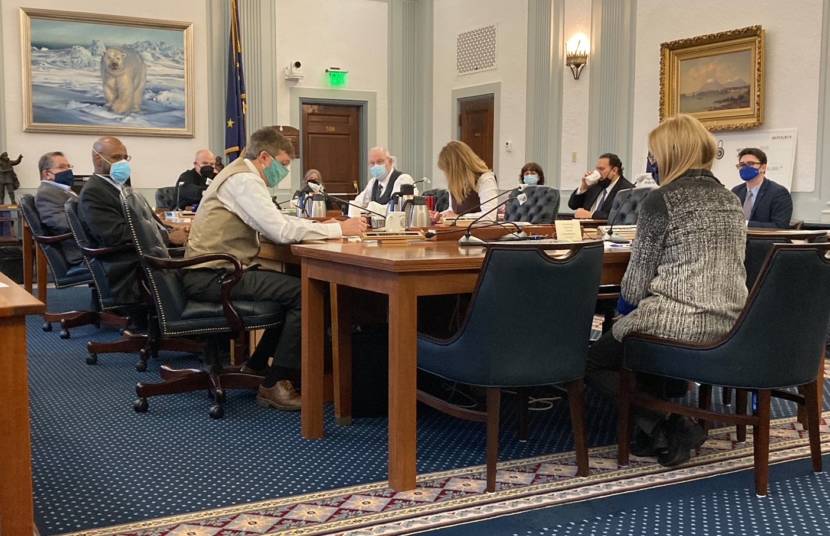
Members of the Alaska Senate Finance Committee attend a meeting on Feb. 4 in the Capitol. On Wednesday and Thursday, the committee is hearing public testimony on the proposed state budget. (Photo by Andrew Kitchenman/KTOO and Alaska Public Media)
The Alaska Senate Finance Committee is taking public testimony for the proposed state budget on Wednesday and Thursday.
Gov. Mike Dunleavy proposed roughly $5,000 in two Alaska Permanent Fund Dividend payments this year. But some lawmakers have expressed concern about how that would affect the future of the permanent fund’s earnings reserve.
While all Alaska residents can call in to any of the meetings, the committee prefers that residents from different parts of the state call in at these specific times:
Nome, Bethel, Utqiagvik, Unalaska and Dillingham residents were asked to call in on Wednesday morning. But they can also call in during the later meetings.
Kenai Peninsula Borough, Anchorage and Matanuska-Susitna Borough residents are asked to call in to the meeting at 1 p.m. on Wednesday.
The committee is asking Southeast, Prince William Sound and Kodiak residents to call in on Thursday at 9 a.m.
And for the 1 p.m. meeting on Thursday, Fairbanks, Interior and Copper River Valley residents are asked to call in.
The phone numbers are: (907) 563-9085 for calls from Anchorage; (907) 586-9085 for calls from Juneau; and (844) 586-9085 for calls from everywhere else. Written testimony can be emailed to finance.committee@akleg.gov.
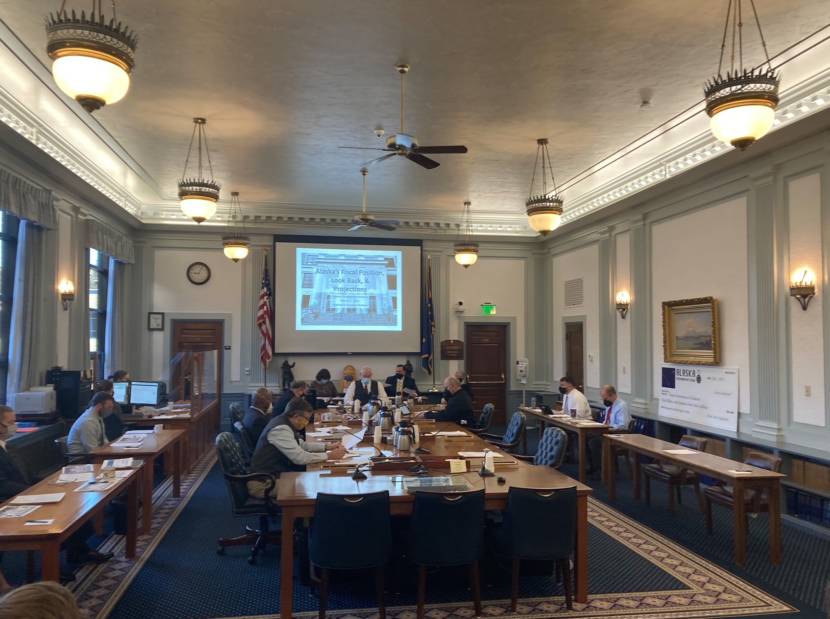
Senate Finance Committee members meet on March 4 in the Capitol. On Tuesday, Department of Revenue officials told committee members that the state’s revenue forecast improved by $791.3 million over this year and next year, compared with the fall forecast. (Photo by Andrew Kitchenman/KTOO and Alaska Public Media)
Alaska’s state government is forecast to receive $791.3 million more in revenue over this year and next year than was projected last fall.
The Department of Revenue released its spring forecast on Monday. It’s an update to the fall projection. The revenue forecast increased by $331.7 million through June and $459.6 million from July to June 2022.
On Tuesday, Revenue Commissioner Lucinda Mahoney described to the Senate Finance Committee the reason for the change.
“We’ve incorporated our actual results to date and have forecast an increase of revenues for the remainder of this fiscal year, with the primary driver being the price of oil,” Mahoney said.
The price of oil and oil production in the state are both expected to go up this year.
The oil price forecast rose $7.73 per barrel this year and $13 per barrel in 2020.
The state forecast is for an increase in production of 4,700 barrels per day this year and 20,100 barrels per day next year.
Even with the improved forecast, the state doesn’t have enough money to pay the full $2 billion in permanent fund dividends under the formula in a 1982 state law without drawing from other sources. Gov. Mike Dunleavy has proposed drawing more from the Alaska Permanent Fund’s earnings reserve account than was planned in a different law, enacted in 2018. His proposal has raised concerns about the long-term health of the fund.
As for the state’s other sources of income — which include taxes for non-oil corporate income, mining licenses, marijuana, tobacco, motor fuel, insurance premiums and fisheries — they’re expected to go up by $26 million more for this year than what was projected in the fall, but the outlook for next year is $17.8 million lower than what was in the fall forecast.
The change in these other income sources for both years was due to changes to corporate income taxes, which were affected by provisions of the federal CARES Act.
There was no change in the planned draw from permanent fund earnings since that amount is based on revenue growth before this year.
Department of Revenue Chief Economist Dan Stickel said the forecast has a high degree of uncertainty.
“Seeing in the news the COVID situation is presenting some room for optimism and [in] the global economy as well, there’s reasons for optimism, and I think our forecast reflects that,” he said.
One area where the forecast isn’t optimistic is tourism. The forecast assumes that large cruise ships won’t visit the state this year, and that there won’t be a full recovery in the state’s tourism sector until 2024. Stickel said the Department of Revenue hopes that the industry improves sooner than that.
The forecast doesn’t account for $1.13 billion that the state is set to receive from the American Rescue Plan Act — the latest relief law enacted earlier this month. Another $230 million is headed to Alaska municipal governments.
Bethel Democratic Sen. Lyman Hoffman said he expects the administration to consult with lawmakers before finishing its plans for how to spend that money.
“I’m looking forward to working with the administration to make sure that the input of the Alaska Legislature has its so-called fingerprints on the document before the expenditures happen,” said Hoffman, the only Democrat in the Senate majority caucus.
The Department of Revenue is waiting for guidance from the federal government on how it can spend the money.
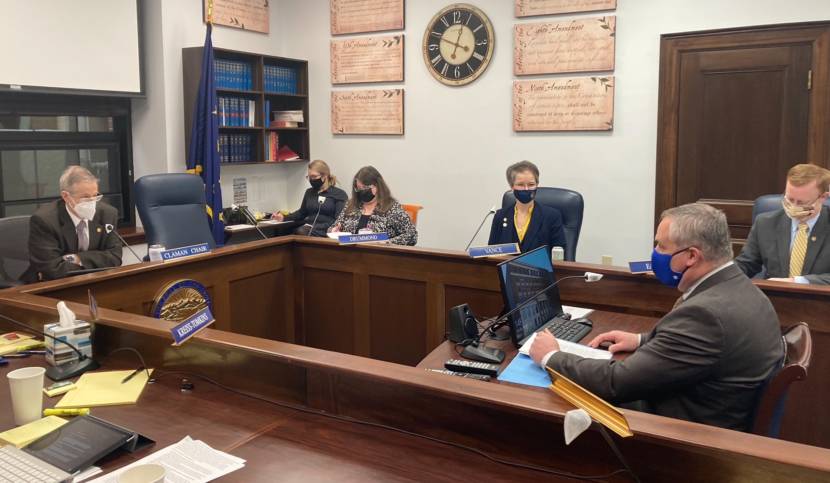
House Judiciary Committee Chair Rep. Matt Claman, D-Anchorage; an aide; Rep. Harriet Drummond, D-Anchorage; Rep. Sarah Vance, R-Homer; Attorney General Treg Taylor; and Rep. David Eastman, R-Wasilla, attend in Taylor’s confirmation hearing on Wednesday in the Capitol. (Photo by Andrew Kitchenman/KTOO and Alaska Public Media)
During his confirmation hearing on Monday, Treg Taylor said his first priority as Alaska’s attorney general is to end the state’s position as the worst for sex crimes.
“I truly believe that until this scourge is rooted out, and our mothers, wives, sisters and children feel protected and safe, we are hobbled as a state,” Taylor said.
He noted that the Department of Law’s budget request includes 10 new prosecutors and nine new support staff that would focus on sex crimes. He said this would allow prosecutors to focus more attention on each case. And he expressed an interest in holding a summit to discuss other ideas on how to reduce these crimes.
Taylor also said he would work to ensure that Department of Law workplaces feel safe and are free of harassment.
House Judiciary Committee members expressed disappointment with the amount of time it took for former Attorney General Kevin Clarkson to face consequences after sending 558 texts to a junior state employee in March 2020. Clarkson resigned in August when the Anchorage Daily News and ProPublica reported on the behavior.
Taylor said “good people sometimes do bad things.”
“I know Kevin very well and he’s a good friend of mine and I know him to be an honorable man,” Taylor said. “He himself would be the first to tell you that he is extremely embarrassed about what had occurred and what had happened and that it was inappropriate in the workplace.”
Sitka Democratic Rep. Jonathan Kreiss-Tomkins said he wouldn’t describe Clarkson’s behavior as at all honorable, nor would he say that Dunleavy’s office responded decisively.
Taylor also discussed how he would approach the ethics case of Ben Stevens, Gov. Mike Dunleavy’s former chief of staff, who recently left the administration to become a vice president for ConocoPhillips Alaska.
A state law prohibits former executive branch officials from working on issues they dealt with in state government for two years after they leave their jobs. The law requires waivers from this prohibition in cases where it wouldn’t harm the public interest. ConocoPhillips has said it doesn’t plan to have Stevens work on issues he worked on in the governor’s office.
Taylor said he expects Stevens to bring individual instances where he’s working in his new job on an issue he worked on in government to the Department of Law’s attention.
“If he encounters a question in his mind, he knows that he can contact the Department of Law any time within the next two years, and speak with our ethics attorneys on whether or not a waiver is needed in that specific situation,” Taylor said.
Committee chair Matt Claman, an Anchorage Democrat, expressed concern that Taylor would rely on Stevens to make the call.
“Isn’t it really not what Mr. Stevens thinks, but what the state thinks Mr. Stevens’ involvement was, in making a decision like that?” Claman said, citing the possibility of Stevens lobbying against an oil tax increase as an example.
Taylor said that if the state is aware of a potential ethics law violation, it would notify Stevens that he must stop working on an issue until he applies for a waiver.
The Alaska Public Interest Research Group has said Stevens’ exit circumvents the state’s ethics laws.
Taylor said he doesn’t plan to rely on blanket ethics waivers in the future, as has been the state’s practice in past cases.
The hearing ended with a discussion of the state’s recent string of legal defeats in major cases. Taylor said there were good legal arguments for each case, but whether he would have advised pursuing the cases is another matter. He said he is hopeful that the state won’t have a similar string of losing cases under his leadership.
The committee didn’t finish its confirmation hearing on Monday and plans to continue it, possibly as soon as later this week.
State Rep. Christopher Kurka of Wasilla left a House floor session on Monday morning after taking off his facemask.
House Speaker Louise Stutes told Kurka she preferred he leave.
In remarks the Wasilla Republican gave before he took off his mask, he described legislative leaders’ enforcement of COVID-19 safety rules as a “thinly veiled power play.” He said that leaders have not always followed these rules. He also noted that the Senate allows members to stand and take off their masks when they’re speaking, in contradiction of the rules.
“Let’s end this charade,” Kurka said. “COVID-19 is here to stay. No measures we take are going to stop it, no matter how repressive a course, or unconstitutional.”
Kurka also expressed doubt that the federal Centers for Disease Control and Prevention’s support for wearing masks is based on science.
Anchorage Democratic Rep. Chris Tuck spoke in favor of the COVID-19 safety rules, comparing them to airlines’ requirement that passengers wear seat belts during takeoff.
And Juneau Democratic Rep. Sara Hannan said Kurka’s speech seemed to impugn the motives of other legislators, in violation of legislative rules.
Kurka became the second Alaska legislator who intentionally violated the rules requiring masks during floor sessions.
Sen. Lora Reinbold, an Eagle River Republican, has worn a clear face shield with gaps around the edges that didn’t comply with legislative rules. On Wednesday, Senate leaders said she would be prohibited from most parts of the Capitol until she complied with COVID-19 safety rules.
On Monday, Reinbold wore a clear face shield with padding around the face that the Senate majority press office described as complying with the rules. In response, she was allowed to sit at her desk on the floor during the session for the first time since leaders started enforcing the rules.
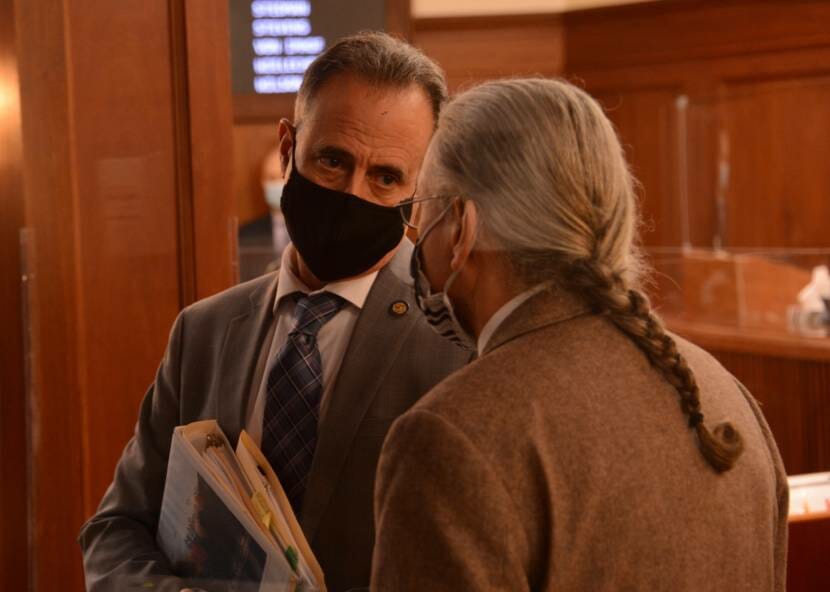
Alaska Senate President Peter Micciche, R-Soldotna, talks to Senate Minority Leader Tom Begich, D-Anchorage, before the start of a floor session on Wednesday in the Alaska State Capitol in Juneau. On Thursday, Micciche talked about how his senior aide’s hospitalization with COVID-19 has given him a new perspective on the disease. (James Brooks/Anchorage Daily News via AP, Pool)
A senior aide to Alaska Senate President Peter Micciche has been hospitalized with COVID-19. Micciche said the illness has given him a new perspective on the threat the disease poses to the people working in the Capitol.
Konrad Jackson became seriously ill from COVID-19 and has been at Bartlett Regional Hospital in Juneau for several days.
The hospital confirmed that Jackson is a patient but wouldn’t answer other questions. Senator Micciche declined to identify Jackson by name. But he says watching a close aide and friend become ill has changed how he thinks about COVID-19.
“When we had the spike of the cases in the building, it started to worry me,” said Micciche, a Soldotna Republican. “But … when it hits someone who I’m that close to, and I hear that person who is always upbeat, always positive, always, you know, raring to go, and you hear him struggling and you realize that we’re playing with people’s lives by not taking this seriously.”
He said there’s only one person in the Capitol who isn’t: Eagle River Republican Sen. Lora Reinbold. On Wednesday, Micciche and other legislative leaders banned her from most parts of the Capitol until she starts complying with COVID-19 safety rules.
Those rules require that everyone in the Capitol wear a facemask. She has worn a transparent face shield that doesn’t comply with that rule.
The rules also require that everyone take a COVID-19 rapid test every four or five days and have their skin temperature screened every day they enter the Capitol. Reinbold hasn’t done that, either, according to legislative leaders.
Micciche said it’s frustrating.
“Deciding to not follow the rules and put people at risk for a few Facebook likes is not my idea of responsible behavior, especially when you’re willing to wear a mask to fly here, you’re willing to wear a mask to go on a school tour,” he said.
Reinbold wasn’t immediately available for an interview. She has defended her positions on social media and said she submitted negative test results to leadership. She has questioned the scientific and public health response to COVID-19 and has invited critics of the response to testify before the Senate Judiciary Committee, which she chairs.
Micciche said he had a different view of COVID-19 before the session.
“When they first made the rules, I thought they were over the top,” he said. “I’m from the Kenai, right? I mean, we’ve got the lowest case count for a large community in the state. We’ve been really low for a long time.”
Now he’s responsible for enforcing the rules. And he’s taking it seriously.
“We’re going to do our part to get through this session, keeping people safe,” he said. “And if folks can’t follow the rules, they will not be here.”
Since Feb. 24, Rep. Mike Cronk, a Tok Republican, and six people who work in the building have tested positive. In addition, 22 people who had close contact with those who tested positive have had to be in quarantine. Currently, Jackson is one of seven staff members who are outside of the Capitol after either testing positive or having close contact with someone who has.
Micciche said he and other legislative leaders are enforcing COVID-19 safety rules to protect staff members and their families.
“You have people choosing between their parents or grandparents and their job,” he said. “This isn’t like anywhere else in Alaska. We are in a tight place and we’ve got a set of rules. And those rules are there to protect the people in the building and their families when they go home at night.”
Micciche said Jackson’s roommate works for a legislator who tested positive — the only one who has recently is Cronk. As soon as that legislator tested positive, Jackson stayed out of the Capitol, before he knew whether he had had close contact with anyone who was positive. But he still contracted the disease.
Micciche said Jackson is struggling, but he has been working on exercises to build up his lung strength.
Micciche added that he’s praised the care at Bartlett.
Bartlett has admitted 53 patients diagnosed with COVID-19 over the past year, according to a hospital spokesperson. One patient has died while being treated by Bartlett. A total of five Juneau residents have died from the disease, including people who died outside of the city.
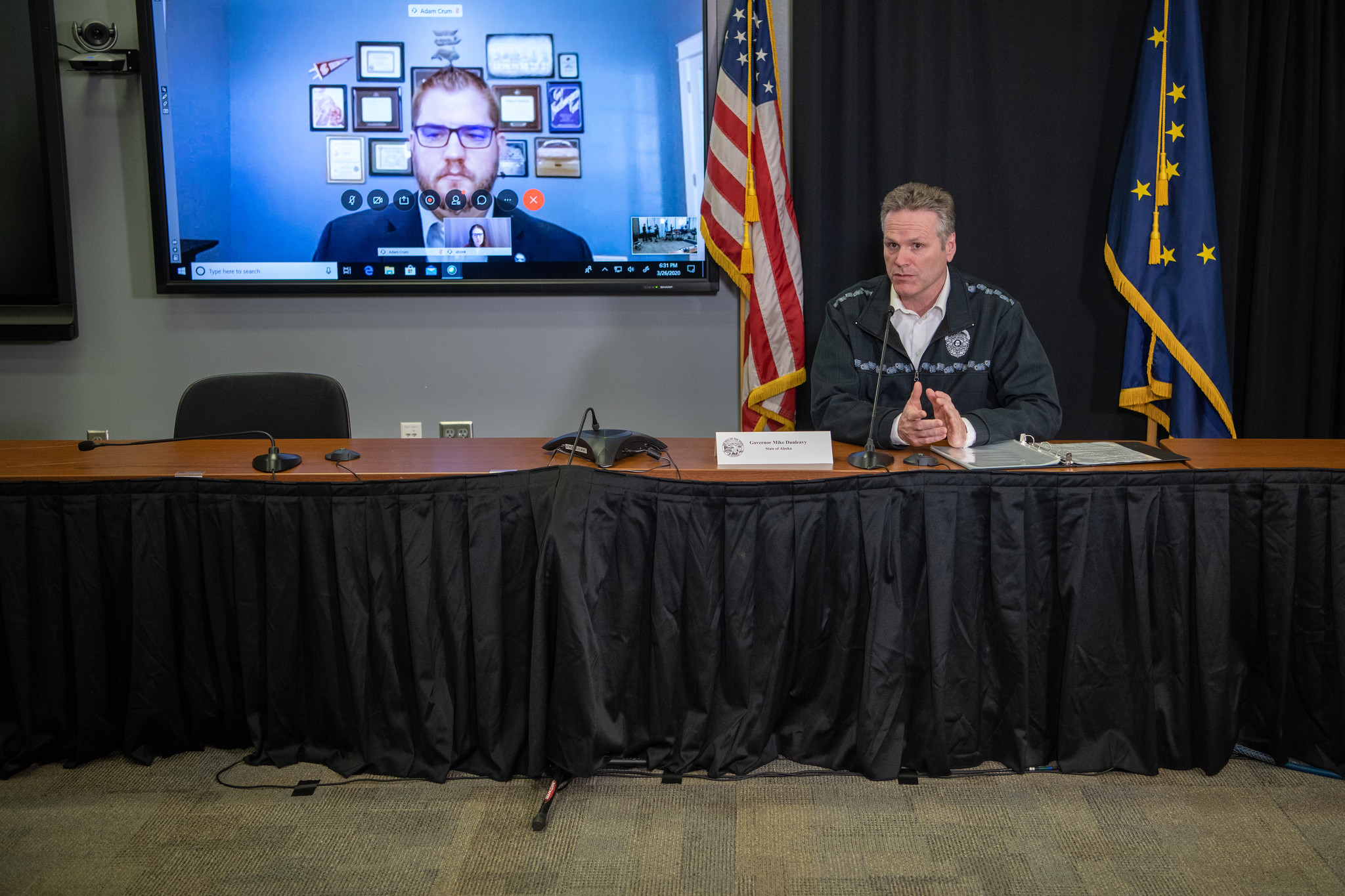
Alaska Gov. Mike Dunleavy speaks at a news conference on COVID-19 in Anchorage, Thursday, March 26, 2020. Health and Social Services Commissioner Adam Crum spoke remotely and appeared on a TV screen to the governor’s right. (Creative Commons photo courtesy Alaska Governor’s Office)
Dunleavy sent a one-sentence letter to Senate President Peter Micciche and House Speaker Louise Stutes on Thursday morning withdrawing the executive order.
Members of the Alaska House of Representatives had prepared a resolution that would have blocked the order, which would have led to two departments: a Department of Health and a Department of Family Services.
“There was a lot of uncertainty and not a lot of evidence or clarification for how this reorganization would work on the ground for Alaskans who are utilizing the services,” said Bethel Democratic Representative Tiffany Zulkosky.
Zulkosky noted tribal organizations and other stakeholders raised concerns that they weren’t included in planning for the split before Dunleavy announced it.
In December, Dunleavy and Department of Health and Social Services Commissioner Adam Crum said the department was too large and that splitting it would improve services.
Tribal organizations, advocates for foster children and the largest union for state workers had expressed concern about the plan. And a lawyer for the Legislature said portions of the executive order appeared to conflict with state law and faced potential legal challenges.
Anchorage Democratic Rep. Liz Snyder said she’s interested in hearing more ideas from the administration on potential changes to the Department of Health and Social Services. But she said the executive order was “a bit premature,” and that more time would have allowed the state to address legal and budget questions, and to engage stakeholders regarding the effect it would have on state programs.
“It is our biggest department. It has a very large budget,” Snyder said. “And, yes, there may be value in having smaller units to focus in.”
Wasilla Republican Representative Cathy Tilton says she hoped the executive order would have led to lower state spending.
“I think that some of the ideas for the reasoning behind breaking the department into two departments might have had some merit. But I can also understand that we are a less-government-is-better [party], and so I will look forward to seeing what the governor and the administration may come up with in the future.”
A joint session would have met to consider the executive order, and a simple majority of 31 combined senators and House members would have been able to block it.
This story has been updated to include lawmakers’ comments.
Close
Update notification options
Subscribe to notifications
Subscribe
Get notifications about news related to the topics you care about. You can unsubscribe anytime.