State Government Reporter, Alaska Public Media & KTOO
State government plays an outsized role in the life of Alaskans. As the state continues to go through the painful process of deciding what its priorities are, I bring Alaskans to the scene of a government in transition.
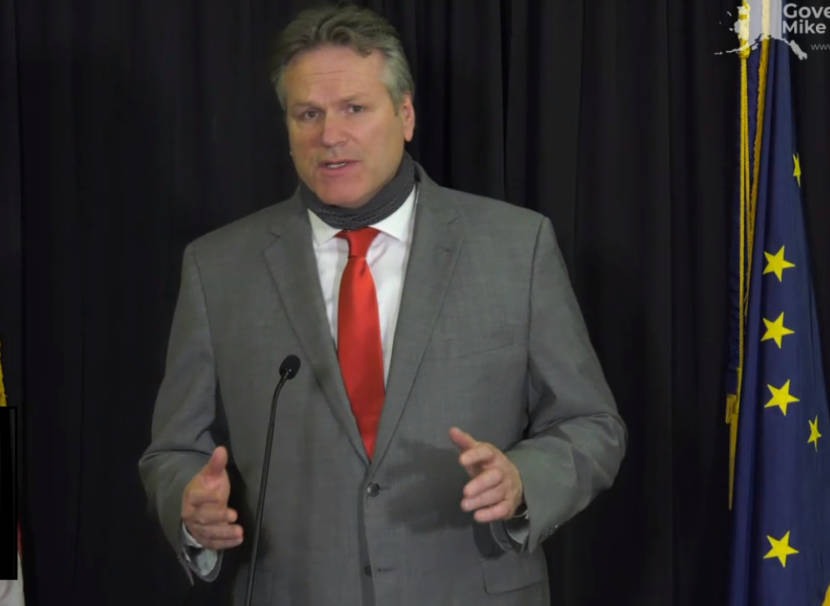
Gov. Mike Dunleavy speaks about his budget proposal during a news conference in December. On Wednesday, he sent a letter to all legislators saying the state should not return to having a disaster declaration. (Screen capture of video stream from the governor’s office)
Alaska Gov. Mike Dunleavy sent a letter to all legislators on Wednesday saying the state should not return to having a disaster declaration. He instead wants the Legislature to pass a more limited bill.
“To reenter a state of disaster without apparent catalyst would irreparably harm the trust Alaskans have placed in us,” he wrote. “Further, it could lead travelers to incorrectly assume that Alaska’s situation is deteriorating, jeopardizing the livelihoods of those working in one of our largest and hardest-hit industries.”
Dunleavy was referring to tourism. In the letter, he said tourism and recreation businesses are gearing up for the summer. He also noted that airline capacity for the state has increased, small cruise ships are operating; and “even our most cautious” municipalities are lightening restrictions.
Hospital leaders opposed ending the disaster declaration, in part because it led to the end of mandatory COVID-19 testing for air passengers. And they have said that not mandating tests for travelers contributes to the spread of the disease in the state.
Dunleavy had proposed a bill to extend his disaster declaration before it expired on Feb. 14. The House did not organize before it expired.
After the declaration expired, Dunleavy said he no longer wanted to have a disaster declaration. He wants a limited bill that would allow the state to allocate and distribute COVID-19 vaccines; provide limited liability to health officials responding to the pandemic; continue enhanced telemedicine; and authorize the state to receive federal funding, such as $8 million per month in family food aid.
The House could consider a bill as soon as Thursday that would extend the disaster declaration, including making it retroactive to the expiration.
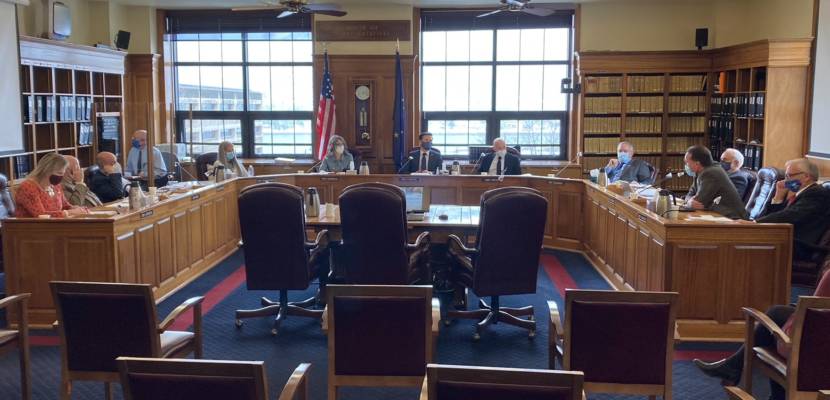
The Alaska House Finance Committee discusses the bill to extend Gov. Mike Dunleavy’s disaster declaration on Monday. The representatives, from the left, are: DeLena Johnson, R-Palmer; Adam Wool, D-Fairbanks; Andy Josephson, D-Anchorage; an aide; Sara Rasmussen, R-Anchorage; Kelly Merrick, R-Eagle River; Neal Foster, D-Nome; Dan Ortiz, I-Ketchikan; Bryce Edgmon, I-Dillingham; Ben Carpenter, leaning forward, R-Nikiski; Bart LeBon, R-Fairbanks; and Steve Thompson, R-Fairbanks. (Photo by Andrew Kitchenman/KTOO and Alaska Public Media)
After Juneau resident Ted Merrell had lung cancer surgery in early February in Seattle, his wife Lucy Merrell hoped he would be able to have his follow-up scans done in Juneau. Ted’s surgeon said that wasn’t possible.
“He said, ‘Unfortunately, because Alaska doesn’t have the COVID emergency in place any longer, he cannot do telemedicine with Alaska residents,’” Lucy Merrell said.
That’s because Gov. Mike Dunleavy’s disaster declaration was allowed to expire on Feb. 14. The House hadn’t organized in time to pass an extension Dunleavy proposed.
Lucy Merrell said that means Ted has to fly down to Seattle for the scans.
More than five weeks after the declaration expired, Dunleavy and some legislators disagree with other lawmakers over whether to bring it back.
Dunleavy said the COVID-19 situation in Alaska has improved enough that a full disaster declaration is no longer necessary. On March 9, he described what he wants instead.
“I don’t think we need to be looking at a full-blown health emergency, health declaration,” he said, crediting Alaskans’ behavior with making that possible.
He added: “We’ll work with the Legislature to get a bill passed that would be very limited and very focused.”
Republican legislators — including some in the Senate majority and House minority caucuses — have worked with Dunleavy’s administration on legislation that would be more limited. It would support the telemedicine that patients like Ted Merrell benefit from; give the administration the authority to allocate and distribute vaccines; and allow the state to accept federal relief, like $8 million a month in food assistance to families.
But the delays have been more than frustrating for groups that never wanted to see the disaster declaration end, like Alaska’s hospitals and most municipalities.
Jared Kosin has been hearing that from hospital leaders as president and CEO of the Alaska State Hospital and Nursing Home Association. And these leaders are telling Kosin it makes no sense to give up some of the governor’s disaster declaration powers during the pandemic — especially the mandate that all arriving air passengers be tested for the coronavirus.
“I understand that Alaskans are fatigued and I completely respect that — and we’re fatigued,” he said. “But if you just take a step back and look at what’s the most logical, efficient way to deal with this, we’re not taking that path right now.”
Kosin said it’s inevitable that fewer passengers are being tested without the mandate. And hospitals are concerned that’scontributed to COVID’s spread in communities like Petersburg, which experienced an outbreak after the declaration expired.
“And then ask yourself, is that productive for getting us through the pandemic and back to a fully functional, open economy?” Kosin said. “And I think the answer is: ‘No, it is not productive. It only has the potential to set us back.’”
He added that hospital executives believe the travel testing mandate is one of the reasons Alaska has the third-lowest death rate from COVID-19 among the states.
Hospitals did get some good news recently — federal officials say the state doesn’t have to be operating under a disaster declaration for hospitals to have the flexibility to keep doing things differently than in non-COVID times would violate federal regulations, like maintaining a separate space in emergency departments for COVID patients.
Alaska Municipal League Executive Director Nils Andreassen said many municipalities want to have a declaration in place. He said it’s harder for local leaders to set effective health measures when people are hearing a different message statewide.
“Can we work together well across levels of government and communicate to Alaskans a common message?” he said. “Right now, it doesn’t seem to be occurring in a way that’s very effective.”
At least some Republican legislators have said they’re hearing from constituents that they don’t want the state to be under a disaster declaration.
Nikiski Republican Rep. Ben Carpenter said the bill advancing in the House attempts to force Dunleavy into a disaster declaration he doesn’t want.
“I think that is a mistake,” he said on Monday after state health officials testified. “It is a bad precedent to set. It is not necessary, as we have heard laid out by members of his administration, to address the COVID crisis.”
As the two chambers consider different bills, some Alaskans just want the issue resolved.
Lucy Merrell in Juneau said doing that sooner would have saved her and her husband Ted a lot of aggravation — and money on airfare to Seattle and a hotel.
“I don’t care who does it. I just want to get it done and fixed,” she said.
The House could pass the bill that would extend the disaster declaration in the coming days. The Senate Finance Committee is scheduled to hear the Senate version of the legislation, Senate Bill 56, on Wednesday.
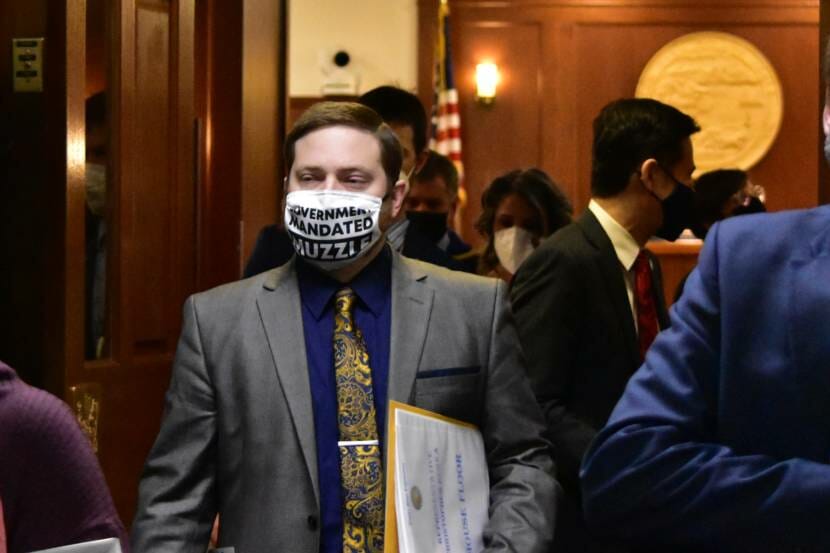
Rep. Christopher Kurka, R-Wasilla, leaves the chambers of the Alaska House of Representatives on Friday after an hour of delays concerning the wording on his mask. (Peter Segall / Juneau Empire via AP, pool)
The Alaska House of Representatives’ floor session on Friday was cut short over a dispute about the message on a member’s face mask.
Wasilla Republican Rep. Christopher Kurka wore a mask with the words “Government Mandated Muzzle” written on it.
Today’s session was delayed by an hour, with House leaders talking with Kurka at various times during the delay.
House leaders told Kurka that the mask was not appropriate and offered him a plain mask, which he declined, according to a House majority caucus spokesperson. The majority includes 15 Democrats, four independents and two Republicans.
On Monday, Kurka criticized the rule that he had to wear a mask during the floor session, before taking his mask off and leaving the session. He later wore the mask with the message on it during committee meetings.
House leaders told the leadership of the Republican minority caucus earlier this week that Kurka wouldn’t be allowed to wear the mask during the floor session, according to the majority spokesperson.
The leaders wouldn’t hold the session as long as Kurka refused to comply.
House leaders consider the mask to violate standards that members adhere to a professional business attire dress code. These standards also prohibit members from having drinks with logos on them during floor sessions. These standards were conveyed to members before this year’s legislative session, but they aren’t written in the Legislature’s rules.
The House is scheduled to hold another floor session on Saturday.
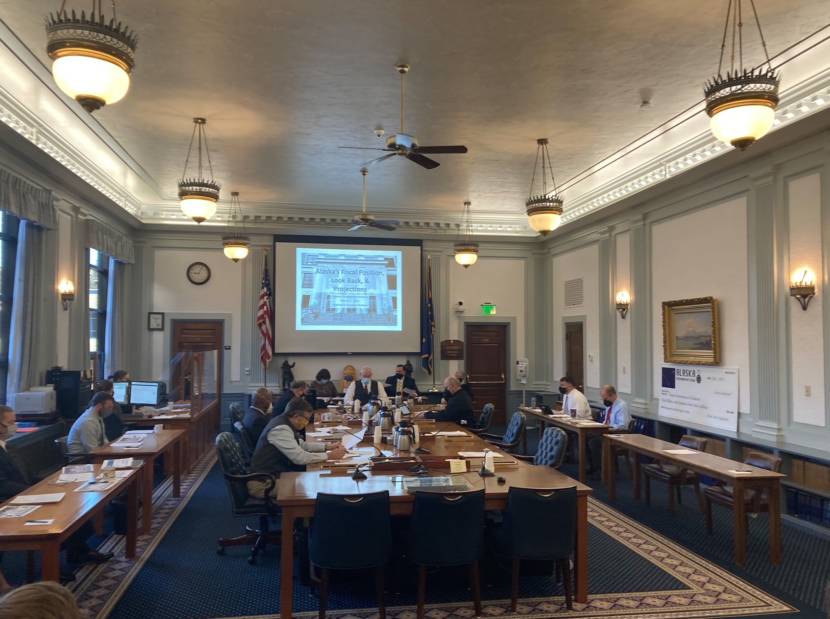
Senate Finance Committee members meet on March 4 in the Capitol. On Wednesday and Thursday, the committee heard public testimony on the proposed state budget. (Photo by Andrew Kitchenman/KTOO and Alaska Public Media)
Most Alaskans who provided testimony this week on the proposed state budget supported stable or increased spending on state programs.
The Senate Finance Committee heard roughly four hours of public testimony from nearly 100 people on Wednesday and Thursday.
By a ratio of nearly six to one, more people testified in favor of spending on government programs compared with people favoring budget cuts. Gov. Mike Dunleavy’s budget proposal includes $6.3 billion in spending on the portion of the budget directly controlled by the Legislature. That’s $1.27 billion more compared with last year, driven by Dunleavy’s proposal for $2 billion in permanent fund dividends. Excluding PFDs and one-time COVID-19 expenses, the budget includes a $79 million reduction, according to the nonpartisan Legislative Finance Division.
Most offered support for specific state programs like the Alaska Marine Highway System and the community assistance program, through which the state pays municipal governments.
Amy Lujan of Juneau spoke more broadly in favor funding the budget. She is the executive director of the Alaska Association of School Business Officials.
“For several decades now, past legislators have become very skilled at kicking the can down the road,” she said. “It seems like there’s always something to save us. It could be savings accounts to drain, an influx of oil revenue, and now, federal pandemic relief money.”
Lujan said she supported a broad-based tax.
Ouzinkie Mayor Elijah Jackson was among several local officials who testified. He said reducing state funding for community assistance is “a punch in the gut” to rural communities.
But others said they would like to see lower spending and the full permanent fund dividends proposed by Gov. Mike Dunleavy.
Miranda Nelson of Nikiski said she supports Dunleavy’s plan for PFDs based on the formula in state law.
“We want a smaller and smarter government that works for us,” she said.
There is still a lot of work to do on the budget, including another opportunity for public testimony.
In the other legislative chamber, House Finance Committee co-chair Rep. Neal Foster, a Nome Democrat, said his committee is tentatively aiming to hear public testimony on April 1 through April 3. The budget could reach the House floor in mid-April, he said.
That puts the Legislature on schedule to have a session of more than 90 days again. Not counting two sessions in which the Legislature immediately went into a special session, it’s only had two 90-day sessions since a voter-passed initiative went into effect in 2008 saying that sessions should be 90 days. Friday is the 60th day of the session.
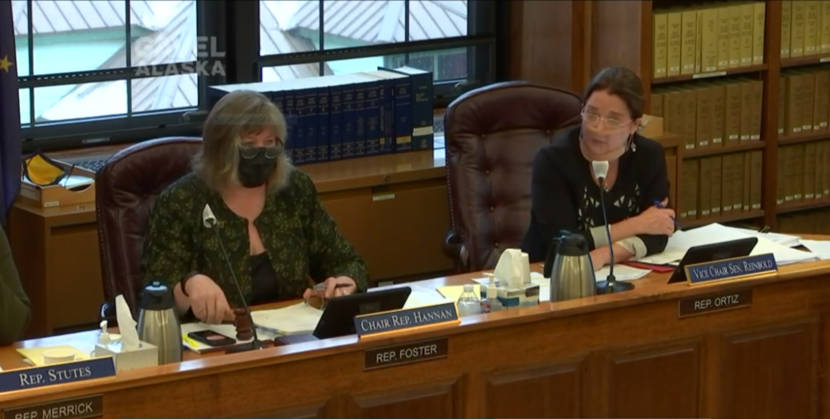
Rep. Sara Hannon, D-Juneau, left, and Sen. Lora Reinbold, R-Eagle River, discuss extending the Legislature’s contract with Beacon Occupational Health and Safety Services during the Legislative Council meeting on Wednesday in the Capitol. Hannan is the council chair and Reinbold is the vice chair. (Gavel Alaska screen capture)
The contract for Beacon Occupational Health and Safety Services to test and screen everyone who enters the Capitol was extended by the Legislative Council on Wednesday.
The extension through June 30 also adds $1.5 million to pay for the contract, which was originally budgeted for up to $1 million. But the federal CARES Act could provide up to $4 million to pay for Capitol safety.
Kodiak Republican Sen. Gary Stevens praised the work done through the contract.
“We’ve been very successful in controlling COVID in this building, through all of the things that we’ve been doing with Beacon,” said Stevens, who chaired the council last year when it approved the contract.
Some Republican members repeatedly attempted to open a discussion of whether the council should change the COVID-19 safety policies.
The policies say that everyone in the Capitol is supposed to wear masks in public spaces, undergo a rapid COVID-19 test every four or five days, and be screened on entering the building every day.
Wasilla Republican Sen. Mike Shower asked for the opportunity to weigh in on those policies before extending the contract.
“It’s kind of the cart before the horse to me,” he said. “I’m being asked to approve a budget extension over policies that I haven’t had a chance to put input into yet. I haven’t had a chance to discuss them. I haven’t had a chance to ask questions.”
A discussion on the policies is set to happen at the council’s next meeting, which hasn’t been scheduled.
The council also retroactively approved allowing the contractor to administer COVID-19 vaccinations since January to lawmakers and staff.
Beacon has provided at least one shot to 240 people who work in the Capitol. Others have been vaccinated by different providers.
The contract extension passed, 11 to 3. The no votes were Republican Sens. Lora Reinbold of Eagle River and Shower and Rep. Cathy Tilton of Wasilla. The approval of vaccinations by Beacon passed 13 to 1. Reinbold was the only no.
Reinbold said she’s concerned about whether the council would be liable for adverse reactions to the vaccines. The federal Centers for Disease Control and Prevention says they’re safe and effective, and that there is no evidence that vaccines have contributed to any deaths. More than 400 million COVID-19 shots have been given around the world, including more than 113 million in the U.S.
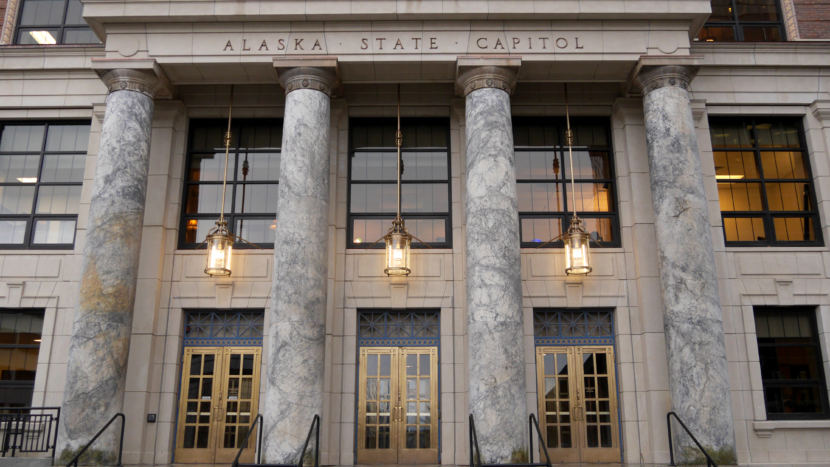
The third person this week who works in the Alaska State Capitol received a positive COVID-19 test. The photo was taken in January 2017. (Photo by Skip Gray/360 North)
An Alaska House of Representatives staff member on Wednesday became the third person who works in the State Capitol with a positive COVID-19 test this week.
The person with the new positive test had close contact with two people who are now in quarantine, according to the Legislative Affairs Agency which maintains the Capitol building.
Earlier this week, two Senate staffers had positive tests, and 14 people who work in the Capitol are in quarantine. Two of those in quarantine are House members.
House Speaker Louise Stutes, a Kodiak Republican, wrote an email on Wednesday morning informing House members and staff of the newest positive test.
“Stay safe everyone and please make good decisions,” she wrote.
In addition, a Senate staff member and a House staff member who tested positive earlier this month continue to isolate themselves away from the Capitol.
There have been 10 people in the Capitol with positive tests since Feb. 24. Republican Rep. Mike Cronk of Tok is the only legislator with a positive test during that time.
The total of 21 people who have to stay away from the Capitol is the highest since March 4.
Everyone who enters the Capitol is supposed to undergo a rapid COVID-19 test every four or five days.
In a meeting late on Wednesday afternoon, the Legislative Council planned to consider extending the contract for the company that does the testing and daily temperature screening — Beacon Occupational Health and Safety Services.
Close
Update notification options
Subscribe to notifications
Subscribe
Get notifications about news related to the topics you care about. You can unsubscribe anytime.