Andrew Kitchenman

State Government Reporter, Alaska Public Media & KTOO

State government plays an outsized role in the life of Alaskans. As the state continues to go through the painful process of deciding what its priorities are, I bring Alaskans to the scene of a government in transition.

Gov. Dunleavy announces national ads to support Alaska tourism, says state in ‘death grapple’ with CDC

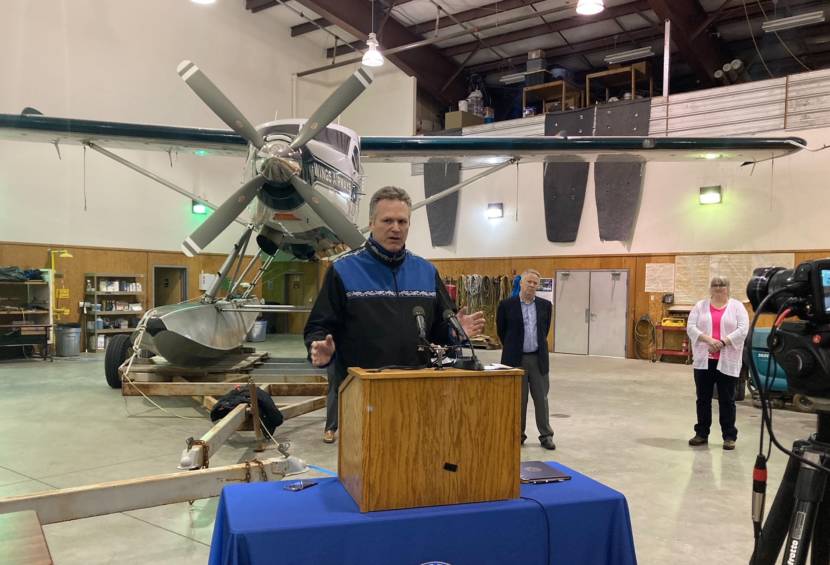
Alaska Gov. Mike Dunleavy speaks about his hopes for holding a summer cruise season this year in a news conference in the hangar of Wings Airways in Juneau, Alaska, on April 9, 2021. Holland America executive Ralph Samuels and Juneau Mayor Beth Weldon are behind Dunleavy. (Photo by Andrew Kitchenman/KTOO and Alaska Public Media)
Gov. Mike Dunleavy speaks about his hopes for holding a summer cruise season this year in a news conference in the hangar of Wings Airways in Juneau on Friday. Holland America executive Ralph Samuels and Juneau Mayor Beth Weldon are behind Dunleavy. (Photo by Andrew Kitchenman/KTOO and Alaska Public Media)

Gov. Mike Dunleavy announced on Friday that Alaska’s state government will conduct a national advertising campaign to support the tourism industry this summer.

The governor, a Republican, repeated his call for the federal Centers for Disease Control and Prevention to allow a cruise season. 

“This is an economic death grapple right now with individuals that are focused on health,” he said at a news conference at the hangar for Wings Airways, which flies cruise passengers for sightseeing around Juneau.

He said Alaska has proven that it can keep visitors and state residents healthy during the pandemic. 

“We know what we’re doing here,” he said. “And I’m not saying this out of arrogance. I’m saying: Look at the data. Look at the results. Look at what happened with the fishing industry. Look what happened with the mining industry. Look what happened with the oil industry.”  

The CDC’s position is just one federal issue that could prevent cruise ships from coming to Alaska. Another is a federal law that requires cruise ships headed to Alaska to stop in Canada, which won’t allow stops until next year.

Dunleavy signed a resolution asking Congress and President Biden to exempt Alaska from the law. 

Juneau Democratic Sen. Jesse Kiehl sponsored the measure, Senate Joint Resolution 9. He said the cruise season can happen without any safety shortcuts. 

“The simple fact is that this is a live-or-die moment for the economy of a huge portion of our state,” he said.

Dunleavy’s office said tourism businesses will receive federal funded relief grants. 

The governor said details of the tourism plan will be announced next week, including how he’s proposing to fund the aid. 

Dunleavy said Lt. Gov. Kevin Meyer will meet with businesses and community groups to gather input on what they need.

Juneau tourism business leaders spoke at the news conference about the effect the shutdown is having on them. 

Reecia Wilson, who owns the Hangar on the Wharf and other Juneau restaurants, said that while all Alaska restaurants benefit from visitors, 75% of her business comes from either cruise passengers or seasonal tourism workers. 

“The difference here in Juneau is our business model — and the infrastructure that we developed over the last 25 years — relies on what I call a cruise-dependent market,” she said. 

Juneau Mayor Beth Weldon said the city stands to lose $26 million in revenue without a cruise season. 

“The collateral business damage is devastating,” she said.

A representative for Holland America said that even if a wave of a magic wand removed all obstacles for a cruise season, it would still take until at least July 1 for cruises to start. 
Bill would rename, add voices to state Alaska Native language council

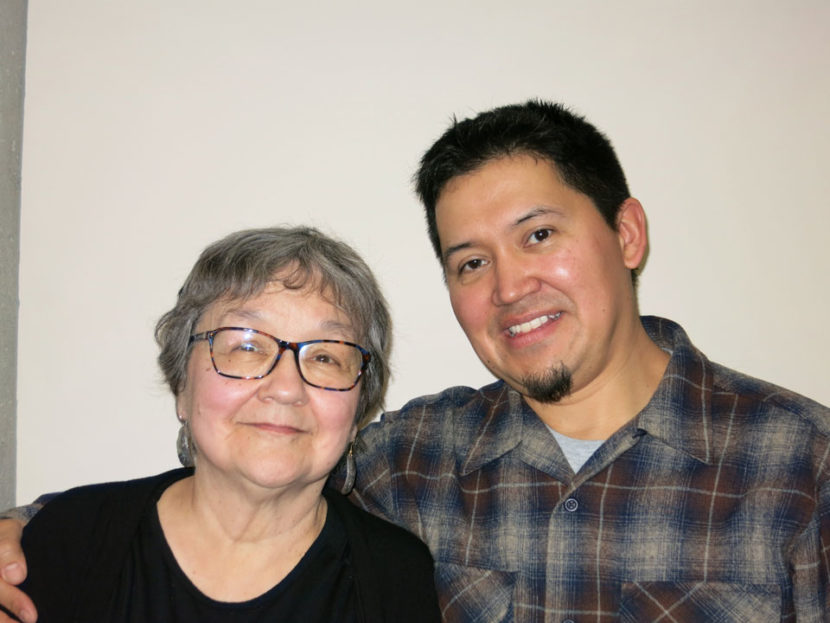
Ernestine Hayes and Lance Twitchell.
Ernestine Hayes and Lance Twitchell pose for a photograph in 2016, when they participated in an oral history project. On Tuesday, Twitchell testified in support of a bill making changes to a state council on Alaska Native languages. (Photo courtesy Juneau Public Library)

A bill advancing in the Legislature would rename a state council on Alaska Native languages and expand its membership. House Bill 47 would rename the Alaska Native Language Preservation and Advisory Council as the Council for Alaska Native Languages. 

Members of the House Special Committee on Tribal Affairs heard from bill supporters on Tuesday

X̱’unei Lance Twitchell, a council member and Tlingit language scholar, said the Legislature should do all that it can to support the 21 Alaska Native languages that are spoken today. 

“But by my estimations, and the estimations of language experts across the state, over half of them may have fewer than 10 speakers remaining, and we’re only talking about incremental change or only toeing a line that does keep us in a death spiral,” Twitchell said.

Twitchell said the word “preservation” should be taken out of the council’s name because it is trying to revitalize languages, not just preserve them. 

The bill would also add two members to the council, expanding it from five to seven members. Supporters say this would help the council represent more of the diversity of Alaska Native languages. 

Twitchell said cultural genocide led to the languages’ decline. 

“What kind of humans are we if we stand upon a foundation of racism and allow systems of communication that are tens of thousands of years old to be lost?” Twitchell asked the committee.

The council produces a report every other year. The report published last year encourages programs to immerse students in Alaska Native languages, among other steps. 

The committee voted to advance the bill to the House Finance Committee.

In letter to White House, Gov. Dunleavy cites $3 billion loss to Alaska from no cruise ship season

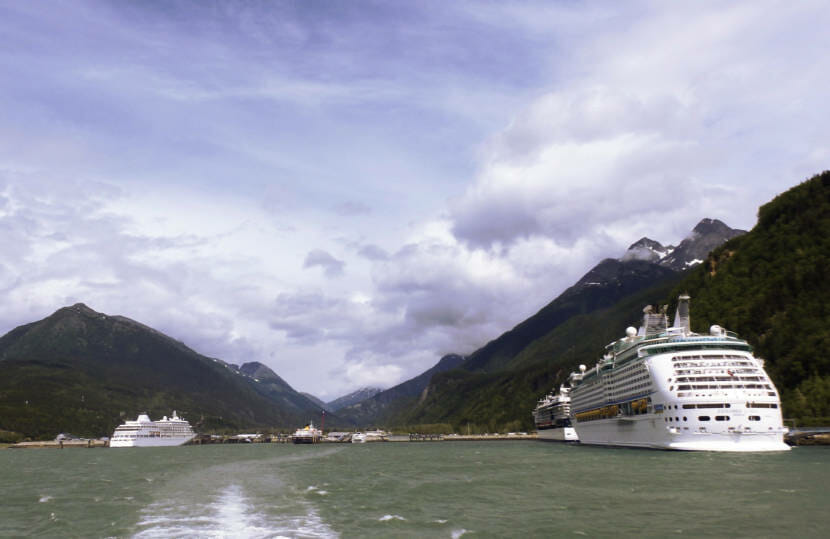
Cruise ships dock in Skagway’s port in pre-pandemic times. On Thursday, Alaska Gov. Mike Dunleavy sent a letter to an advisor to President Joe Biden about the cost of lost cruise seasons. (Photo by Emily Files/KHNS)

Gov. Mike Dunleavy sent a letter to an adviser to President Joe Biden on Thursday asking for the Centers for Disease Control and Prevention to allow a summer cruise season.

Along with the letter to Jeffrey Zients, the White House’s coronavirus response coordinator, Dunleavy sent a report that says Alaska’s economy would lose $3 billion each year if there is no cruise season. Port and cruise-line-related communities have lost more than 22,000 jobs compared with the year before the pandemic.

Alaska Department of Commerce, Community, and Economic Development Commissioner Julie Anderson acknowledged that it would be challenging for cruise ships and communities to ramp up quickly if a cruise season were allowed. But she said she’s spoken to cruise industry members who said there still could be Alaska cruises in August or September.

“Our communities are suffering so tremendously that anything will help,” she said. “To be able to have something to help you offset (costs) to help you get through the winter — to give you hope for the next season — I think would just be immeasurable. It would be wonderful to be able to have that.”

The letter did not address a federal law, the Passenger Vessel Services Act, that requires cruise ships coming to Alaska to stop in Canada. The Alaska Senate passed Senate Joint Resolution 9 on Wednesday, asking Congress and Biden to exempt Alaska-bound ships from that requirement. 

Supreme Court rules in favor of Gov. Dunleavy in case over unconfirmed appointees

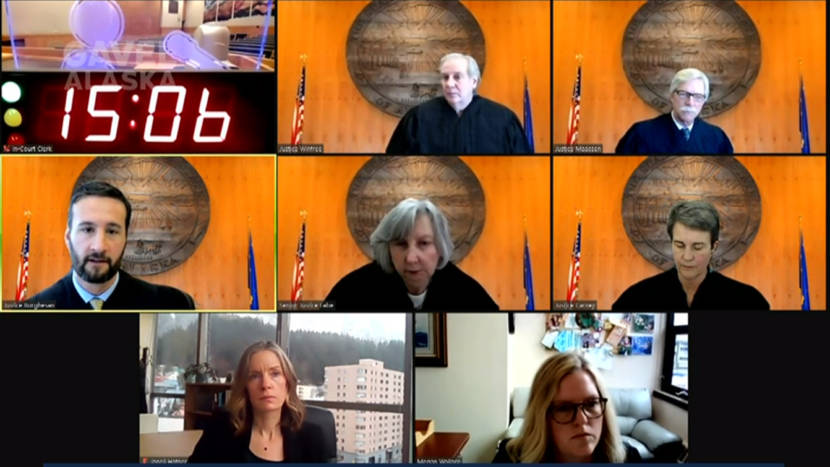
The Alaska Supreme Court listens to oral arguments in a case on whether 94 of Gov. Mike Dunleavy's appointees were valid after the Legislature failed to hold a joint session in 2020, in a Zoom call on April 6, 2021. (Gavel Alaska screen capture)
The Alaska Supreme Court listens to oral arguments in a case on whether 94 of Gov. Mike Dunleavy’s appointees remained valid after the Legislature failed to hold a joint session last year, in a Zoom call on Tuesday. On Thursday, the court ruled in favor of Dunleavy. (Gavel Alaska screen capture)

The Alaska Supreme Court ruled on Thursday that many of Gov. Mike Dunleavy’s appointees were valid after the Legislature failed to meet on whether to confirm them last year. 

The ruling reverses a Superior Court decision that the 94 positions had been vacated in December. 

The court found that a provision of a longstanding state law is unconstitutional. That law says that when the Legislature fails to act on appointees, it rejects them. 

The ruling came two days after the court heard oral arguments in the case between the governor and the Alaska Legislative Council. 

In that hearing, Justice Dario Borghesan said the people who framed the state constitution appeared to view the joint session as a measure of how acceptable appointees are. And he questioned whether the Legislature failing to act indicated its position on appointees.

“How can that be squared with the framers’ intent that the confirmation process really be the ultimate voice on the governor’s appointees?” Borghesan asked the council’s lawyer. 

Kodiak Republican Senator Gary Stevens chaired the council last year. He said after reading the ruling that while his side lost, he’s glad the court cleared up an issue related to the separation of powers between the Legislature and the governor. 

“It’s always good to get the Supreme Court’s interpretation of the constitution,” he said. “So now we know.” 

The Legislature didn’t hold a joint session when it left Juneau early, after the pandemic started. Stevens said he doesn’t expect that will happen again. 

The ruling comes less than two months after Juneau Superior Court Judge Philip Pallenberg ruled that Dunleavy didn’t have the power to keep the appointees after a deadline in December passed.

The Supreme Court ruling was two pages long. A full opinion explaining the court’s position will be released later. 


Alaska legislators apologize for allowing public to attend gathering in Capitol complex, against safety rules

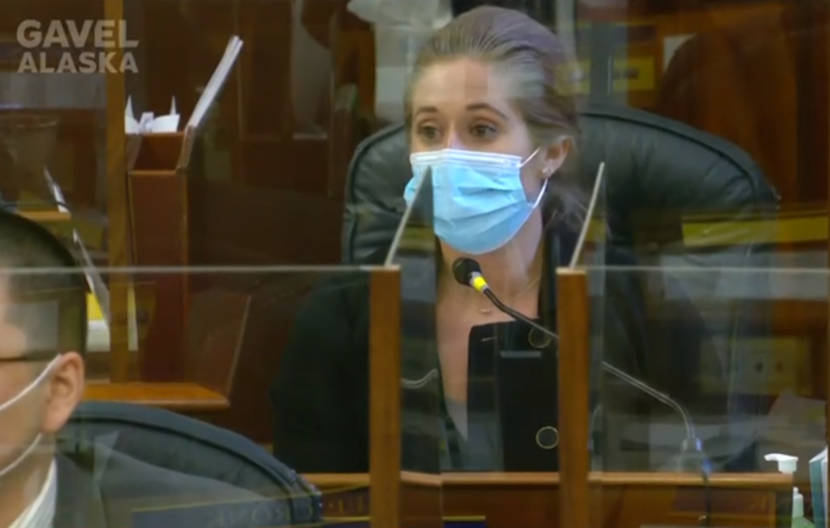
Rep. Sara Rasmussen, R-Anchorage, apologizes during a House floor session on April 7, 2021, in the Alaska State Capitol in Juneau, Alaska. Her apology was for allowing members of the public barred from the Capitol complex due to pandemic safety rules to enter the Terry Miller Legislative Legislative Office Building for a social gathering last week. (Gavel Alaska screen capture)
Rep. Sara Rasmussen, R-Anchorage, apologizes for allowing members of the public barred from the Capitol complex due to pandemic safety rules to enter the Terry Miller Legislative Legislative Office Building for a social gathering last week. She spoke during a House floor session on Wednesday in the Capitol. (Gavel Alaska screen capture)

Members of the public who are barred from the state Capitol complex due to pandemic safety rules attended a social gathering with legislators in a complex building last week. 

The gathering was in the gymnasium in the Terry Miller Legislative Office Building, which is across 5th Street from the Capitol. 

Anchorage Rep. Sara Rasmussen told the Alaska House of Representatives that it was a mistake during the floor session on Wednesday.

“I apologize to all of you for the lack of judgment that was exercised when several of us entered the gym and allowed [in] a few people who are members of the public and do not have keycard access to the facility,” she said.

Rasmussen said the gathering included playing ping pong and shooting basketballs. She is a Republican who is not a member of either House caucus.

After the gathering, the head of the office that oversees the Capitol — the Legislative Affairs Agency — sent an email to all legislators and legislative aides reminding them that no one is allowed into legislative buildings who hasn’t been tested and screened for COVID-19.

Anchorage Rep. Kelly Merrick echoed Rasmussen’s apology. She is a Republican who caucuses with the mostly Democratic majority.

“Last week we made a poor choice and pledge not to repeat that mistake,” she said. “We also immediately have apologized to the Legislative Affairs Agency and we ask forgiveness from this body and from Alaskans.”

Anchorage Democratic Rep. Zack Fields also attended the gathering. He did not talk about it during the floor session.


Much work remains for a state budget that’s seen few changes so far

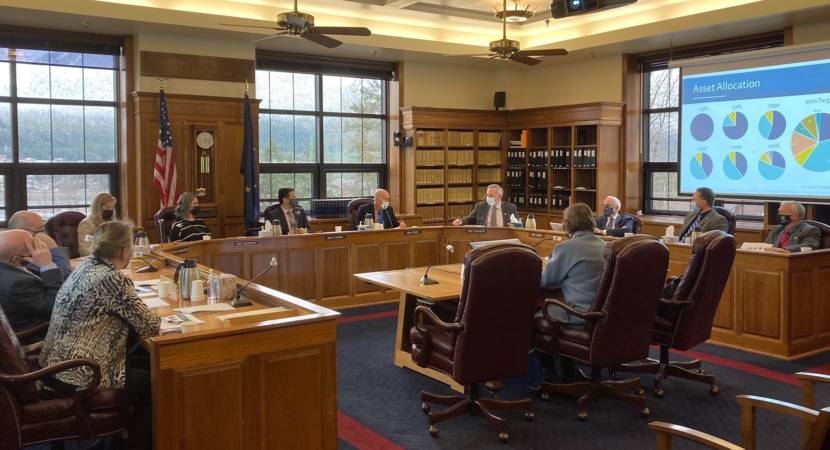
Alaska House Finance Committee members meet with Alaska Permanent Fund Corp. CEO Angela Rodell in the Capitol in Juneau, Feb. 23, 2021. (Photo by Andrew Kitchenman/KTOO and Alaska Public Media)
Alaska House Finance Committee members meet with Alaska Permanent Fund Corp. CEO Angela Rodell in the Capitol on Feb. 23. Beginning on Thursday, the committee will hear public testimony on the budget for three days. (Photo by Andrew Kitchenman/KTOO and Alaska Public Media)

There have been relatively few large changes to the Gov. Mike Dunleavy’s proposed budget in the first step of the Legislature’s annual budget process. 

Public testimony is planned for Alaska House Finance Committee meetings on Thursday, Friday and Saturday. The committee is considering the changes recommended by 16 budget subcommittees that closed out their work in late March. 

While there have been some significant changes to what Dunleavy proposed, they’re far less extensive than the changes two years ago. That’s when lawmakers rejected the deep cuts to services that Dunleavy proposed to pay for $3,000 permanent fund dividends under the formula in a 1982 state law.  

This year, House members looking at the Department of Law budget recommended rejecting the administration’s proposal to shift the cost of prosecuting misdemeanor crimes to home-rule municipal governments. 

Home-rule municipalities have the authority to write their own misdemeanor laws. Anchorage and Juneau have, so they’re already paying for their own prosecutors. And the North Slope Borough pays the state. But other municipalities aren’t. 

Deputy Attorney General John Skidmore, who heads criminal prosecutions for the state, referred to a line from Spider-Man when he explained the reasoning behind the administration’s proposal at a March 5 subcommittee meeting

“With great power comes great responsibility,” Skidmore said of home-rule municipalities. “They have the power to do this for their citizens, and the argument then is that there is some responsibility that would go along with it.”

But the proposal raised concerns with municipalities. Seward’s acting police chief Alan Nickell told legislators on March 12 that his city already has a large deficit. 

“In a time where everyone is hurting for money, following the pandemic, this is not the time to make it harder for anyone,” Nickell said. 

The Department of Law subcommittee recommended restoring $1.29 million in state funding for misdemeanor prosecutions. 

Another significant change was the addition of $1 million for the Redistricting Board. It will draw the map that will determine who controls the Legislature for the next decade. 

The board will be working later than normal.  It won’t draw the map until the fall this year because the census numbers are being delayed by the pandemic. In addition, the board generally has to pay to defend itself against lawsuits over whatever map it comes up with. 

Dunleavy has again proposed paying for full PFDs under the traditional formula. Instead of paying for them with cuts to services, he proposed drawing more than planned from the Alaska Permanent Fund’s earnings reserve account. Some lawmakers are concerned that doing that would lead to drawing down the permanent fund in the future. 

None of the House subcommittees focused on the PFD amount. 

The budget process is later than normal because the House majority caucus took a month to organize. That makes it virtually impossible for the Legislature to finish its work in 90 days.

Not counting two sessions when the Legislature immediately went into a special session, it’s only had two 90-day sessions since a voter-passed initiative went into effect in 2008 saying that sessions should be 90 days. The state constitution allows sessions to last up 121 days. This year, the 90th day will be April 18, and 121st will be May 19. 

Along with the PFD, another major uncertainty left in this year’s budget is how the state will spend more than $1 billion it’s receiving in American Rescue Plan Act money. Federal guidance on how to spend it will be available on May 10, nine days before the deadline to end the session. 

Site notifications
Update notification options
Subscribe to notifications