Andrew Kitchenman

State Government Reporter, Alaska Public Media & KTOO

State government plays an outsized role in the life of Alaskans. As the state continues to go through the painful process of deciding what its priorities are, I bring Alaskans to the scene of a government in transition.

Alaska House bill would fund schools ahead of time, prevent pink slips

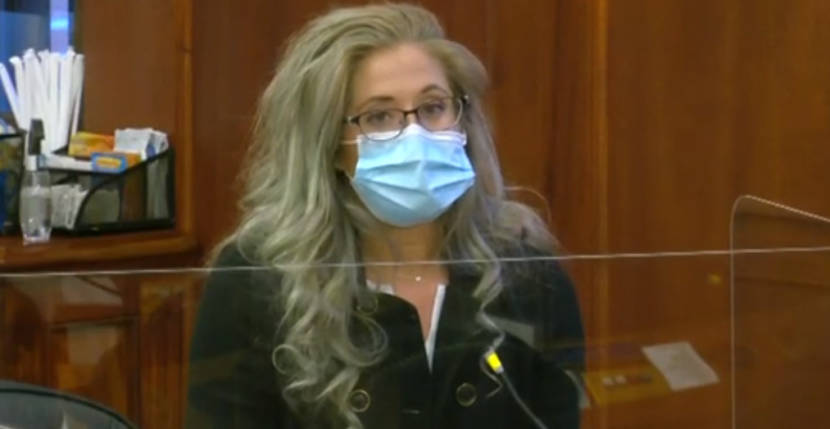
Rep. Sara Rasmussen, R-Anchorage, speaks in favor of an amendment she proposed on April 21, 2021, in the Alaska State Capitol in Juneau, Alaska. The amendment would commit the Legislature to fund public education for the school year starting in 2022, a year ahead of time. (Gavel Alaska screen capture)
Rep. Sara Rasmussen, R-Anchorage, speaks in favor of an amendment she proposed on Wednesday in the Capitol. The amendment would commit the Legislature to fund public education for the school year starting in 2022, a year ahead of time. (Gavel Alaska screen capture)

A bill being debated in the Alaska House of Representatives is aimed at funding public schools for the next two years. 

House Bill 169 would fund education ahead of the rest of the state budget, to avoid teachers and other school staff receiving layoff notices next month. This happens when the Legislature goes deep into May without passing a budget, triggering notices required under teachers’ contracts.   

The education funding is usually included in the same bill as the rest of the state budget. But there have been years when it was provided in a separate bill, to prevent pink slips. And there have also been times when it was funded more than a year ahead of time. But the state had savings to draw from at that time. 

The House amended the bill on Wednesday seeking to assure funding for not just the school year starting this summer, but the one after that. 

Anchorage Republican Rep. Sara Rasmussen explained why she sponsored the amendment

“Over the last year, students have faced many disruptions due to the pandemic,” she said. “And I think that it’s incredibly important that the Legislature provide some stability.” 

And Democratic Rep. Harriet Drummond said that during the nine years she was on the Anchorage School Board, it was terrifying not knowing how the Legislature would handle school funding. She said the amendment is reassuring.

“There’s a great sigh of relief that’s going to be felt all across this state, from school districts, school board members, parents when they understand that their child’s teacher will be able to stick around,” she said, adding that teachers could “make plans, buy a home, stay in the community.”

Several members of the all-Republican minority caucus said the amendment for the extra year of funding should have been discussed earlier. 
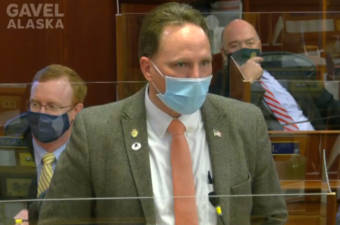
Rep. Ben Carpenter, R-Nikiski, speaks against an amendment to House Bill 169 on April 21, 2021, in the Alaska State Capitol in Juneau, Alaska. (Gavel Alaska screen capture)
Rep. Ben Carpenter, R-Nikiski, speaks against an amendment to House Bill 169 on Wednesday in the Capitol. The amendment would commit the Legislature to fund public education for the school year starting in 2022, a year ahead of time.   (Gavel Alaska screen capture)

Nikiski Republican Rep. Ben Carpenter said lawmakers don’t know enough about the effect of the amendment. 

“I’m not making an argument that early funding or forward funding education is not in the best interest of the school districts or of the teachers or of the students — or any other emotional plea we can put forward as to why this is necessary,” he said. “What I’m speaking to is how we do business on this floor.”

Wasilla Republican Rep. David Eastman said the amendment would prevent the Legislature from holding school districts accountable. He said all parts of the state government normally compete for funding. 

“This amendment and the idea that we would take our public education system out of that competitive process is why our system is failing our students, why our system is failing in many cases our parents, and why it is failing our teachers,” he said. 

The vote to pass the amendment was 25 to 14.

Three minority-caucus Republicans from Interior Alaska — Fairbanks Reps. Bart LeBon and Steve Thompson and Tok Rep. Mike Cronk — voted for the amendment. The other 14 minority caucus members present voted against it. All 15 Democrats, four independents and two Republicans in the majority caucus voted for it, as did Rasmussen, who isn’t in a caucus. Anchorage Republican Rep. David Nelson was absent.

The amendment could be complicated by a court case recently argued in front of the Alaska Supreme Court. The court is weighing whether it is constitutional to fund schools a year ahead of time when the money isn’t sitting in a state account. 

The bill would provide $1.2 billion this year and — if the state formula to fund schools stays the same — a similar amount next year.

The House is scheduled to debate the full bill on Thursday. If it passes, it would be sent to the Senate.  
Senate votes to remove Reinbold as chair of Judiciary Committee

The Alaska Senate voted 17-1 to remove Republican Eagle River Sen. Lora Reinbold as chair of the Senate Judiciary Committee on Monday. 

Senate President Peter Micciche did not cite any specific instances of rules Senator Reinbold violated in explaining the change.

“This is entirely based on decorum and the mutual respect that’s expected as we operate in this building,” he said.

Micciche, a Soldotna Republican, says Reinbold would be restored to her position as chair if she observes the rules regarding decorum and treats others with respect, like other senators do.

Reinbold has repeatedly clashed with other lawmakers over her violating COVID-19 safety rules requiring facemasks and rapid coronavirus tests, but Micciche says the action was “essentially unrelated” to Reinbold’s violations of the safety rules.

Reinbold addressed her colleagues before they voted.

“Today’s actions on the floor severely violate and possibly sever an agreement that Republicans came together on,” she said. “Removing me as judiciary chair is a very serious move.”

She said she was willing to work on “legitimate concerns.”

“I received no formal complaints by members, no formal written concerns from leadership or members that have been brought before me, and given me an opportunity to address,” she said.

She was the only vote against the change, which she described as “un-American.”

She remains a member of the majority caucus. The majority leader, Palmer Republican Senator Shelley Hughes, says she hopes Reinbold makes changes.

“This is temporary,” she said. “We care deeply about Lora. I truly mean it when I say I love her like a sister. She’s our colleague. She’s our friend. And this is intended to be temporary. And it’s really in her lap right now how she’d like to proceed.”

Gov. Mike Dunleavy sent Reinbold a letter earlier this session saying the administration would no longer respond to her as the Judiciary Committee chair. In the letter, he said she had spread misinformation about the administration’s response to the pandemic.

Reinbold has called for the governor to retract the letter and apologize. Some of his appointees later met with the committee for their confirmation hearings.

Reinbold asserts that the governor’s office is responsible for her being removed from her position, but Micciche and other leaders say the decision has nothing to do with the administration.

At one point, Senate leaders barred her from most of the Capitol building, citing her failure to comply with COVID-19 safety requirements to wear a facemask and undergo rapid coronavirus tests. While she started to comply with the rules, she was later fined for another violation.

Another conflict occurred during a Senate Health and Social Services Committee meeting on Thursday, during which Reinbold did not comply with the mask requirement. She said she told a nonpartisan committee aide that if they were concerned about it, then perhaps they consider not working in a job close to others.

Wasilla Republican Sen. David Wilson says that he and others in the room interpreted Reinbold’s comments as threatening the aide’s job. Wilson is the committee chair. He says he told Reinbold that if she continued to disrupt committee meetings and prevent the Senate from doing its business, he would request a special resolution that could lead to Reinbold being expelled from the Legislature.

She didn’t immediately change her approach to the rules.

Hours after the floor vote, Reinbold held a news conference in front of the Senate chamber. She didn’t wear a mask. Micciche arrived and told Reinbold she could not be in the hallway without a mask, adding that there are people who work in the Capitol who are at risk.

“Please put your mask on if you want to continue your press conference,” he said. “Or you will be escorted to your office.”

Reinbold then moved the news conference to her office, where she defended her work with the Judiciary Committee this year.

While Reinbold lost her seat on the Judiciary Committee, she retained her positions as vice chair of the Legislative Council and a member of the Senate Health and Social Services Committee.

Anchorage Republican Senator Roger Holland replaced Reinbold as both a member and chair of the Judiciary Committee.

This story has been updated.

In plan to boost Alaska tourism, governor announces state will offer vaccines to tourists

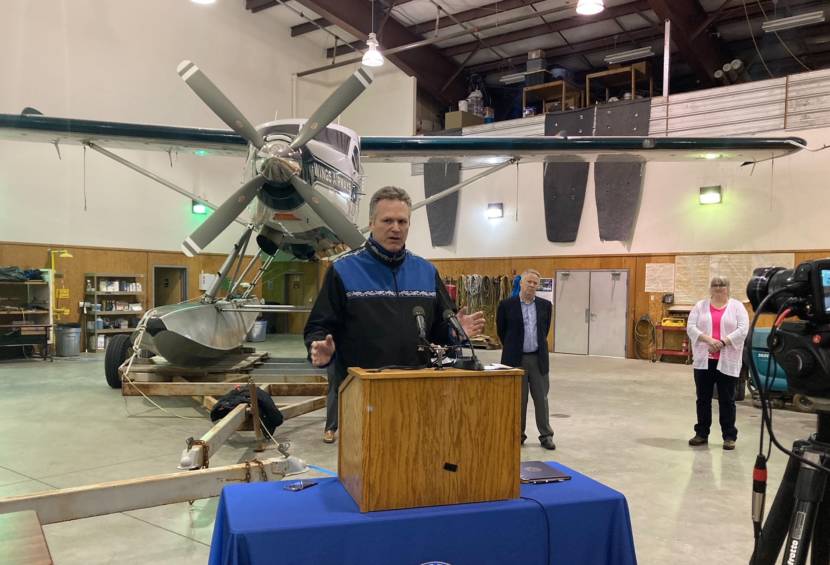
Alaska Gov. Mike Dunleavy speaks about his hopes for holding a summer cruise season this year in a news conference in the hangar of Wings Airways in Juneau, Alaska, on April 9, 2021. Holland America executive Ralph Samuels and Juneau Mayor Beth Weldon are behind Dunleavy. (Photo by Andrew Kitchenman/KTOO and Alaska Public Media)

Alaska will offer tourists vaccinations starting on June 1 as part of the state’s plan to assist tourism-related businesses, Gov. Mike Dunleavy announced on Friday at the Alaska Native Heritage Center in Anchorage.

State officials acknowledged that the U.S.’s relatively high vaccination rate compared with other countries could make Alaska’s offer attractive internationally.

State Public Health Director Heidi Hedberg said the state currently has plenty of vaccines.

“We are not setting aside or delineating vaccine for Alaskans or nonresidents. Right now, what we’re saying is: ‘Today’s the day, Alaskans. Please get educated. Please get vaccinated,’” she said. “And starting June 1st, it’s going to be opened up for those tourists.”

She said the state is planning to operate sites in Anchorage, Fairbanks, Juneau and Ketchikan. The plan is for vaccinations to happen outside of the security areas at the airports, so state residents could get vaccinated when they pick up visitors.

Dunleavy also proposed spending $150 million to promote tourism and adapt for the potential loss of the cruise ship season.

The state tourism money would come from the $1 billion that the state government can determine how to spend from the federal American Rescue Plan Act.

Dunleavy also said a national advertising campaign he announced last week would likely be one of the largest the state has ever funded.

“It’s going to be print, it’ll be digital, it will be on TV stations, radio stations,” he said. “We want to make sure that they don’t forget about Alaska. And don’t get me wrong, there’s a lot of beautiful states down in the lower 48. This is a spectacular state.”

In describing who could benefit from the tourism assistance, Dunleavy noted that both large and small businesses have been affected.

One small business owner is artist Robert McCoy-Apangalook of Gambell. He carves walrus ivory, whalebone, baleen and antlers. He attended the announcement with his mother Barbara Apangalook, who sews sealskin, polar bear and sea otter fur, and walrus whiskers and intestines. He said venues where his art usually is sold to tourists did not provide business during the pandemic, which began shortly after his daughter was born. It led to an eviction notice at one point.

“I had never felt like such a failure and [became] certain I had made the wrong decision choosing my art as a career,” he said. “Fortunately, I found a new — new to me — market via social media, and a rebirth in support that has allowed me to regain my confidence as an artist.”

Alaska Native Heritage Center Executive Director Emily Edenshaw said that as the state rebuilds its tourism industry, Alaska Natives should be treated justly.

“For centuries, Alaska Natives have endured with resilience an existence at the receiving end of unjust policies, grounded in the erasure of our languages, histories and cultures,” she said.

She said the drop in tourism provides breathing room to reimagine who and what participates in tourism, including presenting more Alaska Native culture.

“It’s essential to talk about our history, because the reality is that our lived experience has consistently been left out of the story told about Alaska,” she said. “And much of our cultural tourism work today is grounded in addressing this deficit, and to tell a more complete story.”

Dunleavy said the state could provide “holidays” from paying certain licenses and fees to help support tourism. But he also said the details of how the money will be spent will draw from what Lt. Gov. Kevin Meyer hears.

On Monday, Meyer plans to begin a two-week tour meeting with tourism-related businesses and community leaders.

He acknowledged that Southeast Alaska communities were hit particularly hard by the loss of cruise ship visits.

“It’s hard to make up that difference with independent travelers, but … with a robust marketing program, we’re going to get as many up here as we can,” he said.

Meyer plans to visit Juneau, Sitka, Ketchikan, Kodiak, Kenai, Homer, Fairbanks, Healy and Nome.

Dunleavy laid out his plan for the entire amount the state will receive from the American Rescue Plan Act, including the $150 million for tourism. It includes $325 million for relief for businesses and other organizations and another $325 million for infrastructure investments, including in safe water, sewers and broadband.

Another piece would provide $80 million for what the administration calls “protecting Alaskans. ” That includes funding for emergency response costs addressing the domestic violence during the pandemic, as well as support for food security, including agriculture and fishing in the state.

Alaska would be first state to use blockchain-based voting system under proposed bill

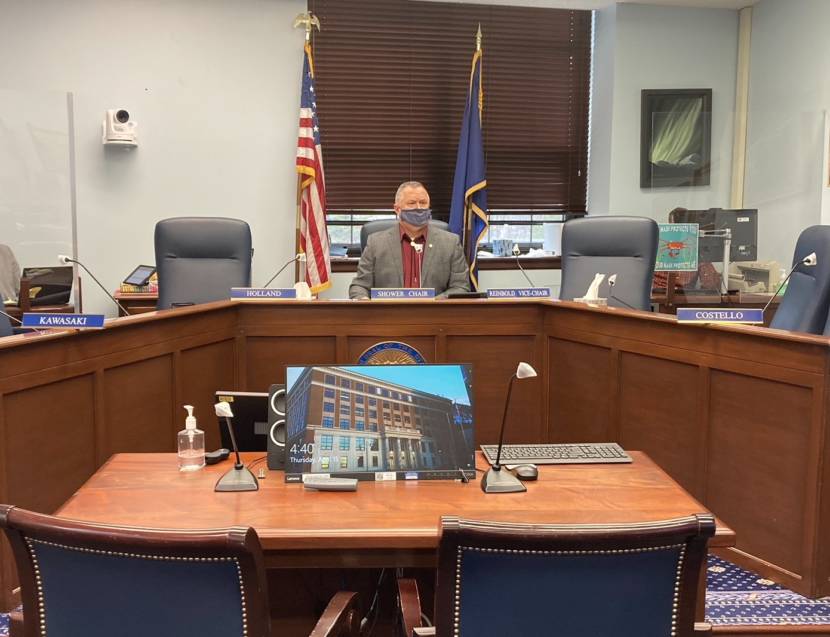
Sen. Mike Shower, R-Wasilla, watches as his aide Scott Ogan gives a presentation by video on Senate Bill 39, a measure making changes in the voting system during a Senate State Affairs Committee meeting on April 15, 2021, in the Alaska State Capitol in Juneau, Alaska. The other senators on the committee were participating by videoconference. (Photo by Andrew Kitchenman/KTOO and Alaska Public Media)
Sen. Mike Shower, R-Wasilla, watches as his aide Scott Ogan gives a presentation by video on Senate Bill 39 during a Senate State Affairs Committee meeting on April 15, 2021, in the Alaska State Capitol in Juneau, Alaska. On Thursday, Shower unveiled a new version of the bill, which would make a series of changes to the state’s voting system. The other senators on the committee were participating by videoconference. (Photo by Andrew Kitchenman/KTOO and Alaska Public Media)

Alaska would become the first state to adopt blockchain technology statewide in its voting security system under a proposal by Wasilla Republican Sen. Mike Shower. 

Shower said he wants to increase voters’ confidence in the system. 

“I’m merely trying to find a way to make it tighter and better as we move into the 21st century, primarily about how we secure our elections, so that people will have faith in the results, even if they don’t like them,” he said.

The proposal is part of a new version of Senate Bill 39 Shower unveiled on Thursday. The bill would require most voters to use an added step to verify their identity, known as multi-factor authentication. An example of this is when websites send users a code to their email or cell phone in addition to requiring their password to allow access. Shower said voters who are unable to comply with this wouldn’t be required to. 

Blockchain is a form of database used in digital currencies like Bitcoin. Chris Miller, an employee of the software company Oracle, told the Senate State Affairs Committee on March 16 that blockchain has been used in elections in Russia. In addition, a county in Utah has allowed a few people to vote using the technology. 

Another provision of the bill would direct the Division of Elections to use more databases to check whether people should be removed from the voting rolls. Shower said the state hasn’t been doing enough. 

“We’re sending ballots to people who shouldn’t be on the rolls here in Alaska,” he said. “So they can’t claim that we’re doing it as clean or as good as we should be. We can do it better.”

He acknowledged that checking more databases could add costs for the state. 

The bill includes some provisions that would increase access to voting, like accepting tribal IDs as a form of voter identification. And it would allow voters to fix mistakes that would invalidate their ballots. 

An earlier version of the bill drew criticism for ending automatic voter registration through the permanent fund dividend application. The new version wouldn’t do that. 


Gov. Dunleavy orders investigation into state disclosure of personal information with Anchorage government

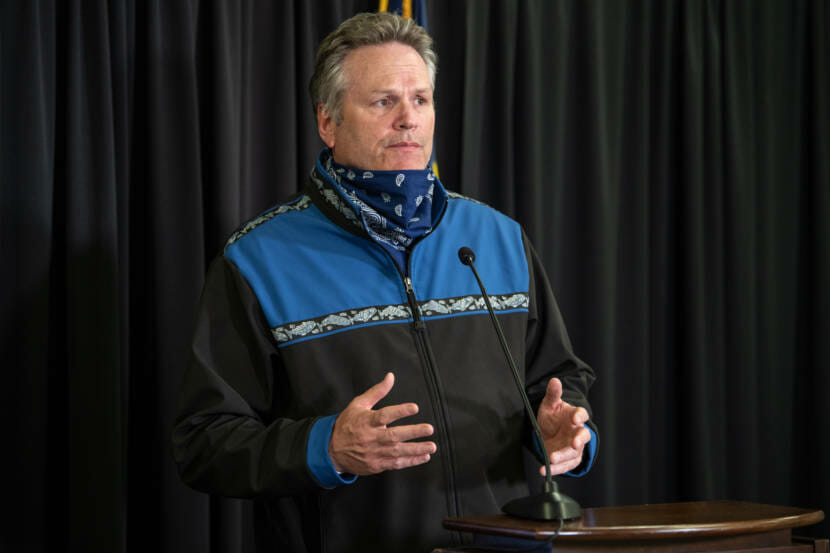
Gov. Mike Dunleavy speaks in June 2020. On April 15, 2021, he ordered the Department of Law to investigate the unauthorized sharing of some Alaskans’ personal information with Anchorage’s municipal government. (Photo from the Office of the Governor)

On Thursday, Gov. Mike Dunleavy ordered an investigation after the state shared individuals’ personal information with Anchorage’s municipal government without authorization, the governor’s office said. 

People working on behalf of Anchorage’s government contacted individuals about COVID-19 vaccine information, according to the governor’s office. The municipality received the names and contact information from state Department of Health and Social Services staff, the office said. 

In a statement Thursday evening, Katie Scovic, spokeswoman for the municipality said the investigation announcement came as a surprise.

“DHSS shared contact information with the Municipality of Anchorage and encouraged us to contact residents with educational information about how to access a vaccine if they were interested,” she said.

Scovic added that the city is committed to helping anyone who wants a vaccine to get one, but that vaccinations will never be mandatory. Already more than half of eligible Anchorage residents have received their first dose.

Dunleavy directed the state Department of Law to investigate whether the unauthorized data sharing violated the law. The governor’s office said that while the state and city health departments have a data-sharing agreement, this information was not shared through that channel. 

Dunleavy also directed state Health and Social Services Commissioner Adam Crum to conduct an internal review of all data-sharing agreements. 

Dunleavy said that while the data shared appears to be limited, he apologized to any Alaskan affected. 

“Alaskans value their right to privacy, especially sensitive health information, and they have a right to know how that information may or may not be used,” he said in a news release.

He said the Department of Law will report back after the investigation with new policies to prevent this from happening again.  

This story has been updated to include a statement from Municipality of Anchorage spokesperson Katie Scovic.

Alaska Public Media’s Kavitha George contributed to this report.

Senators unveil bill to extend, limit Alaska disaster declaration as deadline for food aid looms

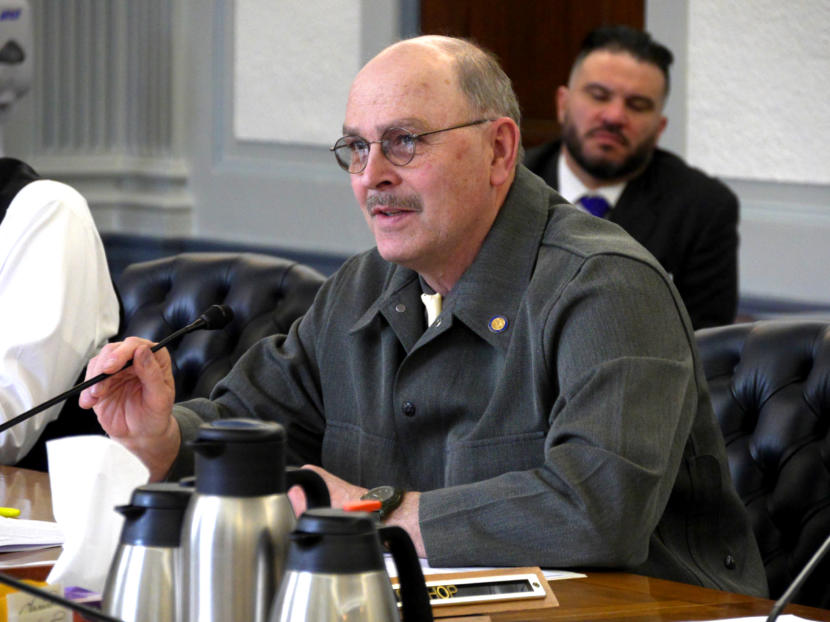
Sen. Click Bishop, R-Fairbanks, participates in a Senate Finance Committee discussion in March 2019. On Monday, Bishop said the committee’s version of House Bill 76 provides for continued additional federal food aid to Alaskans while also limiting Gov. Mike Dunleavy’s COVID-19 disaster declaration powers. (Photo by Skip Gray/KTOO)

Some Alaska state senators are aiming to pass a bill that would extend Gov. Mike Dunleavy’s disaster declaration, but with more limited powers than were in place until mid-February. 

The end of the month is the deadline for the Legislature to pass a bill — and for Dunleavy to sign it — or low-income Alaskans will lose $8 million in emergency food aid. 

On Monday, the Senate Finance Committee introduced a new version of House Bill 76, which the House passed on March 26. 

Fairbanks Republican Sen. Click Bishop said the goal of the bill is to allow the state to collect additional food aid, as well as assist with the COVID-19 response in areas like distributing vaccines. But he also said the committee listened to the administration in offering a more limited bill. 

“We’ve heard loud and clear that the governor didn’t need all these powers, and so we’ve acted accordingly,” he said. 

This bill is on the middle ground between what the House passed and the more limited measure the governor wants.  

It would extend the disaster declaration through the end of the year, allowing Alaskans to receive $72 million in food aid. Bishop said this money will help people who have been disproportionately affected by the pandemic. 

“We talk about wanting to help the economy and people in need,” he said. “We all know that the highest percentage of unemployed Alaskans is [among] those that are making less than about $40,000 a year. They’re the ones in the greatest need.”

In February, the average additional Supplemental Aid to Needy Families benefits in Alaska ranged from $265 in urban areas to $436 in the most rural areas.

The additional food aid wasn’t sent to families earlier this month, though they are receiving their regular benefits. They could still receive these additional benefits retroactively. A spokesperson for the state Department of Health and Social Services said it’s the department’s understanding that Alaska would be eligible to receive the additional aid for April if a law is enacted that complies with federal emergency requirements by the end of the month. 

The bill would give Commissioner of Health and Social Services Adam Crum more public health emergency powers during the pandemic. This is similar to what is being done in Michigan, another state without a disaster declaration. 

Some lawmakers would like to make permanent changes to state law that would allow for public health emergencies that are more limited than the full range of powers that the governor has under disaster declarations. 

The Senate Finance version of the bill also would have an effect on the state budget. 

The bill would add a provision that would limit the administration’s ability to spend federal relief funds in areas that the Legislature hasn’t already approved. Sitka Republican Sen. Bert Stedman said this may require the Legislature to meet in a special session. 

 “It’s to ensure that the Legislature convenes and exercises its appropriation authority dealing with these substantial dollars coming from the federal government,” he said.   

He said federal pandemic aid won’t solve the state’s long-term budget problems

“It does not fix our structural deficit. Let’s be very clear about that,” he said. “This is just frosting on a lumpy cake, to make it look nice and smooth, right?  So it doesn’t fix the underlying issues that we’re struggling with.”

Stedman said it’s likely the Legislature will pass a plan to use federal funds from the American Rescue Plan by the May 19 deadline to end the session. But he said it’s important that the Legislature also pass a plan for any large new amounts of federal money that come in after the session ends. 


Site notifications
Update notification options
Subscribe to notifications