State Government Reporter, Alaska Public Media & KTOO
State government plays an outsized role in the life of Alaskans. As the state continues to go through the painful process of deciding what its priorities are, I bring Alaskans to the scene of a government in transition.
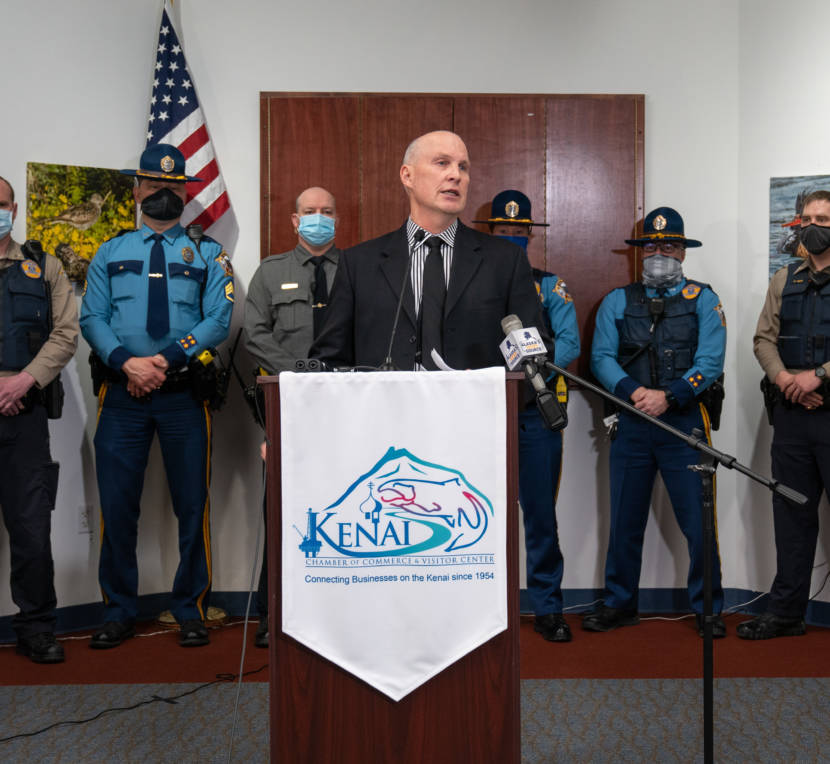
Jim Cockrell speaks at the press conference at the Kenai Chamber of Commerce and Visitor Center where he was appointed commissioner of the Alaska Department of Public Safety on April 6, 2021. (Office of the Governor)
Former head of the Alaska State Troopers Jim Cockrell has been appointed the new commissioner of the Department of Public Safety by Gov. Mike Dunleavy.
“I look forward to working with you to make Alaska a safer place,” Cockrell said to Department of Public Safety employees during the announcement in Kenai.
He added that he would work tirelessly to ensure the department has the resources and tools they need to do their jobs.
Cockrell replaces Amanda Price, who resigned in February. Price said she was forced out over disagreements with Dunleavy over personnel and policy.
Cockrell said that if he lasts in the position four to six years, he would want to be able to say that he made a difference.
Dunleavy said he doesn’t think the confirmation process will be difficult with Cockrell. His appointment will be subject to a vote of the entire Legislature in joint session.
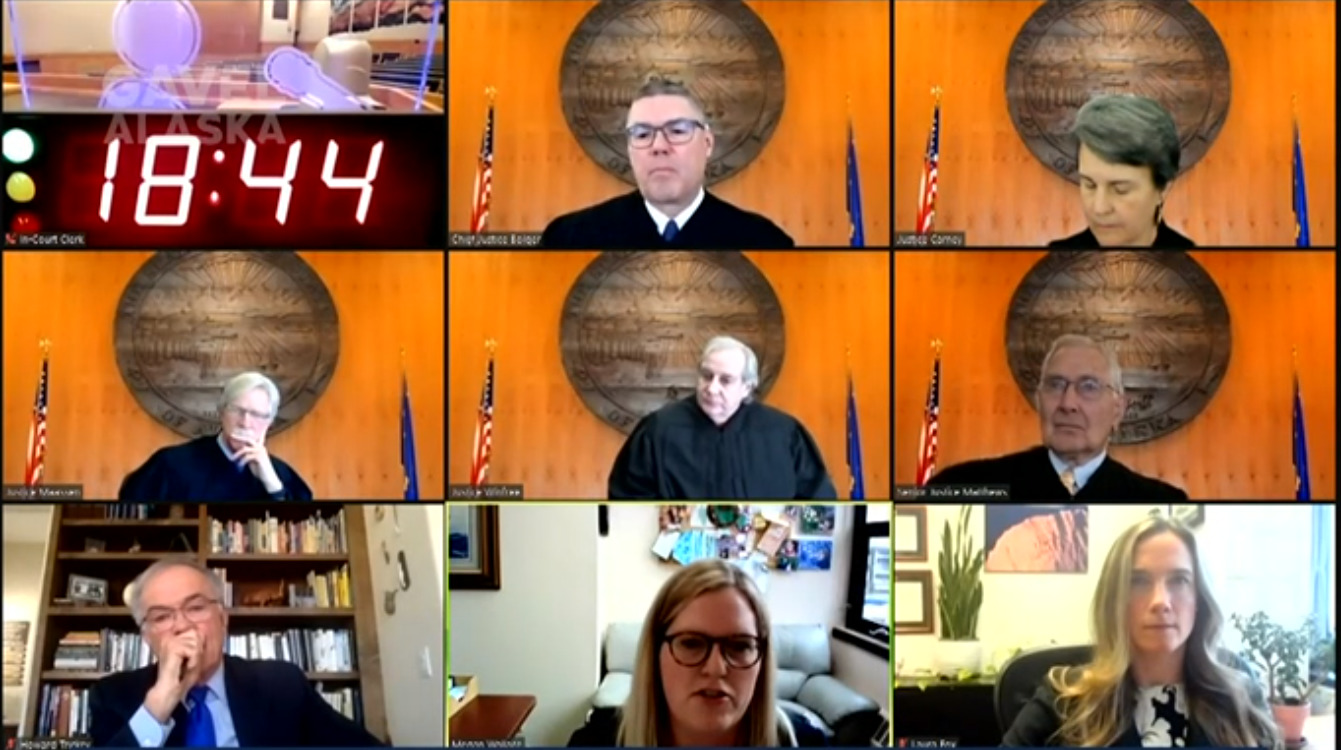
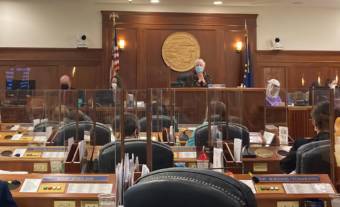
The Alaska Supreme Court listens to oral arguments in a lawsuit between Gov. Mike Dunleavy and the Legislative Council and Coalition for Education Equity on March 31, 2021. Top row: Chief Justice Joel Bolger and Associate Justice Susan Carney. Middle row: Associate Justice Peter Maassen; Associate Justice Daniel Winfree; and Senior Justice Warren Matthews. Bottom row: Coalition for Education Equity lawyer Howard Trickey; Legislative Legal Services Director Megan Wallace; and Assistant Attorney General Laura Fox (Gavel Alaska screen capture)
Justices on the Alaska Supreme Court on Wednesday questioned the constitutionality of the Legislature funding public education a year early.
The questioning happened during oral arguments in a lawsuit between Gov. Mike Dunleavy on one side and the Legislative Council and school funding advocates on the other.
Justice Daniel Winfree asked if there was any limit on the Legislature’s ability to decide spending years ahead of time for any part of the state budget, such as permanent fund dividends.
“Why couldn’t the Legislature appropriate the money for the next 15 years of permanent fund dividends based on the statutory provision and have that be a public purpose? What would stop that? What is the limiting principle?” Winfree asked an attorney for the Legislature.
The lawsuit came out of a dispute between Dunleavy’s administration and the Legislature. Three years ago, before Dunleavy was elected, the Legislature included $20 million of school funding in the budget to be spent the following year.
Dunleavy’s administration argued that this funding was unconstitutional because the Legislature can only budget for one year at a time. The Legislative Council and the nonprofit Coalition for Education Equity sued to support the Legislature’s position.
Legislative lawyer Megan Wallace argued that the Legislature could always repeal money that had been budgeted in an earlier year.
“Those future appropriations remain available for future Legislatures as they balance revenue and expenditures to make changes to amend, repeal and to ensure that there’s adequate revenue to cover those expenditures,” Wallace said.
But Wallace continued to face skepticism from multiple justices on the five-member court.
Assistant Attorney General Laura Fox represented the administration. The justices also questioned her, but not as much.
She said the Alaska Constitution doesn’t allow for budgets that cover future years.
“It thwarts the democratic process by allowing past legislators and the past governor to control the budget, even after voters have voted them out,” she said.
Senior Justice Warren Matthews sat in on the case since Justice Dario Borghesan was a lawyer for the administration on the case before he was appointed to the court. He recused himself.
It’s not clear when the court will rule on the case.
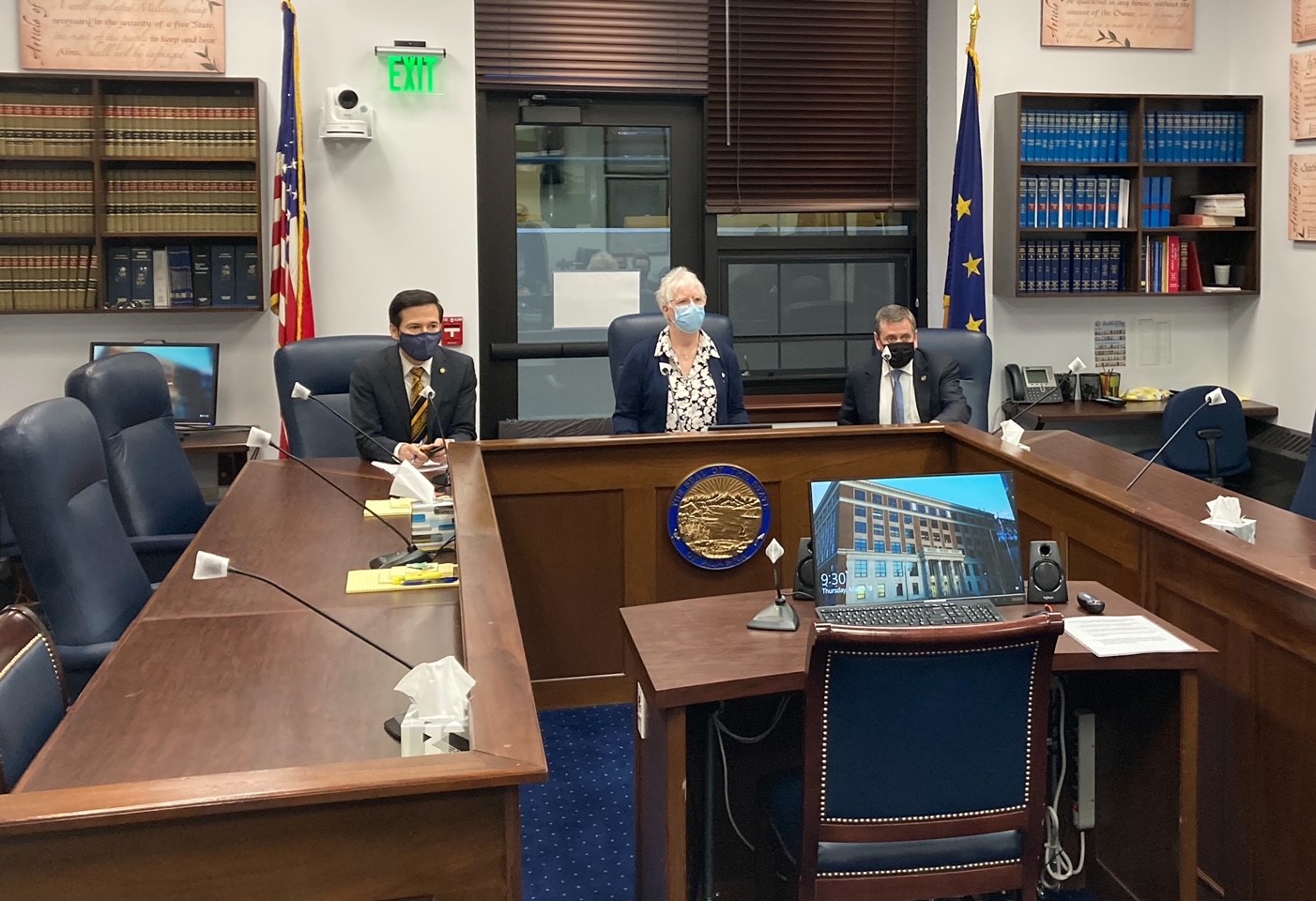
Rep. Neal Foster, D-Nome; House Speaker Louise Stutes, R-Kodiak; and Rep. Chris Tuck, D-Anchorage, prepare for a House majority caucus news conference on March 18 in the Capitol. Foster said members of the caucus have different views on whether the Alaska Permanent Fund Dividend should be the $3,000 Gov. Mike Dunleavy proposed this year or a smaller amount that would maintain more funding in the permanent fund’s earnings reserve. (Photo by Andrew Kitchenman/KTOO and Alaska Public Media)
How much will Alaskans receive in permanent fund dividends this year? As the Legislature works its way through the annual budget process, the answer to that question is once again unclear. A new factor shaping the debate this year is the large amount of federal money coming into the state.
Alaska’s legislators will have to decide whether to pay the roughly $3,000 dividends proposed by Republican Gov. Mike Dunleavy using the formula in state law, or a smaller amount. Over the past five years, they’ve ranged from a low of $992 in 2020 to a high of $1,606 in 2019.
Nome Democratic Rep. Neal Foster noted at a March 18 news conference that paying a smaller number than Dunleavy proposed would help maintain the Alaska Permanent Fund’s earnings reserve. Money from the reserve pays for both dividends and state government services.
“We’ve got a lot of folks in our caucus that want the smaller, reasonable PFD,” he said. “They don’t want to jeopardize the ability to pay PFDs in the future. They don’t want to potentially impact our schools and our roads and our public safety down the road.”
But Foster said there’s another view within the House majority caucus.
“There are other folks who support the full PFD,” he said. “They say, ‘If there’s any time, you know, to support one, now’s the time, during a global pandemic.”
Until early March, it looked like the state would have to draw more than was planned from the permanent fund’s earnings reserve to pay for any PFD.
However, Congress recently passed the American Rescue Plan Act, which includes more than $1 billion that the state government can spend, as well as more than $300 million for Alaska schools. That money could be used to pay for the state budget. And that would allow room for the state to pay dividends.
Foster said this money could help — but he doesn’t want it to be used to avoid making hard choices about the dividend.
“We can’t allow this federal money coming in right now to be an excuse for us to continue to kick the can down the road,” he said. “We’ve already done that for a few years now.”
The federal money isn’t the only thing that could help create room in the budget to pay for dividends. Rising oil prices led the state to increase the amount it forecasts to receive in revenue this year and next by nearly $800 million.
Foster and other lawmakers hope to forge an agreement on a bigger goal than just this year’s dividend. They’re looking to make a permanent change to the formula in state law. That hasn’t happened since the state stopped following the original formula five years ago.
Dunleavy has proposed putting PFDs in the state constitution, as part of an amendment that would outline rules for the overall annual draw from the fund.
Leaders of both the state House and the Senate have expressed optimism that the state can pass a new formula for dividends this year.
Soldotna Republican Senate President Peter Micciche said it will be necessary that any new dividend formula both helps pay for state government and meets the expectations of Alaskans. He says now is the time to do it.
“Because if you don’t do it this year, next year’s an election year,” he said. “If you think that the Legislature has been ineffective on any forward motion on this in the last five years. Without any action this year, they will continue that trend on an election year.”
That’s a challenge because finding a way to pay for dividends beyond this year would require broader agreements on issues that divide Alaskans — and the state’s leaders. Those include whether to cut state services much more deeply as Dunleavy proposed two years ago, introduce a broad tax like a statewide income or sales tax, and whether to increase the taxes paid by oil companies.
Resolving these differences has proven to be a stubborn problem, between a conservative Republican governor, a mostly Republican Senate majority that has sometimes differed with him on policy, and a mostly Democratic House majority.
Anchorage Democratic Rep. Ivy Spohnholz is among those searching for a potential long-term solution, as the chair of the new House Special Committee on Ways and Means.
“We’re going to look at everything,” she said. “We’re going to look at ways to cap the growth of government, spend our resources more wisely, and we’re going to look at new revenue because we need to make meaningful progress.”
For this year, it’s not yet clear exactly how the state can spend the American Rescue Plan money. The federal government is scheduled to release guidelines on May 10. That won’t leave much time for the Legislature to pass a plan for the money before May 19, the constitutional deadline to end the session.
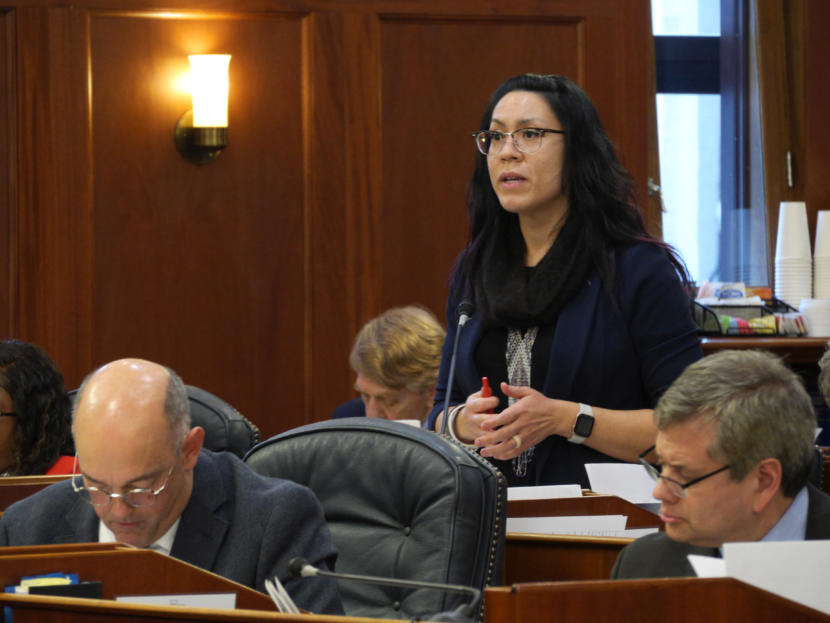
Rep. Tiffany Zulkosky, D-Bethel, speaks during a House floor session in the Capitol in Juneau on March 16, 2020. On Friday, she spoke in favor of House Bill 76, to extend Gov. Mike Dunleavy’s COVID-19 disaster declaration. The bill passed, 22-15. (Photo by Skip Gray/KTOO)
On Friday, the Alaska House of Representatives passed a bill to extend Gov. Mike Dunleavy’s COVID-19 disaster declaration. The bill would make the extension retroactive to Feb. 14, when the declaration expired.
Dunleavy now opposes the extension, saying the state no longer needs to be in a state of emergency. That’s a change since Dunleavy proposed the bill earlier this year before the declaration expired.
He now wants a more limited set of provisions, and Senate leaders have written a revised version of the bill in line with his request.
The House debated the measure, House Bill 76, for more than an hour during a Friday floor session.
Bethel Democratic Rep. Tiffany Zulkosky noted that the statewide COVID-19 threat level remains high. And she said the effect of new, highly contagious variants of the coronavirus in the state is unknown.
“The simple fact is, House Bill 76 reliably and efficiently provides Alaska the tool and resources needed by our businesses, hospitals, nonprofits and local governments,” she said.
Hospital leaders have said the mandatory COVID-19 testing of air travelers is necessary. That program ended in February when the disaster declaration expired.
But Dunleavy maintains that extending the declaration would undermine Alaskans’ trust in the state government and harm the upcoming tourism season.
Anchorage Republican Rep. Tom McKay says the state declaration led to local abuses.
“Using the emergency declaration as cover, our Anchorage interim mayor and Assembly, continuously and callously ignored constituents and abused their powers to destroy the Anchorage economy,” McKay said.
Anchorage Acting Mayor Austin Quinn-Davidson and Assembly members have said restrictions would help the economy recover by decreasing the spread of the virus.
Alaska House Speaker Louise Stutes, R-Kodiak, on the dais in the center, listens to the debate on House Bill 76 on Friday in the Capitol. The House passed the bill, which would extend a statewide disaster declaration issued by Republican Gov. Mike Dunleavy. (Andrew Kitchenman/KTOO and Alaska Public Media)
The vote to pass the bill was 22-15. Fairbanks Republican Rep. Bart LeBon voted in favor of it, citing a provision that limits the liability of businesses. He was the only member to cross caucus lines. Anchorage Republican Rep. Sara Rasmussen, who doesn’t belong to a caucus, voted no.
The House voted on amendments to the bill on Thursday. Only one amendment passed. It would seek to prohibit the state from spending any federal COVID-19 funding on abortions that aren’t mandated by state law. The Alaska Supreme Court has ruled that state laws to prohibit Medicaid spending on abortions are unconstitutional because the laws treat abortions differently than other medical procedures.
The bill now goes to the Senate. If the Senate passes legislation closer to what Dunleavy prefers, the House could agree to the changes, or a committee with members from both chambers could write a compromise bill that could become law.
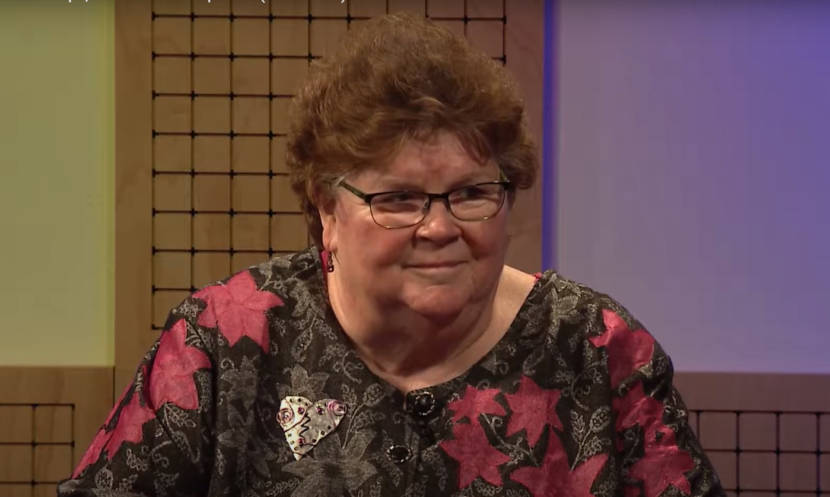
Former Alaska House Speaker Gail Phillips appears in a 2017 interview with Tim Bradner on Capitol Views on KTOO 360TV. She died on Thursday at the age of 76. (Capitol Views screen capture)
Former Alaska House Speaker Gail Phillips died today, at the age of 76.
Phillips was born in Juneau, grew up in Nome and later lived in Fairbanks, Anchorage and Homer.
She was a Republican who represented Homer in the House from 1991 to 2001.
She was the speaker from 1995 to 1999.
She advocated for resource development. She described why in a 2017 interview for the Capitol Views TV show on KTOO 360TV.
“I think if people live here and work here — and especially if they have a job in one of the resource industries — they realize that that is what is keeping Alaska going,” she said. “And that is what enables all of us to live here and to have the good life that we have here today.”
She ran for lieutenant governor in 2002 and finished fourth in the primary.
Former Gov. Sean Parnell was a House member during Phillips’ first two years as speaker. He said she was a steady leader who set a respectful tone in the chamber.
“Just like today, there were some difficult financial times that she helped lead us through,” he said. “And I always appreciated the way she led with fairness for all members.”
In an article she wrote as she was leaving the Legislature, Phillips said her priorities had been schools, roads and programs for seniors on the Kenai Peninsula.
Phillips was a partner in a mining company and worked for airlines for 10 years.
She was married and had two daughters. She served on the Iditarod Trail Committee and was honored by the Iditarod last year as the annual honorary musher.
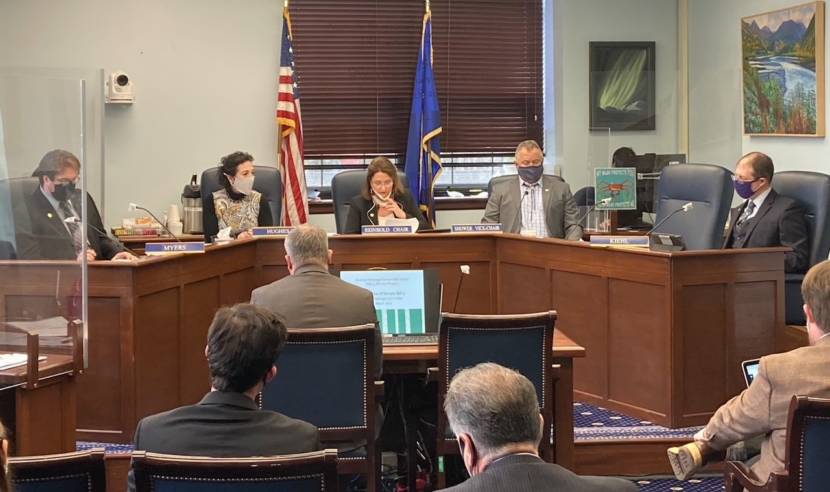
Sen. Lora Reinbold, R-Eagle River, at center, briefly lowers his face shield to ask Attorney General Treg Taylor a question during his confirmation hearing with the Senate Judiciary Committee on Wednesday in the Capitol. Taylor, seated with his back to the camera, had asked her to clarify a question. Senators Robert Myers, R-North Pole; Shelley Hughes, R-Palmer; Mike Shower, R-Wasilla; and Jesse Kiehl, D-Juneau, also are seated at the committee table. (Photo by Andrew Kitchenman/KTOO and Alaska Public Media)
Alaska Attorney General Treg Taylor defended Gov. Mike Dunleavy’s response to the COVID-19 pandemic during a confirmation hearing with the Senate Judiciary Committee on Wednesday.
Eagle River Republican Sen. Lora Reinbold repeatedly asked Taylor whether he found various health mandates to be legal or constitutional. Taylor said he did.
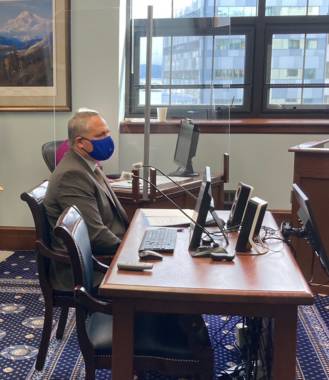
Alaska Attorney General Treg Taylor answers questions during his confirmation hearing with the Senate Judiciary Committee on Wednesday in the Capitol. (Photo by Andrew Kitchenman/KTOO and Alaska Public Media)
For example, Reinbold asked Taylor his opinion of the administration distinguishing between essential and non-essential workers in mandates issued last year.
Taylor said it was a challenging time.
“Given the nature of the epidemic, there had to be tough calls made, and the governor chose to make those,” he said. “As the duly elected governor of this state, obviously, he answers to the voters of this state. And we’ll see how the voters react to his policy calls in the upcoming — in the next election.”
Dunleavy’s term ends next year. He hasn’t said whether he plans to run again.
Taylor said it may be appropriate for the Legislature to amend the Alaska Disaster Act based on the state’s experiences over the past year.
Juneau Democratic Sen. Jesse Kiehl questioned the legal basis for the three disaster declarations Dunleavy issued after the first declaration expired. Taylor says state law allows governors to issue new declarations.
Dunleavy wrote Reinbold a letter last month saying the administration would no longer respond to her as the chair of the Judiciary Committee.
The governor’s office released a statement explaining Taylor’s participation.
The statement said the administration and Legislature have “a great deal of business to conduct,” and that the administration would work with any committee chair to provide the information they need. The statement added that Dunleavy expects that committee meetings “will be conducted in a professional manner” to accomplish state business.
The committee didn’t finish questioning Taylor, and Reinbold said he would be invited back for another hearing.
Close
Update notification options
Subscribe to notifications
Subscribe
Get notifications about news related to the topics you care about. You can unsubscribe anytime.