Andrew Kitchenman

State Government Reporter, Alaska Public Media & KTOO

State government plays an outsized role in the life of Alaskans. As the state continues to go through the painful process of deciding what its priorities are, I bring Alaskans to the scene of a government in transition.

Alaska lawmakers reject $3,000 dividend during weekend debate over the state’s budget

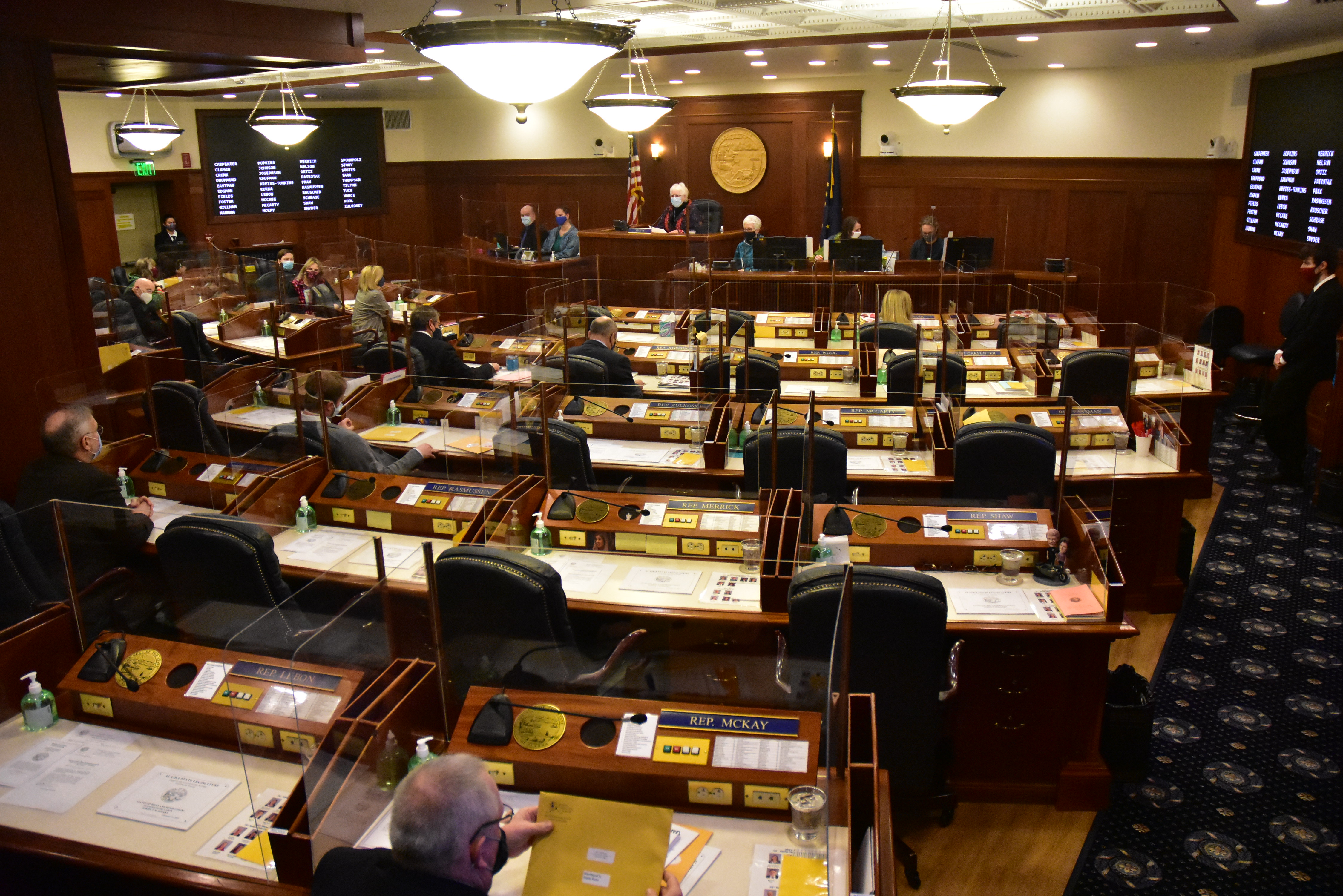
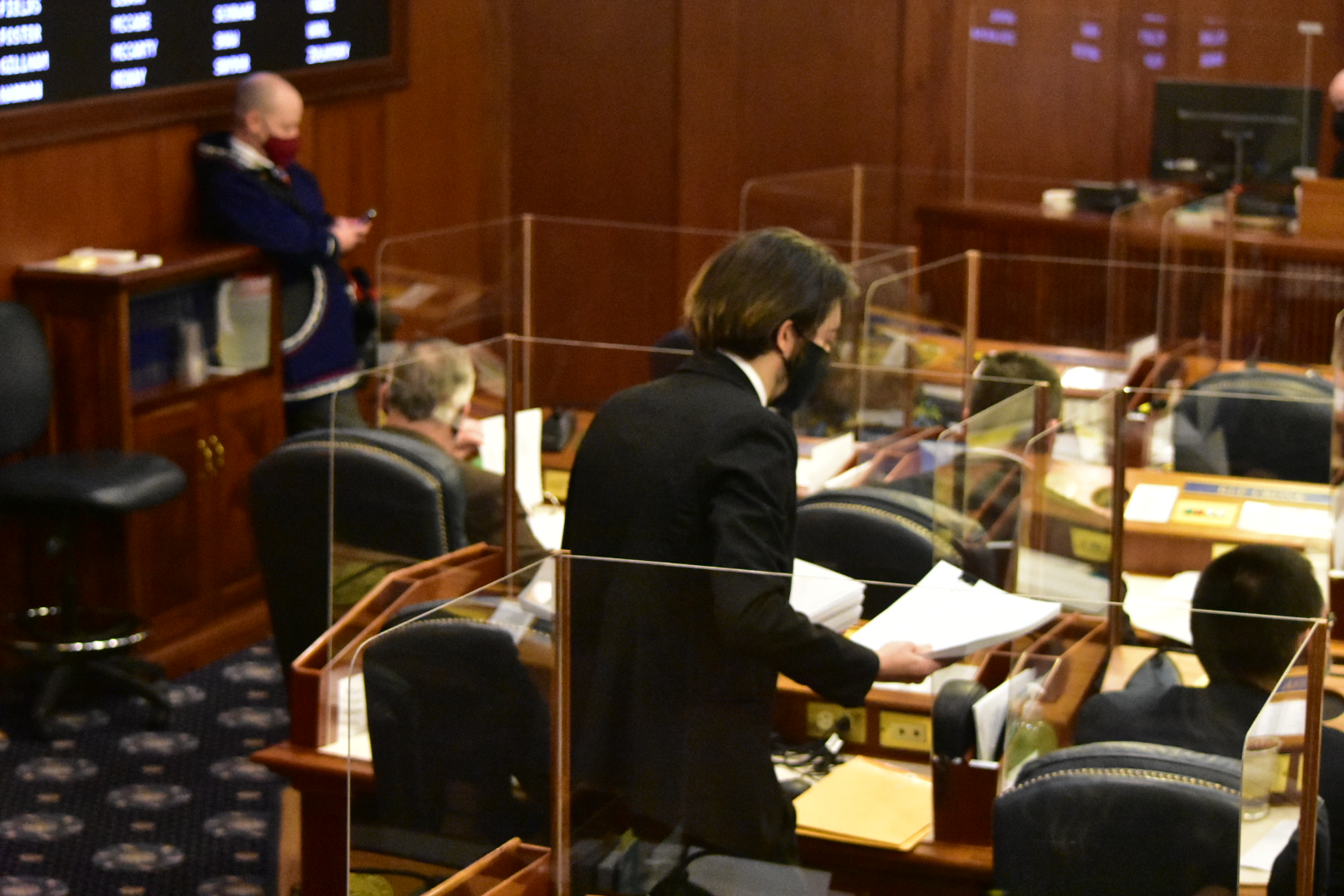
A page in the Alaska House of Representatives hands out copies of a budget bill over 100 pages long on Friday, April 30, 2021. (Peter Segall / Juneau Empire via AP, Pool)

Early in a marathon day of floor sessions on Saturday, the Alaska House of Representatives rejected a proposal to pay permanent fund dividends of more than $3,000 this year.

Big Lake Republican Rep. Kevin McCabe proposed the budget amendment to pay dividends based on the formula in a 1982 state law, at an estimated cost of more than $2 billion.

“This is simple: We either follow the law — we’re going to vote for a full PFD,” he said. “Or we’re not going to vote for a full PFD.”

Anchorage Republican Rep. Sara Rasmussen tried to show what it would take to balance the state budget with full dividends without overdrawing from the permanent fund’s earnings reserve. A state law limits annual draws to roughly 5% of the fund’s value, to prevent fund earnings from being depleted.

Rasmussen, who doesn’t belong to either caucus, proposed an amendment that would cut spending on state agencies by an amount equal to the cost of full PFDs. She said this “would put our money where our mouth is.” She noted that oil revenue has declined, but the demand for services hasn’t.

“But the reality is, Alaskans across the state are still asking for services,” she said. “The Mat-Su is still asking for troopers. Anchorage is asking for K-12 education. Fairbanks wants the University of Alaska funded. Kenai Peninsula wants their roads plowed… Coastal Alaska wants their ferries. Rural Alaska wants affordable heat.”

Rasmussen withdrew her proposal, saying it would cause legal problems.

Sitka Democratic Rep. Jonathan Kreiss-Tomkins said he appreciated Rasmussen’s proposal. He noted the House passed a plan to balance the budget in the long term in 2017.

“When you spend down the permanent fund unsustainably, everybody loses,” he said. “If you like dividends, you lose. You’re not going to be able to pay dividends in the future. If you care about ferries [or] the Silvertip maintenance station on the Kenai, or whatever your priority is: You lose. You lose. Everybody loses when we start spending down the permanent fund.”

But Palmer Republican Rep. DeLena Johnson said that the state should follow the PFD law.

“As we go through this budget, it doesn’t say the permanent fund dividend is paid last,” she said. “It says that we shall pay the permanent fund dividend.”

She said it’s a matter of priorities.

“We’ve chosen to fund this and fund this, and then if we have a little left over, we pay a PFD — not a full PFD — but a PFD,” she said.

She said that the public’s support for dividends keeps the Legislature honest.

The full-PFD amendment failed by an evenly split 20 to 20.

Most minority-caucus Republicans voted for it, along with Nome Democratic Rep. Neal Foster; Utqiavik independent Rep. Josiah Patkotak; and Anchorage Democratic Rep. Liz Snyder. Rasmussen also voted for it. But 18 members of the mostly Democratic majority caucus voted against it, as did minority-caucus Fairbanks Republicans Rep. Steve Thompson and LeBon.

Lawmakers did pass an amendment to the budget on Saturday that will require the Legislature to open the Capitol building to the public on or before May 19. The session must end by that date, according to the state constitution.

Wasilla Republican Rep. David Eastman proposed the amendment, tying funding for the Legislature itself to the building opening.

Since March of last year, COVID-19 safety policies have restricted access to the Capitol to lawmakers; legislative staff members; some state officials; and news reporters. Eastman said that’s indefensible.

“I fear that we do ourselves a disservice when we allow a policy like this to endure now for more than a year,” he said. “And I think we subconsciously allow ourselves to believe that this building is for us.”

Dillingham independent Rep. Bryce Edgmon opposed the amendment. He said public health experts still advise lawmakers to adhere to federal Centers for Disease Control and Prevention guidelines. He noted that fully vaccinated people could still carry and spread the coronavirus.

“The moment we get a green light from the CDC and the medical professionals, we would do everything we could to return the building to a normal state,” he said.

The amendment passed 21 to 19 with majority-caucus Republican Kelly Merrick of Eagle River voting in favor along with Patkotak, Rasmussen and the 18 minority-caucus Republicans.

The House was nearly evenly split on every amendment considered over more than 12 hours of on-and-off floor sessions on Saturday.

Five amendments from minority-caucus Republicans passed, while 12 were defeated.

Another Eastman amendment provoked a debate on oil royalty payments to the permanent fund. The amendment would have transferred $199 million dollars from the Constitutional Budget Reserve — a savings account that’s been drawn down from more than $10 billion to less than $1 billion. The money would go to the permanent fund’s constitutionally protected principal. The amendment failed, 20-20.

In addition to the amendments voted on during Saturday’s session, the House also rejected two amendments on Friday.

One of those, proposed by Nikiski Republican Rep. Ben Carpenter, would have transferred $1 billion in permanent fund earnings to offset the state’s liability for public employee pensions. It failed, 18 – 22.

By the end of the day Saturday, there were 71 budget amendments submitted. It’s not clear how many of the 52 remaining amendments will be debated.
Gov. Dunleavy ends Alaska’s COVID-19 disaster declaration, but signs state law to keep the response going

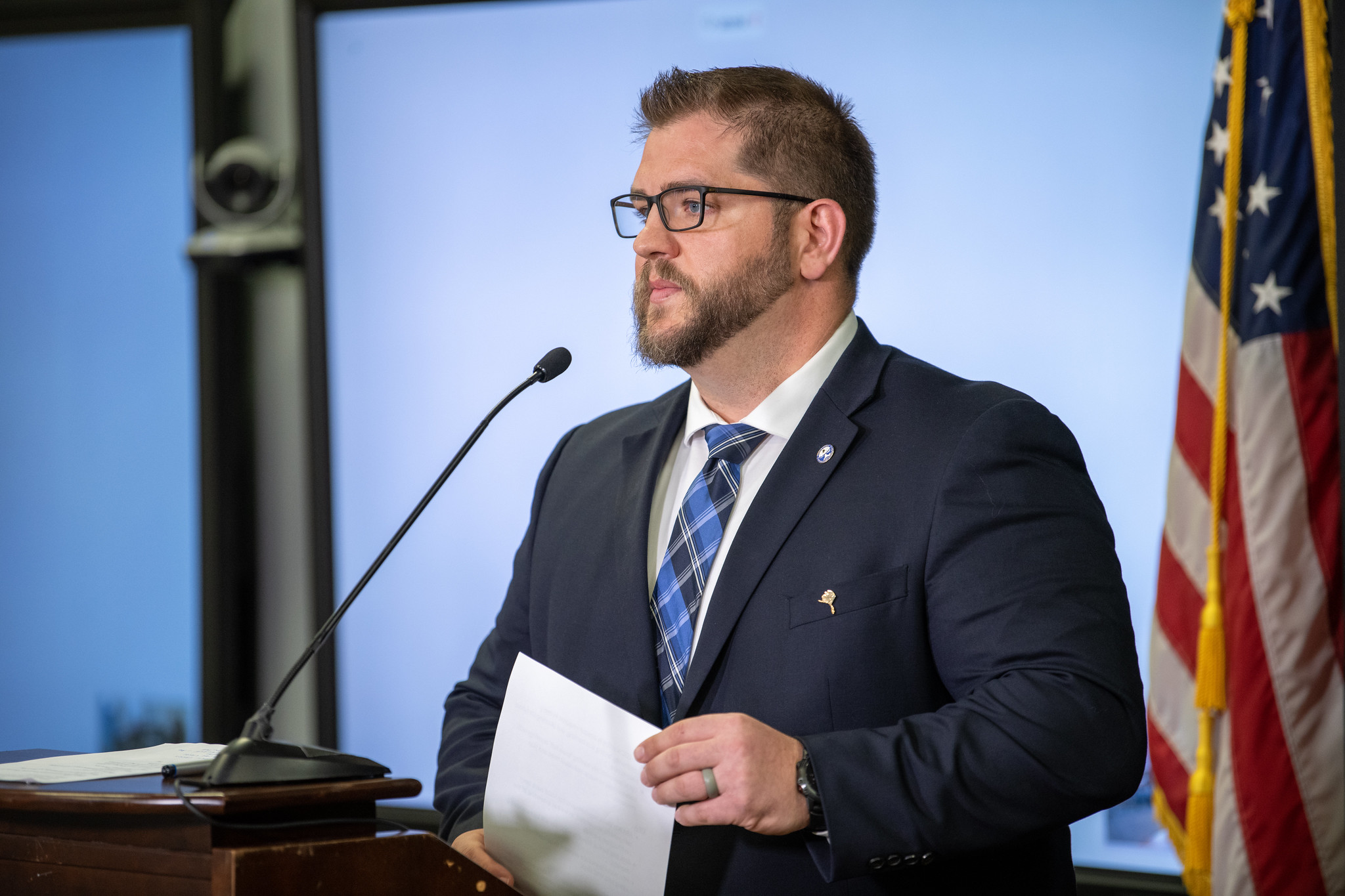
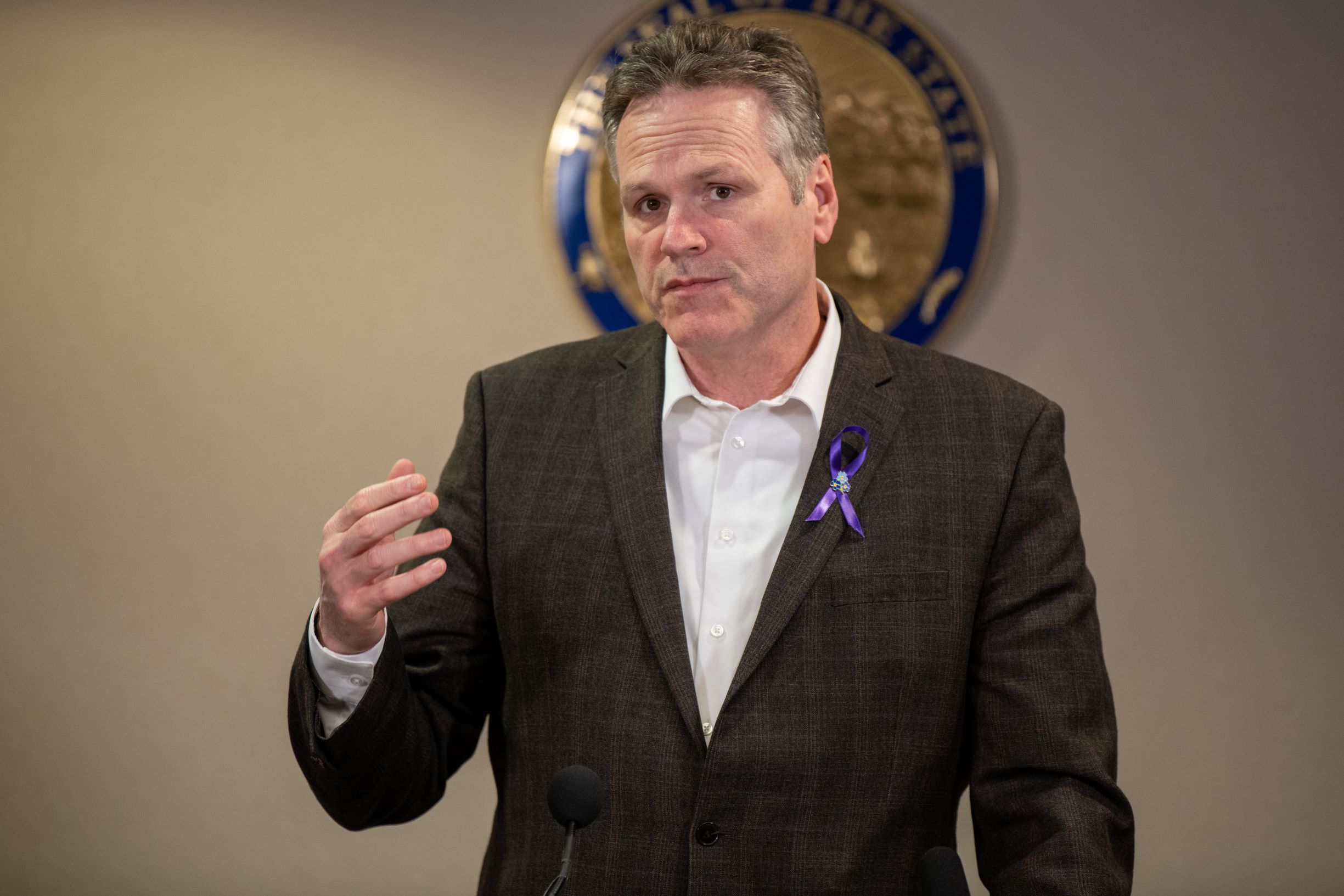
Alaska Republican Gov. Mike Dunleavy speaks at a news conference in 2020. (Photo courtesy of Office of the Governor)

Gov. Mike Dunleavy on Friday signed the bill extending the state’s COVID-19 disaster declaration into law, allowing some Alaskans to receive up to $9 million more in food aid for April than what they would normally receive.

But after signing the bill, Dunleavy ended the disaster declaration.

Shortly before Dunleavy ended the declaration, state Health and Social Services Commissioner Adam Crum declared a more limited public health emergency under powers granted by the newly signed law.

Crum said the disaster declaration had become stigmatized.

“The word ‘disaster declaration’ became a bad word,” he said in a news briefing. “And this became something to where people automatically will have a visceral response to it. And when we really evaluated where we are at — is this the same situation we were in, in November and December? And it absolutely is not.”

The law retroactively ratifies disaster extensions Dunleavy issued during the fall and winter. And it retroactively extended the disaster from mid-February through Friday.

The new public health emergency gives legal support for the state continuing to receive funding from the federal government, including for the food aid provided to households in need. It protects health care providers and state workers from legal liability from damages suffered by clients who contracted COVID-19.

Crum said ending the disaster declaration will give Alaskans a “mental break.” And he said the new law gives the state the tools it needs to maintain its public health response.

“Just to continue this level of protection, while at the same time, letting Alaskans, letting tourists, letting the state know that we are in a recovery phase,” Crum said. “We’re going to continue to do this, but we’re still going to put forward our health recommendations. We’re still going to make sure that the necessary tools to continue the response are available.”

Crum also said the state met a federal threshold required for Alaskans to receive up to $9 million in pandemic food aid, slightly higher than an earlier state estimate of $8 million. The end-of-month deadline to receive this month’s benefits served as motivation for lawmakers to resolve their differences over the legislation.

The governor’s actions drew mixed responses from legislative leaders. House Speaker Louise Stutes, a Kodiak Republican, said in a statement that Dunleavy “opted for politics over policy and decided to gamble with the health of Alaskans and with our economic recovery.”

Stutes and other members of the House majority had supported requiring testing for air travelers arriving in Alaska. The testing mandate expired with the disaster declaration in February. But state public health officials said many travelers are complying with a state recommendation to be tested, and that 20 to 30 positive cases are being detected weekly from travelers.

Senate President Peter Micciche, a Soldotna Republican, praised Dunleavy’s decisions to both sign the bill and end the disaster declaration.

“I think where we are in Alaska — right now — this was the right move,” he said.

The emergency will remain in effect until Crum rescinds it, or the federal public health emergency ends.

Alaska House committee votes against $3,000 PFDs over concerns about future permanent fund earnings

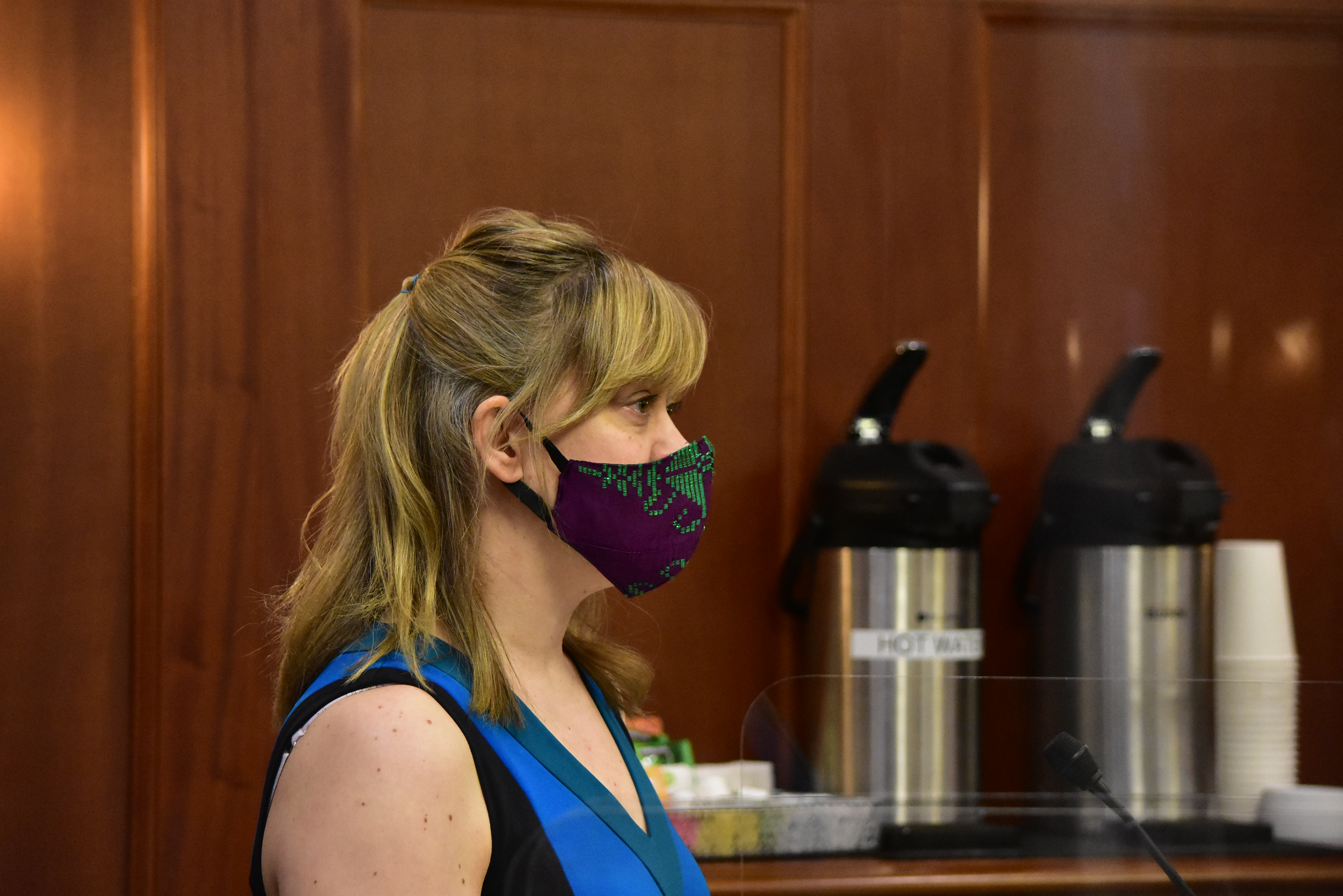
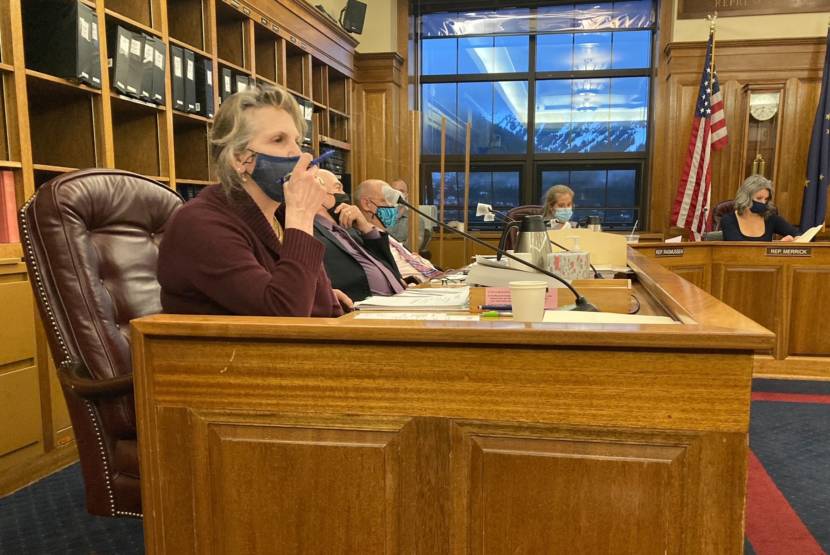
Palmer Republican Rep. DeLena Johnson pauses before commenting on her budget amendment to pay $3,000 dividends on Thursday in the Alaska State Capitol in Juneau, Alaska. Rep. Adam Wool, D-Fairbanks; Rep. Andy Josephson, D-Anchorage; a committee aide; Rep. Sara Rasmussen, R-Anchorage; and Rep. Kelly Merrick, R-Eagle River, are behind Johnson. (Photo by Andrew Kitchenman/KTOO and Alaska Public Media)
Palmer Republican Rep. DeLena Johnson pauses before commenting on her budget amendment to pay $3,000 dividends on Thursday in the Alaska State Capitol in Juneau. The amendment was defeated by a vote of 8-3. Rep. Adam Wool, D-Fairbanks; Rep. Andy Josephson, D-Anchorage; a committee aide; Rep. Sara Rasmussen, R-Anchorage; and Rep. Kelly Merrick, R-Eagle River, are behind Johnson. (Andrew Kitchenman/KTOO and Alaska Public Media)

The Alaska House Finance Committee rejected a proposal on Thursday that would have paid out permanent fund dividends of roughly $3,000 this year.

It was the first salvo in the annual argument over whether the state should follow the formula in a 1982 state law or follow a different law that limits how much can be drawn from permanent fund earnings.

Palmer Republican Rep. DeLena Johnson proposed the amendment to pay $2 billion for PFDs. She said lawmakers have avoided making other difficult decisions by not paying full dividends the past five years.

“By not paying the full, statutory PFD, it’s allowed us to kick the can down the road,” she said.

Her amendment was defeated by a vote of 8-3. Along with Johnson, Nikiski Republican Rep. Ben Carpenter and Nome Democratic Rep. Neal Foster voted in favor of the statutory PFD. Johnson proposed another amendment that would have used some federal American Rescue Plan Act money for full dividends, but it was defeated by the same count.

One of the votes against Johnson’s amendments was Anchorage Republican Rep. Sara Rasmussen. She had proposed making full dividends this year dependent on changing the formula for future dividends.

After Rasmussen’s proposal was voted down, she said she was concerned that the state would pay full PFDs until the permanent fund’s earnings reserve is emptied.

“I’m willing to have the conversation about the one-time, last statutory dividend, if we can find resolution,” she said. “But until we can reach a consensus, I will not be supporting it.”

The committee finished its budget amendments and moved the bill out of committee Thursday night. This sets up the budget debate in the full House this weekend.

This story has been updated to reflect that the committee finished its work on the budget amendments later on Thursday night.

Alaska lawmakers pass COVID-19 disaster declaration bill, with $8 million in federal food aid on the line

Speaker of the House of Representatives Rep. Louise Stutes, R-Kodiak, presides over a partially-filled floor session on Friday, Feb. 12, 2021. On April 28, 2021, the Legislature passed an extension to the state’s COVID-19 disaster declaration, which is retroactive to mid-February, when the last declaration expired. (Peter Segall/Juneau Empire via AP, Pool)

A bill that would extend Alaska’s disaster declaration was passed by the Legislature on Wednesday.

While the disaster declaration expired on Feb. 14, House Bill 76 would make the extension retroactive to that date. It would allow the state to operate under the declaration through the end of the year, although Gov. Mike Dunleavy could end the declaration at any time.

The Senate debated the bill over seven hours before passing it, 14 to 6. The House then voted 25 to 15 to agree to the changes the Senate made to the bill.

Senators differed over whether the disaster declaration should be in place.

Sen. Mia Costello, R-Anchorage, on Friday, April 23, 2021. (Peter Segall / Juneau Empire via AP, Pool)

Anchorage Republican Sen. Mia Costello supported an amendment that would have removed the governor’s powers under the disaster declaration from the bill, but kept other elements of the legislation. She said that instead of declaring a disaster, the state should declare a victory.

“I believe that this amendment strikes at the golden heart of this bill,” she said. “If this amendment were to pass, it would retain all of the things that the other branch has told us that they need in order to move forward.”

But Juneau Democratic Sen. Jesse Kiehl opposed the amendment. He said the future path of the pandemic is uncertain.

“Our state has taken the steps we needed when we needed them, and not more,” he said. “Occasionally, I may have wanted one or two more, but we have had success thus far. Let’s leave the tools available to the governor, in case we need to reinstate testing at our airports — testing that has caught more than 2,000 cases coming into Alaska.”

The amendment was narrowly defeated by a vote of 9 to 11.

The Legislature faced a tight deadline for getting the bill to Dunleavy’s desk. Some Alaskans would lose $8 million in federal food aid if he doesn’t sign the bill into law by Friday.

State Health and Social Services Commissioner Adam Crum sent Senate President Peter Micciche and House Speaker Louise Stutes a letter on April 23 warning them about the deadline.

Dunleavy proposed a similar bill before the disaster declaration expired. But after it expired, he said the state no longer needs to be operating under the declaration.

The administration supported different language for the bill that would not have extended the disaster declaration. That language was intended to maintain state access to federal funding, as well as the state’s ability to allocate and distribute COVID-19 vaccines.

Alaska Health and Social Services Commissioner Adam Crum speaks at a news conference on COVID-19, Wednesday, April 1, 2020. (Creative Commons photo by Office of Gov. Mike Dunleavy)

Even if Dunleavy signs the bill, he will have the option of ending the disaster declaration. The bill also would provide Crum with the ability to declare a more limited public health emergency. The only other state operating without a statewide disaster or emergency is Michigan. It’s operating under a similar order from its health department.

The six senators who voted against the bill are all Republicans in the majority caucus: Roger Holland, Anchorage; Shelley Hughes, Palmer; Robert Myers, North Pole; Lora Reinbold, Eagle River; Mike Shower, Wasilla; and Costello.

In the House, three minority-caucus Republicans joined the majority in voting to concur to the Senate’s changes: Reps. Mike Cronk, Tok; Bart LeBon, Fairbanks; and Steve Thompson, Fairbanks. Rep. Sara Rasmussen, an Anchorage Republican who is not in a caucus, also voted to concur.

National divide on whether there’s a problem with voting security reflected in Alaska proposals

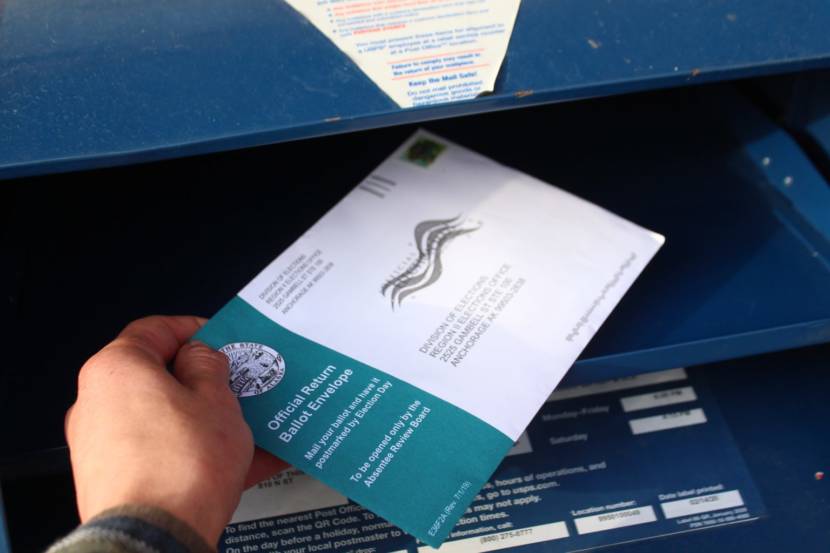
A voter mails an absentee ballot in October 2020.
A voter mails an absentee ballot in October 2020. Bills proposed in the Alaska Senate and House this year would overhaul the state’s voting system. (Lex Treinen/Alaska Public Media)

A national divide over how voters cast ballots has been reflected in the reactions to bills related to voter laws introduced in the Alaska Legislature this year. A Republican senator has proposed a bill he said would make elections more secure. But it’s raising concerns among advocates for making it easier to vote. They favor a bill proposed by a Democratic House member. 

When it comes to any potential changes to Alaska’s voting laws, passions are running high. Senators recently heard that firsthand, during public testimony on voting legislation, including from Pamela Samash of Nenana. 

“What makes America great is that we can vote,” she said. “But it’s worthless if it’s not a fair vote.  And I don’t believe at all that last election was fair at all. I think it was completely rigged.”

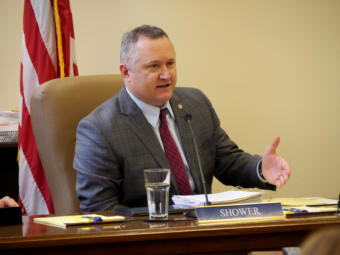
Sen. Mike Shower, R-Wasilla, at a committee hearing this year. (Photo by Skip Gray/KTOO)

Wasilla Republican Sen. Mike Shower said he knows many voters have lost trust in the system and so he’s focused on improving the integrity of Alaska’s elections. 

“This is a critical issue for the state and the country, that the citizenry gets back to a point where they can accept the election results,” he said.

Shower introduced a bill that would make many changes to how Alaskans vote, including introducing new technology in the form of something called “multi-factor authentication.” An example of this is when websites send users a code to their email or cellphone in addition to requiring their password to allow access. ‘

“We’re trying to drive ourselves to the point where we get into the 21st century, so that we use available technology to secure our elections, while making sure that we’re not putting up obstacles to people to actually be able to register and vote,” he said.

The measure, Senate Bill 39, also would require something similar to the blockchain technology used for cryptocurrencies like Bitcoin. 

Other elements of the bill would add a potential penalty related to the requirement over who can witness voter signatures on absentee ballot envelopes. Currently, witnesses can be an official qualified to administer oaths. But if the voter believes that an official isn’t “reasonably accessible,” they can use any adult as a witness. Under the bill, a voter would commit perjury if they used a nonofficial as a witness when an official was available. 

The bill would bar people from soliciting to help others mail their ballots, and would prohibit people from assisting mailing in more than six ballots. Shower has said he wants to prevent people who are paid to mail ballots. 

And it would require municipalities that use the state registry of voters in their elections to also have multi-factor authentication. 

People who want to make it easier to vote in Alaska have concerns about the bill. 

They include Celeste Hodge Growden, the president of the Alaska Black Caucus, which advocates for Black Alaskans. She said adding multi-factor authentication would add an unnecessary step when there isn’t evidence of voter fraud in the state.

“I don’t see it being a problem here, and so why introduce legislation that makes it seems like there are issues when there really isn’t?” she said.

Hodge Growden said she believes some of the proposals in the bill are forms of voter suppression, especially the parts that could make it harder to help people mail-in ballots or find witnesses. 

“The Alaska Black Caucus will do everything in its power to make sure it doesn’t become law,” she said. “We will no longer sit idly by.”

Shower has vehemently denied accusations of suppression, saying that his bill is intended to increase trust and includes some provisions making it easier to vote, like allowing voters to apply to receive mail-in ballots permanently.

Hodge Growden isn’t alone in having doubts about the Senate bill. 

Kendra Kloster, the executive director for Native Peoples Action Community Fund, is also concerned. Her nonpartisan organization advocates for the well-being of Alaska Natives and encourages voting. 

She said that changes to who can help voters mail-in ballots could prevent the kinds of help voters received last year when the pandemic made it difficult or dangerous for some people to return their ballots. 

“We heard through this last election cycle communities really coming together, and tribal leaders and tribes working to help during COVID of course — when people were often staying home or in quarantine or in lockdowns — on how we could help get ballots,”  he said. 

 She also noted that Shower has emphasized provisions of the bill that would encourage the Division of Elections to use more databases to update its records. 

The state has an unusually large number of people living outside of the state who remain enrolled in Alaska — there are 585,961 registered voters and only an estimated 525,000 eligible voters. In part, that’s because state law allows people to remain registered here as long as they plan to return and do not register to vote elsewhere. But Kloster said the division could make progress on cleaning up its voting rolls without many of the proposals in the Senate bill. 

She does like other provisions recently added to the bill, like the one allowing voters to apply to permanently receive mail-in ballots. It also would allow voters to fix errors on mail-in ballot envelopes that the Division of Elections finds that would prevent their vote from counting. This is allowed in some municipal elections but not in state elections.

Kloster offered support for a provision in the bill that would add tribal IDs to the list of forms of identification the division must accept. But she’s disappointed the bill would drop hunting and fishing licenses from that list. 

Both Kloster and Hodge Growden prefer a different piece of legislation, House Bill 66, sponsored by Anchorage Democratic Rep. Chris Tuck.

It would provide a way for voters to apply to permanently receive ballots to vote by mail and for ballot curing. It would also allow voters to register and vote on Election Day, which makes it easier to vote, though their ballots won’t count until after the Division of Elections checks their eligibility. It would raise the pay of election workers, locking in the $3 per hour increase the division issued last year as an emergency measure during the pandemic. And it calls for the state to provide postage to cover the costs of mailing in ballots. 

House Bill 66 is scheduled for a hearing in the House State Affairs Committee on Thursday. Senate Bill 39 is being considered by the Senate State Affairs Committee. State officials haven’t estimated the potential cost if either bill became law. 

In addition to those bills, lawmakers are considering Senate Bill 83, introduced by Lt. Gov. Kevin Meyer, who oversees the Division of Elections

Meyer’s bill would make smaller changes to the state’s election system.  It would expand the division’s ability to audit election results. And it would allow entirely by-mail elections in communities of less than 750 residents, if the division is unable to hire election workers. Meyer said it’s been a long-running challenge to recruit election workers in some villages.

Meyer said last year’s election went well in Alaska.

He noted that some voters raised concerns about the effect of the vote-counting machines made by Dominion Voting Systems. But he said a statewide hand count of the Ballot Measure 2 results confirmed that the initial count was accurate. 

“You know, having just gone through it, I think there’s enough check-and-balances in place that people should feel good about the elections, and the outcomes,” he said. 

Meyer also noted that the larger House and Senate proposed bills would go into effect for next year’s election. He said it already will be a challenge to conduct the election without any major changes from these bills. That’s because there’s already a large overhaul to election laws from Ballot Measure 2, and the scheduled launch of new election maps from the census. 

He said the Division of Elections should be able to give lawmakers input on what it would take to implement any major changes to elections. 

While the House and Senate bills have some things in common, Kloster said they represent two different approaches to voting. And with the legislative session ending by May 19, there isn’t much time to resolve the differences this year. 

Alaska House committee budget plan would provide less relief, save more than Dunleavy proposal

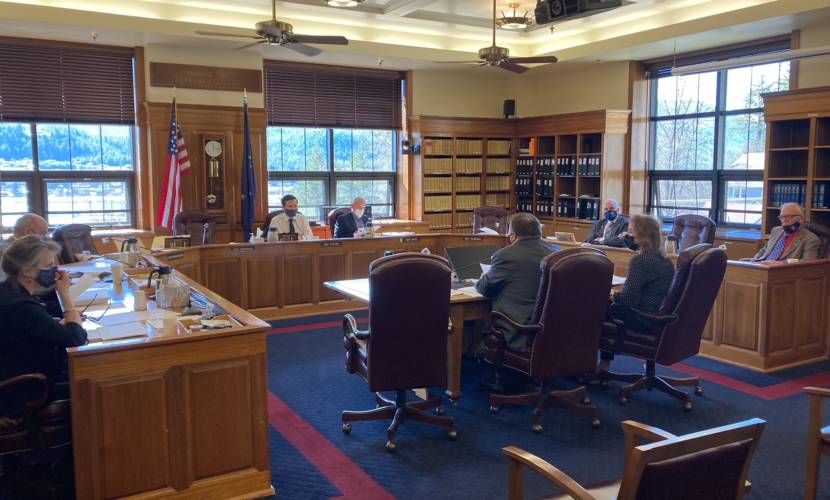
Alaska House Finance Committee members listen to a presentation on the committee proposal for how to spend American Rescue Plan Act funds on April 23, 2021, in the Alaska State Capitol in Juneau, Alaska. (Photo by Andrew Kitchenman/KTOO and Alaska Public Media)
Alaska House Finance Committee members listen to a presentation on the committee proposal for how to spend American Rescue Plan Act funds on Friday, April 23, 2021, in the Capitol. (Photo by Andrew Kitchenman/KTOO and Alaska Public Media)

The Alaska House Finance Committee proposed a very different plan from Gov. Mike Dunleavy on how to spend $1 billion in federal aid.

The draft committee plan released on Friday would free up roughly $410 million by using American Rescue Plan Act funds to replace state revenue. That money could be spent on permanent fund dividends; roads and other capital projects; or other items. 

The committee will consider changes to the draft proposal next week.

The proposal would provide grants totaling $80 million for local governments, $30 million for businesses and $30 million for nonprofits to offset money lost due to the pandemic. It also includes money $42 million to offset lost cruise-ship taxes.  

Roughly 30% of the $1 billion in federal rescue money would be held for next year. 

Dunleavy had proposed spending much larger amounts than the committee in relief for the tourism industry, other businesses and infrastructure, and replacing a much lower amount in state revenue — $139 million. 

The committee included its plan for the federal money in its overall draft proposal for the state operating budget that begins in July, which it also unveiled on Friday. That proposal is similar to what the governor proposed, except it doesn’t include funds for PFDs. 

The Legislature set the dividend amount shortly before the end of the session the last two years. Under the state constitution, the session must end by May 19. 

Committee members can propose amendments to the budget on Monday, April 26. When the committee is done with the budget, the full House will consider it. The Senate is working on its version of the budget. 

Site notifications
Update notification options
Subscribe to notifications