Andrew Kitchenman

State Government Reporter, Alaska Public Media & KTOO

State government plays an outsized role in the life of Alaskans. As the state continues to go through the painful process of deciding what its priorities are, I bring Alaskans to the scene of a government in transition.

Alaska lawmakers agree on a lot of the budget, but settling on a PFD amount remains a big challenge

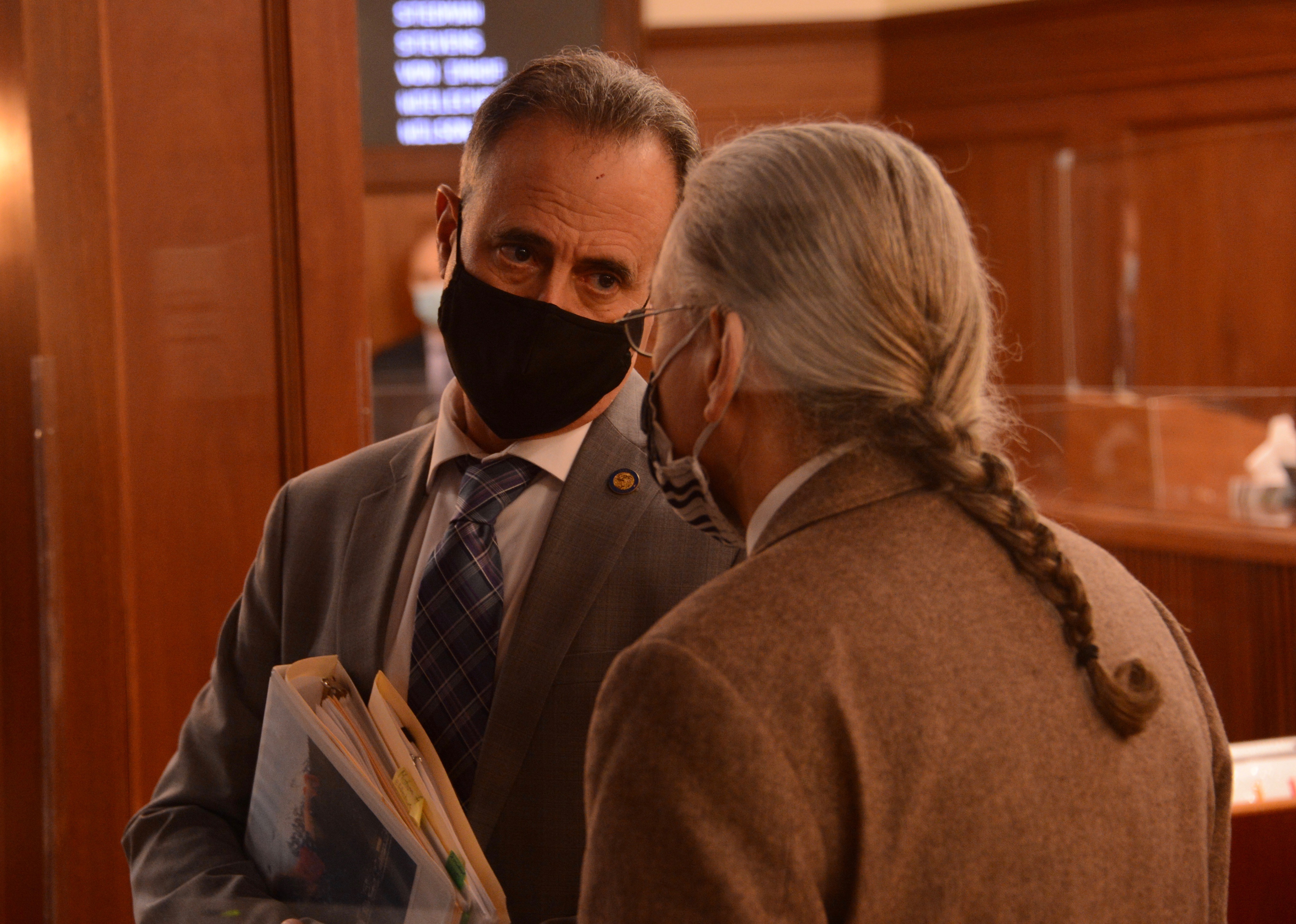
Alaska Senate President Peter Micciche, R-Soldotna, talks to Senate Minority Leader Tom Begich, D-Anchorage, before the start of a floor session on Wednesday, March 10, 2021 at the Alaska State Capitol in Juneau, Alaska. (James Brooks/Anchorage Daily News via AP, Pool)

While Alaska lawmakers agree over many parts of the state budget, they once again face a major challenge in determining the size of permanent fund dividends. But there are even larger obstacles to quick action on a proposed amendment that would put PFDs in the Alaska Constitution. They include uncertainty over everything from the price of oil to whether there will be new taxes.

Gov. Mike Dunleavy recently proposed amending the Alaska Constitution to include permanent fund dividends at a level that’s currently $2,300. And when the state Senate passed its version of the budget on Wednesday, that’s the PFD it went with.

That amount would be 50% of the annual draw from permanent fund earnings. A 2018 state law set that draw at 5 percent of the fund’s average value over the previous five years. The other 50% of the draw would pay for government services.

Soldotna Republican Senate President Peter Micciche says voting for dividends similar to the amount under this 50-50 formula was a statement about where senators stand, even if the details of the budget must be worked out.

“At some point, we’re going to have to get out of here,” he said. “But I think that the 50/50 is an important stake.”

The dividend at that level is less than the roughly $3,500 Alaskans would receive based on the formula in state law, which the state hasn’t followed in six years.

The $2,300 PFD amount received support from both conservative and liberal senators. So with the governor on board as well, why isn’t it on a clear path to being adopted?

It comes down to another number: $1.5 billion. That’s how much the state would draw over the $3 billion it already planned to spend from permanent fund earnings this year. If the state spent that much every year, nonpartisan budget experts project there would be nothing left in the permanent fund’s earnings reserve within 10 years, and no money for PFDs.

Nome Democratic Rep. Neal Foster chairs the committee that will recommend the PFD amount for this year to both chambers. The House Representatives didn’t include the PFD in its version of the budget and members of the House majority don’t want an overdraw. Foster says there will be give and take.

“But at the end of the day, it’s still an overdraw and I know that there’s a lot of folks who really don’t want to do that.”

Both Micciche and Foster believe some form of new revenue would be necessary to pay larger dividends than in recent years. But Gov. Mike Dunleavy hasn’t supported any large new taxes, and he says any broad-based statewide tax like a sales or income tax would have to be approved by voters.

Foster says the governor’s position is a potential hurdle.

“A lot of folks on both sides of the aisle are in agreement that, you know you seriously need to look at additional revenue, but if right off, right out of the starting gate, you’ve got that issue of, you know, the governor saying no new taxes unless it goes for a vote — that is a challenge,” he said.

Micciche says the administration knows that setting dividends at 50% of the draw would leave a large hole in the budget. But Dunleavy used only generic language about revenue in his proclamation for a second special session. So Micciche wants Dunleavy to introduce specific revenue bills to fill the hole.

Some lawmakers remain adamant that neither taxes nor a change in the dividend formula should happen until there’s a new limit placed on how much the state can spend.

Wasilla Republican Rep. Cathy Tilton leads the House minority caucus.

“We would definitely like to see some long-term budget reduction. Some big-picture budget reduction,” she said. “I’m not talking about going into agency (budgets), but what can we do to bring the cost and the spend of government down.”

Another challenge to finding a long-term solution is getting lawmakers to agree on the size of the problem. A computer model used by the Legislature’s nonpartisan budget analysts forecast a deficit of roughly $1 billion per year over the next nine years with dividends equaling half of the draw.

But the administration projects deficits that are somewhat more than half that size, roughly $600 million per year. Much of the difference between that number and what the legislative model forecast is due to the administration assuming that future budgets will include cuts that the governor hasn’t proposed yet.

And lawmakers continue to talk about how the deficit would shrink if the permanent fund grows faster than projected. The fund has grown dramatically over the past year, and is now worth more than $77 billion dollars.

Anchorage Democratic Sen. Tom Begich says the Legislature and Dunleavy must start off on the same page about the size of the gap.

“It’s critically important for us to work off of the same assumptions,” he said. “And that’s the problem we have here. We have different sets of assumptions.”

Two changes that happened in March made the apparent size of future state deficits much smaller. Between December and March the administration substantially increased its forecasts for both oil prices and production over the next decade.

In December, the administration forecast that oil would be $57 per barrel in 2030, and oil production would be 481,800 barrels per day. In March, it forecast $71 per barrel oil in 2030, and production reaching 565,500 barrels per day.

Altogether, the oil revenue forecast for 2030 increased by 70% in three months. It has the effect of cutting the projected deficit by an average of $600 million per year over the next decade.

University of Alaska Anchorage economist Mouhcine Guettabi says lawmakers’ eyes have to be open to the risk involved.

“I was really surprised that nobody seems to be talking about the big effect the revision is having on the conversation,” he said.

Guettabi says it’s difficult to forecast the global and complex oil market.

“This is a big bet — if you want to call it that — that there is this kind of big increase in oil prices, that there is some increase in production,” he said.

He notes that oil production has fallen since 1988, so a decade-long rise would be a large change.

And if the oil forecast is wrong, Guettabi notes that the state could be facing large deficits in the future, even if lawmakers can agree on a long-term plan for the budget.
Alaska’s regular legislative session ends without finalizing a budget or PFD amount

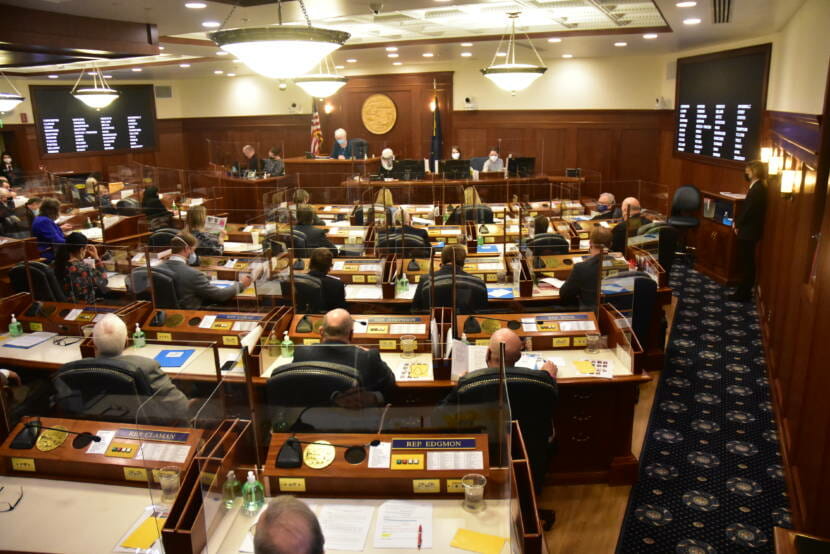
Alaska House representatives sit in their desks facing House Speaker Stutes. The back of their heads are facing the camera and plexiglass dividers are between each desk.
Members of the Alaska House of Representatives prepare for a floor session on Wednesday, Feb. 24, 2021. (Peter Segall/Juneau Empire via AP, pool)

Alaska lawmakers’ regular session ended Wednesday, but they have a lot of work left to do on the state budget, and they still need to finalize the size of this year’s Permanent Fund dividend.

Under a version of the state budget approved by the Senate Wednesday, Alaskans would get PFD checks of about $2,300. But not everyone agrees on that amount. Critics say it’s way too much money to draw from the fund’s earnings reserve.

A 30-day special session to address these issues is scheduled to start at 10 a.m. Thursday.

‘People’s lives we’re talking about’

Sen. Shelley Hughes (R-Palmer) voted for an amendment Wednesday for $2,300 PFDs.

The dividend benefits every Alaskan, she said, and she wants it added to the state constitution, ensuring it’s paid before other state expenses.

“Then we could settle this once and for all, and we will know what we need in order to pay for government, once we take the first call for the PFD,” said Hughes.

Sen. Mike Shower (R-Wasilla) said a $2,300 PFD is a step in the right direction, and lawmakers should look beyond the numbers.

“How do you balance the budget?” he said. “Well, there’s more than that. There’s people’s lives that we’re talking about. And their ability to survive and thrive and have a good quality of life.”

But a $2,300 dividend would require drawing $1.5 billion more than planned from the Permanent Fund’s earnings reserve.

‘Sick and tired of kicking the can down the road’

Sen. Lyman Hoffman (D-Bethel) voted no on the amendment, as well as on another amendment that would have paid dividends of more than $3,000. He said he supports larger dividends, but paying them when the budget isn’t balanced will put off resolving the issue.

“So today, I’m a big supporter of the dividend,” Hoffman said. “I’m a big supporter of trying to resolve the problem. And I’m sick and tired of kicking the can down the road.”

Sen. Bert Stedman (R-Sitka) warned against drawing down the earnings reserve. He said paying a smaller dividend of $1,000 this year would allow the Permanent Fund to grow to benefit future generations.

“They’ll have very nice, handsome dividends, our grandchildren,” Stedman said. “I don’t want them to look back in the history books of my ancestors that helped, you know, lived in Alaska at the time they put it together. And me liquidating it.”

More work to do in special session

Gov. Mike Dunleavy has put two items on the agenda of the special session that starts Thursday: finishing work on the budget and consideration of a constitutional amendment that would enshrine the PFD in the constitution.

Lawmakers have been deeply divided for six years over how to pay for dividends and how high PFDs should be.

Sen. Bill Wielechowski (D-Anchorage) said the budget problem is due to low oil taxes. He described the state government’s message to industry:

“Go ahead, take the resources — don’t have to compensate us. Pay the lowest taxes in the world. And instead we’re going to take it from the people. And that is unfair. The people need to understand that,” Wielechowski said. “They need to know that this is a tax on them. This is unfair.”

Shower said a statewide sales tax could contribute to closing the budget gap.

But Natasha von Imhof (R-Anchorage) said it doesn’t make sense to tax one group of Alaskans to pay for larger dividends.

“I cannot be the senator that taxes hard-working Alaskans and takes money from their paycheck only to deposit it in the personal checking account of their neighbor,” she said.

Other Senate amendments would provide $13 million for a trail from Fairbanks to Seward and allow COVID-19 business grants to pay for pandemic recovery costs. But the Senate rejected adding language similar to the House bill intended to block state Medicaid funding for abortions. The Alaska Supreme Court has ruled that similar laws unconstitutionally singled out the procedure.

Since the House and Senate didn’t agree on each other’s versions of the budget, there will be a committee with three members from each chamber that will work out the differences between the two chambers. It could set the PFD at a smaller level than the Senate.

The Senate members will be Click Bishop (R-Fairbanks), Donny Olson (D-Golovin) and Stedman. The House members will be Neal Foster (D-Nome), Kelly Merrick (R-Anchorage) and Steve Thompson (R-Fairbanks).

Flurry of bills approved at last minute

In addition to the work on the budget, lawmakers ended the session with a flurry of other activity.

Fifteen bills will head to Gov. Mike Dunleavy’s desk for him to sign or veto.

They include a bill that allows people to share ownership of a dairy producing animal and pay another owner for raw milk or other dairy products made from raw milk. It would remain illegal to sell raw milk to those who don’t share ownership.

Another bill would expand the rights of people who live in assisted-living homes. Providers will be required to allow visitors. Residents would have a right to internet access and to meals consistent with their cultural preferences.

Work on bills that only passed one chamber will resume during the next regular session in January.

Alaska Senate passes bill to pay for Alaska’s essential and laid-off workers to attend college

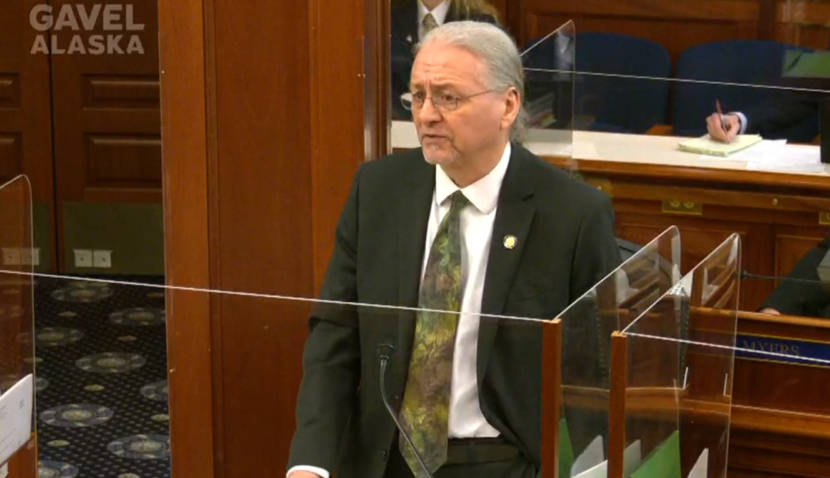
Sen. Tom Begich, D-Anchorage, speaks in favor of Senate Bill 10 on May 17, 2021, in the Senate chamber of the Alaska State Capitol. The bill would pay tuition for Alaskans who were employed as essential workers or laid off at the beginning of the COVID-19 pandemic. (KTOO 360TV screen capture)
Sen. Tom Begich, D-Anchorage, speaks in favor of Senate Bill 10 on Monday, May 17, 2021, in the Capitol. The bill would pay tuition for Alaskans who were employed as essential workers or laid off at the beginning of the COVID-19 pandemic. (KTOO 360TV screen capture)

A bill that passed the Alaska Senate on Monday would pay university tuition for Alaskans who were employed as an essential worker or were laid off when the federal COVID-19 emergency began. 

Senate Bill 10 would provide up to $10 million through the end of 2024 for students to attend Alaska colleges or other state-certified postsecondary programs. Students must apply for grants this year. 

Anchorage Democratic Sen. Tom Begich sponsored the bill. He said it’s in thanks for those who put themselves at risk.

“Folks lost opportunity during this pandemic,” he said. “They lost work. They lost their health. I’m urging a yes vote in support of those frontline workers — and those who’ve suffered, whether from the pandemic directly or from loss of employment.”

The funding would come from the state’s share of the federal American Rescue Plan Act money. Begich noted that people with college degrees are paid more on average than those without. 

“It’s about giving those who’ve given up so much during the pandemic something that could be life-changing,” he said. “The path to a successful democracy is an educated public.”

Anchorage Republican Sen. Natasha von Imhof voted for the measure. She said it’s a form of investment in the state. And she emphasized that being able to use the federal pandemic aid was appropriate, and would avoid spending other state money.

Palmer Republican Sen. Shelley Hughes voted against the bill. She said the money could be spent for a different purpose. 

“Even though it’s going to be paid by all federal aid … that seems good, but those are all public tax dollars,” she said.

The Senate passed the bill 12 to 7. All seven Democrats voted for it, as did Republican Sens. Click Bishop of Fairbanks; Josh Revak of Anchorage, Bert Stedman of Sitka, Gary Stevens of Kodiak and von Imhof. The other Republicans voted against it, except for Sen. Mia Costello of Anchorage, who was absent.

The bill now goes to the House of Representatives. If the House passes it, Gov. Mike Dunleavy would decide whether to sign it or veto it. 

Alaska Senate president lays out different timeline from governor on budget, permanent fund changes

Sen. Peter Micciche, R-Soldotna, listens to testimony in a 2018 meeting. He is now the Senate president. He said on Friday that lawmakers could pass the state budget before the special session Gov. Mike Dunleavy called for May 20. (Photo by Skip Gray/KTOO 360TV)

The president of the Alaska Senate is laying out a different timeline for trying to solve Alaska’s long-term budget problem than Gov. Mike Dunleavy. 

Senate President Peter Micciche welcomed Dunleavy’s call for a special session in August to address the state’s long-term budget problem. 

But Micciche, a Soldotna Republican, said on Friday that lawmakers are working to finish their work on the budget by the end of the regular session. And he questioned whether this month is the right time to consider changes to the Alaska Permanent Fund without other large budget changes.

Dunleavy issued the first of two special session calls for Thursday to finish the budget and pass a constitutional amendment regarding the permanent fund. Micciche said it may be more appropriate for the Legislature to consider permanent fund dividends along with other issues in August. 

“We have to take the PFD issue off the table. And whatever solution that is has to be funded,” he said. “But people [will] have been here for 121 days by then. And those are big items.”

House Speaker Louise Stutes has praised Dunleavy for engaging with legislators on major long-term issues. But she agreed with Micciche that it would be difficult to pass the governor’s plan for dividends before considering other legislation. The plan would devote 50% of the annual draw from the permanent fund for dividends. 

“How can you put a 50% PFD out there with no way to pay for it?” Stutes said while emphasizing that this was her personal view and that the House majority caucus has to discuss the special session plan.

The regular session is scheduled to end on Wednesday. The first special session would begin on Thursday.


Alaska legislators end face mask mandate in Capitol

Eagle River Republican Sen. Lora Reinbold waves her mask immediately after taking it off on May 14, 2021, in the Alaska State Capitol in Juneau. (photo by Andrew Kitchenman/KTOO and Alaska Public Media)
Eagle River Republican Sen. Lora Reinbold waves her mask immediately after taking it off on Friday. The Legislative Council had voted to end a mask requirement in the Capitol. (Andrew Kitchenman/KTOO and Alaska Public Media)

Legislators and others in the Capitol are no longer required to wear face masks to prevent the spread of COVID-19. 

The Legislative Council voted unanimously on Friday to replace the requirements with a more limited set of rules. Masks became optional, though there are exceptions if individual legislators require them for their offices. 

Soldotna Republican Senate President Peter Micciche was eager to address mask-policy opponent Sen. Lora Reinbold immediately after the vote.

“If I may, Sen. Reinbold, you can remove your mask now,” Micciche said to laughter and applause from people in the room.

Lawmakers cited new Centers for Disease Control and Prevention guidance for fully vaccinated people in making the change. The new policy covers everyone in the Capitol, including those who are unvaccinated. The policy change also dropped a requirement that unvaccinated people undergo weekly tests for the coronavirus. The tests are now a recommendation. 

The Legislature hasn’t changed the rule that closed the Capitol to members of the public. The building has been limited to lawmakers, legislative aides, news reporters and some state employees. 


Gov. Dunleavy calls for special sessions on budget, permanent fund, taxes and spending

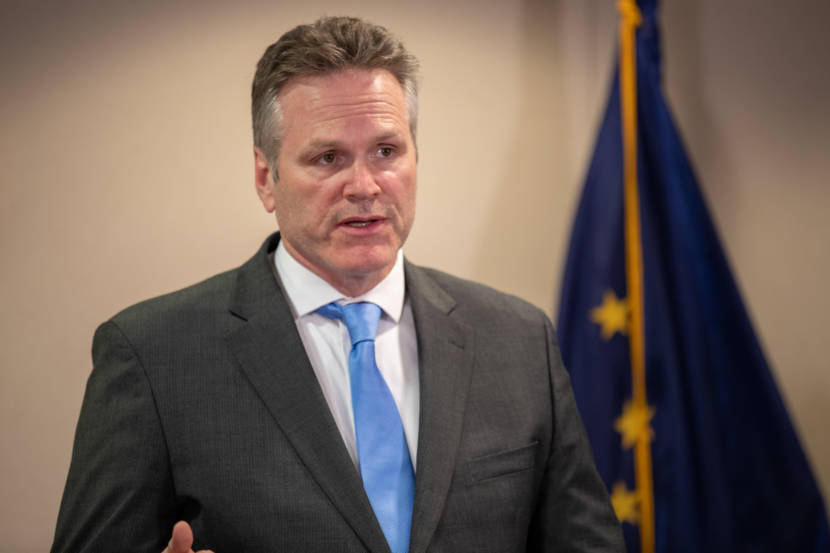
Gov. Mike Dunleavy during a press conference in March 2020. (Office of the Governor)

Gov. Mike Dunleavy announced on Thursday afternoon that there will be two, upcoming special legislative sessions.

The first 30-day session would begin on May 20, the day after the regular session ends. It will focus on finishing work on the state budget, and on a constitutional amendment intended to protect the permanent fund’s earnings reserve, permanent fund dividends and a fund lowering rural electricity costs. 

Dunleavy said in a statement that it was clear that more time is needed based on his conversations with legislative leaders. 

“Nothing is more important than giving Alaskans a long-term solution to our fiscal challenges, and this session is an important first step,” he said in the announcement.

The second special session would begin on Aug. 2. Dunleavy is directing the Legislature to work on constitutional amendments to limit spending and to require a vote by Alaskans before new taxes can be instituted. It would also consider potential bills to increase state revenue and to spend federal relief funds.

Site notifications
Update notification options
Subscribe to notifications