State Government Reporter, Alaska Public Media & KTOO
State government plays an outsized role in the life of Alaskans. As the state continues to go through the painful process of deciding what its priorities are, I bring Alaskans to the scene of a government in transition.
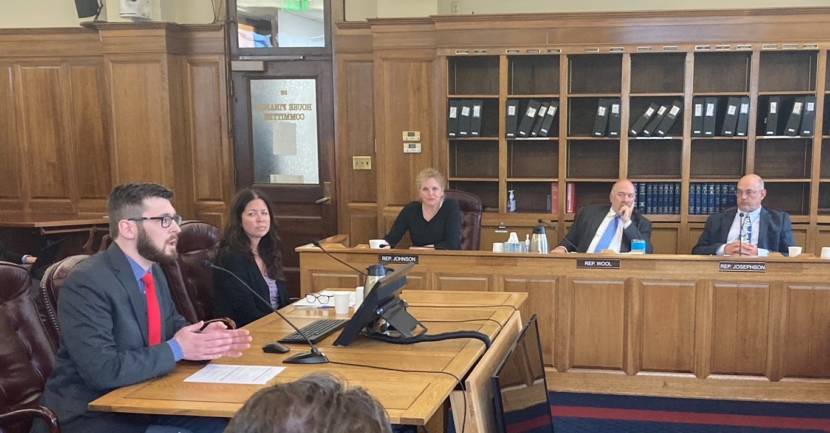
Alaska Office of Management and Budget Director Neil Steininger (left) responds to questions from House Finance Committee members in the Capitol on Thursday. The others in the photograph are, from the left, state Division of Personnel and Labor Relations Director Kate Sheehan; Rep. DeLena Johnson, R-Palmer; Rep. Adam Wool, D-Fairbanks; and Rep. Andy Josephson, D-Anchorage. The committee also heard from business leaders concerned about a potential state government shutdown on July 1. (Photo by Andrew Kitchenman/KTOO and Alaska Public Media)
Routine road maintenance, veterans services, student loans, the PFD division — these are among the state programs that will be shut down if lawmakers don’t agree to make the budget effective on July 1.
Many other state services will continue to operate, while others will be partially shut down.
The House Finance Committee heard on Thursday from industry leaders who expressed concern about the impact of a shutdown on the private sector.
Sarah Leonard, president of the Alaska Travel Industry Association, is concerned about the loss of staff in state parks. The ATIA would receive money in the state budget.
“ATIA’s current national marketing campaign attracting pandemic-weary travelers would cease in the event of a shutdown, effectively cutting the cord of our microphone right now as we are saying to the world: ‘Go big, go Alaska, and we welcome you,’” she said.
Marcus Trivette is a construction executive with Fairbanks-based Brice Inc. and a board member of the Associated General Contractors of Alaska. He said the worst-case scenario is that permitting office closures could ruin an entire season of building. But he said even a shorter delay would hurt.
“Alaska’s private sector employers are in a precarious position coming out of a pandemic and in the midst of a recession,” Trivette said. “A government shutdown, even a partial one, will negatively impact our ability to get work done and will cost us time and money.”
Gov. Mike Dunleavy’s administration published a list on Wednesday of what state government services will operate in the event of a state government shut down.
State Office of Management and Budget Director Neil Steininger told the committee that the state was balancing multiple goals: On the one hand, it must provide constitutionally required services. On the other hand, the state is not supposed to spend money that hasn’t been included in a law that has gone into effect.
“There’s a clear constitutional obligation for the public health and public safety that we feel weighs higher than that consideration of valid appropriations,” he said.
Services that would be fully shut down include the senior benefits program, the Department of Corrections’ domestic violence program, the state’s medical education program, and teacher certification.
Other programs potentially to be shut down are: the Department of Health and Social Services’ tribal assistance programs; tourism and seafood marketing; Power Cost Equalization payments; the Alaska Vocational Technical Center; and the Alaska Police Standards Council.
The Division of Motor Vehicles would also be shut down, except for functions that support law enforcement and the courts.
No more details about legislative talks to prevent a shutdown were released through late Thursday afternoon.
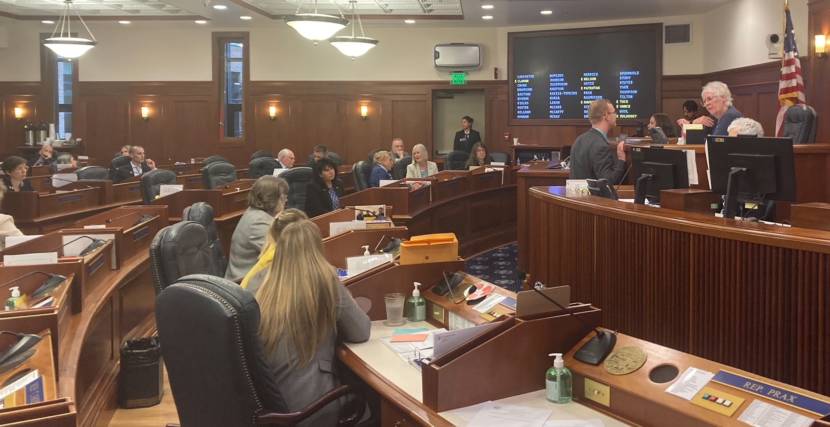
Alaska House of Representative members attend the first floor session of the second special session this year on June 23, 2021, in the Alaska State Capitol in Juneau. House Speaker Louise Stutes, R-Kodiak, on the far right, talks with Rep. David Eastman, R-Wasilla, about comments he was making on the floor. (Photo by Andrew Kitchenman/KTOO and Alaska Public Media)
A new version of the state budget from Gov. Mike Dunleavy would set the permanent fund dividend at roughly $2,350. But it would draw more than planned from permanent fund earnings.
The new budget bill, Senate Bill 2001, was introduced on Wednesday, the first day of the second special session.
Lawmakers are discussing what it will take to avoid a state government shutdown on July 1. A vote in the House on the original budget bill, House Bill 69, fell four votes short of the number needed to make the budget effective on that date.
Leaders from both House caucuses said that their talks are focusing on the vote on the effective date for the budget bill the Legislature has already passed.
House Speaker Louise Stutes, a Kodiak Republican, was positive about the negotiation.
“Nobody wants a shutdown,” she said. “And I’m very optimistic.”
Palmer Republican Rep. Cathy Tilton, the minority caucus leader, agreed that no legislators are “hoping for a shutdown.” She said members of her caucus want a public agreement from majority caucus legislators on the components of a long-term plan for the state’s budget. She said what lawmakers have said so far isn’t enough.
“We’ve had this 154 days of no discussion about what this structural fix looks like, and we’ve had a plan that’s been put in front of us — albeit a governor’splan and maybe not a perfect plan — but we have not even had discussion on that,” Tilton said.
Tilton would not provide information on the details of the agreement her caucus is seeking, saying they are part of the negotiation.
Rep. Sara Rasmussen, an Anchorage Republican, was absent for the first budget vote. She said she would vote to make the budget effective on July 1, which would reduce the number of votes needed to prevent a shutdown to three. Sixteen members of the 18-member House minority voted against making July 1 the effective date for the budget, while all majority caucus members and Fairbanks Republican Reps. Bart LeBon and Steve Thompson also voted for it. Rasmussen is not a member of either caucus.
Members of the mostly Democratic House majority caucus have said Dunleavy, a Republican, chose to make a shutdown possible. They have said decades of precedent and legal opinions support keeping the state government open. The current Department of Law disagrees that the precedents apply to what’s happening this year.
Attorney General Treg Taylor filed a lawsuit seeking an opinion from the courts on the issues under dispute. Anchorage Superior Court Judge Herman Walker scheduled oral arguments in the case for next Tuesday, June 29, one day before the deadline to avoid a shutdown.
The House Finance Committee is scheduled to meet on Thursday afternoon to discuss the effective date of the original budget bill.
CORRECTION: This story has been corrected to reflect the correct days for oral arguments in the state lawsuit and the deadline to avoid a shutdown.
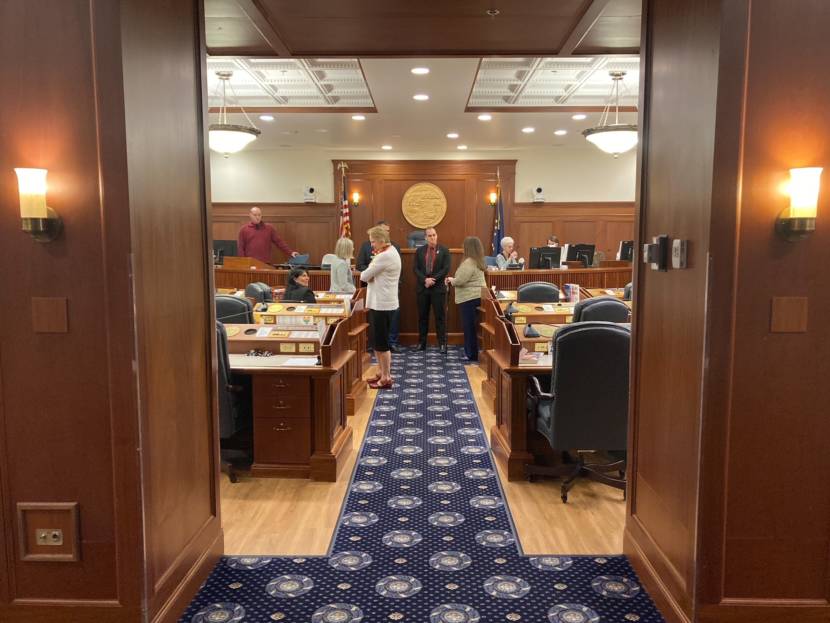
Members of the Alaska House of Representative mill around the front of the House chamber before a brief technical session on Friday in the Capitol. A new special session to prevent an impending state government shutdown is scheduled to begin on Wednesday. (Photo by Andrew Kitchenman/KTOO and Alaska Public Media)
Legislators are converging on Juneau for the second special session that starts on Wednesday.
Gov. Mike Dunleavy has cited the failure of a vote related to the budget bill in announcing the shutdown.
Four more House members would have to vote for the budget to go into effect on July 1 to prevent a shutdown.
State officials are assessing which state services will continue and which will cease if the government shuts down on July 1, according to a spokesperson for the governor.
State workers received a document on Tuesday that provides details about how the shutdown will affect them. According to the document, workers who are required to work during the shutdown will be paid. But workers who are laid off or furloughed will not be paid for the time they’re out of work.
Workers will continue to have health insurance in July. But laid off workers won’t have health insurance in August, according to the document, if the shutdown continues that long.
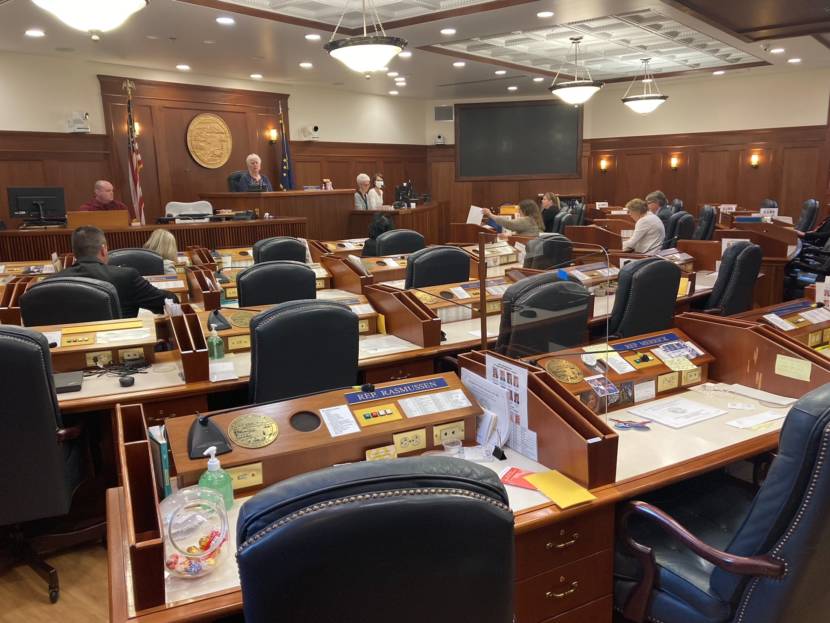
Alaska House Speaker Louise Stutes, R-Kodiak, in front, presides over a nearly empty chamber on the last day of the special session. There was a brief technical floor session. Gov. Mike Dunleavy has called the Legislature into another special session starting on Wednesday. (Photo by Andrew Kitchenman/KTOO and Alaska Public Media)
The Alaska legislative special session ended on Friday without an agreement to avoid a state government shutdown on July 1. Gov. Mike Dunleavy called the Legislature back into a new special session to start on Wednesday, June 23, with the goal of reaching agreement.
He issued the call shortly after the House held a brief technical floor session to end the first 30-day special session.
Nearly 15,000 Alaska state workers received layoff notices on Thursday.
Legal Arguments
Dunleavy and the Department of Law cite a section of the state constitution in giving the reason for the shutdown. That section requires that bills go into effect 90 days after they become laws, unless two-thirds of both legislative bodies approve a different day. While the Senate had enough votes to approve July 1 as the day when the budget would go into effect, the House didn’t.
“The budget passed this week is constitutionally impaired if the goal was for it to take effect on July 1,” said Dunleavy.
House majority leaders said on Friday that the layoff notices and potential shutdown were Dunleavy’s choice. They point to a history of Alaska governors spending money based on bills that lacked the same effective-date provision as this year’s budget bill. And they did it based on advice they received from state lawyers. They say he could draw from available funds to cover state spending during the time period before the legal effective date.
“His choice to send out pink slips is a very sad day for Alaskans,” said House Speaker Louise Stutes of Dunleavy. “To put them on shaky ground needlessly is very distressing.”
Stutes is a Kodiak Republican who leads a caucus with 15 Democrats, four independents and one other Republican.
House majority leaders said Dunleavy should ask members of the House minority to vote for the effective date.
Dunleavy told conservative talk show host Michael Dukes on Friday that the House majority tried to pressure the minority.
“Nobody should be strong-arming the other side,” he said. “They’ve got to sit down and work together and craft something that’s going to work, in which they want to bring people together, as opposed to twist arms and force them to vote. And that’s what happened the other day. That arm-twisting didn’t work. This is the result.”
What budget opponents want
With a shutdown on the horizon, legislators who voted to block the budget from going into effect on time gave the first public outline of what they want to avoid the shutdown.
Members of the Republican House minority caucus said they want agreement on the components of a long-term plan for the state budget.
Rep. Cathy Tilton did not say how detailed the agreement on the components must be. But she did say it extends beyond passing the budget.
“The budget is a part of that conversation,” she said. “It’s an integral part. But it’s not the only component of this long-term fiscal stability that we’re looking to get to.”
Other Republicans who voted against a July 1 start to the budget emphasized specific issues.
Anchorage Rep. James Kaufman said he wants the Legislature to agree on what the sequence of policy changes will be, including which changes must happen at the same time.
“For me, what this would look like would be the framework — the master framework — of what we’re doing, what components have already been put in place, and then what possible pieces need to be in place that are not yet there,” he said.
North Pole Republican Rep. Mike Prax emphasized that the permanent fund dividends should be drawn from permanent fund earnings, and not other sources of funding, like most of the dividend money was in the budget bill.
“The permanent fund dividend is only a permanent fund dividend, if it comes from the earnings of the permanent fund: easy concept,” he said, adding that if it comes from some other account it “is not a permanent fund dividend. We have to start recognizing that, and not letting them get away with deceptive words.”
Dividend remains controversial
Like in other years, lawmakers remain divided over the size of PFDs.
In May, Dunleavy proposed making dividends half of the annual draw from the permanent fund as part of a constitutional amendment to move permanent fund earnings into the constitutionally protected principal. This year’s dividend under the formula change would be roughly $2,350, rather than the roughly $3,500 they would receive under a formula in state law that hasn’t been followed the past five years.
But lawmakers who worked on the budget are concerned that dividends of that size will draw down the earnings reserve account (ERA) and threaten the permanent fund’s future.
Eagle River Rep. Kelly Merrick is, along with Stutes, one of the two Republicans in the House majority. She noted that Dunleavy’s administration wants the Legislature to adopt the $2,350 dividend formula before any other major changes.
“They are hoping to have that conversation about revenue and cuts later,” she said. “And I feel like it needs to be done at the same time, because you can’t pay out a big PFD now and decide how to pay for it later.”
Nonpartisan legislative analysts estimate the governor’s PFD proposal would lead to an average deficit of $1 billion per year for the next nine years under current state policies. Dunleavy’s administration hasn’t proposed policy changes on the scale necessary to close this gap.
The nonpartisan analysts estimate that without new revenue or spending cuts, the state budget would be balanced in the long term with dividends of roughly $500 to $600.
Dillingham independent Rep. Bryce Edgmon, a member of the House majority caucus, said the state may be able to pay dividends in the range of the $1,100 included in the original version of this year’s budget without instituting a broad-based tax.
“We have the ability — if we do it right — to maintain essential services to the degree that Alaskans depend on them; have a sustainable permanent fund dividend at around the historical average of the dividend since it began in 1982; and have an environment where we continue to have low taxes in Alaska,” he said.
Power Cost Equalization, scholarships remain unfunded
The failure of the effective date vote on the budget isn’t the only outstanding budget issue. Both chambers failed to pass a provision to draw funds from the Constitutional Budget Reserve.
Every year, that vote is used to re-stock dozens of funds, including the $1 billion Power Cost Equalization Fund, which lowers the cost of electricity in rural and other high-cost areas.
The $340 million Alaska Higher Education Investment Fund also is maintained through the CBR vote. It funds $11.8 million in Alaska Performance Scholarships for high-achieving students and $6.4 million in Alaska Education Grants for students with financial need.
To restore these funds would require an even higher vote threshold then to pass the effective date clause — three quarters of both legislative chambers.
The next special session is scheduled to begin at 10 a.m. on Wednesday in the Capitol.
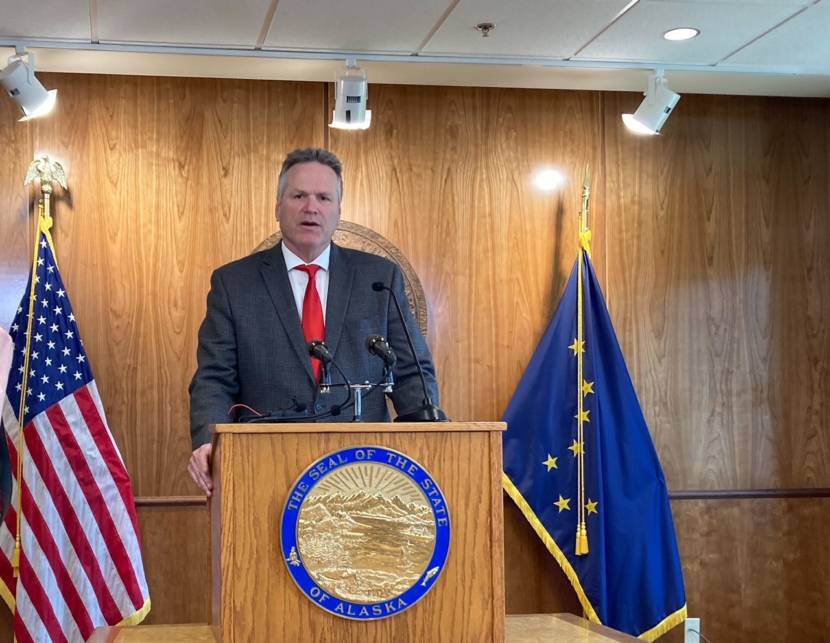
Gov. Mike Dunleavy at a press conference on June 17, 2021. (Photo by Andrew Kitchenman/KTOO)
Gov. Mike Dunleavy announced that layoff notices are being sent to state workers on Thursday. He said that’s because the budget the Legislature passed is “defective” because it won’t go into effect by July 1.
“Unfortunately by law, layoff notices have to be sent out by 4 p.m. today. And they’ve been sent out notifying folks that the potential for a layoff is real,” he said.
The governor said many functions of state government will shut down. His office said that essential public health and public safety employees will continue to work. The administration didn’t immediately announce what programs would be shut down and how many state workers would be laid off, but said it numbers in the thousands.
Dunleavy said the failure of two motions caused the problem. One would have allowed the budget to take effect on July 1 — the first day of the new state budget year — and the other would draw from the Constitutional Budget Reserve.
Dunleavy called on legislators to reach a compromise by the end of the special session on Friday. If they’re not successful, he said he would call the Legislature back into a special session starting on Wednesday, June 23.
The effective date clause fell four votes short of the necessary number, which means the law wouldn’t go into effect until September. The CBR vote failed by six votes.
Dunleavy said he hopes legislative leaders listen to all members.
“So it’s my hope and the hope of Alaskans that some of the maneuvers and brinksmanship that crafted this particular budget could be put aside and a budget be crafted that benefits all Alaskans, everyone working together because we’re running out of time,” he said.
The Department of Law advised the governor that state spending under the budget bill cannot be made until the bill goes into effect 90 days after it becomes law. It takes two-thirds of both legislative chambers to agree to have a different effective date. The Senate passed the July 1st effective date clause, but the House didn’t.
The Department of Law said there are exceptions to meet constitutional obligations like maintaining Alaskans’ health and safety, or to comply with with federal requirements.
House Speaker Louise Stutes, a Kodiak Republican, said Dunleavy ignored four decades of previous legal advice and long-standing precedent in announcing the shutdown. She said the House majority is ready to reaffirm its votes for the budget “in hopes that the minority will join us.” She said it could be fixed by Friday.
Legislative leaders were negotiating Thursday.
Lawmakers who voted against the budget have criticized how the permanent fund dividend is funded.
They also want a larger dividend. The budget included a $525 dividend without the CBR draw passing. If it had passed, the dividend would be $1,100. But some legislators support paying a dividend of roughly $3,500, the amount under the formula in a 1982 state law.
Dunleavy has proposed a change to the formula that would lead to a $2,350 dividend, half of the planned draw from the permanent fund’s earnings reserve.
But legislators who worked on the budget are concerned that drawing more than planned from the permanent fund’s earnings would start the state down a path of spending down the earnings reserve and would threaten the permanent fund’s future.
This story has been updated to include details about public health and public safety employees continuing to work and reaction from a lawmaker.
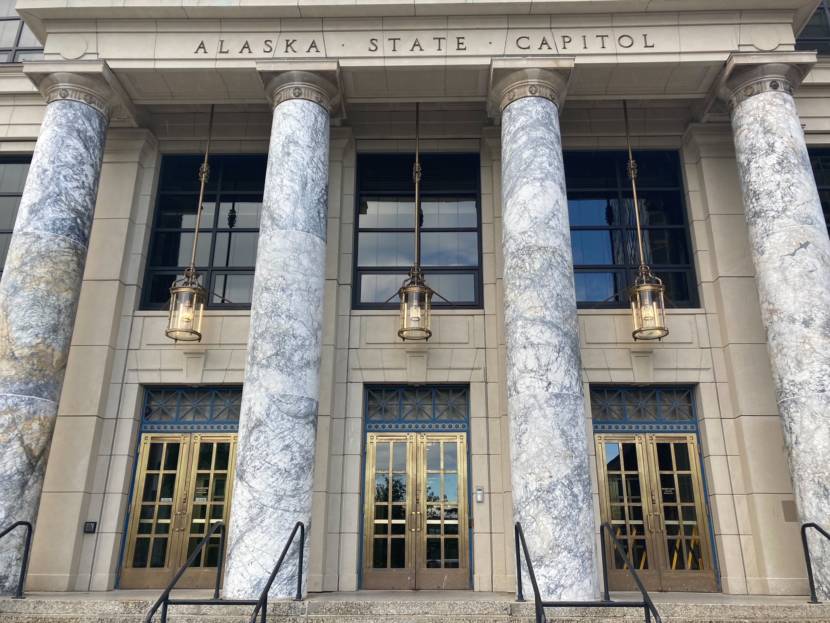
The Alaska State Capitol doors have required key cards to unlock throughout the 2021 legislative session. But membres of the public who approached the doors during business hours were granted entry beginning on Wednesday afternoon. The Legislative Council voted to reopen the building to the public. (Photo by Andrew Kitchenman/KTOO and Alaska Public Media)
The Alaska State Capitol is open to the public for the first time in 15 months.
The Legislative Council voted on Wednesday to revise its pandemic safety policies to allow for public access to the Capitol. All 10 council members present voted for the reopening.
The policy change also ends mandatory screenings for lawmakers, legislative aides, executive branch employees and news reporters to enter the Capitol.
Kodiak Republican Sen. Gary Stevens said the safety policies protected those in the Capitol and thanked the Legislature’s nonpartisan staff for implementing them. He helped develop the safety policies when he served as the Legislative Council chair last year.
“We’ve had very limited exposure in this building,” Stevens said. “We should be very, very proud of it.”
The House version of the budget required that the Capitol be opened by the last day of the regular session in May. That provision isn’t in the compromise budget passed this week. But the policy change went into effect immediately, allowing the public in before the end of the special session.
“That has been a day that I looked forward to,” said Rep. Cathy Tilton, a Palmer Republican and council member. “I was hoping we would get to this day sooner and have Alaska’s Capitol open to Alaskans. But I am very pleased that this day is here.”
The Legislature’s contract with the company that has done COVID-19 screening and testing, Beacon Occupational Health and Safety Services, expires this month.
The change comes just over a month after the Legislature ended a mandate to wear face masks in the Capitol. That policy had been the focus of disputes between legislative leaders and Eagle River Republican Sen. Lora Reinbold.
The legislative special session must end by Friday. Gov. Mike Dunleavy has called a second special session, scheduled to begin on Aug. 2.
Close
Update notification options
Subscribe to notifications
Subscribe
Get notifications about news related to the topics you care about. You can unsubscribe anytime.