Andrew Kitchenman

State Government Reporter, Alaska Public Media & KTOO

State government plays an outsized role in the life of Alaskans. As the state continues to go through the painful process of deciding what its priorities are, I bring Alaskans to the scene of a government in transition.

Alaska Federation of Natives, others sue Dunleavy administration over funding for Power Cost Equalization program

Generators at the Bethel power plant in 2016. (courtesy of Lenny Welch/AVEC)

The Alaska Federation of Natives and other organizations, municipalities and rural power providers sued Gov. Mike Dunleavy’s administration on Monday to keep the funding that helps lower power costs in high-cost areas.

The lawsuit said that the administration’s plan to sweep money from the Power Cost Equalization Endowment Fund and leave the PCE program unfunded this year is unconstitutional.

Since Dunleavy’s first year as governor in 2019, the administration has said that the $1 billion PCE Endowment Fund is subject to an annual vote of the Legislature. If less than three-quarters of both chambers vote to draw money from the Constitutional Budget Reserve, then the money that’s in the PCE fund is swept into the CBR, according to the administration.

That vote failed in both chambers of the Legislature this year.

Scott Kendall, a lawyer who worked on the lawsuit, said the administration is wrong about the Power Cost Equalization Endowment Fund.

“PCE is not a program that was ever meant to be subject to the political whims of the time,” he said. “The 80,000 Alaskans who rely on it shouldn’t have to decide between keeping their lights on and feeding their families.”

The lawsuit argues that $32.4 million in the budget for power cost equalization should continue to be paid and that the administration’s position effectively means that the governor vetoed the money, even if it wasn’t on his list of vetoes.

The Power Cost Equalization Endowment Fund was established in 2000 to provide stable funding for the program, which had been the subject of annual legislative debate. Kendall said it was never intended to be swept.

“Rural Alaskans are largely disconnected from the grid and disconnected from each other. We couldn’t build one big billion-dollar project to solve those energy cost issues. We created this fund as though it’s a piece of infrastructure,” he said. “If we build a hydro dam, we wouldn’t be trying to tear it down every year. We’d be allowing it to serve its purpose.”

The plaintiffs are seeking to have the lawsuit heard quickly. So is Dunleavy.

In a statement, the governor authorized the administration to pursue an expedited judgment.

“This issue is too important to delay any further,” he said. “A decision by the court will help clarify what is in the General Fund and what is not to determine what gets swept into the Constitutional Budget Reserve to repay it.”

Dunleavy has proposed including power cost equalization in the state constitution as part of an amendment that would also mandate the payment of permanent fund dividends.

The case has been assigned to Anchorage Superior Court Judge Josie Garton.

Several other funds are maintained in a similar way, including the Higher Education Investment Fund, which provides money for academic scholarships and need-based grants to help Alaskans pay for college.

Some of the House members who voted against drawing from the Constitutional Budget Reserve to maintain the PCE Endowment Fund have said that PCE and similar programs should have to compete for funding with all other state programs as part of the annual process. They have proposed continuing to fund PCE in the budget this year, while no longer maintaining the endowment fund.

They also cited a provision of the state constitution that prohibits the state from maintaining funds dedicated for special purposes.

But majorities in both chambers rejected this approach. Supporters of the endowment fund said that it should be considered equivalent to the permanent infrastructure like dams that the state subsidized to provide power in urban areas.

Kendall said the PCE Endowment Fund isn’t subject to the constitution’s prohibition on dedicated funds because the Legislature can use and has used it to fund programs other than power cost equalization, so it isn’t dedicated to a special purpose.

The lawsuit was filed by 18 organizations, city governments and power providers. In addition to AFN, they include the First Alaskans Institute and Association of Village Council Presidents.

The municipalities include the Aleutians East and Yakutat boroughs, and the city governments of Kake, Saint Paul, Adak and Sand Point. The nine power providers range from Inside Passage Electric Cooperative Inc. in Southeast Alaska to Kotzebue Electric Association Inc. in the Northwest Arctic Borough.

Correction: This story has been updated to include the correct name of the Northwest Arctic Borough.
Mat-Su had nation’s largest gap between excess deaths and reported COVID deaths

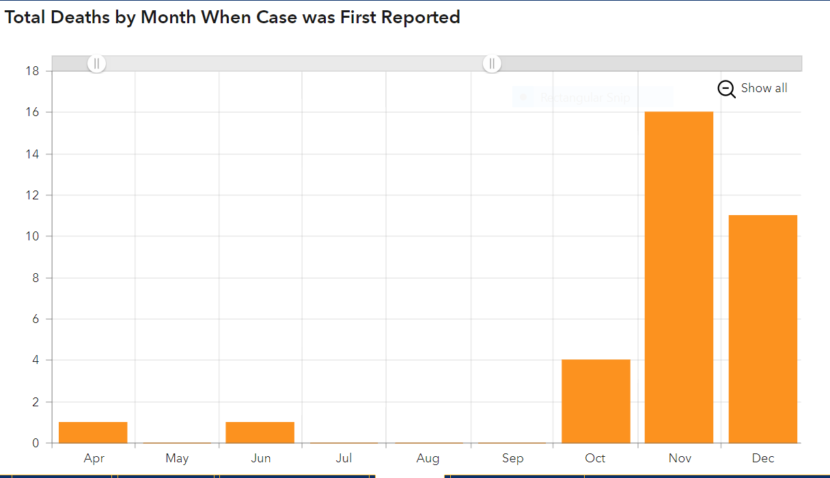
This chart shows the official state count of deaths in the Matanuska-Susitna Borough that were caused by COVID-19 by month in 2020. A recently published analysis in the journal PLOS Medicine found that the borough had the lowest ratio among county-equivalents in the country in the ratio of recorded COVID-19 deaths to excess deaths, which are the deaths above what is expected in a normal year. (Screen capture from Alaska Department of Health and Social Services site)

The Matanuska-Susitna Borough had more deaths last year than would be expected in a normal year. That’s true for many communities in the United States because of the pandemic. 

But the Mat-Su Borough stands out from the rest of the country in one way. A recently published analysis found that the borough had the country’s lowest number of reported COVID-19 deaths compared to the number of people who died in the borough beyond what would normally be expected. 

The analysis looked at how many deaths in each county — or in Alaska, each borough — were recorded as being caused by COVID-19 last year. The authors then compared that number to another statistic, known as “excess deaths”: the deaths each county had last year from all causes above the number expected in a normal year. 

They wanted to know if the official number of pandemic deaths is accurate.

The authors found that the Mat-Su Borough trailed the rest of the country in the ratio between recorded COVID-19 deaths and excess deaths in 2020. 

Nationally, this kind of gap is a challenge for public health experts who are trying to understand how many people truly died from the disease. The authors didn’t reach conclusions on why there are big gaps in individual counties. But the authors said one cause could be that COVID-19 isn’t being recorded as the cause of death on death certificates for people who died from the disease. 

The analysis was published in the journal PLOS Medicine in May.

The data used in the analysis was provisional, and the authors noted some data was delayed.

The authors concluded that the direct COVID-19 death counts in the U.S. substantially underestimated the deaths attributed to the pandemic, by roughly 17%.

They wrote that there are several potential causes. They include lower rates of COVID-19 testing in some counties, reduced access to health care, regional differences in diagnosis and political attitudes. 

The authors also wrote that some deaths, like drug overdoses, may be indirectly related to the pandemic.

Gov. Dunleavy’s per diem veto over PFD situation raises concerns for Legislature

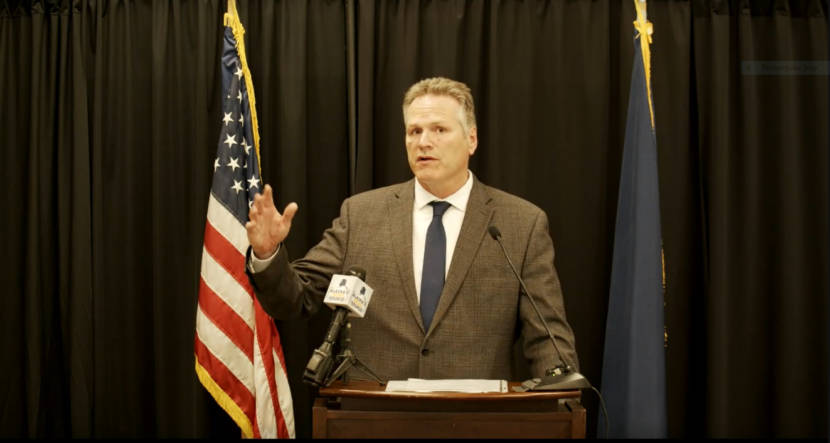
Gov. Mike Dunleavy talks during a news conference on Thursday, July 6, 2021. Dunleavy said he would veto a $4 billion transfer from the permanent fund's earnings reserve to the constitutionally protected part of the fund. (Screen capture of the news conference)
Gov. Mike Dunleavy talks during a news conference on July 1. Dunleavy said he vetoed legislative per diem funding because the Legislature hasn’t taken action to resolve permanent fund dividends. (Screen capture of the news conference)

Gov. Mike Dunleavy vetoed the money that would pay for lawmakers’ daily expenses during the legislative session. Voices in the Legislature — and a prominent critic of the governor — are concerned about the short- and long-term impacts it will have on lawmakers. 

The Legislature passed a budget that included roughly $2 million to pay for the daily food and housing needs of lawmakers and their families attending the session. But Dunleavy said it doesn’t make sense for legislators to receive the money until they’ve resolved the future of permanent fund dividends. 

In the budget year that ended in June, the payments, know as per diems, equalled $293 per day. The rate is based on what the federal government pays its employees when they’re traveling in Alaska. 

The day after he vetoed the money, Dunleavy, a Republican, said he knew the veto would not be appreciated by some legislators. 

“Every day a legislator is in session, they get close to $300 to pay for expenses,” he said during a July 1 news conference. “I certainly understand that those expenses have to be offset. But we’ve had two special sessions in which thousands of dollars was collected by members of the Legislature and, at the same time, the permanent fund and the permanent fund dividend was not dealt with.”

Dunleavy has proposed changing the PFD formula through an amendment to the state constitution. It would be based on half of the amount the state draws annually from the permanent fund. This year, that amount would be roughly $2,350. 

The amendment also would limit the annual draw. And it would protect the money in the permanent fund’s earnings reserve by combining it with the rest of the fund, which is already protected. 

Committees in both the House of Representatives and the Senate held hearings on the amendment during the special session. But neither chamber has held a vote on it. 

Anchorage Democratic Rep. Matt Claman chaired one of those hearings.

Claman is concerned that the governor is trying to pressure the Legislature to take his position on dividends at a time when Alaskans need to know more about all of the effects of Dunleavy’s PFD proposal. Claman said the tactic won’t increase cooperation.

“I feel that if the governor’s trying to apply that pressure to say, ‘I’m going to take away the funds that provide expenses so the Legislature can work—.’ I mean, that doesn’t seem like it’s likely to accelerate the process because some legislators may not be able to come to Juneau at all without the per diem,” he said.

Claman said the per diems are essential to drawing a diverse range of Alaskans to run for the Legislature. Without the funding, he fears it would limit the number of people who could afford to become legislators. 

“For me, this really comes back to: Are we trying to make the Legislature something that people from all walks of Alaska could serve in?” he said.

Annual legislative salaries have been set at $50,400 since 2009. The per diems at the current rate can reach as high as roughly $35,000 for a 121-day session.

Claman said it’s incorrect to say the Legislature hasn’t taken action on the dividend. Most of this year’s dividend lost its funding when it failed to receive enough votes. And Dunleavy vetoed the money that was left, saying Alaskans viewed it as “a joke.” 

“The Legislature did address the dividend,” Claman said. “We appropriated $1,100 for the dividend. And then … the three-quarters required did not fund that fully and then the governor vetoed it. So the Legislature actually approved a dividend.”

Several Republican legislators did not return calls for this story on Friday. 

Anchorage lawyer Scott Kendall served as chief of staff to Dunleavy’s predecessor, former Gov. Bill Walker. Kendall said he never had and would never advise a governor to veto money that legislators use to cover their expenses.

Kendall said Dunleavy has a history of attacking other branches of government — including vetoing court system funding due to his opposition to court rulings on abortion. That veto became one of the grounds for recall in the campaign to remove Dunleavy from office. Kendall has advised the recall campaign.

“I’m not concerned about future governors doing this,” Kendall said. “I think most people respect the norms and have the common sense not to engage in a back and forth between branches of government.”

Kendall said that if Dunleavy maintains the veto, the Legislature could eliminate appropriations for some of the costs of the governor’s office. 

Kendall adds that Dunleavy’s dividend proposal would require spending that would lead to an annual deficit of at least $1 billion. And he said that since proposing budget cuts two years ago that prompted a public outcry, Dunleavy hasn’t proposed policy changes to close the deficit. 

A special session is scheduled to begin on Aug. 2.

Anchorage judge Jennifer Stuart Henderson to be newest Alaska Supreme Court justice

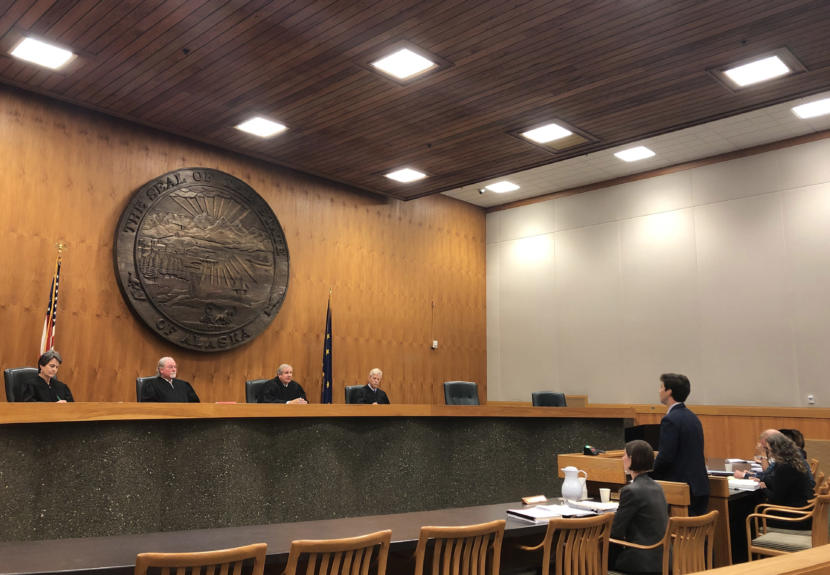
The Alaska Supreme Court hears arguments in 2019 in a lawsuit filed by young Alaskans regarding climate change. On Wednesday, Gov. Mike Dunleavy appointed Anchorage Superior Court Judge Jennifer Stuart Henderson to fill a vacancy on the supreme court. (Elizabeth Harball/Alaska’s Energy Desk)

Anchorage Superior Court Judge Jennifer Stuart Henderson will be the newest member of the Alaska Supreme Court after Gov. Mike Dunleavy appointed her on Wednesday. 

Henderson fills the vacancy created by the retirement of former Chief Justice Joel Bolger. Justice Daniel Winfree succeeded Bolger as chief justice on July 1.

Henderson has lived in Alaska for 18 years and has been a judge since 2012 when she was appointed to the district court by former Gov. Sean Parnell. She was appointed to the superior court in 2017 by former Gov. Bill Walker.

She has primarily heard civil cases as a judge. In December, she weighed in on a lawsuit over Dunleavy’s vetoes of state funding for abortions from the court system’s budget. 

She ruled them to be unconstitutional, saying they violated the separation of powers doctrine. 

She wrote in her decision that she had faith the judiciary remained independent.

Dunleavy did not veto the money again this year. 

Dunleavy appointed Henderson six days after asking the Alaska Judicial Council for a new slate of nominees. Under the council’s bylaws, it cannot reconsider nominees unless there are not enough nominees available for a limited set of reasons.

Sunday, July 11 would have been the deadline for Dunleavy to make the appointment.

Henderson is originally from San Diego and graduated from Yale Law School, according to the biographical statement she submitted in her application for the position. She was a clerk for former Alaska Supreme Court Justice Warren Mathews. She also was an assistant district attorney in Anchorage before working as an attorney for the firm Farley & Graves. 

Correction: This story has been corrected to reflect the correct year that Henderson became a superior court judge and that she was appointed to the superior court by former Gov. Bill Walker.

Budget working group aims for compromises that have eluded Alaska Legislature for years

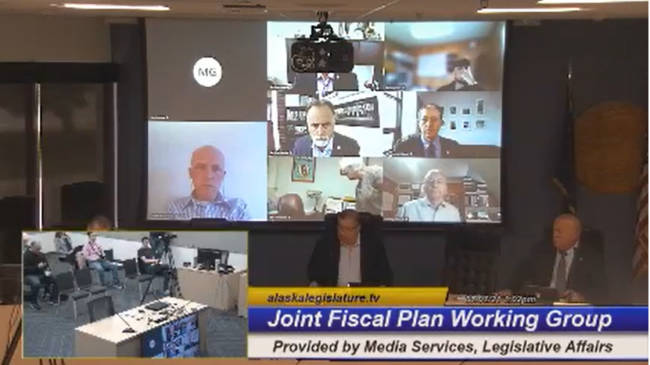
The members of the Joint Comprehensive Fiscal Plan Working Group listen to Sen. Lyman, D-Bethel, at the bottom center, on July 7, 2021, in the Alaska State Capitol in Juneau. The group held its first meeting. (Gavel Alaska screen capture)
The members of the Joint Comprehensive Fiscal Plan Working Group listen to Sen. Lyman Hoffman, D-Bethel, at the bottom center, on Wednesday in the Anchorage Legislative Information Office. The group held its first meeting. (Gavel Alaska screen capture)

Alaska lawmakers seeking to agree on long-term changes to the state budget said at their first meeting that they want to reach compromises that have so far eluded the Legislature.

Palmer Republican Sen. Shelley Hughes, one of eight members of the new working group, said the group’s recommendations will lead to changes if they can gain the support of legislators from all parts of the state.   

“We want to put forward an actual, workable, realistic package — built around consensus — that will get the needed votes,” Hughes said at the meeting at the Anchorage Legislative Information Office. “And that’s no easy thing. As we know, for the past six years.”

The state has been spending much more than it raises in revenue since oil prices fell in 2014. 

The working group may consider changing the formula for setting permanent fund dividends, lowering the maximum amount that the state government can spend and raising new or higher taxes. And it may recommend that these changes be made in state law or through amendments to the Alaska Constitution.

Legislative leaders’ goal is for the working group’s recommendations to be presented to the entire Legislature for the next special session. 

Gov. Mike Dunleavy has called for a special session to begin on Aug. 2. But working group members and legislative leaders raised the possibility that the timing could be moved back if the group is making progress and needs more time. A spokesperson for Dunleavy said it remains the governor’s intention to start the special session on Aug. 2.

Lawmakers have been unable to reach agreement on major issues like changing the permanent fund formula. 

Several task force members expressed the importance of compromising. 

Bethel Democratic Sen. Lyman Hoffman, one of the group’s co-chairs, noted that legislative leaders are committed to having each chamber act on the group’s recommendations.

Hoffman is the longest-serving legislator in Alaska history. He talked about the challenges the Legislature has had in proposing amendments to the state constitution. 

“I would like to remind the people of Alaska, the House of Representatives and the senators, and especially the members of this committee: We have the opportunity to have the battle. We may not all win it. But at the end of the day, we should accept what work has been done,” Hoffman said.

The group’s eight members are split equally between the four legislative caucuses. 

The Senate members are majority-caucus Sens. Hoffman and Hughes, and minority-caucus Sens. Scott Kawasaki, a Fairbanks Democrat, and Jesse Kiehl, a Juneau Democrat.

The House members are majority-caucus Reps. Jonathan Kreiss-Tomkins, a Sitka Democrat who will serve with Hoffman as co-chair, and Calvin Schrage, an Anchorage independent, and minority caucus Reps. Ben Carpenter, a Nikiski Republican, and Kevin McCabe, a Big Lake Republican.

Hoffman said the group may meet as frequently as twice per week, beginning next week. The next meeting date was tentatively set for Tuesday in Anchorage. Hoffman said future meetings could be held in Juneau, Fairbanks and the Matanuska-Susitna Borough. 


Protected portion of Alaska Permanent Fund grows by $4B thanks to apparent mistake

Gov. Mike Dunleavy talks during a news conference on Thursday, July 6, 2021. Dunleavy said he would veto a $4 billion transfer from the permanent fund's earnings reserve to the constitutionally protected part of the fund. (Screen capture of the news conference)
Gov. Mike Dunleavy talks during a news conference on Thursday. Dunleavy said he would veto a $4 billion transfer from the permanent fund’s earnings reserve to the constitutionally protected part of the fund. (Screen capture of the news conference)

The portion of the Alaska Permanent Fund protected by the state constitution has grown by $4 billion. That’s the result of a transfer from the fund’s earnings reserve. 

Gov. Mike Dunleavy said he was going to veto the transfer. But his office failed to cross out the lines in the actual budget bill delivered back to the Legislature.

The $4 billion transfer is roughly as much as the state spends of its own money to operate all of state government. 

Dunleavy signed the budget bill last Wednesday. But before he did that, he made his line item vetoes — things he intended to cross out from the budget. 

On Thursday, he said he had stopped the $4 billion transfer from happening with a veto. In explaining why he wanted to veto the money, Dunleavy said he wanted to work with the Legislature on a comprehensive approach to the permanent fund, including the money in the earnings reserve.

But on page 138 of the budget bill, the line about the $4 billion transfer was not crossed out. So the transfer was not vetoed. 

Legislators became aware of the issue late last week. Dunleavy tried to correct the error. He told Senate President Peter Micciche and House Speaker Louise Stutes that he intended to veto the transfer. But legislative staff weren’t prepared to make the change he was asking for. 

On Tuesday, the governor’s office said he will allow the transfer to go through, despite his intention to veto it. 

It means that the amount of permanent fund money that’s protected under the state constitution — known as the “corpus” — has risen from just under $48 billion to nearly $52 billion. But that still leaves nearly $30 billion that either is in the earnings reserve or is locked up in gains in investments like real estate that haven’t been realized yet. 

On Aug. 2, the Legislature is scheduled to convene for the third special session this year. The governor has proposed a constitutional amendment that would protect the remaining amount in the earnings reserve. It also would put the permanent fund dividend in the constitution. 

The size of PFDs that Dunleavy is proposing would be based on half of the amount drawn from the fund annually. Currently, that would lead to a dividend of roughly $2,350. 

But nonpartisan budget analysts estimate it would create annual deficits averaging $1 billion this decade, without other changes to policy. 

Members of both legislative majorities praised the transfer. 

Sitka Republican Sen. Bert Stedman helped develop the proposal as co-chair of the Senate Finance Committee. He’d like to look at protecting more of the permanent fund. 

“My concern is that the Legislature will walk through the earnings reserve like a knife through hot butter,” he said. “And we need to protect it for current and future generations.”

And Anchorage Democratic Rep. Ivy Spohnholz said it was critical to protect the $4 billion that was transferred, considering the state government’s history of spending from savings. 

“I think in the end, it came out the way it needed to come out, which is ensuring that another $4 billion is protected in the corpus of the permanent fund,” she said. 

Dunleavy spokesperson Corey Allen Young said the transfer won’t adversely affect his permanent fund  proposal, which he said would  “guarantee Alaskans receive their share of the state’s resource wealth each year and end the annual debate over the amount of the PFD.” 


Site notifications
Update notification options
Subscribe to notifications