State Government Reporter, Alaska Public Media & KTOO
State government plays an outsized role in the life of Alaskans. As the state continues to go through the painful process of deciding what its priorities are, I bring Alaskans to the scene of a government in transition.
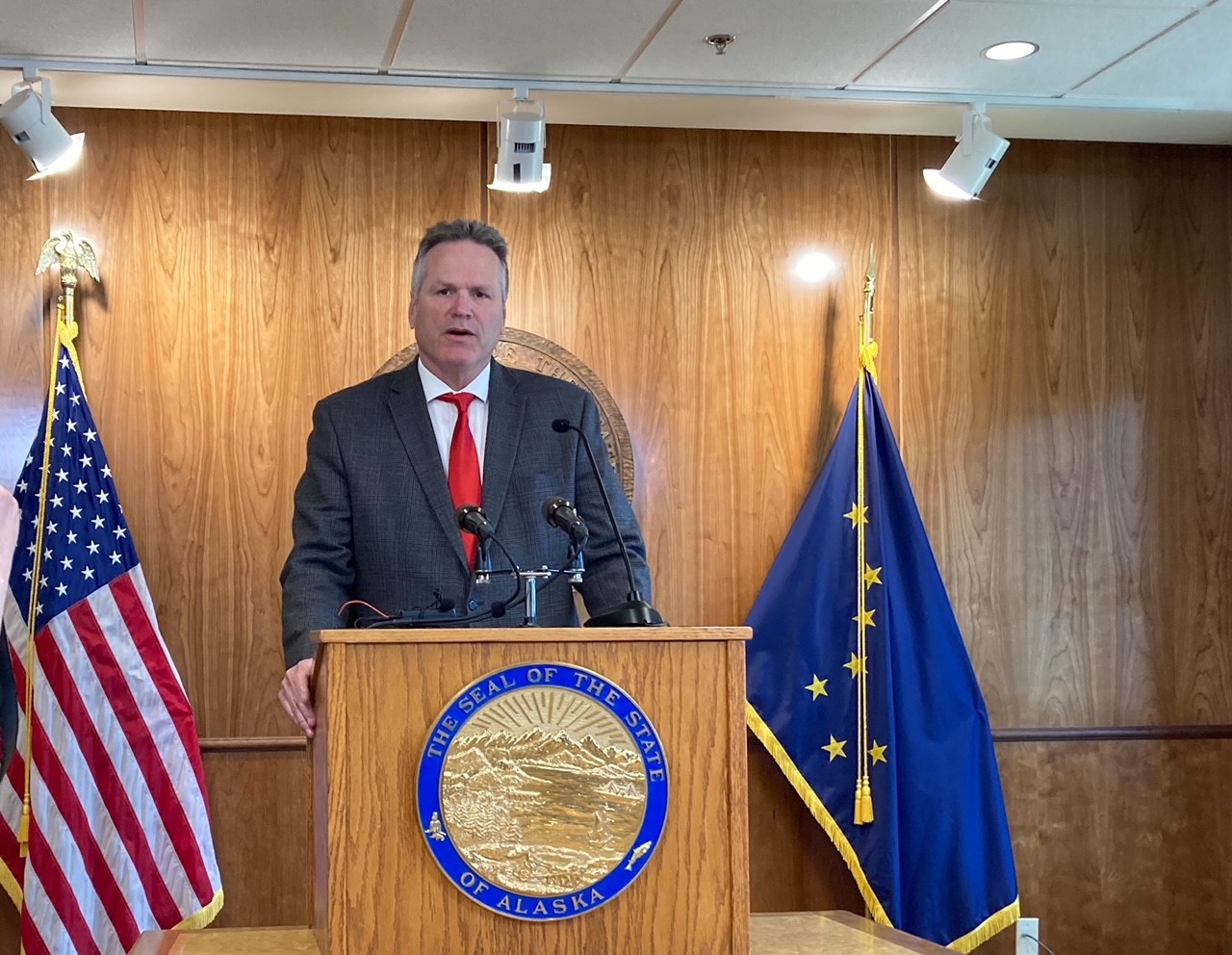
Gov. Mike Dunleavy at a news conference in June. His office may spend up to $250,000 to advertise his proposal to amend the state constitution to include permanent fund dividends, power cost equalization and an annual draw from the permanent fund to pay for PFDs and state government. (Photo by Andrew Kitchenman/KTOO)
Gov. Mike Dunleavy has proposed changing the state’s constitution to include the permanent fund dividend. Now, his office is willing to spend up to $250,000 to spread the word about his proposal.
Dunleavy’s proposed constitutional amendment also would add the annual draw from the permanent fund to pay for PFDs and the state budget. And it would add the power cost equalization program.
The governor’s office has posted a request for media agencies interested in contracting with the state for the campaign. Agencies have until Friday to respond.
In the request, the state noted 67% of Alaskans in a recent poll were unfamiliar with Dunleavy’s amendment proposal. For an amendment to pass, a majority of voters must approve it.
Under the proposed amendment, PFDs would be set at half of the annual draw. The current estimated amount of this year’s dividend would be roughly $2,350 under the proposal. There currently is no funding for PFDs this year. Under the budget the legislature passed, dividends would have been just over $500, but Dunleavy vetoed that amount, saying they should be larger.
In an emailed statement, Dunleavy’s office described the purpose of the campaign. It said he believes constitutionally protecting the permanent fund, PFD and power cost equalization is the first step to securing the future of state finances.
Dunleavy’s office said the money for the advertising would come from the governor’s office’s budget and compared it to similar spending in previous administrations. It will be spent on radio and online advertisements.
Dunleavy agreed to reimburse the state $2,800 last year to settle an ethics complaint over advertising that criticized the governor’s opponents and praised his allies. The settlement said that Dunleavy did not admit wrongdoing.
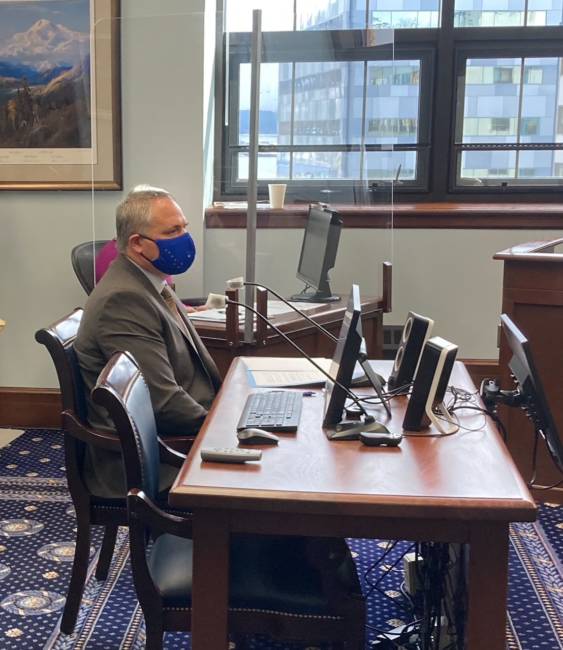
Alaska Attorney General Treg Taylor answers questions during his confirmation hearing with the Senate Judiciary Committee in March in the Capitol. He recently signed a brief urging the U.S. Supreme Court to overturn Roe v. Wade. (Photo by Andrew Kitchenman/KTOO and Alaska Public Media)
Alaska’s state government has joined with other Republican-led states in asking the U.S. Supreme Court to overturn Roe v. Wade. The 1973 decision found that there is a constitutional right to have an abortion.
Alaska Attorney General Treg Taylor signed onto a filing in support of an appeal by Mississippi. The brief was filed by Texas Attorney General Ken Paxton.
The appeal seeks to defend a Mississippi law that outlaws most abortions after 15 weeks of pregnancy. Lower courts struck down the law.
New Hampshire is the only state with a Republican attorney general that did not sign the Texas filing.
If Roe v. Wade is overturned, abortion law could be determined at the state level. The Alaska Supreme Court has ruled that the right to privacy in the state constitution includes the right to an abortion as a fundamental right.
The Supreme Court is scheduled to hear the case in its term that begins in October.
Taylor’s office didn’t immediately respond to a request for comment on why he signed the brief.
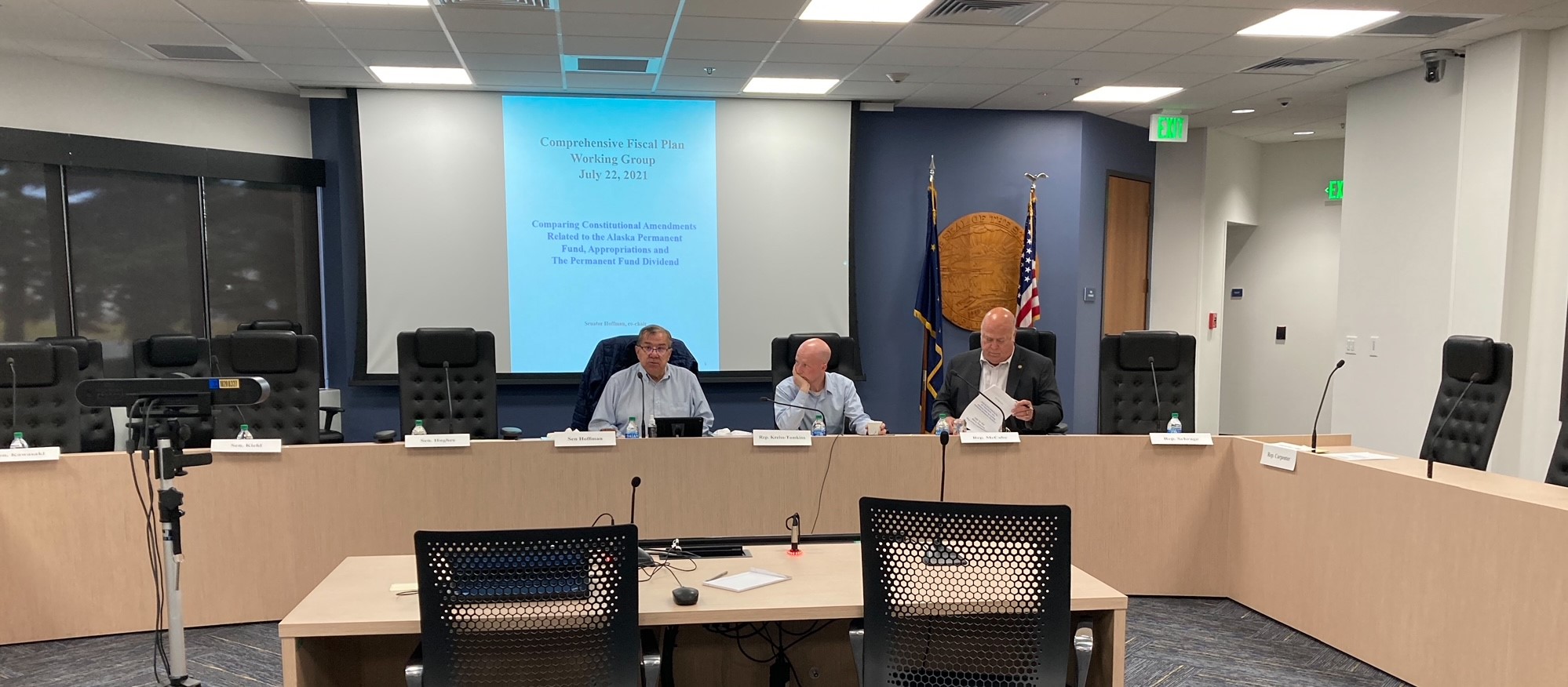
Sen. Lyman Hoffman, D-Bethel; Rep. Jonathan Kreiss-Tomkins, D-Sitka; and Rep. Kevin McCabe, R-Big Lake, attend a comprehensive fiscal plan working group meeting on July 22, 2021, at the Anchorage Legislative Information Office. (Photo by Andrew Kitchenman/KTOO and Alaska Public Media)
The Alaska Legislature has nine days to go before the scheduled start of a special session. And it’s not yet clear whether a working group of lawmakers will recommend proposals the rest can consider during the session.
The working group is weighing whether to recommend amending the state constitution.
Gov. Mike Dunleavy has proposed putting permanent fund dividends in the constitution. He wants to spend 50% of the money drawn annually from the permanent fund on PFDs. The other 50% could pay for state services.
Group co-chair Sen. Lyman Hoffman raised the possibility of phasing in new revenue. He spoke at a working group meeting on Thursday.
“One concept could be that we would agree to the 50/50 split, but we would have to come up with a stair-stepped approach until the revenue measures came into place,” Hoffman said.
Hoffman is a Bethel Democrat who caucuses with Republicans. Dunleavy is a Republican.
Currently, the PFD amount under a split would be roughly $2,350. That’s nearly twice the average paid over the past five years. But it’s more than one-third lower than what would be paid under the formula in state law.
But without new taxes or spending cuts, the state would spend more than $922 million than it raises each year.
Hoffman said the dividend could be phased in as new revenue measures go into effect.
Palmer Republican Sen. Shelley Hughes is a working group member who called into the meeting on Thursday. She said there’s an advantage to not cutting dividends to close the gap: Only Alaskans receive dividends.
“When you use part of the PFD to close that revenue, it impacts residents only,” Hughes said. “Other forms of revenue impact nonresidents as well.”
The working group is weighing several proposed constitutional amendments that would protect permanent fund earnings and limit how much money is drawn from the fund each year.
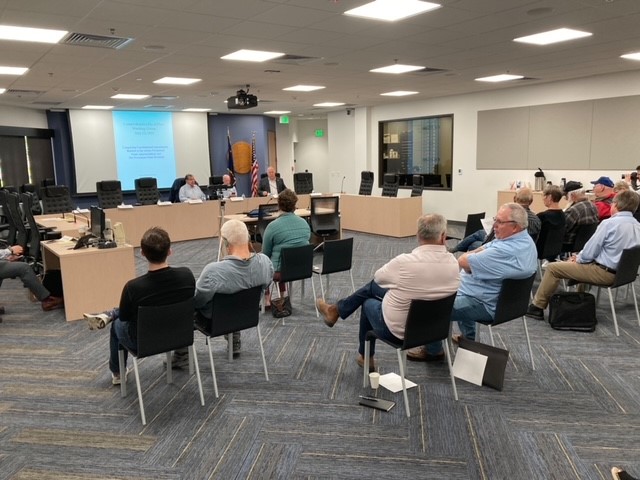
Members of the Alaska legislative comprehensive fiscal plan working group meet on Thursday in the Anchorage Legislative Information Office. The group announced four days of public testimony starting on July 29. (Andrew Kitchenman/KTOO and Alaska Public Media)
Alaskans will soon have a chance to weigh in with what changes to state taxes, services or permanent fund dividends they would like to see in the long term.
A working group of legislators has been meeting to consider ways to close the gap between what the state spends and what it brings in. The group plans to hear public testimony over four days beginning next week.
The first round of public testimony will be in Anchorage on Thursday, July 29, from 6 to 9 p.m.
The second will be in the Matanuska-Susitna Borough on July 30, from 6 to 9 p.m.
The third will be in Fairbanks on July 31, from 1 to 4 p.m.
And the last will be in Juneau on Aug. 2, from 6 to 9 p.m. Residents who can’t attend the hearings can call in to provide testimony on Aug. 2.
Specific locations for the hearings were still being finalized on Thursday afternoon. Before the four days of public testimony, the working group will meet on Monday and Tuesday at 3 p.m.
As part of a deal that prevented a state government shutdown, the House agreed to launch the working group. Its goal is to recommend changes for the next special session. The special session is scheduled to start on Aug. 2, the last day of public testimony.
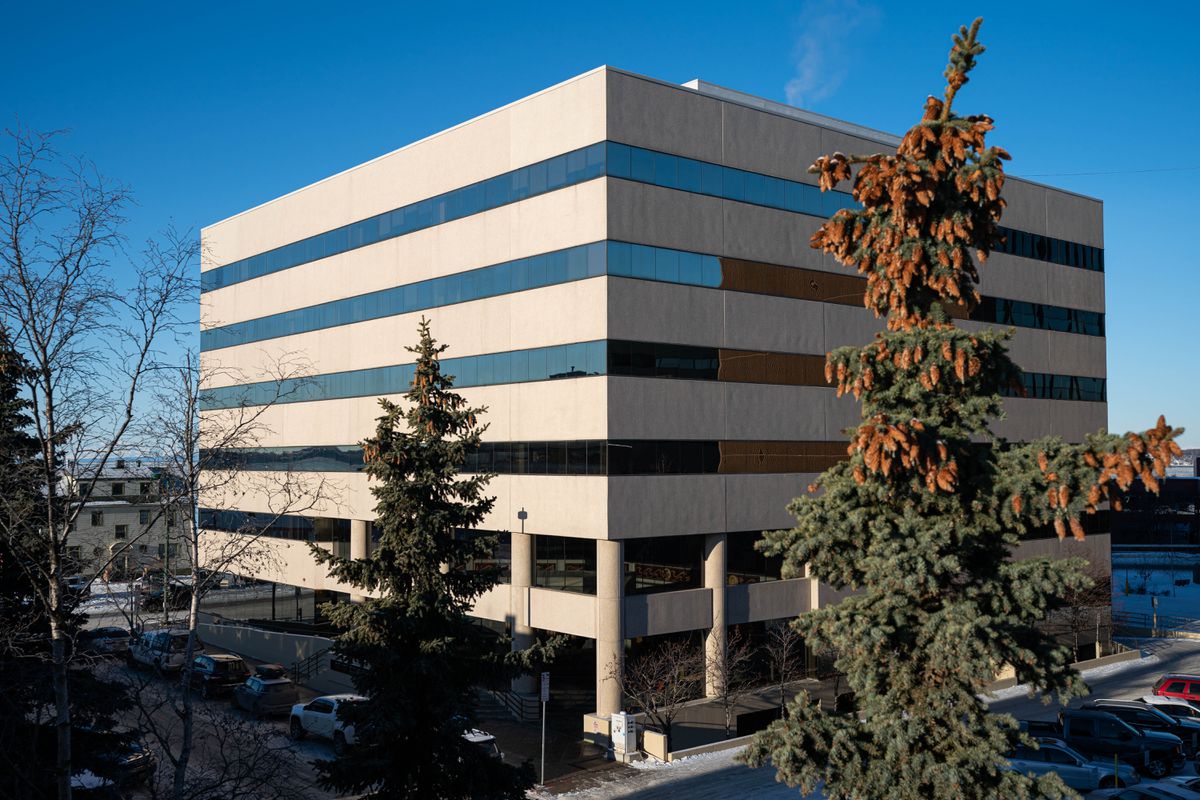
The Brady Building in downtown Anchorage houses Alaska Department of Law offices. Photographed on Saturday, Jan. 30, 2021. (Loren Holmes / ADN)
The Alaska Department of Law is looking into allegations that Assistant Attorney General Matthias Cicotte posted racist, anti-semitic and homophobic comments on social media.
The Guardian reported on Wednesday that Cicotte posted under an alias. His identity was discovered by researchers who identify as anti-fascists.
The posts said all Black Lives Matter advocates should be in prison “or worse,” that someone who participated in a drag story hour “should be burned to death” and that parents who encourage children who are transgender should be jailed for child abuse.
Cicotte is an attorney with the state’s torts and workers compensation section. He is among the lawyers who represent the Department of Corrections.
In a statement, the Department of Law said it takes the allegations seriously.
“We uphold the dignity and respect of all individuals and ask that all of our employees do the same,” the statement says. “Having just learned about this late last week, we are gathering information and conducting a review. Since this involves personnel issues, we are very limited in our ability to comment further.”
On Thursday, the Department of Law said in a statement that Cicotte “has been removed from his caseload and his status with the Department is subject to change at any time as the investigation continues.”
The allegations raised the concerns of Alaska civil rights advocates.
“I am just so disappointed and frustrated that we cannot move forward, that we’re not breaking ground because we have people in power that believe in racism and spew this racist rhetoric,” said Celeste Hodge-Growden, the president of the Alaska Black Caucus.
She said that if the department finds the article is true, it must review all cases Cicotte worked on to determine whether they should be reopened. And if he made the posts, he must not be in a position where he can influence the lives of others.
“Because if he is an individual that is racist or he exhibits racist behavior, and his actions show that he has concerns or concerns with people of color, then he clearly is in the wrong position,” she said.
NAACP Anchorage Branch Executive Director Kevin McGee said that if the story is true, Cicotte should be fired.
“You can’t justify yourself being in the Department of Law,” he said.
Cicotte didn’t immediately respond to a request for comment, and didn’t respond to requests from the Guardian.
The posts were under the name J. Reuben Clark, which is also the name of the law school Cicotte graduated from according to his LinkedIn page. The account made posts in support of Deseret nationalists, a group loosely associated with fringe members of the Church of Jesus Christ of Latter-Day Saints, or Mormons.
While the account used a pseudonym, the researchers found a trail of evidence regarding Cicotte’s identity, including photos matching his house’s interior.
This story was updated on Thursday with a new statement from the Department of Law.
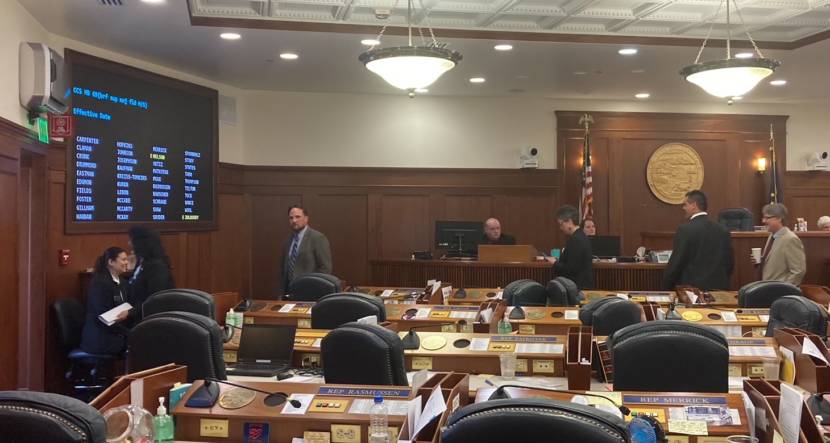
Members of the Alaska House Republican minority caucus leave the floor to discuss the wording of an agreement with the mostly Democratic majority to prevent a shutdown of much of state government on June 28, 2021, in the Alaska State Capitol in Juneau. House minority caucus members’ votes have been at the center of debates on how and at what level to fund permanent fund dividends and other programs. (Andrew Kitchenman/KTOO and Alaska Public Media)
Members of the Republican minority caucus in the Alaska House have been at the center of the most contentious arguments in the Legislature this year. Past minorities have used their power to influence state policy, but the Republican caucus has pushed further. While their approach is new, it’s rooted in frustrations building among some Republican legislators and voters for years.
When legislators ended the session early in 2020 due to the COVID-19 pandemic, budget negotiators reached a deal that linked a vote that would lead to a roughly $1,000 permanent fund dividend to funding the emergency response to the pandemic.
If that vote failed to be approved by three-quarters of both the Alaska Senate and House Representatives, dividends would have been cut to $500, instead of $1,000.
It passed, with no votes to spare.
Homer Republican Rep. Sarah Vance voted against it despite being a supporter of larger dividends under the formula in a 1982 state law. And a day later, Vance criticized how the budget was written to talk radio host Michael Dukes.
“It’s unconscionable,” she said.
Vance said her caucus was unlikely to allow a similar vote to pass again.
“If it had been any other year … we would have done it,” she said. “We would have called their bluff.”
A year later — this spring — proved Vance right. This time, the vote would allow for dividends of $1,100. And this time it failed, leaving dividend funding at just over $525. After the vote, Governor Mike Dunleavy vetoed the remaining amount. So there may be no PFDs this year.
And the power cost equalization, college scholarships for Alaskans and some other programs also remain unfunded.
At the center of this debate are most members of the Republican House minority caucus, who joined Vance this time in voting no on drawing money for PFDs and other programs.
The money would have come from the Constitutional Budget Reserve, or CBR, a state savings account that the Legislature has used to balance the budget. It required the approval of three-quarters of both chambers to pass.
The Republican legislators’ concerns have been brewing for a long time. They believe that there should be much deeper cuts in state spending and that dividends should be much larger.
Interviews with some of the members show why things have come to a head.
Rep. Kevin McCabe of Big Lake was among those who voted no. The vote also would have funded construction projects in the Matanuska-Susitna Borough, McCabe’s home.
He said there was too much pressure to vote yes.
“I hate being bullied,” he said. “And the six or so projects that they put into the CBR that were specifically directed at the Mat-Su to obtain my vote. Frankly … I termed it, bully budgeting.”
McCabe is among eight first-term House Republicans. All of them voted no on the deal.
Some members have said this provides leverage in supporting action on the governor’s proposals to amend the state constitution.
McCabe likes Dunleavy’s proposal to resolve the size of permanent fund dividends through a constitutional amendment. New proposals to cut spending or increase state revenue would be addressed later. And McCabe said there’s an advantage to dealing with proposals to cut spending after the dividend is set: It would force cuts that the Legislature has been unwilling to make.
“Frankly, you know, I’m a conservative, small-government kind of guy and I believe our government continues to grow,” he said.
It’s an argument that parallels one that Dunleavy made when he ran for governor: that state spending is too high. Dunleavy later proposed cuts in his first year as governor. And a large public backlash to service cuts fed into a recall campaign against the governor. Dunleavy hasn’t proposed those cuts in the following two budgets.
McCabe said the biggest lesson he draws from that budget fight is that communication in support of the cuts should have been better. He said all heads of agencies funded by the budget should have been in sync with the governor. He pointed out that former University of Alaska President Jim Johnsen spoke publicly about the impact of the cuts on the university.
“We need to all get together on the same message instead of battling over limited dollars,” he said.
North Pole Republican Rep. Mike Prax also voted against drawing money from the CBR.
In addition, he voted against making the budget date effective on July 1. The failure of that vote in the House led Dunleavy to say that much of state government would shut down. The shutdown was prevented during a special session in late June.
Prax said he’s advocating for his principles.
“Nobody wants to shut down the government, put all the employees and all the programs under this much uncertainty — nobody wants to do that,” said Prax, who’s in his second term. “But … we the public have been talking about this going on 20 years, when it comes right down to it.”
Prax wants votes on the three constitutional amendments proposed by the governor, or at least something similar that would put the dividend in the constitution, limit spending and require public votes on new taxes.
Prax also wants to see the PFD resolved first. He said Alaskans should receive the dividends under the formula in state law. This year, that amount would be roughly $3,700, while Dunleavy has proposed dividends of roughly $2,350 under a constitutional amendment he’s proposed. And Prax said Alaskans should be paid back what they would have received over the past five years if the state followed the formula. Altogether, that amount would be more than $10,000, or nearly $7 billion in permanent fund earnings.
Eagle River Republican Rep. Ken McCarty, a first-term member, said the dividend formula should be fixed.
He hasn’t reached conclusions on what changes need to be made to the dividend and state spending, as well as taxes or other revenue. He expressed frustration that more of his questions weren’t answered during this year’s budget process.
“To make informed decision-making, we need information,” he said. “And life is not just a ‘yes/no.’ But it’s ‘yes, no and I need more information before I can make that yes/no (decision).’”
McCarty also noted that this year is different because the balance in the Constitutional Budget Reserve is lower than in the past.
Its value has fallen from more than $12 billion in 2014 to roughly $1 billion today.
“That’s our safety net money,” McCarty said. “If there was some major disaster, where is that money to cover those type of needs? And we don’t have it anymore.”
He said there should be larger cuts to spending on state agencies than have happened in the past five years. He also said the state must devote money to rebuild the Constitutional Budget Reserve. And he said it must invest in its infrastructure, from maintaining roads and bridges to increasing the amount of food that’s grown in Alaska to increase its food security.
Fairbanks Democratic Rep. Adam Wool says the new Republican minority has gone further in its demands than previous minority caucuses have. He said for the Legislature to function, the minority can have some say, but ultimately their power should be limited.
“When I was in the minority, did I feel like I had a lot of influence? Not really. I mean, we could hold up a three-quarter vote on the CBR for certain budget items,” he said. “But, you know, there’s a price to pay to be in the minority and there’s a reward for being in the majority.”
For example, in his first two years in the Legislature as a member of the then-Democratic minority, it used its power to block draws from the Constitutional Budget Reserve to protect tens of millions of dollars in education funding, while members the current Republican minority supports permanent fund dividends that would cost at least $1.5 billion.
Wool also rejected the argument from minority-caucus Republicans that their voices weren’t heard enough in the budget process. Wool said their voices were heard, but most of their proposals didn’t have the votes to pass.
Wool said the minority-caucus Republicans’ numbers don’t add up.
And he expressed concern that they want to draw more than planned under a law intended to limit draws from permanent fund earnings. He noted that at the same time, they criticize spending down the amount in the CBR.
“On a good year, you spend 5% and on a bad year, you spend 5%,” he said. “And if they don’t understand that or want to abide by it, then I think … it’s going to be hard to see eye to eye on some of this stuff.”
Lawmakers who supported the limit on the annual draw from permanent fund earnings expressed concern that the Legislature would spend down the permanent fund’s earnings reserve if there wasn’t a limit.
Wool has proposed a bill to change the dividend formula and introduce an income tax among other provisions. The measure is intended to balance the budget in the long run. Wool noted that none of the minority-caucus Republicans have put forward a detailed plan.
“I’m waiting for them to put out a plan that’s a balanced-budget plan into the future, with balancing revenues and expenditures, including the PFD, without overdrawing the (permanent) fund,” he said.
A legislative special session is scheduled to begin on Aug. 2.
Close
Update notification options
Subscribe to notifications
Subscribe
Get notifications about news related to the topics you care about. You can unsubscribe anytime.