State Government Reporter, Alaska Public Media & KTOO
State government plays an outsized role in the life of Alaskans. As the state continues to go through the painful process of deciding what its priorities are, I bring Alaskans to the scene of a government in transition.
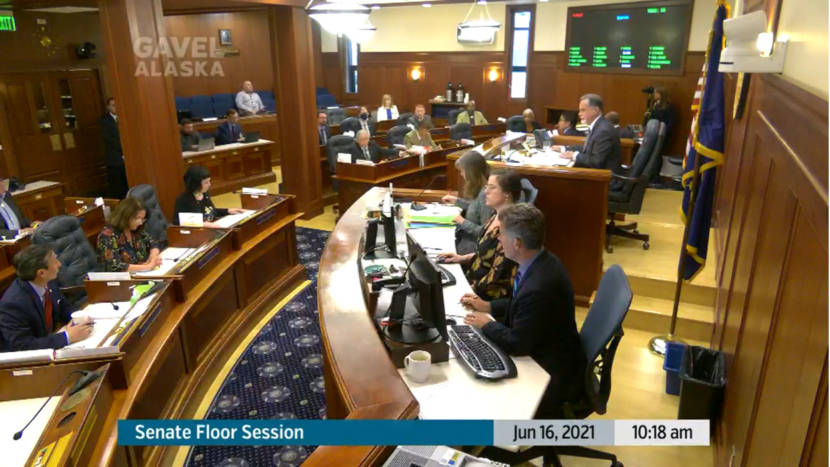
The Alaska Senate during a floor session on June 16, 2021. (Screen capture Gavel Alaska)
The Alaska Senate passed a state budget by a margin of one vote on Wednesday, the day after the House passed it.
This year’s permanent fund dividend would be $525 if the Legislature doesn’t add more funding later.
A motion that would have funded the dividend at $1,100 failed to receive support of three-quarters of the members of each chamber, which was required for it to pass.
A program to lower the cost of electricity in high-cost areas and university scholarships also are not funded in the budget due to the failure of the votes to draw from the Constitutional Budget Reserve.
Lawmakers in both chambers have said they support funding these programs. But a compromise may not be possible before Friday. The special session must end by then.
That means the Power Cost Equalization program and university scholarships may not be funded starting on July 1, the first day of the new budget.
The Senate budget approval came after drama. It failed in an earlier vote. But Bethel Democratic Sen. Lyman Hoffman moved to rescind the vote. On the second vote, Hoffman changed from no to yes, allowing it to pass, 11 to 6.
Hoffman has said the state should make changes that would allow for higher dividends without drawing down the amount of money available in the permanent fund’s earnings reserve.
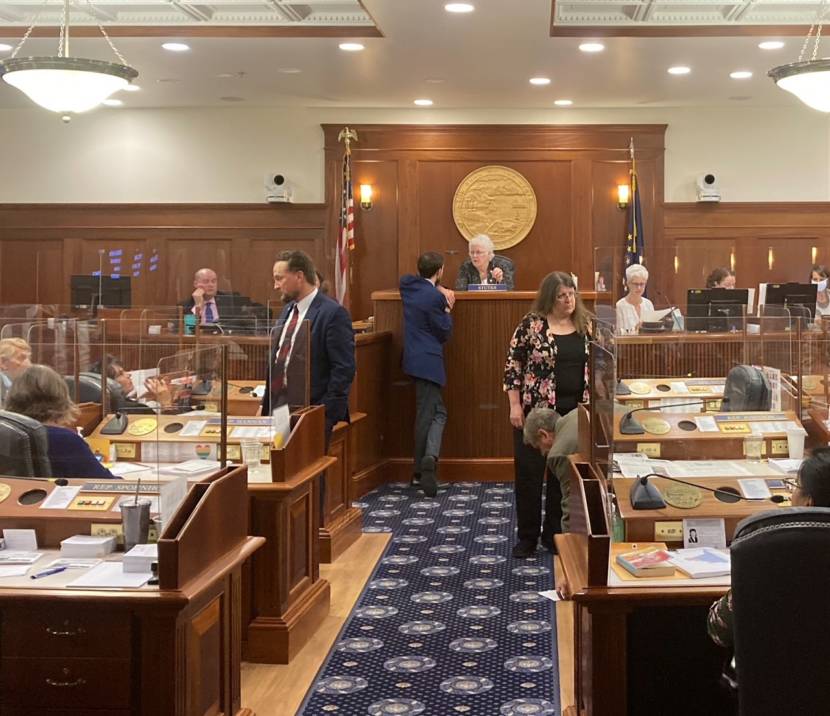
Alaska House members talk during a break in the debate on whether to draw from the Constitutional Budget Reserve in the Capitol in Juneau on Tuesday. Kodiak Republican House Speaker Louise Stutes is seated in the center below the state seal. (Andrew Kitchenman/KTOO and Alaska Public Media)
The Alaska House of Representatives voted to pass the state budget on Tuesday. But most of the Republican minority caucus voted against a provision that would have provided an $1,100 permanent fund dividend. So the PFD would be $525, though several Republicans said they wanted the amount to be larger.
A program that provides financial assistance for electricity in high-cost areas won’t be funded. Neither will state-sponsored university scholarships.
Those programs and most of the dividend funding depended on three-quarters of the House members agreeing to draw money from the Constitutional Budget Reserve. That failed by six votes.
Nome Democratic Rep. Neal Foster noted that past debates to sweep money into the Constitutional Budget Reserve affected residents of high-power-cost areas and university students. He said funding PFDs through the vote put all House members in a similar position.
“You know, we should all be in the same boat,” Foster said. “Why is it that certain groups are subject to the sweep?”
Some minority-caucus Republicans said they had little input in how the budget was structured. And they said that it would be wrong to hold them responsible for voting against funding programs from the Constitutional Budget Reserve. They said they would support funding the program to offset high power costs later this year.
Wasilla Republican Rep. Christopher Kurka argued for a larger dividend. He said government spending should be taken from the crumbs of the draw from Alaska Permanent Fund earnings, not from the dividend.
“This $1,100 amount, Madam Speaker, I believe is an insult to Alaskans, when the real PFD should be $3,500,” Kurka said.
Fairbanks Republican Rep. Bart LeBon was one of three minority-caucus members who voted in favor of drawing from the Constitutional Budget Reserve. He said having an $1,100 dividend allows for a sustainable draw from permanent fund earnings. And he said that would protect the permanent fund for future generations.
“I voted for $1,100, not $500, so I’m disappointed that the gamesmanship has brought us here today,” he said.
A separate vote to pass the budget passed along caucus lines, 21 to 18.
Anchorage Democratic Rep. Ivy Spohnholz praised the budget. She noted that it includes more spending on capital projects.
“I’m thrilled that we have a larger capital budget than we’ve seen in many years. I think it’s important … to address our deferred maintenance needs across the state and to get Alaskans back to work,” she said.
Wasilla Republican Rep. Cathy Tilton expressed disappointment that the budget didn’t devote more American Rescue Plan Act funding to private businesses.
“If I had the opportunity, I would put more relief out to the private sector, so that the private sector could help to move our economy along,” she said.
Using the formula in a 1982 state law, dividends would have been roughly $3,500. That would cost the state $1.5 billion more than a $1,100 dividend. Paying $2,350 dividends equalling half of the draw from permanent fund earnings, as Gov. Mike Dunleavy has proposed, would cost roughly $750 million more than a $1,100 dividend.
The Senate is set to debate the budget on Wednesday. The special session must end by Friday. Dunleavy has called the Legislature into a second special session that starts on Aug. 2. He could add items that aren’t funded this week onto the agenda for that session.
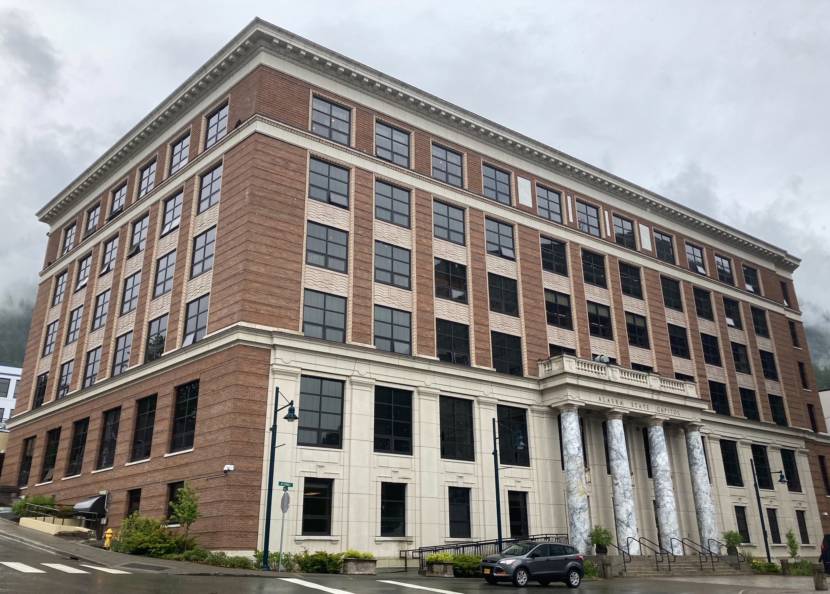
The Alaska State Capitol in Juneau hosts legislative negotiations on a rainy day on Tuesday. Neither legislative chamber held a session on Monday. While the Senate held a three-minute technical session on Tuesday morning, the House delayed its session through the afternoon. (Photo by Andrew Kitchenman/KTOO and Alaska Public Media)
The legislative special session is scheduled to end on Friday, and lawmakers have not passed a budget.
Budget negotiators agreed to a compromise on Sunday. But neither chamber has held a regular floor session through Tuesday afternoon.
There is still disagreement over the size of the permanent fund dividend, and how to pay for it.
The compromise budget sets the permanent fund dividend at $1,100. But it would be reduced to $525 if three-quarters of either chamber fails to approve a separate motion after the budget vote.
Legislators met in private, seeking agreement on the next step.
The Senate held a three-minute technical session on Tuesday.
Sen. Bill Wielechowski, D-Anchorage, asks for a vote on the budget compromise during a brief technical floor session on Tuesday. Senators Robert Myers, R-North Pole, and Jesse Kiehl, D-Juneau, are behind Wielechowski. (Screen capture from Gavel Alaska)
Anchorage Democratic Sen. Bill Wielechowski objected to the short floor session, noting it had been scheduled as a regular floor session.
“We have important business to do,” he said. “The session ends in a couple days. We need to vote on this conference committee report.”
The Senate narrowly voted to adjourn today’s floor session. The House had delayed its scheduled floor session Tuesday afternoon.
State workers are scheduled to receive layoff notices on Thursday if the budget isn’t approved.
State debt manager Deven Mitchell gives an overview of the state’s credit ratings and debt to the Senate Finance Committee in 2019. On Friday, Mitchell said the state’s improved credit outlook led to lower costs for municipalities. (Photo by Skip Gray/KTOO)
As Alaska lawmakers decide what to do about the budget, one group that’s keeping an eye on the outcome are the agencies that rate the state’s ability to pay off its debts. As the budget situation worsened in recent years, the agencies downgraded the state’s credit rating 10 times between 2016 and 2020.
But the rating agencies see improvement in Alaska’s outlook.
The past year has seen oil prices stabilize. And investment growth has added to the Alaska Permanent Fund.
Edward Hampton says both are good news for the state budget. He’s analyzed Alaska’s finances since Sarah Palin was the governor. And he worked on a Moody’s Investors Service report in April that revised the outlook for Alaska’s credit rating from negative to stable.
“Alaska is a state that is adjusting to a new approach to the oil industry,” he said. “And a big part of that is being able to rely on the permanent fund’s earnings in a systematic way.”
It isn’t just the oil and investment markets that have helped. Hampton said the three years of the state sticking to a plan to draw from permanent fund earnings are also a reason for the improved outlook.
“For at least the time being, we are accepting that the state is adhering to its structured draw approach and is not going to try to deviate from that in a dramatic way that would deplete the permanent fund earnings reserve account,” he said. “Obviously there is risk if the state goes in the direction of paying higher dividends.”
This week, legislators are debating a budget that would pay a $1,100 dividend, less than half the amount proposed by Gov. Mike Dunleavy.
Despite the improved outlook, Moody’s currently gives only two states worse credit ratings than Alaska: Illinois and New Jersey.
And Hampton said Moody’s would likely need to see lawmakers make it clear that they won’t draw more than planned from permanent fund earnings before the state’s credit rating is upgraded.
In May, S&P Global Ratings also changed Alaska’s credit outlook from negative to stable this spring. Like Moody’s, S&P analysts cite improvements in oil prices and permanent fund earnings.
State debt manager Deven Mitchell said there are practical benefits for the state and its residents when the ratings agencies see an improved outlookIn his job, Mitchell tries to protect the state’s credit rating.
Mitchell said the revised outlooks allowed Alaska municipalities to refinance loans at a lower rate — and the City of Sand Point and the Southeast Alaska Power Agency took out new loans at less expense — through the municipal bond bank.
“And so if that was only, you know, a tenth of a percent, it still makes a big difference when you’re talking about a couple hundred millions dollars of bonds being issued,” he said.
But Mitchell noted that the ratings agencies continue to point out risks related to uncertainty over how much will be drawn from permanent fund earnings.
A third agency — Fitch Ratings — didn’t revise its negative outlook for Alaska this spring. Fitch analysts expressed concern that the permanent fund’s earnings reserve could be drawn down if investments decline and the state draws more than planned.
A provision of the proposed budget compromise being debated could increase that concern. The budget would transfer $4 billion from the earnings reserve — which isn’t protected by legislative spending — to the fund’s constitutionally protected principal.
Mitchell said he understands why lawmakers are proposing the transfer.
“That, from a long-term perspective, is in my view a smart thing to do, a prudent thing to do,” he said. “But from a strictly ‘how are you going to pay your bills?’ perspective, you know, cash is king. You want to have liquidity in order to pay your bills.”
But Mitchell said that while there are divisions over the budget, lawmakers have been less dire in their predictions than they were when the agencies repeatedly downgraded Alaska’s credit rating. And he said that’s helped improve the credit outlook.
“I think that’s made a big difference: It’s just the tone of the discussion in the state of Alaska, even though some of the same issues remain,” he said.
Legislative budget negotiators are hoping to pass the budget before Thursday, when state workers are scheduled to receive layoff notices.
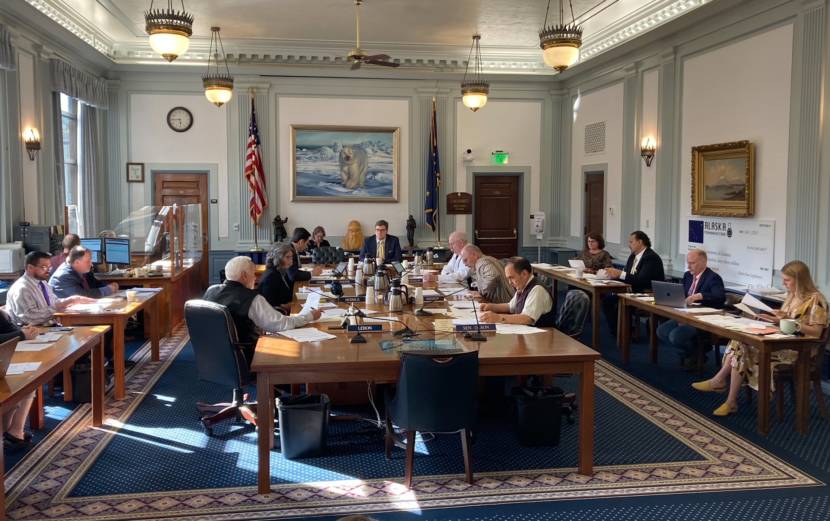
Members of the conference committee on the state budget bills review documents on Sunday in the Capitol. The bills would fund the budget that begins on July 1. The members seated on the left of the center table include Reps. Bart LeBon, R-Fairbanks; Kelly Merrick, R-Eagle River; and Neal Foster, D-Nome. Seated on the right are Sens. Bert Stedman, R-Sitka; Click Bishop, R-Fairbanks; and Donny Olson, D-Golovin. Legislative budget analyst Alexei Painter is in the center. (Photo by Andrew Kitchenman/KTOO and Alaska Public Media)
This year’s permanent fund dividend would be $1,100 under a compromise budget proposal that the Legislature will vote on this week.
A committee composed of both senators and House members agreed to a budget that would set the dividend at less than half the roughly $2,350 amount that Gov. Mike Dunleavy proposed and the Senate passed during the regular session.
But it keeps the annual draw from permanent fund earnings within a limit set in a 2018 law.
Fairbanks Republican Rep. Bart LeBon voted for the $1,100 dividend amount. He said he was concerned that drawing more than planned to pay a larger dividend would threaten the long-term health of the permanent fund.
“Protection of the permanent fund itself is a high priority in my thinking and this accomplishes that,” he said.
The committee passed an amendment to the budget that would make most of the dividend funding dependent on spending money from a state piggy bank known as the Constitutional Budget Reserve, or CBR. That would require a vote of support from three-quarters of both chambers. The amendment also makes more than $30 million in funding for projects in Matanuska-Susitna Borough dependent on the vote to draw from this reserve.
Sen. Bert Stedman said the amendment could build support for this vote.
“It certainly encourages some folks to seriously consider what vote they’re going to, what position they’re going to take on the CBR,” he said.
The CBR vote preserves funds for dozens of programs that pay for everything from offsetting the cost of electricity in rural areas to university scholarships. But members of the Republican House minority — including several Mat-Su lawmakers — have withheld their votes the past two years in efforts to pay higher dividends.
If the CBR vote fails, dividends would be $525. That would be the lowest in the program’s history, when adjusted for inflation.
Stedman said the budget would allow for a dividend in a similar range to $1,100 next year, without drawing more than planned from permanent fund earnings.
Members of both chambers will have a chance to vote on the changes later this week. Committee members have expressed hope that the budget will pass before Thursday, when state workers are scheduled to receive layoff notices due to delays in the budget passing.
The compromise budget would transfer $4 billion from the permanent fund’s earnings reserve — which is not protected from legislative spending — to the constitutionally protected principal.
And it reduces funding for all abortions paid by Medicaid. Alaska courts have found that previous legislative attempts to end abortion funding violated provisions of the state constitution.
Dunleavy criticized the dividend amount in a post on social media Sunday. He said it provides proof that the dividend should be protected in the state constitution. He has proposed to do that through a constitutional amendment. Legislators have already raised questions about how he would pay for higher dividends.
Lucinda Mahoney, commissioner of the Alaska Department of Revenue, left, listens to Rep. Ben Carpenter, R-Nikiski, right, during the House Finance Committee meeting on on Tuesday in the Capitol. (Photo by Andrew Kitchenman/KTOO and Alaska Public Media)
Gov. Mike Dunleavy’s administration plans to present lawmakers with a few revenue options during the second special session later this summer.
State Revenue Commissioner Lucinda Mahoney told the House Finance Committee on Tuesday that the options would include the governor’s proposal to expand gambling in the state. She said the administration is seeking more detailed analysis of how much money it would raise.
“What is more important about that initiative is the economic impact of that industry on our economy,” she said. “And the potential to diversify the economy.”
Mahoney said there will be “a few more” revenue measures presented to legislators. But she only hinted at what they would be.
“These new revenue measures are very different than any tax that we’ve seen in Alaska,” she said. “They’re more modern. But we are still fleshing them out.”
Mahoney said the administration is working on an update to how much money different revenue proposals would raise.
The Department of Revenue presented estimates a year ago that ranged from $2.3 million from legalizing gambling on card games to $1.2 billion if the state were to adopt a sales and use tax similar to one in South Dakota.
Nonpartisan experts estimate the gap between what the state would raise and what it would spend under Dunleavy’s permanent fund dividend proposal to be $1 billion per year over the next decade. The administration estimates it to be smaller, equalling $300 million by the end of the decade. The governor also has proposed taking $3 billion from the permanent fund’s earnings to cover budget gaps over the next five years.
There are 10 days left in the first special session.
Close
Update notification options
Subscribe to notifications
Subscribe
Get notifications about news related to the topics you care about. You can unsubscribe anytime.