State Government Reporter, Alaska Public Media & KTOO
State government plays an outsized role in the life of Alaskans. As the state continues to go through the painful process of deciding what its priorities are, I bring Alaskans to the scene of a government in transition.
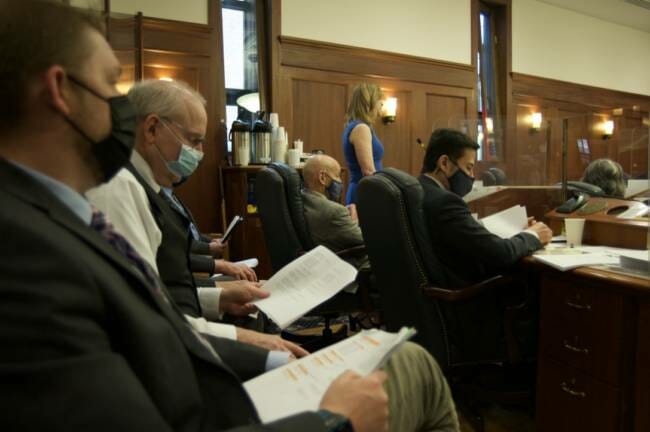
Alaska state Sen. Mia Costello, R-Anchorage, speaks in support of Abe Williams who was rejected from sitting on the Alaska Board of Fisheries on Tuesday, May 11 2021, in Juneau, Alaska. The Alaska Legislature held its annual joint confirmation hearing for dozens of the governor’s appointees to boards and commissions. (AP Photo/Sean Maguire, Pool)
The Alaska Legislature rejected one of Gov. Mike Dunleavy’s nominees to the state Board of Fisheries on Tuesday.
The nomination of Anchorage resident Abe Williams failed in an 18 to 41 vote during a joint session.
Bethel Democratic Sen. Lyman Hoffman urged legislators to vote against Williams. He was especially concerned that Williams would vote to increase the length of boats that commercial fishermen can use in Bristol Bay.
“And the people in the villages would not have the resources to invest in those larger boats,” Hoffman said.
The Legislature is considering two years of nominees because there was no joint session last year after the pandemic reached Alaska. It’s the first time in state history the Legislature has doubled up on this work.
Lawmakers rejected two other nominees during the joint session.
Anchor Point resident John Cox fell one vote short of being confirmed to the Alcoholic Beverage Control Board.
Opponents of Cox’s nomination raised concern that he supported liquor license holders losing their license if they don’t put it to use.
Annette Gwalthney-Jones of Anchorage fell two votes short of being confirmed to the Alaska Mental Health Trust Authority Board of Trustees. She received criticism for strident social media posts about politics and for not meeting the requirements for board members.
Attorney General Treg Taylor was confirmed, in a 35 to 24 vote. Jim Cockrell was confirmed as the commissioner of the Department of Public Safety without opposition. And Lucinda Mahoney was confirmed as the commissioner of the Department of Revenue, 53 to 6.
A total of 174 of Dunleavy’s nominees were confirmed.
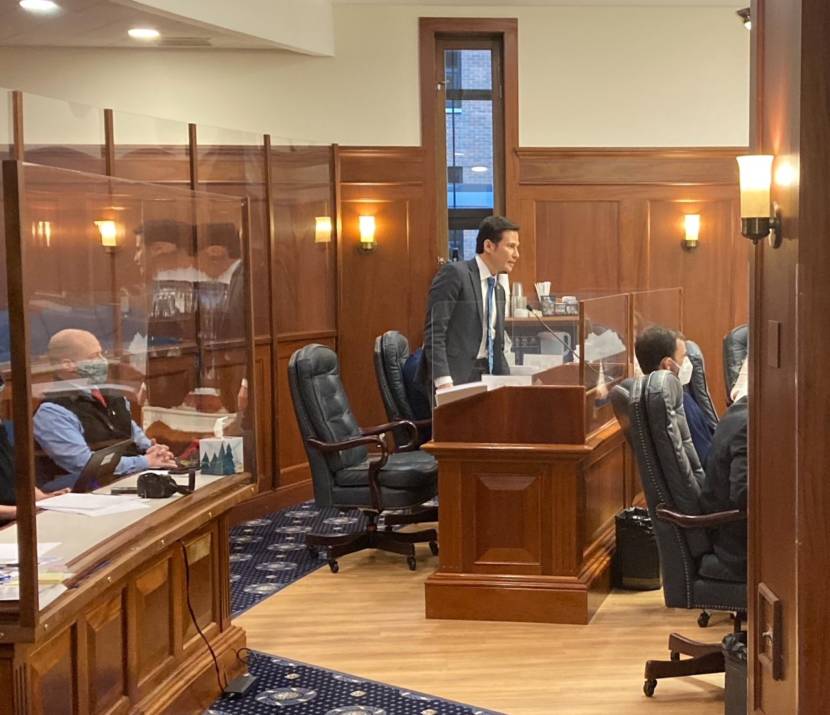
Rep. Neal Foster, D-Nome, offers his closing argument for the operating budget bill, which passed moments later, 23-16, on May 10, 2021, in the Capitol. (Photo by Andrew Kitchenman/KTOO and Alaska Public Media)
The Alaska House of Representatives passed the state’s operating budget bill on Monday.
The budget includes most of what Gov. Mike Dunleavy proposed for state agencies. But it doesn’t include funding for permanent fund dividends.
Members of the mostly Democratic House majority caucus say they expect to fund PFDs in a separate bill.
Nome Democratic Rep. Neal Foster said he’s comfortable working out any remaining budget issues with senators.
“This is largely a flat budget compared to last year,” he said. “It seeks to protect and enhance some important public services like transportation, like education. And at the same time, we’ve taken advantage of the American Rescue Plan funds that are coming to the state. That’ll help Alaskans deal with this global pandemic.”
The 23 to 16 vote to approve the budget came the same day that news from the federal government raised a new potential budget problem.
It appears that Alaska will receive roughly $200 million less in COVID-19 relief this year than House members planned. That’s because it appears that Alaska will be among the states that will have half of their American Rescue Plan Act money withheld for a year.
A draft of long-awaited federal guidance on how states can spend the money was released on Monday.
Big Lake Republican Rep. Kevin McCabe voted no on the budget, citing the inclusion of the federal money as one reason. He said it’s unsound, and that the Legislature should have followed more of the administration’s recommendations.
“Structurally, this budget has a number of problems, in addition to the sort of emotional amendments for some projects that we have added to it,” he said.
Nikiski Republican Rep. Ben Carpenter also voted no.
“I think we missed an opportunity to address our savings,” he said. “We missed an opportunity to use the federal dollars to help us with making those structural changes. We missed the opportunity to help reduce our budget.”
But Anchorage Democratic Rep. Geran Tarr said the minority caucus offered few amendments that would have significantly reduced spending.
“I think we’re responding to the public’s demand for the services they value,” she said. “And we’re trying to do the best we can.”
The House amended the budget bill, House Bill 69, to say that the state’s Medicaid program wouldn’t pay for abortions. The state supreme court has ruled similar laws unconstitutional in the past, because they violate the Alaska Constitution’s equal protection clause.
The House spent most of the day debating more than 30 other proposed budget amendments.
Including two earlier days of debate, the House passed 18 amendments and turned down 38.
The largest change that passed added $3.5 million to fund public assistance workers. Dunleavy’s administration anticipates eliminating the positions due to a shift to online applications for public benefits. But that shift may not happen in time to save the money in the next year.
Other amendments that passed say that it’s the Legislature’s intent that the state government shouldn’t keep any data that can be used in facial recognition software, or to provide driver’s license information to foreign-owned corporations or foreign governments. But this intent language isn’t binding on the government.
The House also voted to pass the Alaska Mental Health Trust budget, which is in a separate bill, House Bill 71.
The votes are just one step before the budget is finalized. It now goes to the Senate, where the Finance Committee is working on a somewhat different version of the budget bill.
The two chambers usually work out their differences in a conference committee.
Neitherchamber has passed a capital budget to fund roads and other projects.
The legislative session is scheduled to end on May 19.
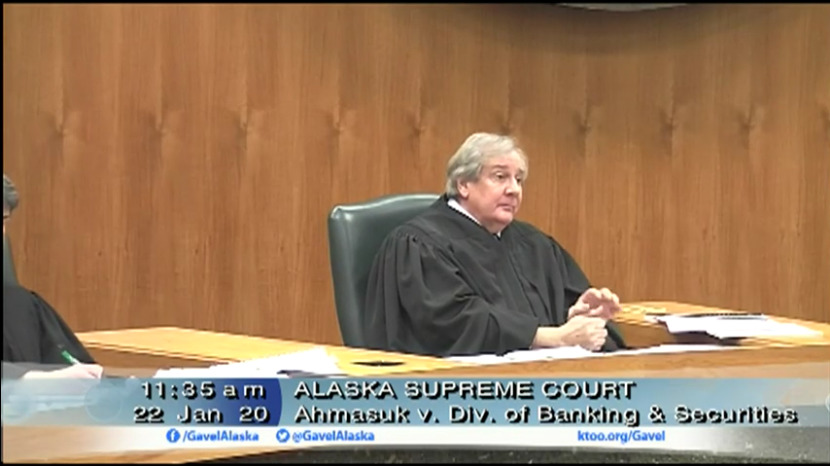
Supreme Court Justice Daniel Winfree questions a lawyer during oral arguments in 2020. Winfree was unanimously selected as the court’s chief justice on Wednesday. (Screenshots courtesy of KTOO 360TV)
Daniel Winfree was selected unanimously on Wednesday as the chief justice of the Alaska Supreme Court.
Under the Alaska Constitution, justices select the chief justice by a majority vote. The chief justice presides over Supreme Court arguments and conferences and is the administrative head of the judicial branch of the state government.
Winfree is from Fairbanks and will be the first chief justice who was born in Alaska. He worked as a truck driver and in pipeline construction camps for the trans-Alaska pipeline. He also worked as a lawyer in private practice for 25 years before being appointed to the court by Gov. Sarah Palin in 2008.
Winfree’s term starts on July 1, succeeding Chief Justice Joel Bolger. Winfree must retire by February 2023, when he reaches Alaska’s mandatory retirement age for judges of 70. This will prevent him from serving a full three-year term as chief justice.
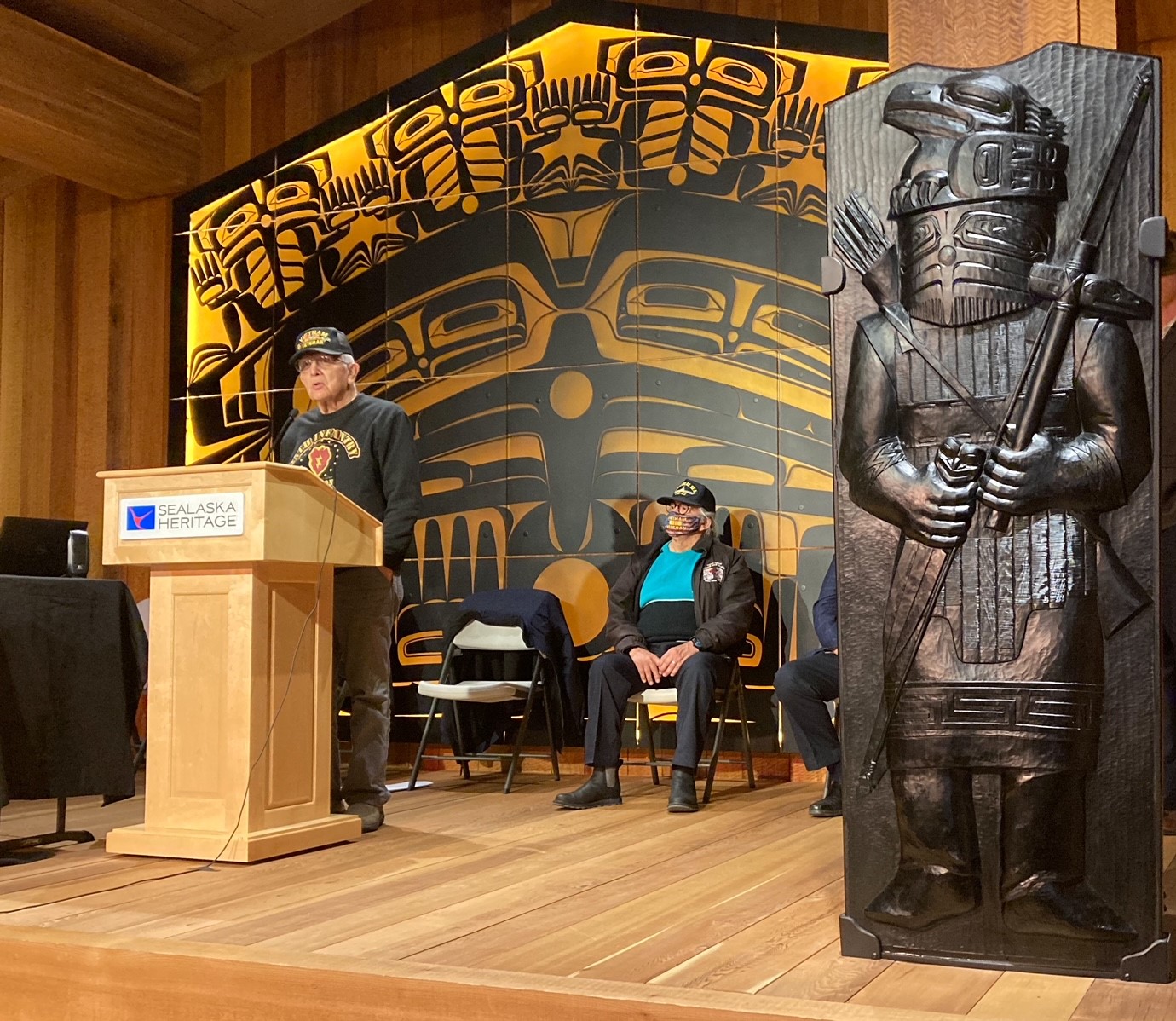
Army veteran George Bennett of Sitka speaks at the announcement of Gov. Mike Dunleavy’s proposal to provide state land to Alaska Native veterans of the Vietnam era on Wednesday in Sealaska Heritage Institute’s Walter Soboleff Building. (Photo by Andrew Kitchenman/KTOO and Alaska Public Media)
Alaska Native veterans of the Vietnam War era would be able to receive state land under a proposal Gov. Mike Dunleavy announced on Wednesday.
Dunleavy said many veterans or their heirs would be able to receive land that’s closer to their homes than they would receive under a federal program.
A 2019 federal law would allow Alaska Native veterans to receive 160-acre allotments of government land. It took until late in the Trump administration to write the rules to put the program into effect. The Biden administration recently delayed a Trump administration order to increase the land eligible to become allotments under the program.
Dunleavy’s proposal would allow veterans to exchange their federal allotments for state land of equivalent value.
Army veteran George Bennett of Sitka welcomed the proposal. He said veterans were dealing with trauma at the time they could have applied for land during the Vietnam era.
“In the first several years that we came home, most of us didn’t want to be bothered, because we were dealing with some demons that had returned with us from Vietnam,” he said.
Bennett attended Dunleavy’s announcement at Sealaska Heritage Institute’s Walter Soboleff Building in Juneau.
Alaska Natives were able to file claims for 160-acre allotments from 1906 until 1971 when the Alaska Native Claims Settlement Act repealed the allotment law. They could file claims for land that they had used continuously.
Relatively few claims for allotments were filed until the two years before ANCSA repealed the allotment law. But in that two-year period — when thousands of claims were filed — some Alaska Natives were unable to apply because they were serving in Southeast Asia, while others had recently returned and were not focused on claiming allotments.
The 2019 federal law is the second time Congress passed a law aimed at helping these veterans. But few veterans took advantage of the earlier law, passed in 1998.
The 2019 federal law doesn’t require the veterans to have used the land, so they could file claims for any available federal land.
And it allows heirs to file claims — the only heirs allowed to file claims under the 1998 law were those of soldiers who were killed in action or who died while prisoners of war or from wounds they received in the war.
Dunleavy said the veterans had to fight the federal bureaucracy to be heard.
“I’m actually proud today to stand with our veterans,” he said. “I believe it is a moral imperative. This is not a political maneuver at all. These folks have fought hard for decades and decades and decades.”
Dunleavy’s proposal is included in an amendment to proposed measures, Senate Bill 97 and House Bill 120, the Legislature already was considering.
Note: This story has been corrected to reflect the fact that the federal program was not halted or delayed. A Trump administration order to add land to the program has been delayed.
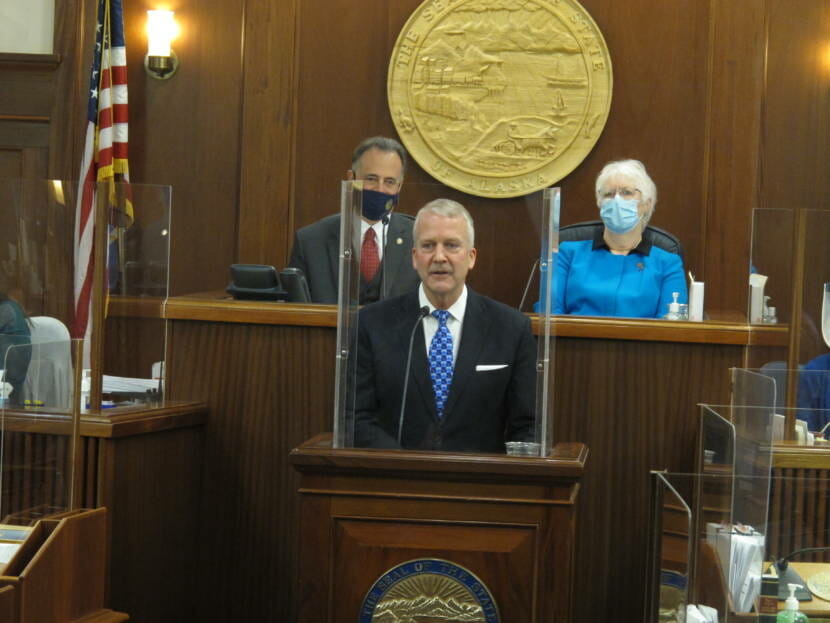
Alaska Republican U.S. Sen. Dan Sullivan, center, speaks to a joint session of the Alaska Legislature on Monday, May 3, 2021, in Juneau, Alaska. Pictured behind Sullivan are, from left, Senate President Peter Micciche and House Speaker Louise Stutes. (AP Photo/Becky Bohrer, Pool)
U.S. Sen. Dan Sullivan told Alaska’s legislators on Monday that President Biden’s administration is at war with Alaska over developing resources.
In an address to a joint session in the Legislature, Sullivan said Alaska’s economy benefited from a series of decisions by former President Trump’s administration. These decisions included on oil development for the Willow Project in the National Petroleum Reserve-Alaska and the development of a road between King Cove and Cold Bay that will run through a national wildlife refuge. He says those decisions are under attack.
“This is not surprising,” Sullivan said. “We knew this anti-Alaska agenda was coming if the national Democratic Party took control of the White House, the Senate and the House. Alaska is always the gift that national Democratic administrations give their extreme, radical environmental supporters.”
This year is the first time Sullivan, a Republican, has been in the minority caucus in the U.S. Senate. And with Democrats controlling both Congress and the White House, he said he will be strategic.
“We need to look for ways to gain ground when we can, even if we feel that we’re in retreat right now,” he said.
He said support in Alaska for developing projects like the oil discovery at Willow hasn’t been partisan.
“But we need all of your help, especially our Democratic friends in the Legislature,” he said. “You all have powerful voices. Please, underscore the importance of Willow in any and all conversations you have with any Biden administration officials. We need to turn Willow into a victory for Alaska and America.”
He said the Biden administration’s proposals are part of a long-term battle facing the country.
“They’re tempting America with cradle-to-grave, European-style socialism,” he said. “They’re cutting the ties between work and income, and in so doing, undermining the notion of earned success and the dignity and importance of work.”
But he did say there were some early successes for the state with the new administration, including the decision to build a dock, pier and office in Ketchikan, to serve as the home port for a National Oceanic and Atmospheric Administration research vessel.
It was the Legislature’s first joint session in the House chamber since the pandemic arrived in Alaska. The Legislature has been easing some of its COVID-19 safety rules, including no longer requiring fully vaccinated people who work in the Capitol to frequently be tested for the coronavirus.
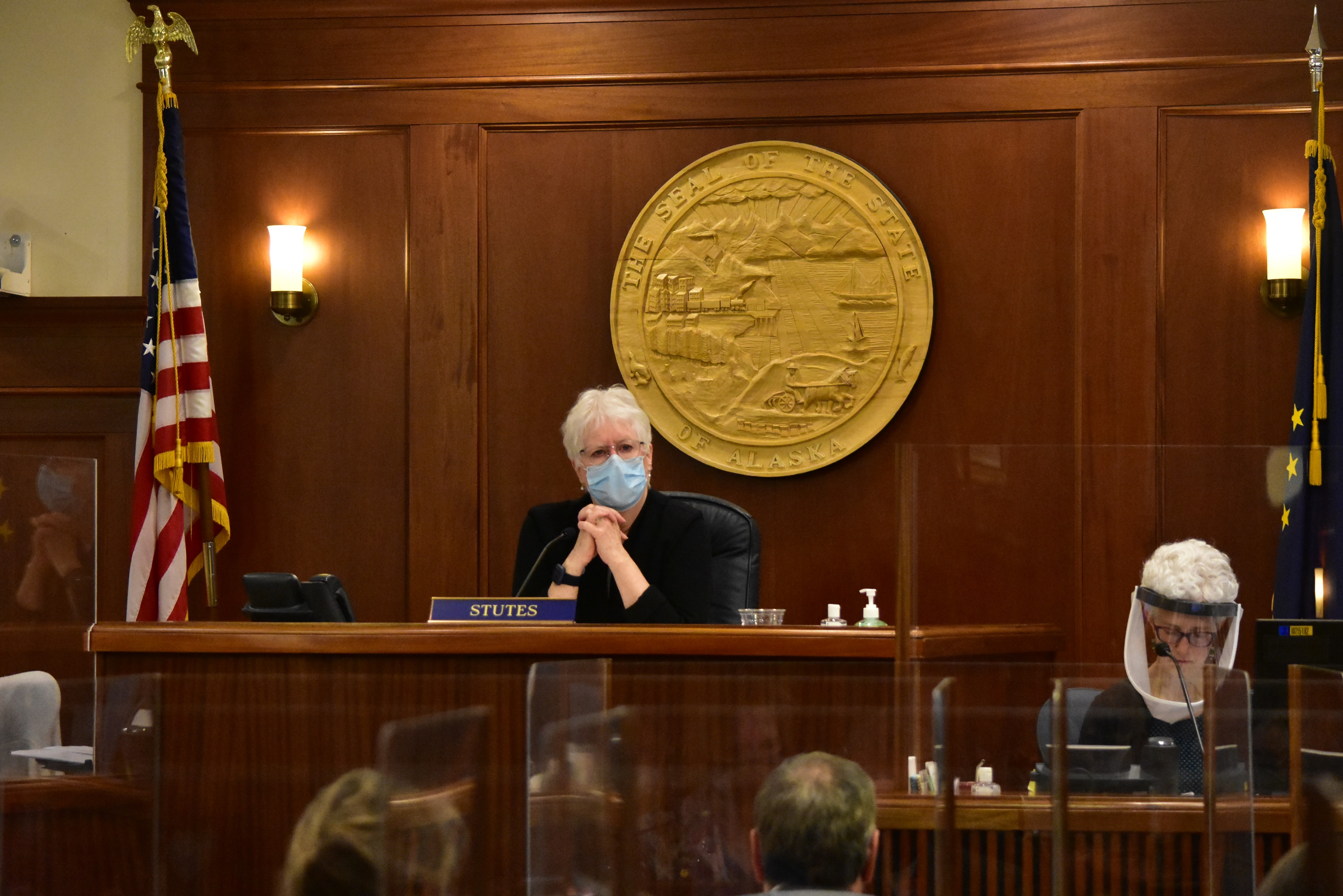
House Speaker Louise Stutes, R-Kodiak, listens to several hours worth of debate over a COVID-19 disaster declaration on Thursday, March 25, 2021. (Peter Segall/Juneau Empire via AP, Pool)
The Alaska House of Representatives will take more time before beginning the final debate on its version of the state budget.
House Speaker Louise Stutes deferred action on the budget on Sunday, after minority-caucus Republicans protested not having dozens of their amendments heard.
Stutes, a Kodiak Republican who caucuses with the mostly Democratic majority said she wanted to send two bills — one dealing with the operating budget and one dealing with the mental health trust budget — back to the House Rules Committee to allow for additional time for the majority and minority caucuses to discuss them.
The current version of the House operating budget would spend $4.2 billion in state funding, more than $200 million less than the previous budget. But it doesn’t address permanent fund dividends.
House Republicans had proposed dozens of amendments that hadn’t been heard. They said they met the deadline set by Stutes. But they lost a key vote early Sunday afternoon, which prevented the amendments from being heard.
Several minority-caucus Republicans wanted to speak about their concerns about how debate on amendments was cut off. This led Stutes to repeatedly tell them to stick to the budget itself.
Big Lake Republican Rep. Kevin McCabe said the decision to stop hearing amendments disenfranchised the constituents of his caucus members.
With tempers flaring on the floor, the House took a four-hour break before Stutes called for delaying action on the budget.
The dispute came a day after the two sides repeatedly haggled over legislative rules, including what language they could use to talk about other members and the executive branch of government.
After both the House and Senate pass their versions of the budget, there will be a committee with members from both chambers that will work out their differences.
The constitutional deadline to end the session is May 19. A key date between now and then is May 10, when the federal government is expected to provide guidance on how states can spend their share of American Rescue Plan Act money. For Alaska, that is $1 billion over two and a half years.
Depending on the federal guidance, that money could be used to support state spending, potentially freeing up state revenue for PFDs. Lawmakers have also suggested that a state savings account — the Constitutional Budget Reserve — could also support dividends, without forcing the state to draw more than planned from the permanent fund’s earnings reserve.
The Constitutional Budget Reserve has roughly $900 million, but state officials have said at least $500 million is needed to manage the monthly flow of money in and out of state coffers.
The House rejected a proposed amendment on Saturday that would have paid dividends according to the formula in a 1982 state law. The formula hasn’t been used the past five years. Including permanent fund earnings through March, dividends would be nearly $3,400 this year under the formula.
But they would also draw more than $2 billion more than planned from the permanent fund’s earnings reserve. House majority lawmakers have said draws of that size threaten the future of both the permanent fund and PFDs.
The House Special Committee on Ways and Means introduced a bill on Friday that would fund $500 dividends this year. Dividends at roughly that level would allow the state budget to be balanced over the next decade without new taxes or spending cuts. But it would be the smallest PFD level since 1985 and the lowest ever when adjusted for inflation.
Close
Update notification options
Subscribe to notifications
Subscribe
Get notifications about news related to the topics you care about. You can unsubscribe anytime.