Archives for:

"King Cove"

State begins permitting process to build Izembek road

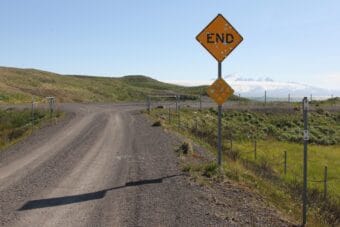
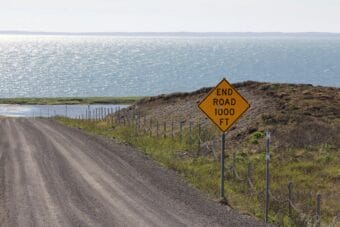
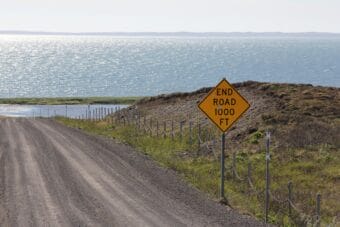
The end of the road leading out of King Cove. June 2024
The end of the road leading out of King Cove. June 2024 (Theo Greenly/KUCB)

A controversial stretch of road connecting two Eastern Aleutian communities is heading toward construction.

The Alaska Department of Transportation has applied for a U.S. Army Corps of Engineers permit to build the road and is taking public comments on the proposed work until Jan. 12.

The 19-mile road would pass through the Izembek National Wildlife Refuge, connecting King Cove residents to nearby Cold Bay. King Cove community leaders say the single-lane, unpaved road could provide life-saving access to Cold Bay’s all-weather airport, but conservation groups have fought the proposal for decades.

In October, federal officials announced a land exchange agreement with the King Cove Corp. to facilitate the road. That wasn’t the first time a swap agreement had been approved, but local leaders said it was the first time the land had actually switched ownership into the hands of the for-profit Native corporation.

The refuge will swap 490 acres of land for the road, in exchange for about 1,700 acres of the corporation’s land. According to the permit, King Cove Corp. also relinquished its selection rights under the Alaska Native Claims Settlement Act to 5,430 acres of land within the Izembek Refuge, which means it gave up its legal ability to select those parcels under ANCSA in return for the agreed land exchange.

Several environmental groups and dozens of Alaska tribes have called for the road to be stopped. They say the refuge shouldn’t be developed because it would threaten wildlife, some of which are precious subsistence resources for communities across the state.

Subsistence is also part of King Cove’s argument in favor of the road. The tribal government says the road would help them access their own subsistence lands, much of which is inaccessible except by boat.

According to the Corps, the road would cross numerous streams, some of which are home to spawning salmon. The project area also covers the habitat of endangered and threatened species, like the Steller’s eider and the short-tailed albatross.

The corps will consult with various organizations, including the U.S. Fish and Wildlife Service, the State Historic Preservation Office and federal tribes before issuing permits. They are also accepting public comments during the application process.

Comments can be submitted via email or sent to the Army Corps field office in Fairbanks. You can find more information on the Army Corp’s website.

Tribes and environmental groups sue to stop road planned for Alaska wildlife refuge

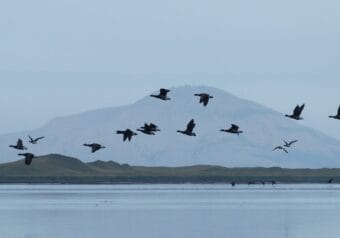
Brant fly over the water on Sept. 28, 2016, at Izembek Lagoon in Izembek National Wildlife Refuge. The refuge supports the entire Pacific population of black brant, a species of goose.
(Kristine Sowl/U.S. Fish and Wildlife Service)

Three tribal governments and several environmental groups sued the Trump administration on Wednesday to try to block a land trade that would allow a road to be built through a national wildlife refuge in southwestern Alaska.

The land swap, approved by the U.S. Department of the Interior last month, would open up a section of the Izembek National Wildlife Refuge.

Supporters argue that the road is needed to connect the community of King Cove, home to about 750 people, with a legacy military airstrip that can accommodate jets. That would give King Cove’s residents access to safer medical evacuations if needed. Opponents say the proposed road — to run 18.9 miles in total, most of that within what is currently refuge land — would damage world-class bird habitat that is in the heart of the refuge.

Wednesday’s challenges came in three lawsuits filed in U.S. District Court in Anchorage. All assert that the land trade and road development pose dire threats to migratory bird populations that use Izembek’s wetlands, including species with Endangered Species Act listings, and to the wider ecosystem. All say the trade and planned road violate the Alaska National Interest Lands Conservation Act and other federal laws.

The three lawsuits have their individual characteristics as well.

One of them, filed by tribal governments in the Yukon-Kuskokwim Delta villages, focuses on threats to traditional subsistence hunters who depend on the birds that use Izembek’s wetlands. The tribal plaintiffs are the Native Village of Paimiut, Native Village of Hooper Bay and Chevak Native Village.

“Izembek’s eelgrass wetlands are a lifeline for emperor geese, black brant and other birds that feed our families and connect us to Indigenous relatives across the Pacific,” Angutekaraq Estelle Thomson, traditional council president of the Native Village of Paimiut, said in a statement. “Trading away this globally important refuge for a commercial corridor devalues our lives and our children’s future. We are joining this lawsuit because defending Izembek is inseparable from defending our subsistence rights, our food security and our ability to remain Yup’ik on our own lands.”

The Center for Biological Diversity, an environmental organization, is also a plaintiff in the case.

A second lawsuit, filed by Friends of Alaska National Wildlife Refuges, Wilderness Watch, the Alaska Wilderness League and the Sierra Club, puts a special focus on the process used to achieve the land swap and what it may mean for all wildlife refuges.

“Trading the ownership of refuge lands that Congress designated for conservation is a terrible precedent for the privatization of public lands. Building a road will have tremendous impacts on fish and wildlife habitat and could also greatly increase both disturbance and sport hunting pressure on vulnerable species,” Marilyn Sigman, president of Friends of Alaska National Wildlife Refuges, said in a statement.

The third complaint, filed by Defenders of Wildlife, puts a focus on the wider environmental impacts.

Green eelgrass appears at low tide in the vast wetlands of Izembek Lagoon, at the edge of Izembek Refuge. (Kristine Sowl/USFWS)

The planned road enabled by the land trade would “result in incalculable and irreversible damage” to myriad wildlife species, including marine and land mammals as well as migratory birds, that lawsuit says. The lawsuit alleges that the land deal violates both the National Wildlife Refuge System Improvement Act and the federal Wilderness Act.

“Under the Trump administration, the Interior Secretary entered into an illegal deal done in the darkness of a government shutdown: a sellout of one of our country’s largest and most pristine wildlife refuges and wilderness areas,” Jane Davenport, a senior attorney in Defenders of Wildlife’s Biodiversity Law Center, said in a statement. “Our treasured public conservation lands belong to all Americans. Defenders of Wildlife will stand up in court to hold this administration to account for recklessly and unlawfully trading them away.”

The Izembek Lagoon area, where the road is planned, holds the largest single stand of eelgrass in the world and the largest bed of seagrass along the North American Pacific Coast, according to the U.S. Fish and Wildlife Service. The entire Pacific population of black brant, a type of goose, uses the refuge’s lagoon area, feeding on the eelgrass. The refuge and its eelgrass support several other bird and mammal species; about half the world’s emperor geese use the refuge as a migratory stopover, according to biologists.

A Department of the Interior spokesperson declined to comment Wednesday on the lawsuits.

Last month, however, Interior Secretary Doug Burgum touted the land exchange and planned road as long overdue.

He spoke about the project during an event called “Alaska Day,” a gathering in Washington with Gov. Mike Dunleavy and the state’s three-member congressional delegation. The Izembek land exchange was one of the pro-development Alaska actions announced at the event.

“It just seems preposterous to me that somehow, it’s taken 40 years for us to put people first,” Burgum said at the event. “Because I know one thing as a governor of a state: You can actually do things like build 18 miles of gravel road and still take great care of wildlife.” Burgum was North Dakota’s governor before being appointed as Interior secretary.

The land trade he approved would convey a little less than 500 acres of refuge land, most of it designated wilderness, to the Native-owned King Cove Corp. The corporation would give 1,739 acres of its land to the U.S. Fish and Wildlife Service to be added to the refuge, and the federal government would also pay the corporation for the land.

The idea of a road linking King Cove to the World War II-era military runway at Cold Bay dates back decades. The legal and political battle over the proposal has also been long. Some of the plaintiffs in the new cases were plaintiffs in previous lawsuits over proposed land trades. The dispute was being considered by the 9th Circuit Court of Appeals, but that court in 2023 determined that the case was moot and dismissed it because the Biden administration was not pursuing the plan endorsed by the first Trump administration.

Green eelgrass appears at low tide in the vast wetlands of Izembek Lagoon, at the edge of Izembek Refuge. (Kristine Sowl/USFWS)

King Cove officials say new land swap agreement brings them closer than ever to building a road to Cold Bay

The road out of King Cove ends at the old hovercraft landing on the shore of Cold Bay, about 7 miles from the city of the same name.
The end of the road leading out of King Cove. June 2024 (Theo Greenly/KSDP)

Department of the Interior Secretary Doug Burgum announced a land exchange agreement Thursday with King Cove’s Native corporation, making way for the controversial construction of what many consider to be a lifesaving stretch of road.
It’s not the first time an agreement like this has been approved for the road, which would connect two eastern Aleutian communities. But according to local leaders, there’s one important difference this time around.

“Having the land exchange agreement already signed, and the ownership of the land now a done deal, that’s never happened before, so that’s big,” said longtime King Cove City Administrator Gary Hennigh in a phone interview Thursday afternoon.

King Cove sits near the western tip of the Alaska Peninsula. It’s a small fishing community that is only accessible by air or water, weather permitting, and its short gravel airstrip is difficult to fly into.

But with the addition of about 11 miles of road, residents could access a neighboring all-weather airport in Cold Bay. King Cove community leaders have fought for that road for decades, arguing that it would provide lifesaving access to emergency medical care.

The problem, though, is that the road would pass through the Izembek National Wildlife Refuge. Environmental groups and several Alaska tribes have said that land shouldn’t be developed in order to protect wildlife.

In 2018, the Trump Administration approved a land swap, which was later revoked by the Biden administration. But Hennigh said this is the first time the land has actually switched hands.

Alaska’s congressional delegation celebrated the agreement at an Alaska Day ceremony Thursday in Washington D.C.

At a press conference after the event, Republican Sen. Lisa Murkowski said the property conveyance, including the patent and the deed to the land, would be recorded Thursday afternoon.

She applauded King Cove’s perseverance.

“They are weary,” Murkowski said. “They are tired of kind of this ‘up and down, and back and forth, and maybe or maybe not.’ They want the certainty that’s going to come with this very small connector road.”

Murkowski said the U.S. Fish and Wildlife Service is swapping 490 acres of federal land for the road. The King Cove Corp. — the local Alaska Native village corporation — will hand over acreage in return.

Some western Alaska tribes have opposed the road, saying it threatens important subsistence species. And federal biologists have acknowledged the road would impact the habitat of Pacific black brant and emperor geese.

Murkowski said she recognizes the significance of those resources and that requirements are in place to ensure the animal populations remain strong.

Nobody’s talking about a multi-lane paved road, moving lots of big trucks back and forth,” she said. “It is still an 11-mile, one-lane gravel, non-commercial-use road.”

The congressional delegation said in a statement that the swap will ultimately “result in the net expansion of the Izembek refuge, clearly adding to its conservation and subsistence values. Under the agreement, Interior will receive or maintain roughly 14 times more land than it gives up.”

Hennigh said there’s still a lot to be done, with things like permitting, public commentary periods and funding to secure. After years of seeing progress toward a road fall back, he said he’s optimistic but cautious.

“We also are not so naive to think that there won’t be some lawsuits along the way,” he said.

Hennigh hopes to see construction begin by 2027.

The Alaska Desk’s Theo Greenly contributed reporting.

Oregon seafood company looks into buying Peter Pan’s King Cove plant

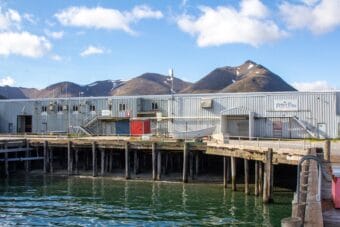
Peter Pan's King Cove facility, pictured in June 2024, has been out of operation since January of that year.
Peter Pan’s King Cove facility, pictured in June 2024, has been out of operation since January of that year. (Theo Greenly/KUCB)

Representatives from Oregon-based Pacific Seafood could be interested in buying the shuttered Peter Pan processing plant in King Cove, according to local officials from the Alaska Peninsula community.

At Thursday’s Aleutians East Borough Assembly meeting, King Cove Mayor Warren Wilson said that representatives from the seafood company had visited the plant the week before.

“They were very impressed with the plant, and they are moving forward with some talks on acquiring the facility,” he said during the public comment period, speaking as a community member. “So there is interest yet.”

Peter Pan ceased operating in King Cove in January of last year and was placed into a court-ordered receivership a few months later. After a legal dispute, the property was awarded to Peter Pan Chief Executive Rodger May. May has faced criticism over Peter Pan’s business practices, including failing to pay fishermen for the 2023 salmon season.

The plant was a major economic driver for the Alaska Peninsula community of about 800 residents. City Administrator Gary Hennigh said it generated about 70% of the city’s revenue.

“We’re not quite living on borrowed time yet, but we’re getting pretty darn close,” he said in an interview Tues.

Hennigh said he’s encouraged by the interest but cautioned that, even if there should be a deal for the plant, it is too late to restart operations for the upcoming salmon season, which opens early next month.

“Common sense just tells me it’s just not meant to happen for this summer salmon season,” he said.

Pacific Seafood has expanded in recent years. The family-owned company says it operates about 40 facilities across the U.S., Canada and Europe, including a former Trident plant in Kodiak that it acquired last year. The company did not respond to a request for comment.

Processors haven’t announced prices for the upcoming salmon season, but fishermen are expecting a higher payout for sockeye after several years that saw historic lows.

‘Enough is enough’: King Cove officials hail Biden Administration backing for Izembek road

The road out of King Cove ends at the old hovercraft landing on the shore of Cold Bay, about 7 miles from the city of the same name. (Theo Greenly/KUCB)

A gravel road leads out of King Cove, a small fishing town near the tip of the Alaska Peninsula. The road passes a small airport and goes on for another 18 miles before ending at the shore of Cold Bay, a large inlet on the south side of the Alaska Peninsula.

King Cove’s mayor, Warren Wilson, helped build the road about 12 years ago. For now, it ends at a defunct hovercraft landing. You can see the city of Cold Bay from the landing, seven miles across the water.

“It’s just a skip and a hop,” he said. “That’s where we’d connect this last 11 miles of road.”

Those 11 miles are what it would take to connect the communities’ roads to each other. That would make it possible for King Cove residents to reach Cold Bay’s all-weather airport by land. Often, flying out of King Cove is impossible due to the weather.

For decades, King Cove’s roughly 800 residents have called for such a road — a link they say could save lives in emergencies. Neither city has a hospital, so residents rely on medical evacuations to reach Anchorage for urgent medical care.

The Biden administration last week endorsed the proposal, recommending a land exchange with King Cove’s Native corporation so the road can be built. But that road would go through a federally protected wilderness area. While residents argue it’s a matter of life and death, environmental advocates say the road could threaten vital wildlife habitat — and set a dangerous precedent.

Twenty deaths since 1980

draft environmental impact statement, released last week by the U.S. Fish and Wildlife Service and the Department of the Interior, supports a land exchange between the federal government and King Cove’s Native corporation to allow construction of a road through the Izembek National Wildlife Refuge. The administration’s endorsement does not actually approve the exchange, but it sets the stage for President-elect Donald Trump’s administration, which is expected to take up the issue in 2025. Trump supported a similar land swap in 2019 but the 9th U.S. Circuit Court of Appeals vacated the case after the feds pulled out of the agreement.

“We’ve been advocating for this road just to make travel possible,” Wilson said. “We’re stuck now. It’s not good for the community to be unable to travel for medical care, not to mention medevacs. That’s what hurts the most.”

Cold Bay’s all-weather airport, built by the military during World War II, has the fifth-longest runway in the state, capable of instrument landings. Flights there are only grounded about 10 days a year. On average, King Cove’s gravel airstrip is too socked in for flights to land more than 100 days a year.

Since 1980, at least 18 people have died in King Cove while waiting for medical transportation, according to Murkowski’s office.

‘Wilderness areas are all threatened’

Environmental groups have opposed the King Cove road for decades, arguing that a road through the Izembek National Wildlife Refuge would threaten critical habitat including Izembek Lagoon, one of the largest eelgrass beds on earth. It hosts hundreds of thousands of birds, like the Pacific black brant, a species of goose whose entire population relies on the refuge.

Brook Brisson, an attorney with Trustees for Alaska, an Anchorage-based environmental organization that went to court to stop the Trump-legacy land exchange, said the group is already taking steps to oppose the exchange.

“I am literally, today, actively reviewing the draft statement,” Brisson said. “I’m going to be working with our clients and our partners to raise concerns about the protection of those subsistence food resources and about the conservation lands and identifying legal concerns with the program, and we will be submitting comments on the draft statement in the coming month.”

While the group says Izembek is important, their larger concern is the precedent it could set.

“Wilderness areas are all threatened by a land exchange for a road in Izembek” Brisson said. “There is a precedential concern here.”

U.S. Sen. Lisa Murkowski, who has long championed the road, thinks it can be built while still protecting the environment. In a Wednesday statement, she praised Biden’s support for the exchange, saying it was the only way to “truly protect the people of King Cove.”

Brisson recognizes King Cove’s challenges but hopes the community will find another solution to cross the bay.

“We have heard the concerns from the community of King Cove, and we understand them. We support transportation solutions, and we think there are viable marine options that have been studied and funded so that the people in King Cove can get the access to the health care and the emergency services that they need,” Brisson said.

At the hovercraft landing site, a yellow road sign, pocked with bullet holes, says “END.” The hovercraft stopped running in 2013, when King Cove officials concluded that the weather was too rough to operate it consistently.

“It only took a couple years to figure out it wasn’t going to work,” Wilson said.

They’ve tried other solutions, like plane charters and ferries, but Wilson said all of those solutions failed due to high costs and the region’s relentless weather. The municipality, Native corporation, and tribal government are all steadfast that a road is the only viable option.

“We’re stopped from going across a refuge because of an environmentalist crowd that has a lot of money, and they could stop a project like this. But in America, you’re supposed to be able to save lives,” Wilson said. “It’s for the safety and well-being of the public traveling for emergencies and medical travel.”

“Too many deaths have happened trying to transit out of King Cove,” Wilson added. “Enough is enough.”

Despite the opposition, the Biden administration’s decision marks a major step forward for King Cove’s decades-long push. A public comment period for the exchange opened Nov. 15 and lasts until Dec. 30. People who wish to comment on the proposed land exchange can do so on the Fish and Wildlife Service’s website.

Biden administration gives support to controversial land trade in Alaska wildlife refuge

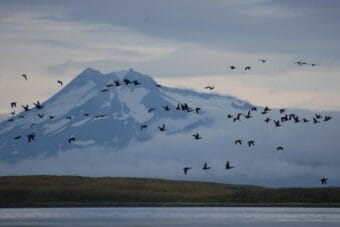
Brant fly by Mount Dutton in Izembek National Wildlife Refuge on Sept. 11, 2009. The refuge supports nearly the world’s entire population of Pacific brant. The debate over the land trade and the road it would enable have pitted concerns about public safety against those about habitat for migratory birds and other wildlife. (Photo by Kristine Sowl/U.S. Fish and Wildlife Service)

The Department of the Interior has set the stage for a controversial land trade that would allow a road to be built through Alaska’s Izembek National Wildlife Refuge.

In a draft environmental impact statement released on Thursday, the department’s U.S. Fish and Wildlife Service recommended a multi-part swap of land between the federal government and a for-profit Native corporation to free up a corridor for an 18.9-mile road cutting through what is currently designated wilderness in the refuge that lies at the tip of the Alaska Peninsula.

The road would connect King Cove, a mostly Aleut community of nearly 900 people, with the airport at Cold Bay, a community about 18 miles by air to the northwest. While Cold Bay is smaller – with only 57 residents, according to the Alaska Division of Community and Regional Affairs – its airport has a long, jet-accommodating runway. Built by the U.S. Army during World War II, the airport is now owned by the state and can operate year-round.

If carried out, the trade would serve multiple needs, the draft EIS said.

“The purposes of the proposed action are to provide a safe, reliable, year-round transportation system for health and safety purposes, with particular emphasis on emergency medical evacuations, between King Cove and Cold Bay, Alaska, and increase the overall conservation values of lands preserved in the National Wildlife Refuge System and also maintain or increase the opportunity for subsistence uses by rural Alaskans,” the document said.

The idea of an Izembek road made possible through a land trade has a decades-long history. Past plans have made it through various stages of the approval process, but then were either dropped by administrative policy changes or, as was the case in 2019, struck down by a federal court as illegal and, after that, mired in the appeals process.

King Cove residents and their supporters, who include Alaska political leaders, have long argued that a road is needed to allow for emergency medical evacuations, among other purposes. There is currently no safe way to conduct medical evacuations from King Cove year-round, the project supporters argue.

Arrayed against the project are environmentalists and some Native residents and organizations in Western Alaska. They argue that the land trade sets a dangerous precedent and that the road development will damage wildlife habitat, including wetlands vital to migratory bird populations on which the region’s Yup’ik people depend for food and culture.

The biological heart of the Izembek refuge is Izembek Lagoon, site of one of the world’s largest eelgrass beds, according to the Fish and Wildlife Service. Nearly the world’s entire population of Pacific brant uses the lagoon eelgrass during migration, according to the service.

Channels in eelgrass beds are seek on May 24, 2006, in Izembek Lagoon, the heart of Izembek National Wildlife Refuge. The lagoon’s eelegrass beds are among the world’s largest. (Photo by Kristine Sowl/U.S. Fish and Wildlife Service)

Interior Secretary Deb Haaland became immersed in the controversy during her term in office. She visited King Cove in 2022 and has been lobbied by both supporters and opponents of the project.

Last year, she withdrew the Trump-era land-trade plan, which had been struck down by U.S. District Court judge Sharon Gleason. But she promised to keep investigating the issue.

The preferred alternative in the draft environmental impact statement, which is technically a supplemental document building on past studies, would give 490 acres of refuge land to the Native-owned King Cove Corp. in exchange for 31,198 acres. Most of the King Cove Corp. land given to the federal government would be added to the Alaska Peninsula National Wildlife Refuge east of Izembek. The Aleut Corp., the regional for-profit Native corporation, would retain subsurface rights in the 29,459 acres added to the Alaska Peninsula refuge, under the alternative. The road, if built, would cost about $21 million, according to the document. It is envisioned as a single-lane gravel route.

Thursday’s announcement from the Department of the Interior pleased road supporters, including Sen. Lisa Murkowski, R-Alaska, who has been one of the most high-profile advocates.

“I thank everyone at Interior for their work on a strong, defensible analysis that adds to the overwhelming case for a life-saving road. I spoke with Secretary Haaland this morning and thanked her for visiting King Cove with me, for listening to the people who actually live there about the environmental injustices they face every day, and for directing her team to make an honest recommendation to her about the path forward. That path forward is clearly a life-saving road, and we must now finish the job by finalizing the process so that a road can be built as soon as possible,” Murkowski said in a statement.

Opponents said they will continue to fight the project.

Among the opponents making statements Thursday was Edgar Tall, chief of the Native Village of Hooper Bay, the tribal government for that Yup’ik community.

“This is deeply distressing news and flies in the face of the Biden administration’s stated commitment to listen to tribes — we have not been heard. We understand the needs of King Cove and Cold Bay, but reliable solutions exist to improve access between the communities that would not jeopardize our tribe and others throughout Alaska,” Tall said in a statement.

“As Secretary Haaland has noted, respecting tribal sovereignty requires really listening to tribal communities. We hope to meet soon with the Secretary so she can hear from us about the importance of these birds and this critical habitat in the Izembek Refuge that so many of us in Alaska depend on for our continuing ways of life and our survival,” he said in the statement.

The Fish and Wildlife Service said it will accept public comments on the draft through Dec. 30. A final environmental impact statement and, potentially, a decision on action are expected after then.

Final action may fall to the incoming Trump administration, which takes office in January.

Site notifications
Update notification options
Subscribe to notifications