Archives for:

"King Cove"

For more than a century, a fish plant fueled King Cove’s economy. Without it, can the community survive?

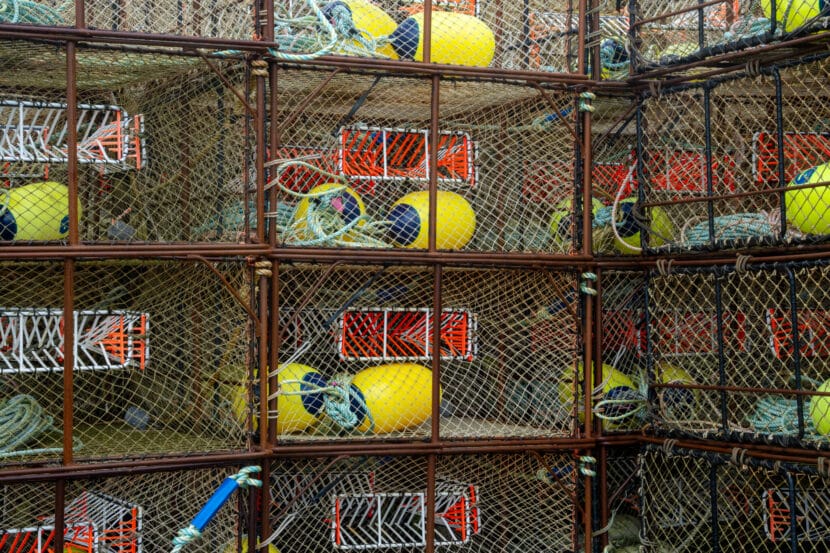
Crab pots in King Cove in September 2024. (Eric Stone/Alaska Public Media)

Five months ago, King Cove Mayor Warren Wilson wrote an opinion piece in the Anchorage Daily News. The headline was stark: Fighting For Our Lives in King Cove.

Peter Pan Seafood Co., the owner of a plant that had served as the economic engine of the Southwest Alaska town of about 800 for more than a century, had just announced it would cease operations.

The Peter Pan plant, which had run year-round for the past five decades, had already been closed all winter. That it would stay closed — indefinitely — was a shock. Wilson wrote that he worried King Cove was on the edge of becoming a ghost town.

“As King Cove’s mayor,” he wrote at the time, “it hurts my heart to say that it has taken only a few short months for me to no longer recognize my world. Events have conspired to threaten our very existence.”

The seafood industry around the world has been devastated by low fish prices, high interest rates, oversupply in some markets and poor fish returns in others. In Alaska, according to a recent report from NOAA Fisheries, profits fell by half between 2021 and 2023.

Few Alaska communities have felt the pain of the seafood industry crisis more than King Cove. With the plant’s owner out of business, residents are left to wonder if their community has a future.
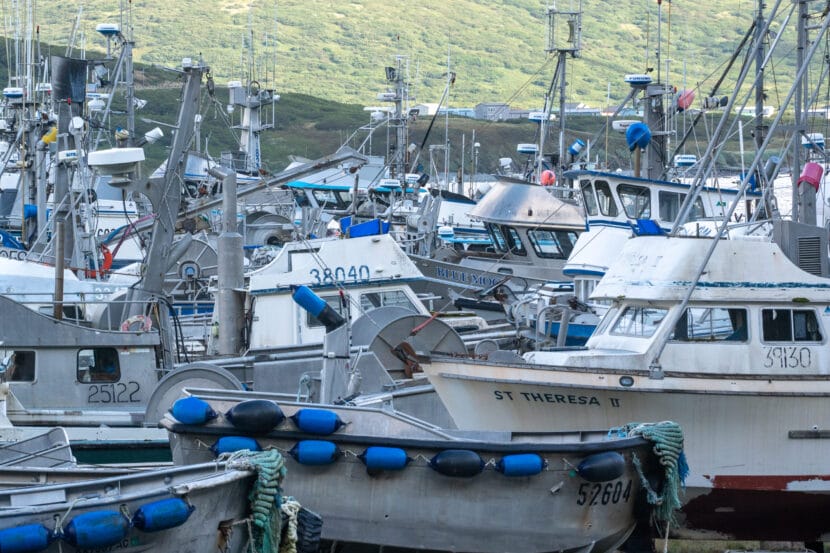
Fishing boats on land and in a harbor in King Cove in September 2024. (Eric Stone/Alaska Public Media)

Driving in his distinctive yellow Ford pickup on a tour of town this summer, Wilson said even his earlier grim assessment might have been a bit too rosy.

“If I had to write that story again now, there would be a little more gloom and doom in it,” he said. “But we’re still fighting for our lives, for sure.”

Aside from the occasional passing car and boat, much of King Cove is quiet. The bar just outside the plant’s chain-link fence is closed.

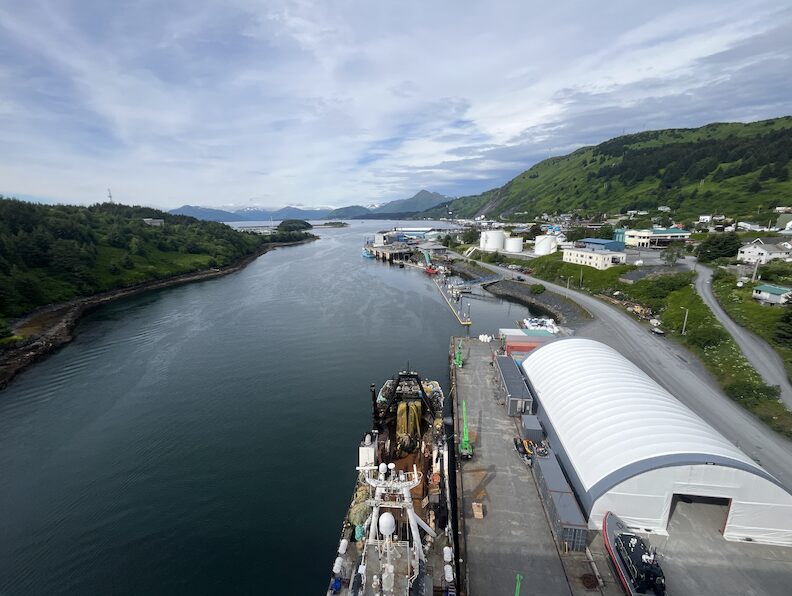
The shuttered Peter Pan plant is sprawling. It dominates the gently sloping waterfront, rivaled only by the boat harbors just down the road. Fishermen used to unload salmon, crab, pollock, cod, halibut and more on the four piers that jut into King Cove’s namesake waterbody. Steel-roofed bunkhouses once housed hundreds of staff who processed the catch.
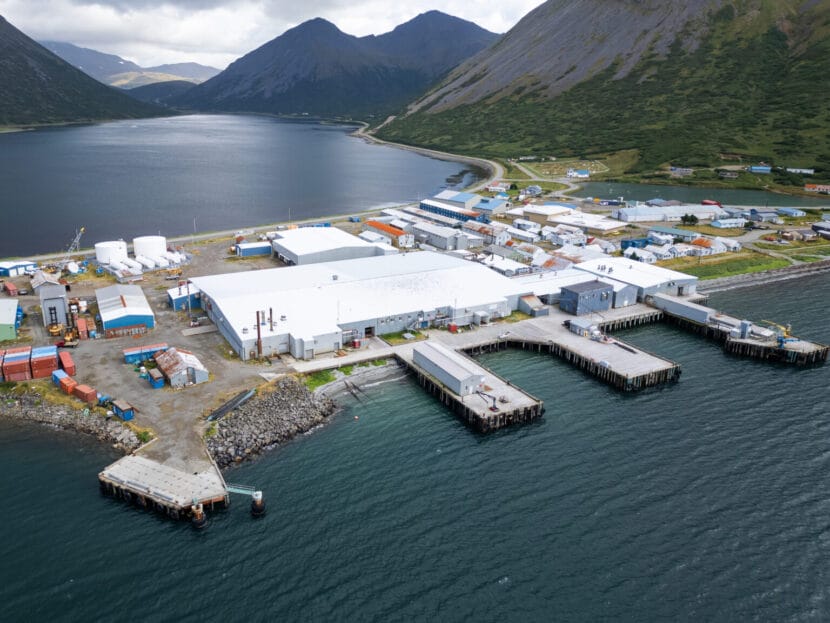
The idled Peter Pan Seafood Co. plant in King Cove shows little sign of activity. (Eric Stone/Alaska Public Media)

Today, blue steel containers emblazoned with the logo of Samson Tug and Barge Company block the plant’s main entrance. Little activity can be seen from outside.

This weekend, all of the action is up the road. Cross-country running teams from Sand Point and False Pass are in town for a regional meet. There’s an all-community volleyball game at the King Cove School.

“Peter Pan was the heart of our community for many, many years,” Agdaagux Tribe of King Cove President Etta Kuzakin said during a break in the action.

King Cove has always been something akin to a company town. It didn’t exist until 1911, when Unangax̂ people relocated from nearby villages to fish for and work at the new Pacific American Fisheries plant. People in King Cove talk about fishing for Peter Pan for decades, or their whole lives. And with the plant idled, Kuzakin says life just feels different.

“A great example is driving down the road at 7 a.m. to go to work, and it’s peaceful,” she said. “There’s no humming, there’s no boats in the bay, there’s nothing.”
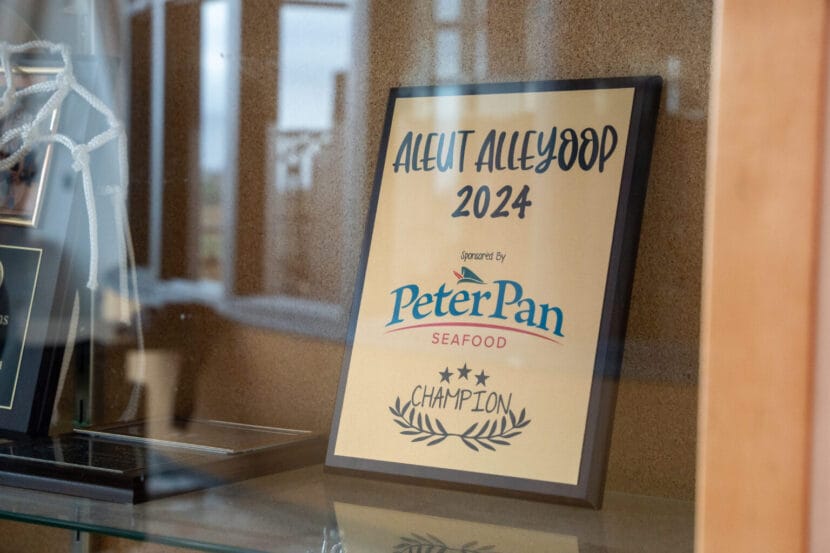
A Peter Pan Seafood Co. logo adorns a plaque in a trophy case at the King Cove School. (Eric Stone/Alaska Public Media)
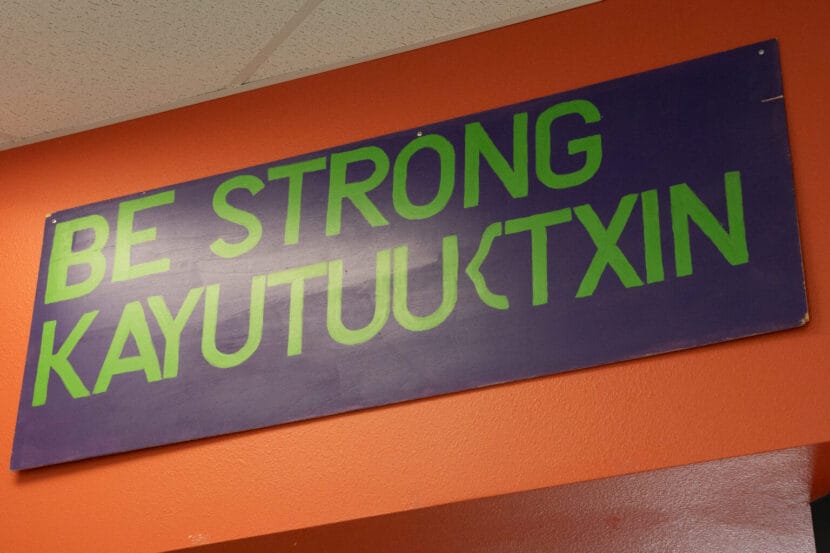
A sign in the King Cove School offers encouragement. (Eric Stone/Alaska Public Media)

“I’m born and raised here. I’m 47 years old, and I’ve never not heard those noises before,” Kuzakin said. “The silence is deafening.”

The hum is gone, but King Cove’s fishermen are still fishing. Many have no other choice. They’re fighting low fish prices and rising costs and doing everything they can to stay afloat. Many are sailing hours out of their way to deliver their catch to plants that offered to buy fish from some King Cove fishermen left in the lurch after Peter Pan folded.

But it’s not easy. And some are thinking about leaving.

In King Cove’s Harbor House, a blue-and-white corrugated metal building near the community’s boat yards and harbors, fishermen sat on overstuffed recliners and couches watching college football, drinking coffee from Styrofoam cups. A gale-force storm was about to roll in, so it was more crowded than usual.

If the plant doesn’t reopen, “[I’m] not staying here,” said Ken Mack, a fisherman who recently purchased land in a nearby community.

Mack has been fishing out of King Cove for decades. With no fish plant to support the primarily small-boat fleet, he said, fishermen are forced to sail hours out of their way to supply their boats and deliver their catch.

“Right now we’re running six hours to False Pass to get fuel and bait, and we’re running nine hours to Sand Point to get rid of the crab, or halibut, or whatever you catch,” he said. “You have to cut off that expense. [The] only way you cut that expense up is [to] move someplace.”

That’s not to mention the unpaid bills that fishermen say they were left with when Peter Pan unexpectedly closed its doors. Ken Mack says he’s still owed money from tendering. Many have filed liens, some in the six figures, for unpaid debts.
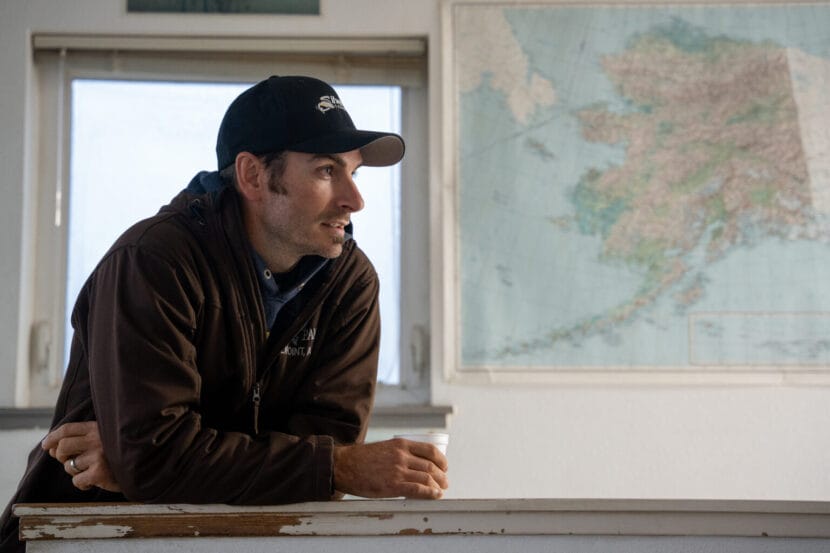
Fisherman Ben Ley speaks at King Cove’s Harbor House. (Eric Stone/Alaska Public Media)

But even so, some of the fishermen are optimistic.

“You have to be,” said Ben Ley, who runs three boats out of King Cove. Otherwise, he said, “I don’t know how you’re doing the next tow, or set, or anything.”

At the same time, he said, there’s only so long fishermen and the businesses they support can hang on.

“I’m worried that by the time it does get good again — which I am optimistic about — the damage is going to be done,” he said. “There’s going to be some businesses here that don’t make it.”

There are other practical considerations, too — until the city put in a gas station shortly before the plant closed, Peter Pan was the only place to buy gas and diesel. And this summer, it still wasn’t clear whether there’d be enough fuel oil to heat residents’ homes for the winter. It all used to come from Peter Pan.

The plant closure is also taking a toll on the city’s finances.

Some 70% of the city’s general fund revenues come from fish taxes and sales taxes connected to the fishing industry, and King Cove has put millions of dollars in public money towards supporting the plant’s needs — water, power and garbage system upgrades aimed squarely at meeting the needs of the Peter Pan plant.
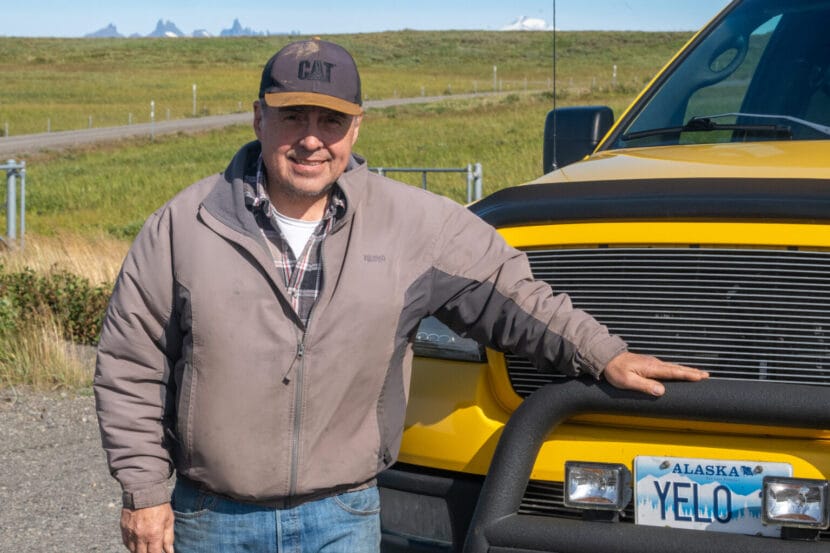
King Cove Mayor Warren Wilson poses with his yellow Ford pickup during a tour of the area. (Eric Stone/Alaska Public Media)

Mayor Warren Wilson said that so far, the city itself has been able to hang on with savings it squirreled away during years when the fishing was good. Grants have come from the state and federal governments to prop up projects in the meantime. The city hasn’t had to make serious cutbacks in services. But that can’t go on forever, Wilson said.

“If it’s not up running next year,” he said, “the cuts will be happening.”

Whether the plant will ever reopen is an open question. Peter Pan, partially owned by a state-backed investment fund, is being sold off for parts in a Seattle court. Rodger May, one of the investors who bought Peter Pan from a Japanese conglomerate recently won an auction to purchase the plant, along with a wide swath of other former Peter Pan assets.

But the community is still waiting for an announcement about the plant’s future.
What happened to those king salmon caught as bycatch?

A trawl vessel sits at the dock in Kodiak in July. (Photo by Nathaniel Herz/Northern Journal)

Northern Journal last week published a story on how Kodiak-based pollock trawlers unintentionally caught 2,000 king salmon — forcing the closure of a major Gulf of Alaska fishery.

Afterward, a number of readers responded with similar questions: What happened to those salmon? Were they sold? Donated? Thrown back into the water?

The short answer, according to a federal management official: The salmon were “discarded.”

Some additional context: Salmon bycatch is “prohibited from entering commerce,” Josh Keaton, a top management official at the National Marine Fisheries Service, said in a brief call Friday.

“Nobody gets paid,” he said. “The fishermen can’t take them home.”

The salmon caught by the trawlers were small, he said — four pounds, on average, compared to the 10 pounds that the smallest recreationally harvested salmon weigh.

When bycatch is of “marketable size” and suitable for food quality, Kodiak seafood companies will often process the fish and donate them to an Alaska nonprofit group, SeaShare, Keaton added. But in this case, they were probably too small, and also sat in containers for two days as independent fisheries observers took genetic samples of each one, he said.

Meanwhile, the fallout from the closure of the central Gulf of Alaska pollock fishery, in response to the salmon bycatch, continues. The Kodiak Daily Mirror reported Thursday that one of the city’s processing companies, OBI Seafoods, is laying off some 50 workers, with an executive telling the newspaper that remaining workers would see “significantly fewer hours,” as well.

The closure strands about $9 million of raw pollock in the Gulf of Alaska, which would have been processed into $50 million or more of headed and gutted fish, fillets, meal and oil, according to a preliminary analysis by Garrett Evridge, an Alaska fisheries economist.

The state and local government will also lose hundreds of thousands of dollars in fisheries tax revenue, according to Evridge’s analysis.

Nathaniel Herz welcomes tips at natherz@gmail.com or (907) 793-0312This article was originally published in Northern Journal, a newsletter from Herz. Subscribe at this link.

King Cove braces for salmon season with no seafood processor amid historic price slump

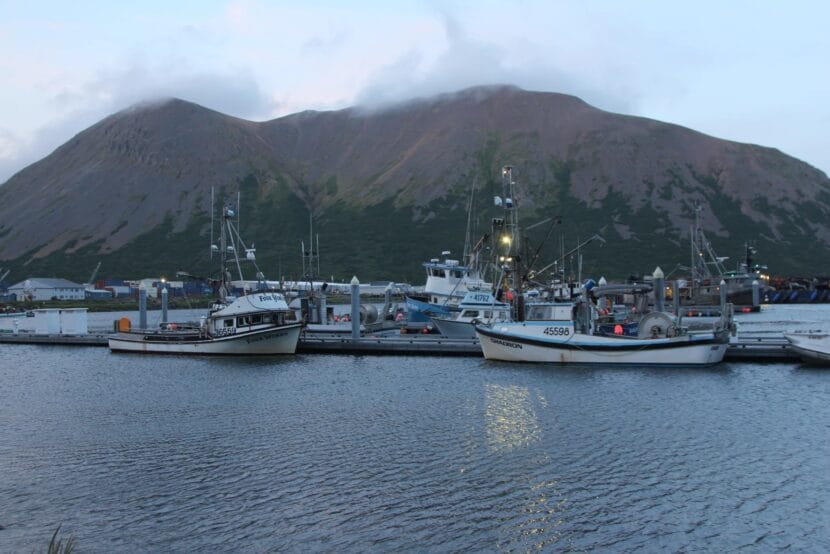
King Cove in August 2023. (Theo Greenly/KUCB)

The city of King Cove is worried about the future after its seafood processor announced earlier this month that it will cease operations. The plant, formerly owned by Peter Pan Seafood Company, is the economic engine of the community on the Alaska Peninsula.

A new owner will take over the processing plant, but it’s unclear when the facility will reopen. Kirsten Dobroth is the Alaska reporter for Undercurrent News, which is a commercial fishing and seafood industry trade magazine. She’s been reporting on what this means just ahead of salmon season.

Listen:

The following transcript has been lightly edited for clarity.

Ava White: Why is this plant closing- at least for now?

Kirsten Dobroth: The seafood industry has been struggling with this historic slump in wholesale and dockside prices. Back in December, Trident Seafoods announced it would sell four of its shoreside processing plants in Alaska because of this market situation. At the time that was kind of a bombshell that got a lot of attention outside the industry.

And within a few weeks of that announcement Peter Pan Seafood Company also said it would temporarily close its facility in King Cove for winter. That’s noteworthy for a number of reasons – it’s the company’s biggest plant, it processes a number of species year round. But at the time Peter Pan said it would reopen for the summer salmon season.

Ava White: And it sounds like now that’s not happening.

Kirsten Dobroth: Right. It was pretty widely reported as time went on that Peter Pan was in some serious financial trouble. And then fast forward to just a few weeks ago – it comes out that Silver Bay Seafoods, which is also a major processor in the state, will take over all four of Peter Pan’s plants as part of this major restructuring plan that’s still being finalized. Silver Bay says in the announcement that it will operate all the Peter Pan plants for the summer – except for King Cove.

Meanwhile, Peter Pan really wasn’t saying anything about what it planned to do with King Cove. But there were some signs that things weren’t looking good – for instance, some fishermen I spoke with were already signing on with other buyers for summer.

And then about two weeks ago the company posted on Facebook that the plant would stay closed and encouraged people to apply to Silver Bay for work. And since then Silver Bay has also confirmed that – at least for now – it doesn’t have plans to open the facility.

Ava White: Okay, so a lot has happened. Why is this Peter Pan news such a big deal in this whole picture?

Kirsten Dobroth: There are a few things that are notable about this announcement between Silver Bay and Peter Pan. One is that it’s a major deal between two of the state’s biggest and more recognizable shoreside processors – and one is effectively ending operations altogether less than two months before the start of salmon season, which is the peak time for most processors and fishermen.

Another noteworthy point to the Peter Pan side of this – the current owners only bought the company back in 2021. One of the financial backers of that sale was McKinley Capital Management, which was using money from the Permanent Fund Corporation’s in-state investment program at the time. I don’t know what the implications of that are. But I think when you look at how quickly this company is halting operations – it’s really indicative of how quickly things have changed for one of the state’s biggest industries.

Ava White: Okay, so let’s go back to King Cove, what does this mean for that community?

Kirsten Dobroth: The implications for the city of King Cove are huge. I’ve talked to city officials there pretty frequently since early this year and this is a big financial hit for them. More than half King Cove’s general fund budget comes from fishing landing taxes. And I think the ambiguous timeline for reopening has people there worried.

Some hurdles to reopening quickly, though, are deferred maintenance at the facility that need to be addressed. Silver Bay has also said it’s prioritizing absorbing as much of Peter Pan’s fleet as possible, including up in Bristol Bay, where Silver Bay will now operate two processing plants because of this Peter Pan deal. So, that will likely eat up some of the company’s more immediate expenses.

But keeping King Cove closed will have a regional impact, too. Fishermen outside of that local fleet have historically delivered to the King Cove plant depending on the species and price at any given point. So, I think there’s a lot of people that are anxiously awaiting word on when things will be back up and running.

Alaska Volcano Observatory reports ‘explosive eruption’ at Mt. Shishaldin

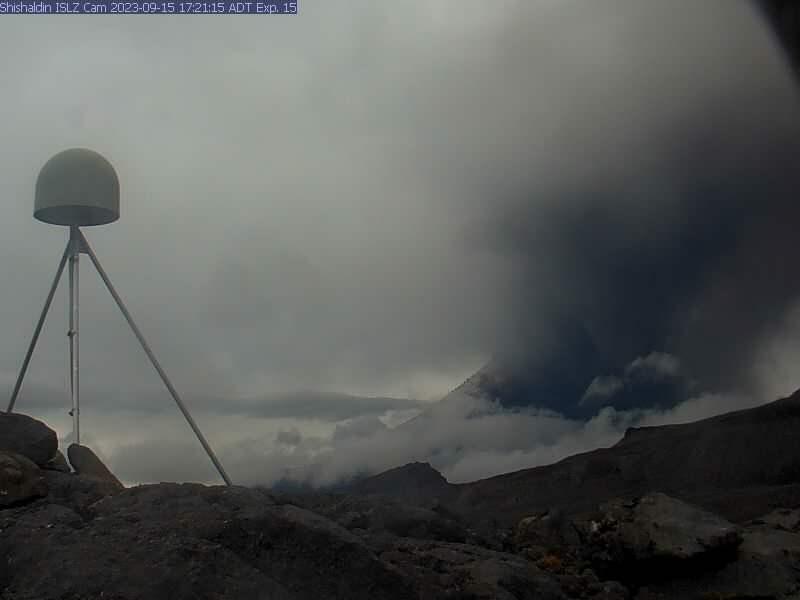
Ash emissions from Shishaldin Volcano captured on an Alaska Volcano Observatory webcam on Sept. 15, 2023. (Courtesy of AVO/USGS)

Mount Shishaldin in the eastern Aleutians is erupting, marking the latest event in a summer of increased activity at the volcano. The Alaska Volcano Observatory said “an explosive eruption” began shortly after 5 p.m. Friday.

“Ash is currently being produced and is drifting to the east below the cloud deck,” the volcano watch group reported.

The stratovolcano is near the center of Unimak Island, about 20 miles from False Pass, a fishing community with around 350 residents.

The National Weather Service issued a statement Friday evening warning of possible “trace ashfall” in False Pass, King Cove and Cold Bay.

Intermittent eruptions at Shishaldin have been disrupting air travel since July, one of which spewed ash as high as 40,000 feet.

The current aviation color code has been raised to red.

Interior secretary rejects Izembek land exchange, commits to new process for King Cove road

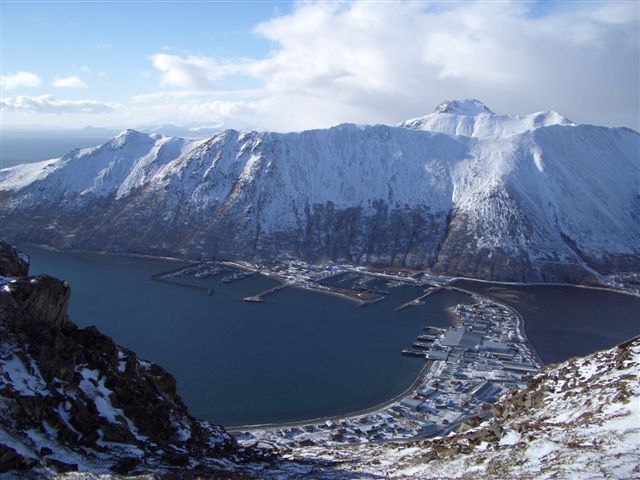
(King Cove. Photo: Aleutians East Borough.)

Interior Secretary Deb Haaland on Tuesday ended the government’s defense of a land exchange agreement that would have allowed the Alaska Peninsula community of King Cove to build a road to reach an all-weather airport. But she she also pledged to launch a new process to get a road for King Cove.

“I have instructed my team to immediately launch a process to review previous proposals for a land exchange,” Haaland said in an emailed statement.

Haaland’s action – essentially conceding in a lawsuit that aims to block the road – starts yet another phase in the decades-long effort by the people of King Cove to get a road to Cold Bay, which they say will save lives by allowing people to fly to a hospital even when the weather is bad.

Road proponents are hopeful that Haaland is sincere about trying to help.

“We have to believe that she is,” said King Cove Corp. CEO Della Trumble, who has lobbied for the road for decades. “We agreed to work with her on it.”

Trumble said that Haaland spoke to local leaders Tuesday with emotion in her voice.

It’s personal for Haaland. She is the first Indigenous secretary of the Interior, and the people of King Cove are primarily Indigenous, too.

The community of about 800 is at the end of the Alaska Peninsula, where the mainland gives way to the Aleutian Chain. It is only reachable by boat, or by its small airstrip, which is frequently weathered in. That can be said of many Alaska towns and villages. But King Cove is unique because it’s near a 10,000-foot runway, at the former Cold Bay Air Force Station, and residents would like to drive there.

The sticking point, as always, is that about 10 miles of the road will have to go through the Izembek National Wildlife Refuge, through land officially designated as wilderness — the highest level of protection.

Conservation groups highlight the area’s importance to migrating birds and call it “one of America’s most ecologically significant refuges.” They’ve repeatedly gone to court to block the road. The latest case is pending before the 9th U.S. Circuit Court of Appeals.

Sen. Lisa Murkowski has championed the project since her early days in Congress. She said she’s not sure what to make of Haaland’s announcement. Murkowski said the pledge to help King Cove was delivered “with a commitment and a resolve that I had not heard before.”

Still, the senator remains wary.

“The people of King Cove had been through so much and have been led down a road of false promises for far too long,” Murkowski said. “This cannot be a false promise.

The new process, Haaland’s email says, will be “rooted in a commitment to engagement in meaningful nation-to-nation consultation with tribes, to protecting the national wildlife refuge system, and to upholding the integrity of ANILCA’s subsistence and conservation purposes,” referring to the 1980 law called the Alaska National Interest Land Conservation Act.

The Interior Department says it intends to initiate an environmental analysis that will reconsider the 2013 land exchange that Sally Jewell, an Interior secretary in the Obama administration, rejected.

Haaland’s announcement is winning favorable reviews from environmental groups.

“We applaud Secretary Haaland for withdrawing the illegal, Trump-era land exchange that would have put at risk the lands, waters, and resources of Izembek National Wildlife Refuge in Alaska,” said League of Conservation Voters Senior Vice President Tiernan Sittenfeld. “Izembek is … home to world-class wetlands that support millions of migrating birds, fish, and caribou. It should be protected for future generations.”

The Alaska Wilderness League, one of the groups suing to block the Trump administration’s land exchange, also praised the announcement.

This story has been updated.

Ship begins laying cable that will bring high-speed internet to the Aleutians

A ship leaving Unalaska dragging a heavy cable behind it
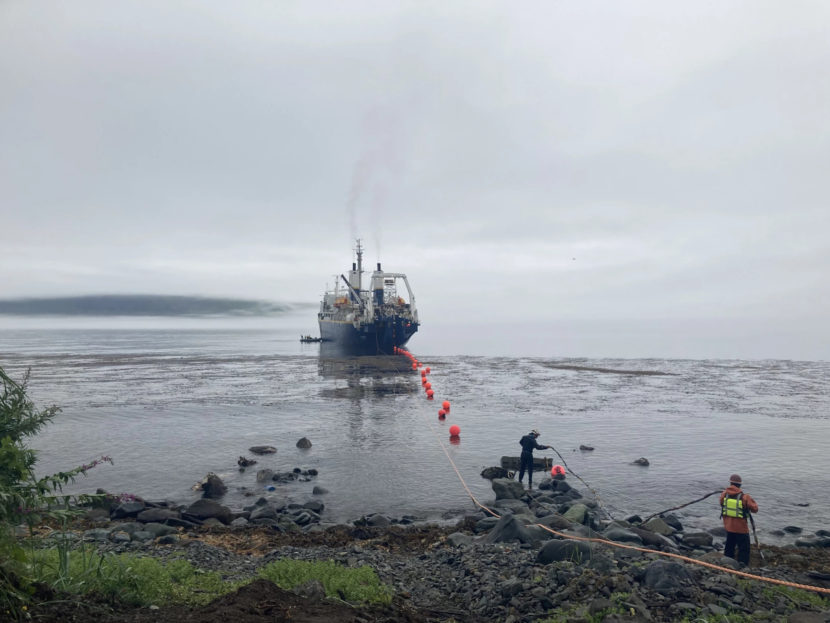
The C/S IT Intrepid begins deploying subsea fiber in Unalaska. (Photo by Laurelin Kruse/KUCB)

Work has started to lay 800 miles of subsea fiber-optic cable that project engineers say will bring high-speed internet to Unalaska and Akutan by the end of the year.

“What you will get in Unalaska is what you would get here in Anchorage,” said GCI Rural Affairs Director Jen Nelson. “It’s going to open up so many capabilities, whether it be education, commerce, or entertainment.”

GCI began surveying for the cable network — called the AU Aleutians Fiber Project — in 2017. Last week, the ship responsible for laying the cable left Unalaska for Kodiak.

Geoff Dunlop is the captain of the C/S IT Intrepid, the 377-foot ship that’s laying the cable.

“Planning a cable route is much like planning a railroad, or a goat trail,” he said. “You take the path of least risk and least resistance. Cables don’t like going over things. They want to follow a contour.”

To find the best possible route, engineers surveyed the geology and marine habitat of the ocean floor. They also met with local fishermen to make sure the cable isn’t in a position where it could get dug up by trawlers.

Once the route was set, the cable had to be specifically engineered to fit the conditions of where it will sit on the ocean floor.

The IT Intrepid typically lays cable at speeds from one to two-and-a-half miles per hour.

While en route to Larsen Bay on Kodiak, the ship will lay cable to Akutan, Sand Point, King Cove and Chignik Bay. It’s expected to complete its work by early fall.

Dunlop said bringing internet to these remote communities is part of a bigger picture — creating infrastructure for the globe.

“The reality is that there’s literally hundreds of thousands if not millions of kilometers of cable on the bottom laid by people like ourselves,” said Dunlop. “It’s not just a local event where small islands are being interconnected. It’s the global network.”

If all goes according to plan, Unalaska and Akutan will have high-speed internet by the end of this year. Service to Sand Point and King Cove will follow by the end of 2023, and Chignik Bay and Larsen Bay in late 2024.

Site notifications
Update notification options
Subscribe to notifications