Andrew Kitchenman

State Government Reporter, Alaska Public Media & KTOO

State government plays an outsized role in the life of Alaskans. As the state continues to go through the painful process of deciding what its priorities are, I bring Alaskans to the scene of a government in transition.

Anchorage House race grows closer as Alaska election results become official

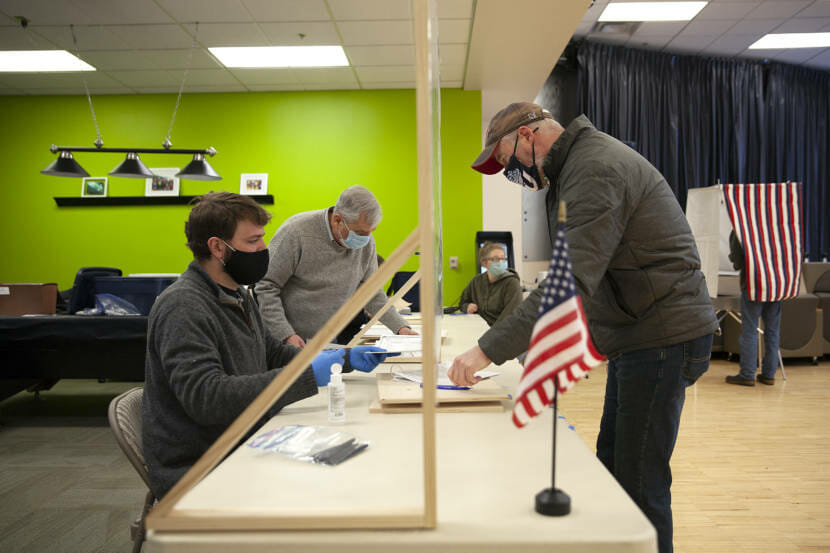
Voters sign for their ballots at the Auke Bay precinct on Tuesday, Nov. 3, in Juneau. The election results were certified and became official on Monday. (Photo by Rashah McChesney/KTOO)

Alaska’s election results became official on Monday. A state review board certified the results after reviewing the accuracy of the vote count. 

Some of the vote totals changed slightly. 

In an East Anchorage House race, Democrat Liz Snyder’s lead over Republican Rep. Lance Pruitt shrank by three votes to 13. Snyder gained one vote while Pruitt gained four. 

Statewide, the total number of ballots counted increased by 716, but the lead didn’t change in any race. 

A state Division of Elections spokesperson said the changes were the result of a combination of uncounted ballots from precincts, absentee and questioned ballots. They included ballots that had been mailed to the division director’s office rather than to a regional office. Ballots in regional offices were counted earlier. 

Candidates or voters have five days to ask for a recount in any race. The Snyder-Pruitt race is the only one that’s close enough that the state would be required to pay for the cost of a recount. 

Recounts have changed the winners of legislative general elections four times in Alaska history. Three of those changes broke ties, including in a Fairbanks House race two years ago when Republican Bart LeBon won over Democrat Kathryn Dodge by one vote. The only time a lead changed after a recount was in a 1978 state Senate race. 

But Snyder’s lead is larger than the leads were in any of those races.  

In addition to any recount, Lt. Gov. Kevin Meyer has requested an audit for the results of Ballot Measure 2. The measure, which passed by 3,781 votes, will overhaul Alaska’s election system. The audit will be similar to a recount. 

Alaska Chief Justice Bolger to retire in June

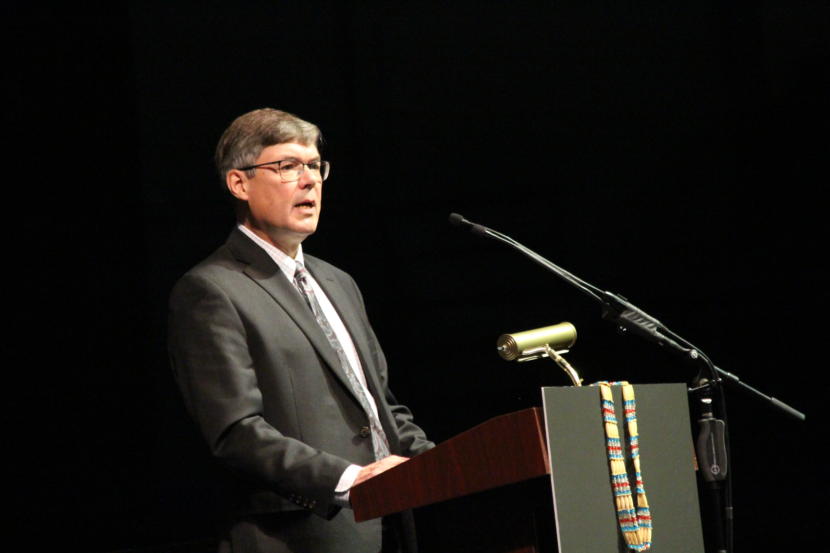
Alaska Supreme Court Chief Justice Joel Bolger addresses the Alaska Federation of Natives convention on Oct. 18, 2019. On Monday, the court system announced Bolger plans to retire in June. (Photo by Wesley Early/KOTZ)

Alaska Supreme Court Chief Justice Joel Bolger plans to retire in June, the court system announced on Monday. 

Bolger was appointed to the supreme court by Gov. Sean Parnell in 2013. His retirement will coincide with the end of his three-year term as the chief justice. 

Bolger has spoken in defense of the independence of the court system. 

He recused himself in March from hearing a case involving the proposed recall of Gov. Mike Dunleavy.

After Dunleavy refused to select a judge from a list submitted by the Alaska Judicial Council, Bolger issued a statement saying that the governor must choose one of the nominees. Dunleavy’s handling of the vacancy later was listed as one of the grounds to recall him. 

Bolger is the first person to be appointed to all four levels of the Alaska judiciary. He previously was appointed to the Valdez District Court, Kodiak Superior Court and the Alaska Court of Appeals. 

Bolger spent the majority of his professional career in rural Alaska and worked as a volunteer attorney in Dillingham and as an assistant public defender in Utqiagvik. 

In his statement, Bolger thanked the judges and court staff for working QUOTE “to provide fair and impartial access to justice” during the COVID-19 pandemic. 


Heavily Republican incoming class of new Alaska legislators prepares for next session

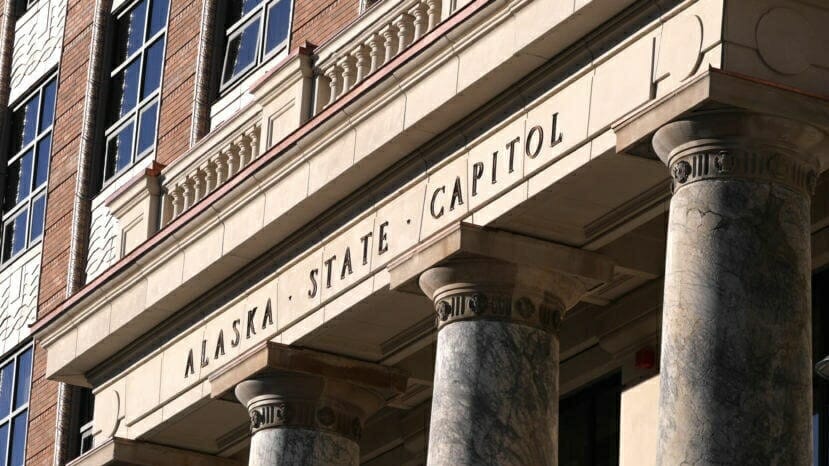
Alaska State Capitol (left) and Dimond Courthouse in Juneau in January 2017. (Photo by Skip Gray/360 North)

Alaska voters elected 13 new members to the state Legislature. The first-time lawmakers are a heavily Republican group; the only Democrat is also the only woman. 

Ron Gillham is one of the new members joining the House. The Soldotna Republican said the new members from his party have a lot in common, including many of the same principles. 

“We want a smaller budget, we want a smaller government,” he said. “You know, we all want to prosper. So we’re all looking at ways that we can put  more people back to work in the state.”

Gillham’s family owns a fishing charter business and he’s also worked as a heavy equipment operator on the North Slope. 

Gillham said he and other new House Republicans are interested in a proposal that Gov. Mike Dunleavy advanced to lower the limit on how much the state can spend each year. 

“And it’s kind of a unanimous thing that if we don’t get a spending cap, we’re not going to get a balanced budget,” he said.

Gillham said last week that he hopes the conversations among Republicans will lead to the party forming a new majority caucus in the House. That hasn’t happened yet. The party holds a bare majority of 21 seats in the chamber. 

Gillham added that while all of the new Republicans are men, they have diverse life and work experiences, which he says will benefit the state.

“It is a very diverse crowd,” he said. “They’re not a bunch of politicians. They’re from all different segments of the state — businessmen, teachers,” among others.

After the last election, House members took a month into the session to organize a majority. 

Big Lake Republican Rep.-elect Kevin McCabe said he thinks there wasn’t enough relationship-building two years ago, and having a group of new lawmakers who already know each other could help next year. 

McCabe, a cargo pilot, said that among the Republicans, there are differences that reflect who they represent. 

“There are some that are a little bit more moderate and they’re from moderate districts,” he said. “And there are some that are a little bit more conservative that are from conservative districts.”

When asked if he’s hopeful that the Republicans will form the House majority caucus, McCabe it’s already established by the fact that most members are party members. 

Liz Snyder of Anchorage is the only Democrat, as well as the only woman, among the new Alaska lawmakers. However, Anchorage independent Calvin Schrage was nominated by the Democrats and Utqiagvik independent Josiah Aullaqsruak Patkotak told the Anchorage Daily News he planned to join a group of rural legislators who currently caucus with the mostly Democratic majority. 

Snyder won by 16 votes over Republican Rep. Lance Pruitt, based on the unofficial results. 

Snyder teaches public health at the University of Alaska Anchorage. She said her career has prepared her to work with lawmakers — including her fellow new legislators — with different political beliefs, to benefit Alaska communities. 

“I have some learning to do, just to understand the landscape, understand how things work, when conversations are had and getting started between now and when session begins in the new year,” she said.

Snyder said it’s been good for the state to have more women serve in leadership positions over time. And she hopes that the long-term trend in having more women legislators will return after a decline this election. 

“I think women on a whole bring a unique perspective, a unique work style, unique experiences and backgrounds, and the more diverse experiences we have in leadership positions, the better we can represent all of Alaska,” she said.

With Snyder joining as the lone woman, the number of female lawmakers will go from a record high in Alaska of 22 down to 18. 

The other new members include two Republicans elected to the senate: Roger Holland of Anchorage and Robert Myers of North Pole. The other new Republican House members are Mike Cronk of Tok; Christopher Kurka of Wasilla; Ken McCarty of Eagle River; and James Kaufman, Tom McKay and David Nelson of Anchorage.

Republicans hold most seats in the Alaska Legislature, but it’s unclear if they’ll form the majority caucuses

The majority of candidates elected by Alaska voters to both the state Senate and House are Republicans. But it’s not yet clear if the majority caucuses that govern both chambers will actually be Republican. 

The majority caucus decides how power and influence is spread across the Legislature and determines the shape of each chamber’s budget proposals. And newly elected Republicans have been talking about how they will organize since election results started to become clear. 

In the House, there will be 21 Republicans, the bare minimum needed to form a majority caucus. The Senate has 13 Republicans, two more than they need to form a majority. 

Soldotna Republican Sen. Peter Micciche helped organize a meeting of the Senate Republicans on Nov. 13. He said he’s “very optimistic” that the Republicans will be forming a majority. 

“The reality of it is, is that Alaskans did choose a vast majority of Republicans, and philosophically, we’re more aligned,” Micciche said. “We have some very healthy differences in our group.”

The differences between Senate Republicans have been deep over the past two years. They haven’t agreed on the size of Alaska Permanent Fund dividends or whether to draw more than planned from the permanent fund’s earnings reserve. They couldn’t agree that their members should be required to vote in favor of the budget.  

Micciche said the majority should listen to each other and shouldn’t rely on punishing members to unite the caucus. He said if the senators feel valued, they’re more likely to work together. 

“But shooting your own soldiers to win a battle, ultimately results in the loss of a war,” he said. “I don’t like to use a military analogy, but you really do need to be a unified team.”

Republican Senators Mike Shower of Wasilla, Shelley Hughes of Palmer and Lora Reinbold of Eagle River lost committee chair positions — and Mia Costello of Anchorage lost her position as majority leader — after coming into conflict with Senate Republican leaders on the budget and procedures. Two of those leaders, Senate President Cathy Giessel of Anchorage and Senator John Coghill of North Pole, were defeated in the Republican primary.

Senate Minority Leader Tom Begich, an Anchorage Democrat, is optimistic that a different Senate  majority — with members of both parties — will form. He expects that if Democrats are in a bipartisan majority, they’ll support the leadership on the budget as long as their voices are heard. He said the Republicans’ differences over the budget and procedures are a recipe for chaos.

“If they can’t work those out, we stand ready to serve with those who are ready to move the state forward,” he said.

In the House, the situation is even more complicated. If the Republicans lose one vote, they won’t be able to form a majority. 

The Republicans failed to form a House majority two years ago due to divisions within the party. Instead, eight Republicans formed a coalition with Democrats and independents.

Someone observing this process from the outside is Nikiski Republican Mike Chenault. He has as much experience organizing majority caucuses as anyone in the state, as Alaska’s longest serving House Speaker. 

He said the key to organizing is to find common ground that all of the members can agree on and to distribute power around the state so “everyone has skin in the game.” His advice is to focus on the budget, considering that the state is spending more money than it has available in revenue. 

“But I think we all also know that you can’t just gut this state budget and fix it in one fell swoop,” he said. “You’ve got to put together a plan — and a maybe a couple-of-year plan — on how you address not only the revenues, but how you address the spending, and what does the state of Alaska actually need to provide to the residents of the state.”

Chenault said requiring majority members to vote on the budget — known as the “binding caucus” — was useful in forging compromises. He cautioned that a proposal from some newly elected Republicans to not have a binding caucus could lead to challenges.

“It gives one or two people the ability to thwart the budget process and keep you in Juneau for additional time because you can’t come to an agreement,” he said.

The binding caucus has been criticized by some legislators and candidates for concentrating power in the leadership. But Chenault said at least some other states have even more powerful legislative leaders, including some speakers who personally assign all committee chairs. 

Chenault added that it can be helpful for Republicans trying to build a majority to talk with rural legislators about whether they want to join. When he last served as speaker in 2016, there were 22 Republicans and four Democrats in the majority. He added that it can be helpful to getting legislative work done to have a good relationship with Democrats even when you disagree on policy and are in different caucuses.

Republicans at the center of talks on forming a House majority either didn’t return calls or declined interview requests. 

Fairbanks Republican Rep. Steve Thompson may be particularly important to determining who is in the House majority because he’s worked with members of both parties in the past. 

Thompson, who will become the longest serving House Republican next year, was among those who declined to discuss organizing a caucus. 

But Thompson said the shape of the next year will be heavily affected by what Gov. Mike Dunleavy proposes for the state budget next month. 

“We’re going to be waiting with bated breath for Dec. 15, to get the governor’s budget,” he said. “We’re hoping that it’ll be something he’ll work with us on and with. And so, it’s going to be the deciding factor in how this session will probably go.”

Thompson outlined his goals for the new Legislature: passing a budget, reducing spending, examining the formula for PFDs and working to find issues where legislators can work with Dunleavy. 

“And the main thing is: We’ve got to move Alaska forward, thinking of the future — not just 2021, but going out five years or more,” Thompson said.

Thompson added that he has remained a conservative Republican regardless of what caucus he’s been in, and that he hopes to steer state policy in a conservative direction. 

Alaska will have a new election system: Voters pass Ballot Measure 2

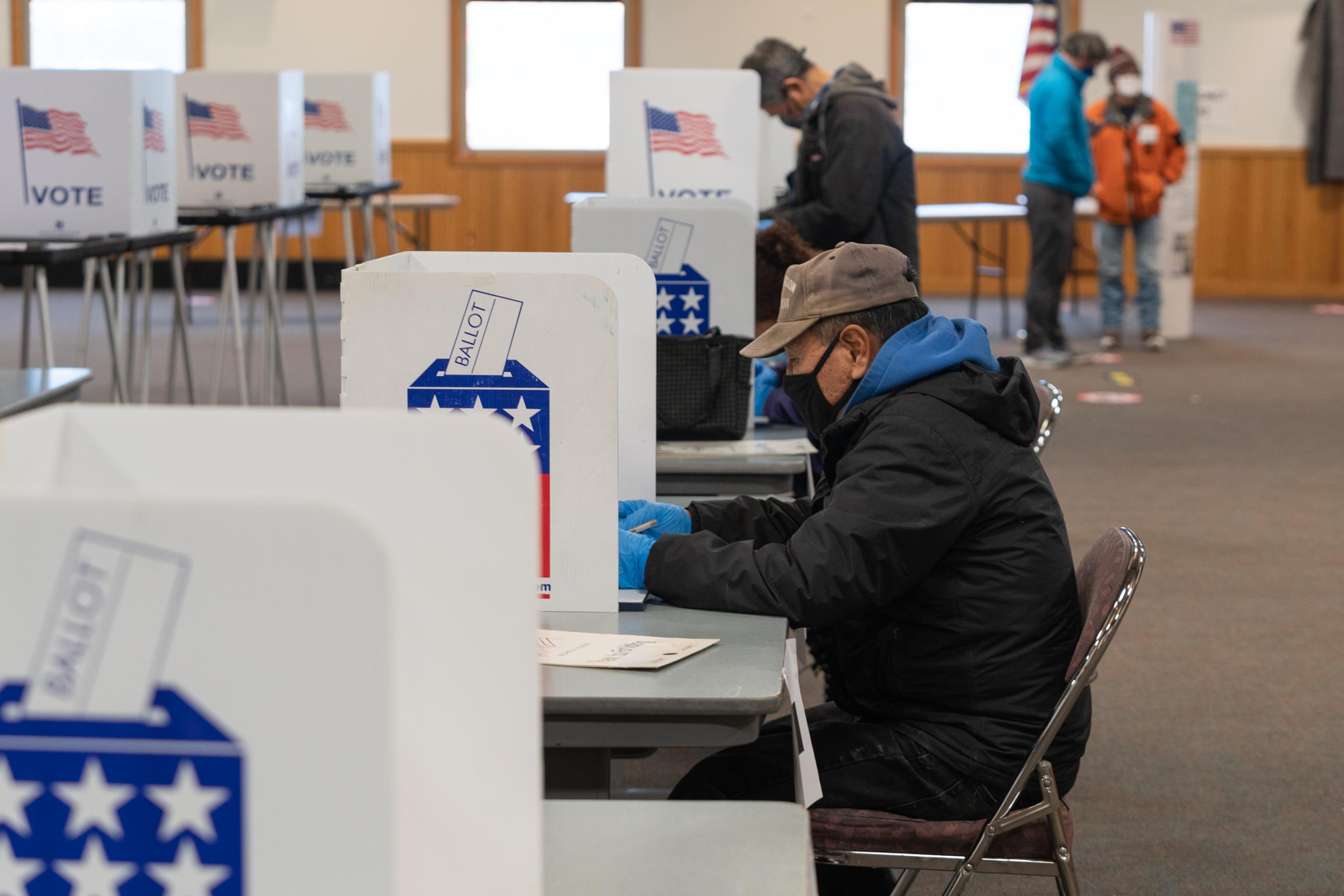
Bethel citizens vote at the Yupiit Piciryarait Cultural Center in Bethel, Alaska on Nov. 3, 2020. (Photo by Katie Basile/KYUK)

Alaska will have a new election system after voters passed Ballot Measure 2.

After Tuesday’s count, the margin between the number of votes approving the measure and those opposing it is greater than the number of ballots that are left to count.

The measure will introduce primaries that are open to candidates with any or no political parties. The top four finishers will advance to the general elections, in which voters will be able to rank their choices. Candidates will win if they receive a majority of the first-preference votes. If none receives a majority on the first count, the votes for trailing candidates will be redistributed until a candidate receives a majority, or all ballots are exhausted.

The last three House races were resolved with Tuesday’s vote count, including two in Anchorage and one in Northern Alaska.

In East Anchorage, Democrat Liz Snyder defeated Republican Rep. Lance Pruitt by 16 votes, if the unofficial count holds up.

But the margin is small enough that the state would pay for any recount.

Pruitt is the leader of the House minority caucus and was seen as a potential candidate for House speaker.

In the district that includes Joint Base Elmendorf-Richardson, Republican David Nelson defeated Democrat Lyn Franks by a margin of 90 votes, based on the unofficial count. The margin is large enough that the state wouldn’t have to pay for a recount and Franks would have to foot the bill if she requests one.

Nelson would succeed Rep. Gabrielle LeDoux, who he defeated in the Republican primary.

And independent Josiah Patkotak defeated Democrat Elizabeth Ferguson by a 212-vote margin, based on the unofficial count. That race is for a district that covers the North Slope and Northwest Arctic boroughs.

Based on the current counts, there would be 21 Republicans in the House, which is the minimum needed to form a majority caucus.

There also would be 15 Democrats, two independents who were nominated by the Democrats and two independents without party nominations.

All results will remain unofficial until they’re certified. The target day for that is next Wednesday.

Correction: A previous version of this story incorrectly listed Lance Pruitt’s position in the legislature, he was the leader of the House minority caucus.

New health orders add testing and quarantine mandates for some in-state travel

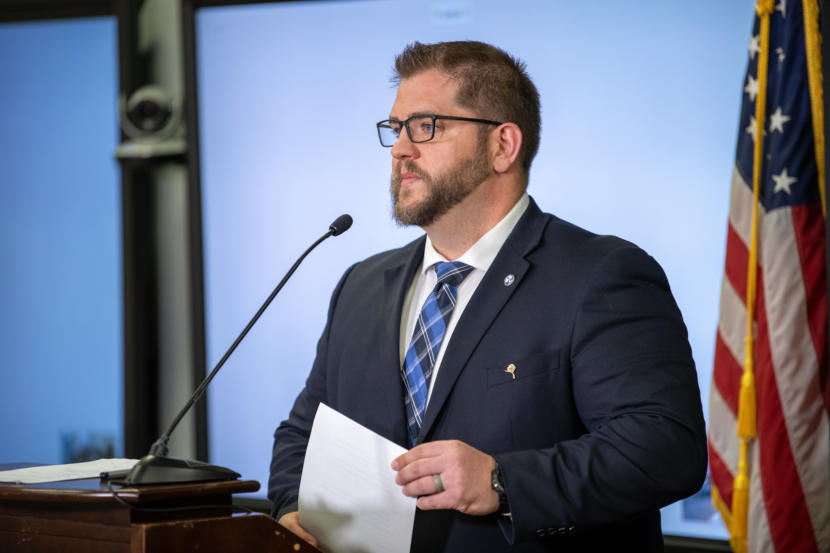
Alaska Health and Social Services Commissioner Adam Crum speaks at a news conference on COVID-19 in April. On Monday, Crum said Gov. Mike Dunleavy issued eight health orders in order to maintain flexibility for health care providers and to slow the spread of the coronavirus. (Creative Commons photo by Office of Gov. Mike Dunleavy)

Gov. Mike Dunleavy issued eight health orders on Sunday under a new disaster declaration that replaces the previous declaration. 

State Health and Social Services Commissioner Adam Crum said the orders allow health care providers to deliver care with flexibility from federal rules. And they’re intended to slow the spread of COVID-19, particularly among health care workers and first responders. 

“We did this disaster declaration because we needed to deliver health care with the federal flexibilities, and we also needed to continue to make sure that everyone understands how important it is that we tamp down on the system,” Crum said. 

Some of the orders extend provisions of mandates that have been in place for months, including rules governing travel in and out of Alaska.

But they also include some new provisions. One order requires any traveler from the road system to rural communities to quarantine until they have a negative test result.

State Division of Public Health Director Heidi Hedberg said the order was developed after consulting with rural communities. 

“We’re asking that individual to get a negative test result, or to have a negative test result before travel,” she said.

The quarantine and testing requirement also affects people traveling from off of the road system to the road system. It asks them to get a test if they’re traveling for more than 72 hours. 

Some legislators have raised concerns about Dunleavy issuing the disaster declaration. They cite a state law that requires the Legislature to approve any extension of a disaster declaration that lasts more than 30 days. 

Juneau Democratic Sen. Jesse Kiehl said the declaration wouldn’t withstand a legal challenge.

“It’s really important,” he said. “Agree or disagree, we’ve got to do it in the constitutional way. Each branch of government has to respect the power of the other. And we ought to be able to work together to at least bring the question to resolution.”  

Acting Attorney General Ed Sniffen said Dunleavy has the power to issue a new declaration, though he said it would be in a “gray area” if it’s challenged.

“Absent any other options, for convening the Legislature safely to consider these issues, this is something we believe the governor does have the authority to do under the Disaster Act, which makes it fairly clear that he does have broad authority to declare these disasters,” Sniffen said. “And it was just in the best interests of the public for this disaster declaration to continue, so we could continue some of the same protections that we were enjoying under the prior disaster declaration.”   

Sniffen said it’s unclear what legal advice his department will provide Dunleavy when the new declaration expires in 30 days. 

Site notifications
Update notification options
Subscribe to notifications