Andrew Kitchenman

State Government Reporter, Alaska Public Media & KTOO

State government plays an outsized role in the life of Alaskans. As the state continues to go through the painful process of deciding what its priorities are, I bring Alaskans to the scene of a government in transition.

8 things to know ahead of the governor’s budget that’s about to drop

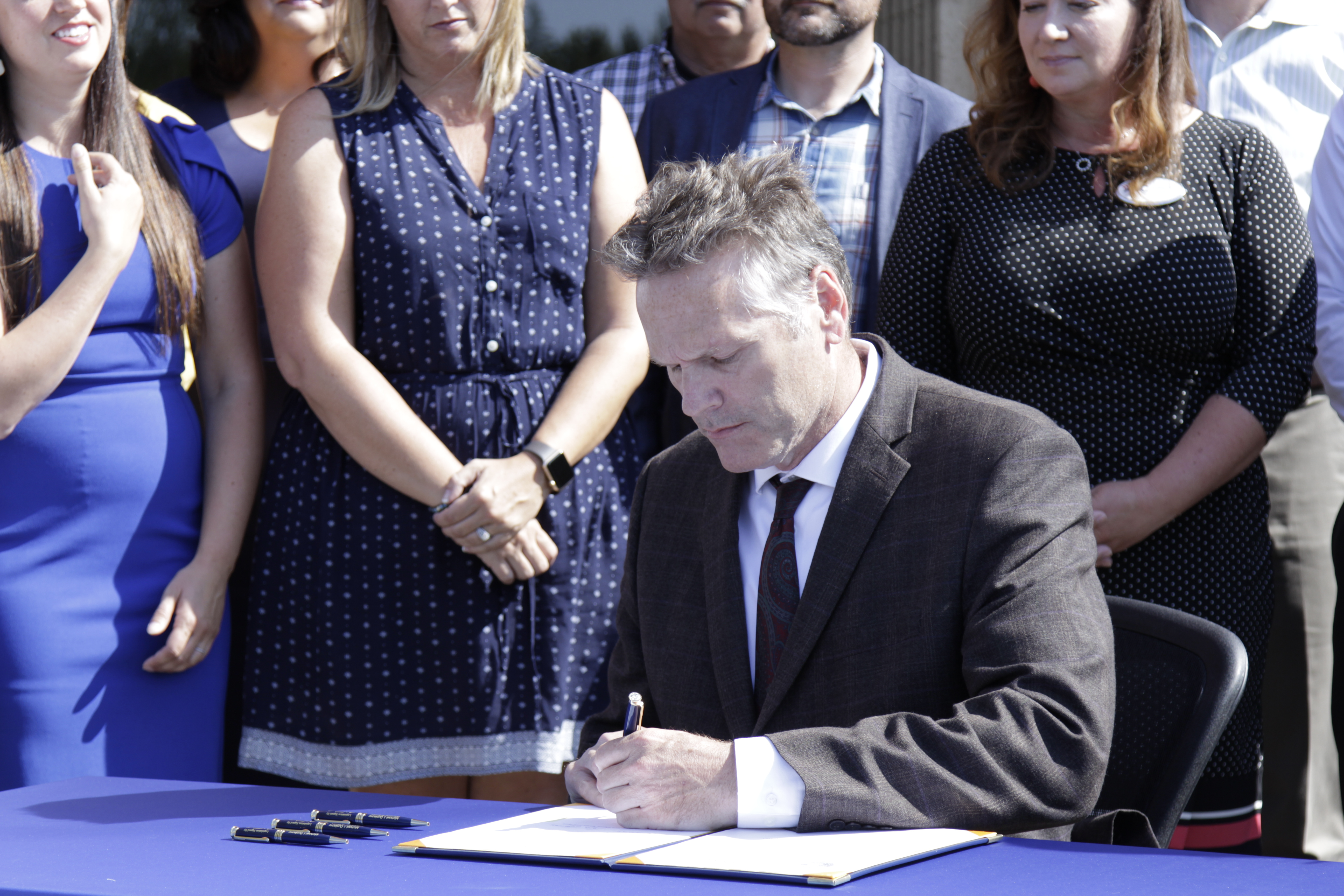
Gov. Mike Dunleavy signs Senate Bill 2002, which funds the capital budget over the next year and maintains 54 separate accounts that fund specific programs like power cost equalization, Aug. 8, 2019. (Photo by Wesley Early/Alaska Public Media)

Gov. Mike Dunleavy is getting ready to propose his third budget. His first budget proposed dramatic cuts to state services. The next didn’t include those deep cuts, but it drew down state savings. This time, it’s not clear what his plan is — or exactly when we’ll see it.

The budget could come as soon as Friday. But under state law, Dunleavy must introduce it by Tuesday.

Here are eight things to know ahead of the budget:

  1. The state’s revenue situation is unclear right now.
    The Department of Revenue hasn’t released the annual revenue sources book, which details how much the state expects to bring in taxes, oil royalties and other revenue over the coming year. Oil futures prices, which the Dunleavy administration has used to project prices, have increased since the spring. And the Alaska Permanent Fund has also grown. But the pandemic hasn’t helped state revenue. It’s not clear how all of the changes combined will affect Alaska’s revenue.
  2. The state is still in the red.
    The current budget, which lasts through June, was projected in the spring to spend $945.7 million more than the state expected to raise in revenue. But that doesn’t include another $1.34 billion for full permanent fund dividends under the formula in a 1982 state law.
  3. The state has less savings to draw from than in previous years.
    The projected deficit for this year is expected to deplete most of the money left in the Constitutional Budget Reserve. That’s the account that the state has used to balance the budget over the past six years. The account has dropped from nearly $18 billion in 2014 to roughly $1 billion today.
  4. “New and interesting” sources of revenue?
    While Dunleavy hasn’t said publicly what the details of the budget will be, he said on the conservative Must Read Alaska podcast that the budget would include “some new and interesting” sources of revenue. He also indicated that the budget would include spending reductions, but he didn’t say what size they would be and where they would fall.
    Much of the discussion of new revenue over the past six years has focused on whether there would be higher taxes on oil production, or a new broad-based income or sales tax. But Dunleavy hasn’t supported either so far as governor. If the governor doesn’t propose either this year — the amount in new revenue will likely only be a small portion of the deficit.
  5. Public education and Medicaid are the largest items in the state budget.
    While Dunleavy proposed large cuts to both areas in early 2019, they have proven politically and practically difficult to reduce. It’s not clear what the governor will propose for both areas this year.
  6. The permanent fund earnings are in the mix.
    Another source of potential funding for the budget is the permanent fund earnings, but only  if the state is able to draw more than allowed under current state law. Majorities in the Legislature have opposed doing that since the law passed in 2018 to draw roughly 5% of total market value of the fund annually. This amount was used because the Alaska Permanent Fund Corporation said it was sustainable. Drawing more than this amount could threaten the fund’s future growth, according to the corporation and lawmakers. But some legislators who took this position lost in the Republican primary to opponents who emphasized a different law, setting the amount for dividends.
  7. Dunleavy will likely include full dividend funding in the budget.
    Dunleavy has been consistent in advocating for a full PFD under the 1982 law. That amount would now be more than $3,000.
  8. Amendments to the state constitution could have long-term budget impacts.
    Dunleavy has said he will reintroduce amendments to the state constitution. One would limit state spending growth. Another would require a public vote on any new or increased taxes. Dunleavy also has proposed an amendment that would enshrine the PFD in the constitution.

This story has been edited to correct two typographical errors.
With vaccine on the way, Gov. Dunleavy to declare third disaster related to COVID-19 pandemic

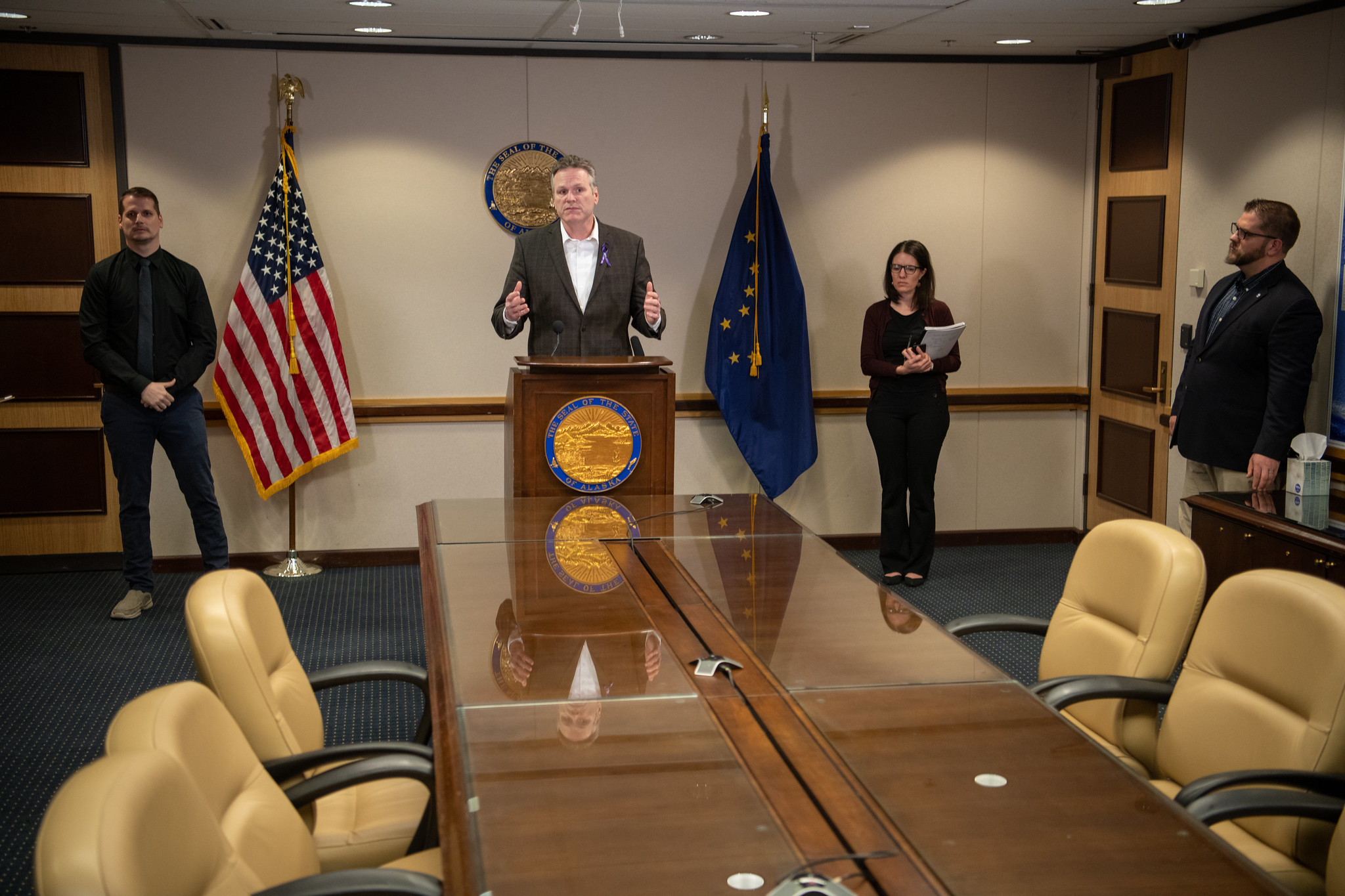
Alaska Gov. Mike Dunleavy speaks during a news briefing about the coronavirus on Tuesday, March 24, 2020. Joining him were Health and Social Services Commissioner Adam Crum (far right) and Chief Medical Officer Dr. Anne Zink (right of Dunleavy). In December 2020, Dunleavy issued his third disaster declaration related to the coronavirus pandemic. (Creative Commons photo by Office of Gov. Mike Dunleavy)

Gov. Mike Dunleavy plans to issue another 30-day disaster declaration in response to the COVID-19 pandemic, his office announced Thursday.

Dunleavy will issue the declaration by Monday and it will go into effect at 12:01 a.m. on Wednesday, Dec. 16th.

In the announcement, Dunleavy said that while the first shipment of a vaccine is expected any day, the threat posed by the virus is still with us.

“We can see the light at the end of the tunnel,” he said in a statement. “But the next 30 days are crucial to advance therapeutic treatments and the vaccination plan so we can defeat this virus and begin returning to normal.”

Dunleavy issued his first COVID-19 disaster declaration in March, and the Legislature extended it until November. Some legislators raised concern before Dunleavy issued a new declaration in mid-November that he lacked the legal authority to do so without the Legislature meeting again.

But Acting Attorney General Ed Sniffen emphasized at the time that the new declaration was based on a new disaster, citing the rising number of cases in the state. The governor’s office said that the legal basis for the Dec. 16 declaration will be provided when the declaration is formally issued.

Gov. Dunleavy believes President-elect Biden has ‘outside chance’ of becoming next president

Alaska Gov. Mike Dunleavy speaks at a White House event celebrating President Donald Trump’s deregulation agenda on Thursday, July 16, 2020. (Joyce N. Boghosian/White House)

Gov. Mike Dunleavy said on a conservative podcast that there’s a “outside chance” that Joe Biden will become the next president.

Dunleavy told Suzanne Downing and John Quick on the Must Read Alaska podcast that accusations of vote fraud must be investigated and that the courts need to determine if fraud has occurred.

“I’m just saying that I’m not there yet,” Dunleavy said. “But in the outside chance — and I’d like to word it that way — that there is a new administration, we will set up a relationship with that new administration and do the best we can to work with them.”

The governor noted that court cases related to the 2000 presidential election weren’t resolved until well into December of that year. The U.S. Supreme Court ruled on Bush v. Gore on Dec. 12, 2000; the 20th anniversary will be on Saturday.

“The people of America need to know that their vote counts, they really do,” he said. “And if there is any suspicion of fraud, which there is, that really needs to be looked into. That really needs to be investigated. That really needs to be determined by, I think, by the courts, that if it does exist, then that needs to be rectified. If it doesn’t exist, then that needs to be proven as well.”

Trump allies have filed dozens of lawsuits related to the election, many of which have already been ruled against in court and none of which have changed any state election results. The federal deadline for state disputes to be resolved has passed. According to those results, Biden won the popular vote by more than 7 million ballots, as well as the Electoral College, 306 for Biden to 232 for President Donald Trump.

Presidential electors are scheduled to vote on Monday, Dec. 14.

Dunleavy expressed concern that Biden’s administration would share a view of Alaska that’s opposed to developing the state’s natural resources.

“I would anticipate … that if there is a new administration, and they try to thwart us at every issue in creating revenue opportunities and job opportunities, that they’re going to have a fight on their hands,” he said.

Four Alaska House members and one representative-elect have called on Alaska Acting Attorney General Ed Sniffen to file a brief in support of a lawsuit by Texas challenging the results in Pennsylvania, Georgia, Wisconsin and Michigan.

Alaska didn’t join 17 other states that joined the brief in support of Texas.

In an emailed statement, a Department of Law spokesperson said a narrow timeline prevented Alaska from joining the suit.

“We agree with the State of Texas that the election integrity of all states and our country needs to be reviewed and assured,” the statement said. “The concept of one person, one vote, needs to be absolute because it is the foundation upon which our country is built. There are very important questions raised by this case that need to be answered quickly.”

The U.S. Supreme Court hasn’t ruled on whether the federal courts will hear the Texas lawsuit.

This is a developing news story and will be updated as information becomes available.

Anchorage Democrat Liz Snyder’s win holds up in Alaska House recount

Anchorage Democrat Liz Snyder won her House race against Republican Rep. Lance Pruitt, with the results upheld by a recount on Friday. (courtesy photo)

The recount in an Anchorage House race didn’t change the winner: Democrat Liz Snyder defeated Republican Rep. Lance Pruitt by 11 votes. 

The margin of victory shrank by two votes, with one vote added to Pruitt’s total and one vote subtracted from Snyder in the recount, which was completed on Friday. 

The recount had been requested by a group of 11 Anchorage voters. 

The election was a rematch, after Pruitt narrowly defeated Snyder in 2018. It was the most expensive Alaska legislative race this year. 

A Division of Elections spokesperson expressed hope that the recount shows that Dominion Voting machines are accurate, and that it will build voters’ confidence in the state’s election process. 

There will be a recount on Friday in the Alaska House race Liz Snyder won by 13 votes

(Photos by KTOO and courtesy Liz Snyder's campaign)
A there will be a recount in an Anchorage House race in which Democrat Liz Snyder, left, defeat Republican Rep. Lance Pruitt. A group of 11 Anchorage residents requested the recount. (Photos by KTOO and courtesy Liz Snyder’s campaign)

There will be a recount in the Anchorage House race in which Democrat Liz Snyder defeated Republican Rep. Lance Pruitt by 13 votes, 4,575 to 4,562.

State Division of Elections workers will start the recount on Friday at 9 a.m. 

A group of 11 Anchorage residents requested the recount on Tuesday. They said they believe an election official made mistakes that could change the result. 

“When an election is that close — and there’s that margin of votes between the two candidates — then even the smallest error can change the outcome of the election,” said Anchorage lawyer Stacey Stone who represents the residents.

The recount application said some ballots, where the voters’ intent to vote for Pruitt was clear, weren’t counted; there were multiple questioned ballots; and there was a failure to ensure that absentee voter ballot certificates were properly completed. 

In addition, the application said there was a failure to properly confirm the results following an electronic count, citing concerns with the Dominion voting system the state recently bought. It also said that a last-minute change in a precinct location led to voter confusion and errors in the ways ballots were cast and counted.

State law allows either candidates or at least 10 voters to request recounts. 

Recounts have changed the outcome of four legislative races in Alaska history. Three of those changes broke ties. But Snyder’s lead is larger than the changes in those recounts. 

The state will pay for the cost of the recount, because the candidates finished within a half-percent of each other. 

Lawsuit challenges Alaska’s recently passed elections overhaul initiative

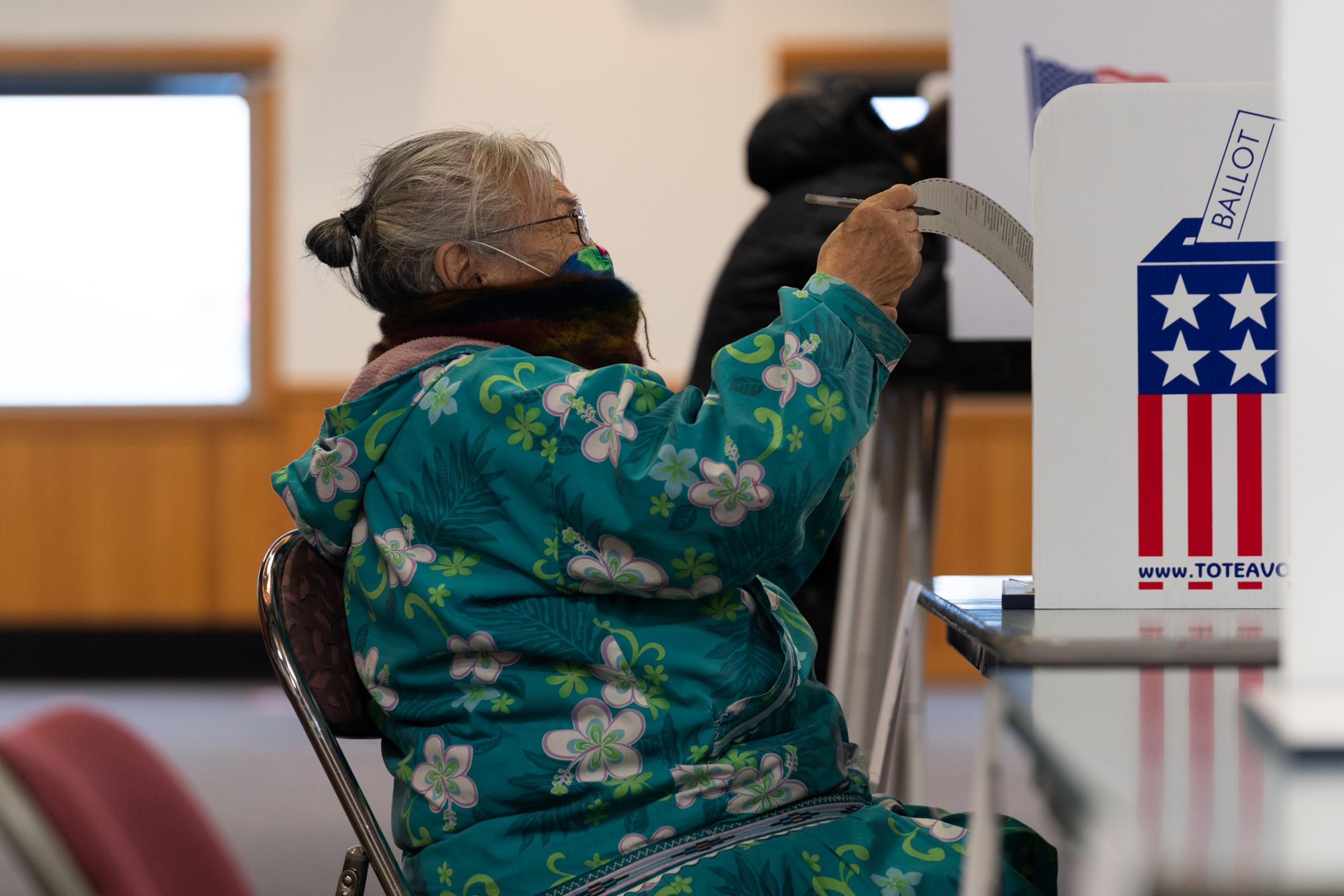
Edna Mathlaw of Bethel reads her ballot on Nov. 3, 2020 in Bethel, Alaska. (Photo by Katie Basile / KYUK)

A group of Alaskans has filed a lawsuit seeking to block the recently passed Ballot Measure 2, the elections overhaul initiative.

Members of the Republican, Libertarian and Alaskan Independence parties filed the lawsuit in Anchorage Superior Court on Tuesday.

“It harms individual rights to free political association, so we can get our candidates elected,” said Attorney Kenneth Jacobus, one of the plaintiffs.

Other plaintiffs include Anchorage resident Scott Kohlhaas, who recently ran as a Libertarian for a House seat; Alaskan Independence Party chair Bob Bird; and the Alaskan Independence Party.

The measure has three main components.

It changes Alaska’s primaries so that members of all parties compete in the same primary, with the top four finishers advancing to the general election.

In the general election, voters will be able to rank their choices. If no candidate receives a majority of the first-place votes, the second choices of trailing candidates will be counted until there’s a winner.

And the measure makes it more difficult for so-called “dark money” campaign donations to be hidden.

The lawsuit says the measure violates provisions of the federal and state constitutions, including those related to political association and free speech.

Jacobus is concerned that the new law allows candidates to determine what party information is next to their names on the ballot. He says this would take away the party members’ rights to associate with who they want to.

“A Socialist could claim they were a Republican, and they’d go Republican on the ballot — withholding information from the people is not in the best interests of anybody,” he said.

Jacobus says he doesn’t object to the ranked-choice voting, but is deeply concerned with the top-four open primary.

According to Jacobus, the plaintiffs filed in state court rather than federal court both because they want the issues to be resolved within the state and because the state law regarding political association is stronger than federal law. Jacobus hopes that other plaintiffs and political parties will join the lawsuit. He noted that there were multiple lawsuits challenging the ranked-choice voting initiative in Maine that were ultimately unsuccessful in blocking a new system there.

He expects the Alaska Supreme Court to ultimately weigh in on the case once it’s been heard in Superior Court.

Scott Kendall is the lawyer for the Yes on 2 campaign and helped write the measure. He says the U.S. Supreme Court has addressed the plaintiffs’ primary argument by allowing similar open primaries in other states.

“Open primaries of this kind are absolutely constitutional,” he said. “So, I mean, this ballot measure was designed with an eye towards existing case law and existing law. And it was designed to withstand constitutional scrutiny. And frankly, we don’t see anything in this lawsuit that presents a serious threat.”

Kendall expects the Yes on 2 campaign to intervene in defense of the law.

A spokesperson for the Department of Law says the department will review the filing and respond in a timely manner.

Site notifications
Update notification options
Subscribe to notifications