State Government Reporter, Alaska Public Media & KTOO
State government plays an outsized role in the life of Alaskans. As the state continues to go through the painful process of deciding what its priorities are, I bring Alaskans to the scene of a government in transition.
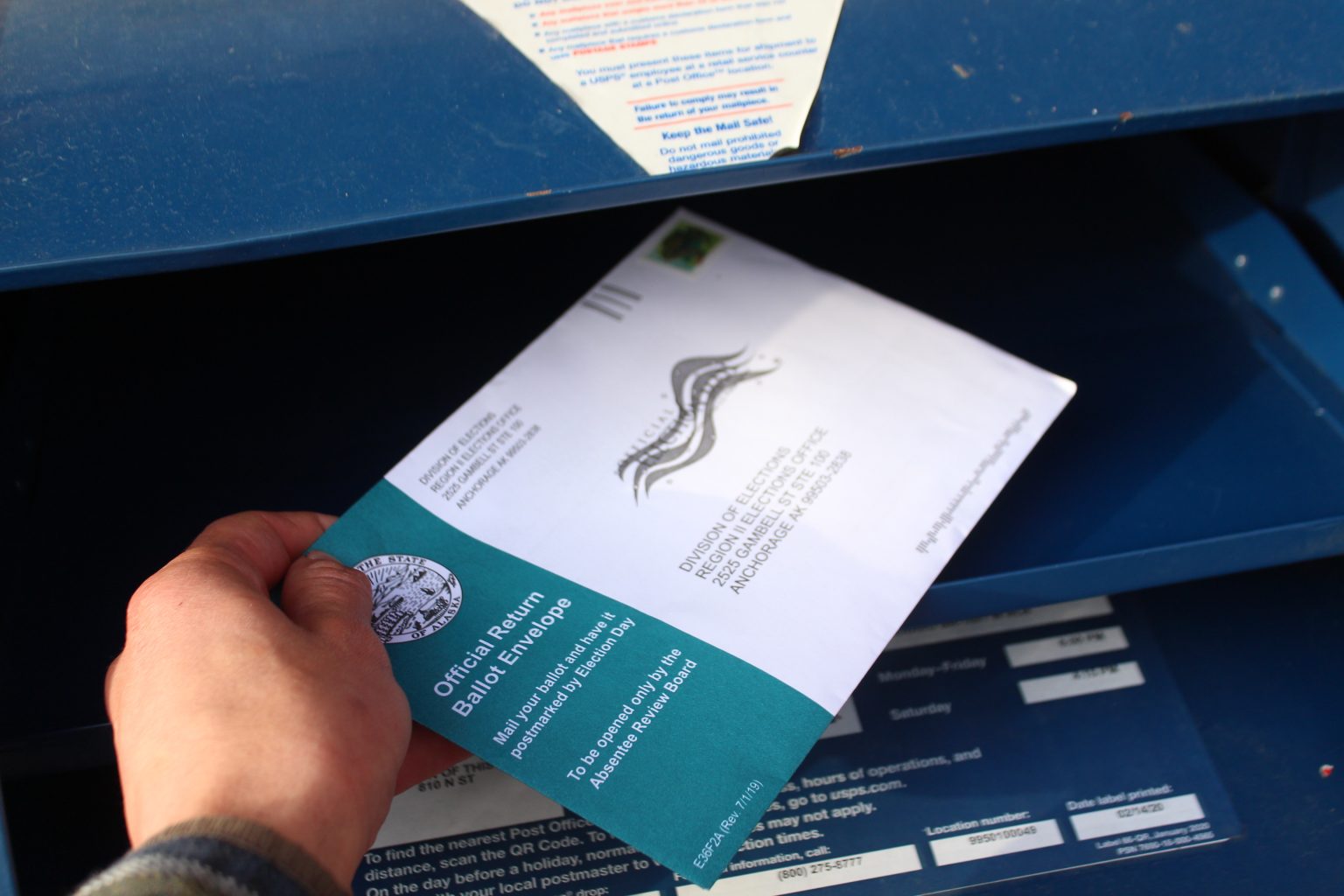
A voter mails an absentee ballot in October 2020. (Lex Treinen/Alaska Public Media)
Ballot Measure 2 looks increasingly likely to pass, after 1,966 more ballots were counted on Monday.
Monday’s count included most of the remaining ballots from districts that have opposed the measure. So, more yes votes than no votes came in with today’s count, but the total count indicates that the measure will pass. The vast majority of the 6,386 remaining uncounted ballots are from districts that have supported the measure, which would overhaul Alaska’s election laws.
Tuesday may be a big day for resolving the three House races where the winner isn’t clear. The remaining ballots are scheduled to be counted in these races.
In the Joint Base Elmendorf-Richardson area district, Republican David Nelson leads Democrat Lyn Franks by 91 votes with 143 uncounted ballots. In an East Anchorage district, Democrat Liz Snyder leads Republican Rep. Lance Pruitt by 17 votes with 114 uncounted ballots. And in the district that includes the North Slope and Northwest Arctic boroughs, independent Josiah Patkotak leads Democrat Elizabeth Ferguson by 148 votes with roughly 570 uncounted ballots.
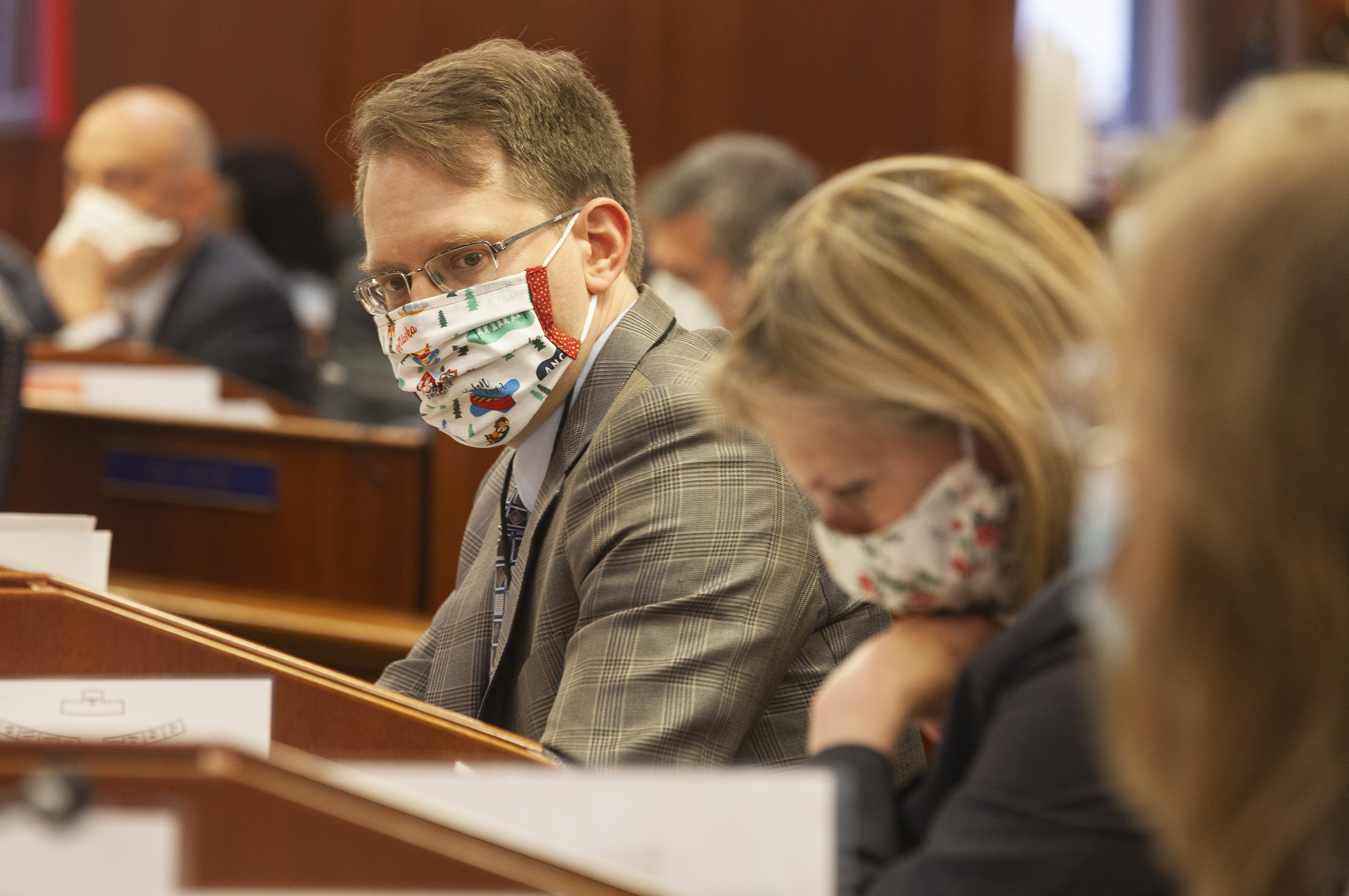
House Minority Leader Lance Pruitt, R-Anchorage, on Monday, May 18, 2020, in Juneau, Alaska, when lawmakers gaveled in for the last few days of their regular session to pass a COVID-19 aid bill. (Photo by Rashah McChesney/KTOO)
The leader of the Alaska House Republican minority caucus is now trailing his Democratic opponent after an update in the vote count on Sunday.
Democrat Liz Snyder leads Republican Rep. Lance Pruitt by just 17 votes. There’s an estimated 114 absentee ballots left to count.
Pruitt has been in the House for 10 years and has led the caucus the last two years.
The race between Pruitt and Snyder was the most expensive in the Legislature this year, with Snyder raising most of the money.
Control of the House is still unclear at this point.
If Snyder wins, the Republicans will have no more than 21 seats, the minimum number for a majority. But three House Republicans have caucused with the largely Democratic majority the past two years. And one — Kodiak Rep. Louise Stutes — has caucused with the majority for four years.
Another Anchorage Republican — David Nelson — solidified his odds of holding the Joint Base Elmendorf-Richardson-area district for the party. While Democrat Lyn Franks decreased Nelson’s lead by 25 votes on Sunday afternoon, she would need to receive more than 80 percent of the remaining ballots to overtake Nelson.
One other House race remains unresolved. It’s for a district that includes the North Slope and Northwest Arctic boroughs. Independent Josiah Patkotak is leading Democrat Elizabeth Ferguson by 148 votes, with roughly 570 ballots left to count.
Ballot Measure 2, which would overhaul Alaska’s elections, moved closer to passing. There are now 3,216 more yes votes than no votes. The margin is large enough that anyone requesting a recount would have to pay for it.
Elections workers counted more than 10,000 ballots on Sunday, representing most of the ballots that were left headed into the day.
It’s not clear when the absentee ballot counting will be complete, but it must be done by a deadline on Wednesday.
The vote counts remain unofficial until the state certifies the results. The target date for that is Nov. 25.
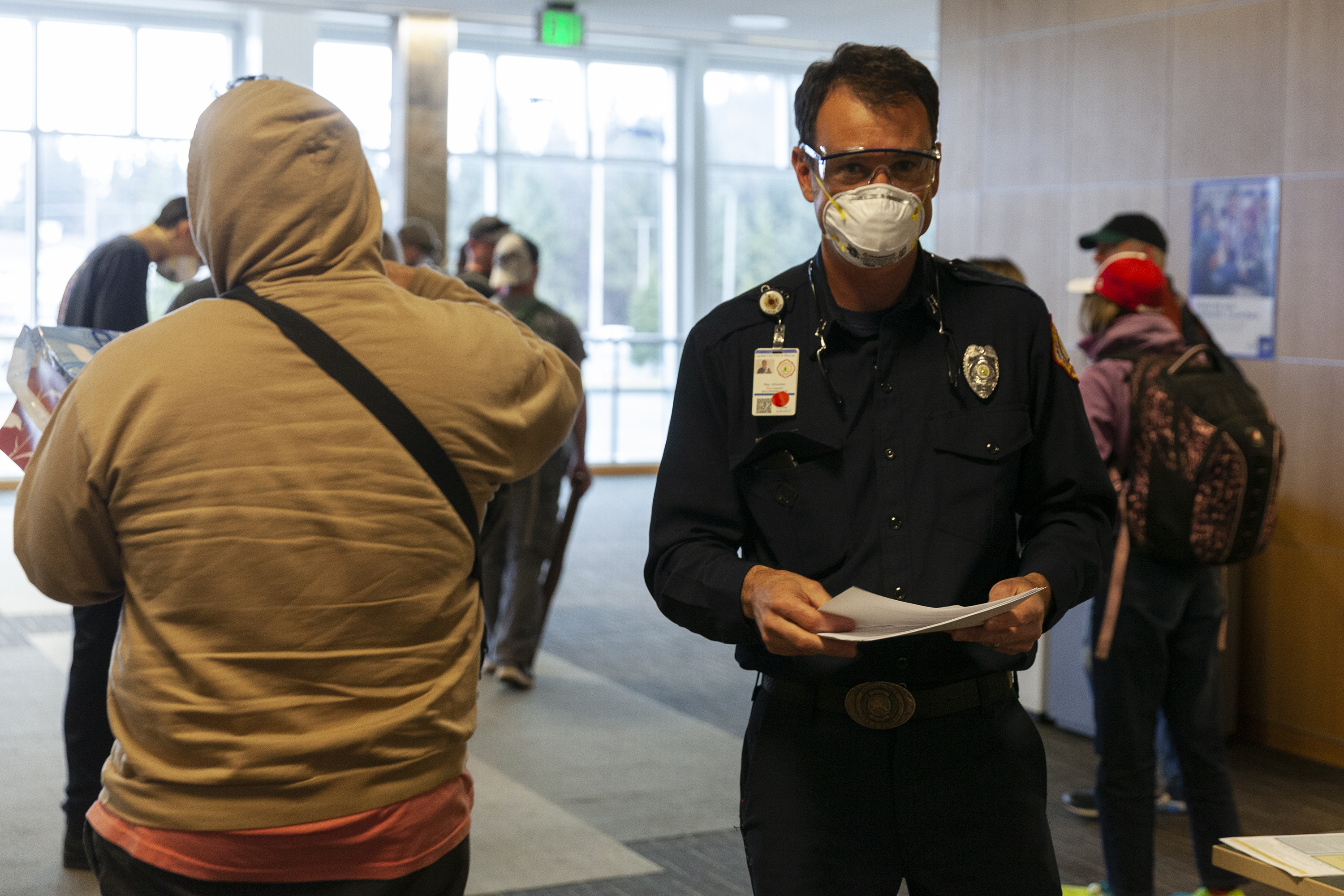
Capital City Fire and Rescue Capt. Roy Johnston talks to people arriving at Juneau International Airport on Saturday, March 21, 2020 in Juneau, Alaska. (Photo by Rashah McChesney/KTOO)
Gov. Mike Dunleavy issued a series of health orders related to the COVID-19 pandemic on Sunday. When the state’s emergency declaration ends at midnight on Sunday, so will the health mandates the governor started issuing in March.
A new, 30-day disaster declaration goes into effect at 12:01 a.m. on Monday, Nov. 16. And with it comes eight new COVID-19 outbreak health orders. Some of the orders are similar to the previous mandates.
Another new order requires that travelers within Alaska who travel off of the road system maintain social distancing until they have a negative test result for the coronavirus.
While the other orders are effective Monday morning, that one goes into effect on Saturday, Nov. 21. But local communities are allowed to impose their own travel restrictions. One of the orders continues to allow that.
Two orders are provisions of Senate Bill 241, which also expires on Sunday. One allows health care professionals licensed in other states to be licensed in Alaska during the emergency, and allows for more telehealth services. And one that allows corporations and nonprofit boards that normally are required to meet in person to meet electronically.
There is an order that requires businesses defined as providing critical infrastructure to submit protective plans. It includes more detailed rules for the fishing industry.
Another order also continues a policy allowing for quarantine and isolation shelter for first responders, health care workers and homeless people.
More than 4,000 of the votes counted on Friday were in the Ketchikan-area House district, where independent Rep. Dan Ortiz has been re-elected, defeating Republican Leslie Becker.
Homer Republican Rep. Sarah Vance also has been re-elected, defeating independent Kelly Cooper.
Besides Ballot Measure 2, there are three other races that are still closely contested, all in the House.
They are for the Anchorage district in the Joint Base Elmendorf-Richardson area, where Republican David Nelson leads Democrat Lyn Franks by 116 votes to replace Rep. Gabrielle LeDoux; an East Anchorage district, where Republican Rep. Lance Pruitt holds a 58-vote lead over Democrat Liz Snyder; and a district that includes the North Slope and Northwest Arctic Boroughs, where independent Josiah Patkotak leads Democrat Elizabeth Ferguson by 148 votes. There were no updates for any of these three races on Friday.
Only one legislative district has changed parties, based on the candidates who are currently leading. In South Anchorage, independent Calvin Schrage, who was nominated by the Democrats, is leading over Republican Rep. Mel Gillis.
Voters have retained all Alaska judges facing votes this year, including Supreme Court Justice Susan Carney.
Today was the last day for ballots mailed by Election Day within the United States to arrive. Ballots mailed from overseas can arrive through Wednesday, which is the deadline to finish the count.
All vote totals remain unofficial until they’re certified. The target date for that is Nov. 25. The Division of Elections Juneau office will count absentee ballots on Saturday. The Anchorage office will be preparing ballots on Saturday to count on Sunday. Nearly all of the ballots for Interior have been counted, and the Fairbanks office will do its final count on Wednesday. The Nome office will be reviewing absentee and questioned ballots on Saturday.
Screenshot of a YouTube video. At 10:00 a.m. on Thursday, Nov. 12, 2020, Gov. Mike Dunleavy sent issued an alert about the escalating spread of COVID-19 in Alaska.
Alaska Gov. Mike Dunleavy’s office issued an emergency alert on Thursday, urging Alaskans to take more precautions to slow the spread of COVID-19.
The alert was sent to cellphones in Alaska, with a link to a YouTube video of the governor. The governor’s office said most Alaskans received the alert.
At 10:00 a.m. on Thursday, Nov. 12, 2020, Gov. Mike Dunleavy sent issued an alert about the escalating spread of COVID-19 in Alaska.
Dunleavy asked Alaskans to change their behavior, and said “the next three weeks are critical.”
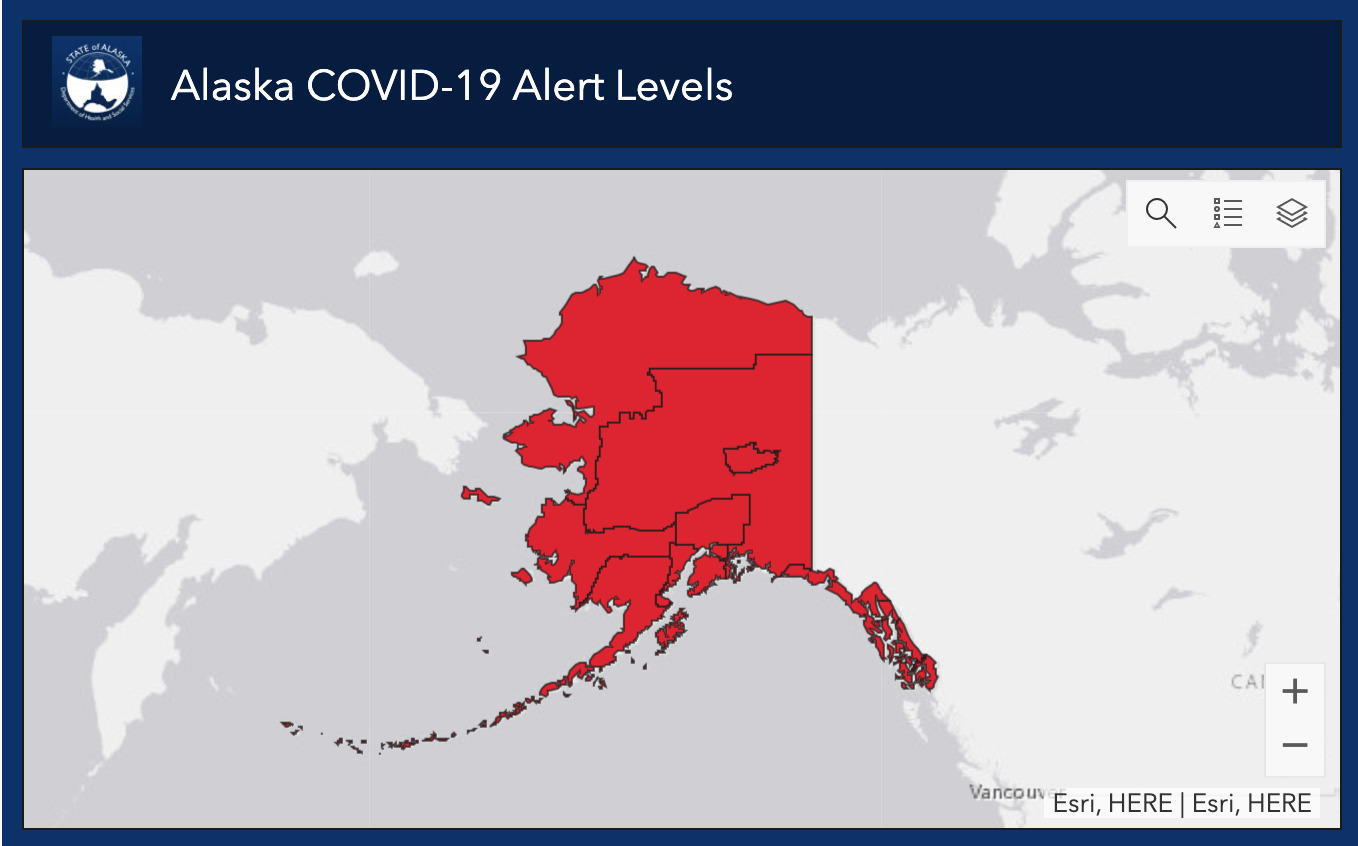
“I’m speaking to you today, because Alaska is facing an escalating crisis that I need your help to solve,” Dunleavy said. “Like the rest of the nation, Alaska’s COVID-19 status is now in the red.”
That means all areas of the state are at the highest alert level and COVID-19 is rapidly spreading through Alaska communities. Dunleavy said health care workers, first responders and service members “are being infected at unprecedented rates.”
He said that if too many trauma nurses, paramedics and police officers are infected, they can’t perform critical duties.
“If we are going to keep our hospitals running and businesses open, all Alaskans must return to the same mindset that worked so well this past spring,” Dunleavy said.
Statewide COVID-19 alert levels according to data from Alaska DHSS
He urged people to stay 6 feet apart from non-household members. And he asked people to wear masks “in any and every setting,” when they can’t stay 6 feet from others.
He noted that people are entering the holiday season, and asked people to celebrate “differently.” He added that his job as governor is not to tell people “how to live your life,” but to ensure the state’s security and safety, adding: “I can’t do that without your help.”
He urged businesses and municipalities to have employees work from home as much as possible through the end of November. And he took the extra action of calling for state workers to work from home whenever feasible and made face masks and social distancing mandatory at state work sites for both state workers and visitors. These two actions are new.
The Alaska State Employees Association, which represents 8,000 state workers, has been calling for similar steps since the first weeks of the pandemic.
Executive Director Jake Metcalfe hopes the governor’s message brings more uniformity to state work-from-home practices, and that it leads to more workers teleworking.
“It’s been a policy that has been applied in some places, but not in all places,” he said.
But he’s concerned that Dunleavy’s reference to working from home “whenever feasible,” will lead to some workers continuing to unnecessarily work in state offices.
Metcalfe also says that mask requirements have varied between state offices, and have not been enforced. He hopes that will change now.
“It’s a safety issue for everybody that goes into a state office building, whether you’re an employee or just a resident of the state,” he said.
Metcalfe says his union wants a statewide mask mandate for all public spaces, not just state offices. The ASEA also is calling for more testing for the coronavirus at state work sites, particularly those that are experiencing outbreaks. And Metcalfe wants more communication between the administration and the union’s members.
This story has been updated with reaction from the Alaska State Employees Association.
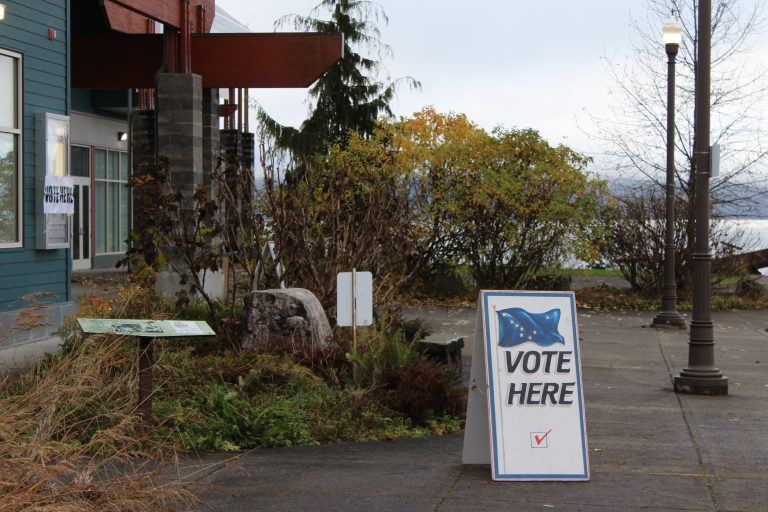
A sign welcomes voters to a polling station in Wrangell, AK. (Photo by Sage Smiley/KSTK)
Alaska’s ballot count continued on Wednesday. With a little more than 25,000 additional votes counted, there was only one change in the frontrunner in any race: Sitka Democratic Rep. Jonathan Kreiss-Tomkins went from trailing Republican challenger Kenny Skaflestad by 151 votes to leading by 1,728 votes.
Another race got much tighter. In an East Anchorage House district, Republican Rep. Lance Pruitt’s lead over Democratic candidate Liz Snyder fell from 1,163 to just 56 votes.
Ballot Measure 2 currently has more no votes than yes votes, but its chances keep looking better. It now trails by 9,318 votes with at least 66,000 ballots left to count. The measure would overhaul Alaska’s elections system by introducing primaries that are open to all political parties; introducing ranked-choice voting in general elections; and increasing campaign finance transparency.
There were no significant changes in the margins in other statewide races. U.S. President Donald Trump has won Alaska’s three Electoral College votes, according to the Associated Press. The AP also called the U.S. Senate race, in which Republican Sen. Dan Sullivan defeated Al Gross, the Democratic nominee. And in the U.S. House race, Republican Rep. Don Young defeated Alyse Galvin, who like Gross is an independent nominated by the Democrats.
The largest statewide margin is on Ballot Measure 1, where no votes lead yes votes by more than 55,000. The measure would have increased the taxes paid by large oil companies.
Along with the Pruitt-Snyder race, there are three other House races whose outcomes remain in doubt.
In a neighboring South Anchorage district, Republican James Kaufman leads Democratic-nominated independent Suzanne LaFrance by 1,706 votes with roughly 5,800 ballots left to count. In an Anchorage district around Joint Base Elmendorf-Richardson, Republican David Nelson leads Democrat Lyn Franks by 116 votes with roughly 500 ballots left to count. And in a district that includes the North Slope and Northwest Arctic boroughs, independent Josiah Patkotak leads Democrat Elizabeth Ferguson by 397 votes with more than 1,200 votes left to count.
There’s only one race in the state where a Republican incumbent is behind a challenger. That’s in the Anchorage district currently represented by Republican Rep. Mel Gillis, who is trailing Democratic-nominated independent Calvin Schrage.
The outcome of only one Senate race remains uncertain: Republican Roger Holland leads Democrat Carl Johnson by 2,002 votes with roughly 6,500 ballots left to count. They’re competing in a district that includes parts of East and South Anchorage.
In the House, Republicans could win anywhere from 19 to 22 seats, with 21 needed to form a majority. But Kodiak Rep. Louise Stutes has caucused with the mostly Democratic majority for four years. It’s not clear which caucus independent Patkotak would join if he’s elected.
This story was updated at 9:15 p.m. after the second round of results were released from the Division of Elections.
Close
Update notification options
Subscribe to notifications
Subscribe
Get notifications about news related to the topics you care about. You can unsubscribe anytime.