State Government Reporter, Alaska Public Media & KTOO
State government plays an outsized role in the life of Alaskans. As the state continues to go through the painful process of deciding what its priorities are, I bring Alaskans to the scene of a government in transition.
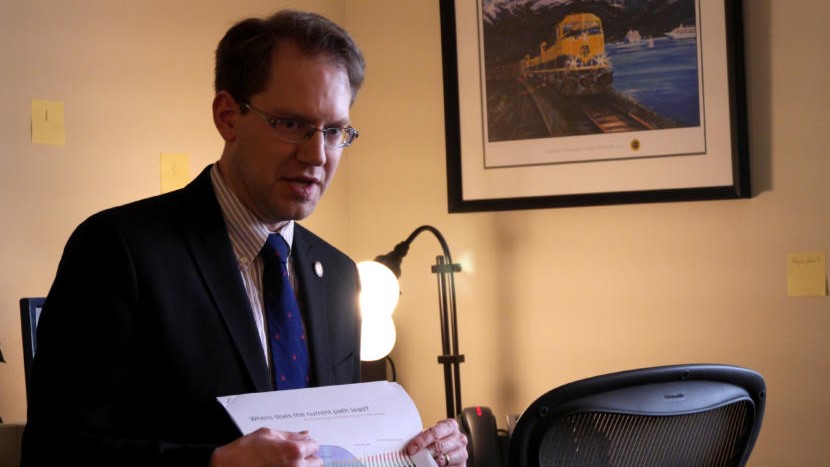
Rep. Lance Pruitt, R-Anchorage, talks to reporters at a House Republican Minority press availability in his office at the Capitol in Juneau in 2018. On Tuesday, an Alaska Public Offices Commission staff report found Pruitt’s 2016 and 2018 campaigns violated state campaign finance laws. (Photo by Skip Gray/360 North)
Rep. Lance Pruitt violated Alaska’s campaign finance laws and should pay a penalty. That’s according to staff for the state’s elections watchdog agency, the Alaska Public Offices Commission.
Commission staff issued a report on Tuesday. They found that Pruitt’s campaigns failed to accurately report expenses, both in 2016 and 2018.
The five-member commission will decide whether it agrees with those findings and what, if any, penalty Pruitt will have to pay.
According to the report:
the campaigns also failed to provide information detailing media advertising placement and consulting services it received;
Pruitt’s 2016 campaign failed to reimburse him for personal funds within the legally required time period, or to report the use of his personal funds as contributions; and
Pruitt’s 2018 campaign failed to return two contributions from a corporation, which are illegal under state law.
The maximum fine for the violations is $1,022,250. The commission staff said that amount would be excessive and recommended it be reduced by 99%. Pruitt would still have to pay $10,222.
The report also recommended that the commission dismiss an allegation that Pruitt failed to obtain required information about the clients of his wife, Mary Ann Pruitt. She is a media consultant who has worked as Gov. Mike Dunleavy’s communication director. The staff said Lance Pruitt made a good-faith effort to get that information.
The investigation was the result of a complaint filed in October by Paula DeLaiarro, a campaign finance expert for Ship Creek Group, a consulting business.
Pruitt is an Anchorage Republican. He recently lost his legislative seat to Democrat Liz Snyder. A lawsuit is challenging the election result.
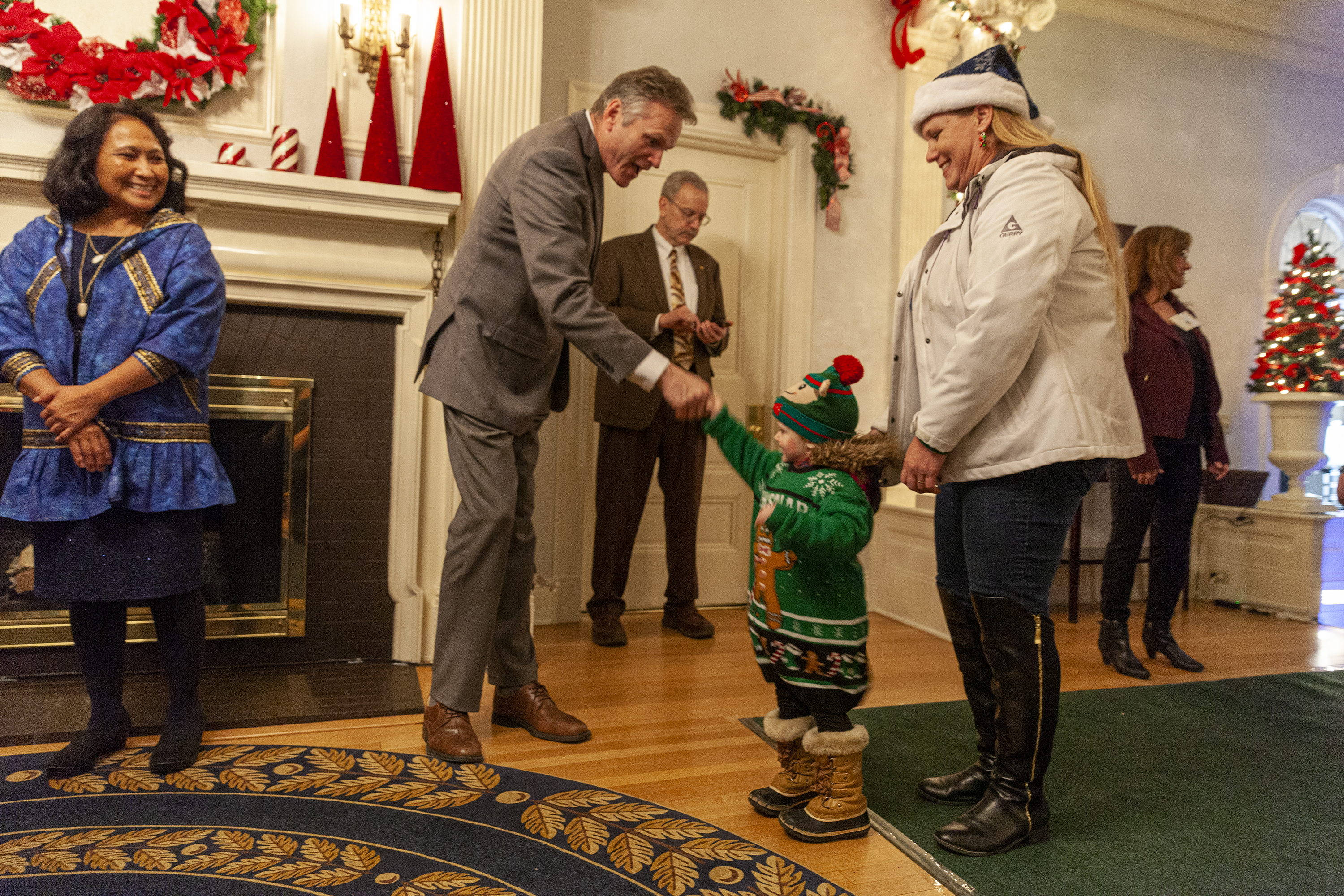
Lala Jackson, 2, shakes Gov. Mike Dunleavy’s hand during the annual Christmas open house on Tuesday, Dec. 10, 2019, in Juneau. (Photo by Rashah McChesney/KTOO)
Gov. Mike Dunleavy encouraged Alaskans to shop at local businesses, support charities and help neighbors affected by COVID-19 during the holiday season.
“If you’re lucky enough to have a job, if you’re lucky enough not to have your hours cut, make this a special Christmas,” he said. “And I’m sincere when I say this: Make this a special Christmas, in which you’re giving.”
The governor made the appeal during a news conference that included an update on the pandemic response. He listed some of those affected by the pandemic, including business owners and single parents who have to support their families.
“It’s really important that we all lock arms and help those Alaskans that are having a difficult time because of this,” he said.
Dunleavy also asked Alaskans to think of those who are having a hard time in their relationships, and to pray for them.
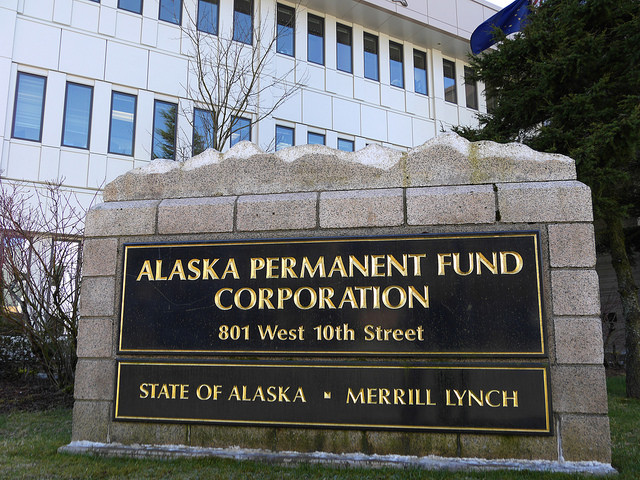
The Alaska Permanent Fund Corp.’s exterior sign. (Photo by Skip Gray/360 North)
Gov. Mike Dunleavy’s proposed state budget does something Alaska hasn’t done before: it draws more than $3 billion more than planned from the Alaska Permanent Fund. That puts the budget on a collision course with a state law intended to build the fund in the future.
Dunleavy said Alaskans — and Alaska’s economy — would benefit next year from receiving full permanent fund dividends under the formula in state law. That’s projected to be more than $3,000.
And he wants to pay out an additional $1,916 to make up for what Alaskans would have received this year in PFDs had the state followed the formula.
All of that money would be in addition to what the state already planned to draw from the Alaska Permanent Fund’s earnings reserve. The governor said it’s a one-time solution.
“So I want people to understand that this is not going to be a situation where my administration is going to go to the earnings reserve of the permanent fund on a consistent basis to pay for large outlays,” he said. “But this year is different. This year we need to get this economy back up off its knees and on its feet.”
This year is different.
But what’s not new is that this is the seventh straight year there’s a gap between what Alaska would spend and what it’s bringing in. And what’s been in the state’s main piggy banks to close these gaps — the constitutional and statutory budget reserves — is down from nearly $18 billion combined in 2014 to roughly $1 billion left in the Constitutional Budget Reserve Fund today.
That leaves the earnings reserve as the last account left.
Alaska Permanent Fund Corporation CEO Angela Rodell stays away from budget politics. But more than a week before Dunleavy introduced the budget, she laid out the stakes of overdrawing from fund earnings.
“We just have to recognize that if we want to have a robust, stable revenue source for multi- years — to take care of our kids, to take care of our grandchildren, to support the state, then we need to be conscientious about how we use the fund, and be very prudent in our spending,” she said at a presentation to the Greater Fairbanks Chamber of Commerce on Dec. 1.
The emphasis on prudence was behind the law the Legislature passed two years ago that limits draws from fund earnings to roughly 5% of its market value.
The market value is calculated on an average over five years. That limits the impact of something like what’s happened over the past nine months, when the fund’s value rose from $60 billion after the pandemic started to more than $72 billion on Monday.
Rodell said it would be unfortunate for the state to go down a different path than the one laid out in the law.
“The state can pay a full PFD. Or it can pay for other essential services,” she said. “But it can’t do both at the full rate it has been. ”
But the governor’s budget tries to do both. Although it does include some spending cuts, they’re not on the large scale he proposed two years ago.
Dunleavy didn’t say last week how he would close most of the $2 billion gap in the budget that would still exist after this year. He did lay out one major proposal — changing the formula for the dividend.
In the existing formula, dividends are half of the fund’s average recent earnings growth. When times are good, dividends are high. During periods with long down markets, there are smaller dividends.
The new formula wouldn’t be based on earnings growth. Instead, it would be based on a share of the annual draw. That draw is based on the fund’s overall market value, including both earnings and the fund’s constitutionally protected principal. It won’t go up and down as much as the current formula. Dunleavy wants it to be at least half of the draw.
The change would be subject to a vote of the people of Alaska, through a proposed constitutional amendment that would enshrine the PFD in the constitution. It doesn’t currently have that protection.
The change would reduce dividend payments by an estimated $427.2 million the first year, in the fall of 2022. It would reduce individual dividends by a little more than $600, leaving them at an estimated $2,300 to $2,400.
But that’s for the future. This year, Dunleavy’s plan for two PFD payments would drain more than $3 billion from the fund, beyond the $3 billion that was planned.
Finance experts have pointed out that every dollar taken from the fund beyond what’s planned will reduce the fund’s earnings forever. For example, the annual earnings growth lost from an unplanned $3.2 billion draw at 5% growth would be $160 million.
Dunleavy said the people of the state should be able to weigh in on any long-term budget solution. Besides enshrining the PFD, he has two other ideas for amending the constitution. One would require the public to vote on new taxes, and the other would lower the limit on how much the state can spend.
“Just like what happened decades ago, that gave us the permanent fund. That allows us to have this discussion today. The very people of Alaska voted on that permanent fund. We all think that was a wise idea. Why not give them an opportunity to vote on how they want to be taxed, if they do?” Dunleavy said. “What changes to the permanent fund, if any, that they would agree to? And in terms of spending limits, why not engage the people of Alaska?”
The proposal faces an uncertain reception in the Legislature.
The day the budget came out, one of the current leaders in the Legislature says he expects the plan to meet strong resistance.
House Speaker Bryce Edgmon, a Democratic-endorsed independent from Dillingham, said some lawmakers want to pay as large a dividend as possible.
“But, the question before us — and I think in front of all of Alaska is — do we spend down the earnings from the permanent fund to meet today’s costs, at the expense of tomorrow’s generation?” he said. “Where there may not be a permanent fund dividend, where you may compromise the earnings of the permanent fund, because this year was a good year in the earnings, next year may be a not so good year. The year after that could be very poor.”
The next step in the budget process starts on Jan. 19, when the Legislature reconvenes.
Gov. Mike Dunleavy declined to say whether he thinks other Alaskans should get a COVID-19 vaccination, although he said he would get one himself.
“So I’m going to do what I think is best for me,” Dunleavy said at a news conference on Tuesday. “I would encourage others to do what they believe is best for them.”
Dunleavy said Alaskans should talk with their doctors, adding that he doesn’t know people’s individual medical situations.
Dunleavy said he expects to get the vaccination in roughly two weeks, because he recently got a flu shot.
“I’m doing that because I don’t want to necessarily occupy a hospital bed if I don’t need to,” he said. “Others may not want to, and I respect that.”
When asked if he believes that the vaccinations are safe and effective, Dunleavy said he wouldn’t be getting one if he didn’t.
Dunleavy also said the vaccinations will be a “game changer” in the state.
There have been declines in the number of new cases, hospitalizations and the percentage of positive tests for the virus in the past week.
State Chief Medical Officer Dr. Anne Zink said Alaskans’ actions to reduce the spread have contributed to the declines.
“On Nov. 12, the governor asked us all to wear a mask and keep our distance and keep our social circle small, and you can see, we’ve been seeing kind of a steady trend there,” she said, referring to the data. “That’s because of all of the hard work that Alaskans have been putting into this and doing these mitigation efforts.”
Dunleavy issued a new COVID-19 disaster declaration that takes effect at 12:01 a.m. on Wednesday. The declaration will last 30 days. He said the declaration will help the state receive and distribute vaccinations.
Some legal experts and legislators have questioned the legal basis of new COVID-19 disaster declarations without the Legislature meeting to extend the original declaration issued back in March. But since Dunleavy issued a second declaration 30 days ago, no no lawsuits have been filed challenging its legality.
Original post — Dec. 15, 4:30 p.m.
Gov. Mike Dunleavy’s latest COVID-19 press conference is scheduled for 5 p.m. today.
The governor, Department of Military and Veteran Affairs Commissioner Torrence Saxe, Department of Health and Social Services Commissioner Adam Crum and Public Health Director Heidi Hedberg, and Alaska’s Chief Medical Officer Dr. Anne Zink will be present.
The update is scheduled to cover the COVID-19 Public Health Disaster Emergency Declaration, the state’s COVID-19 vaccination plan and the weather-related disaster in Haines and Southeast Alaska.
Alaska-specific COVID-19 resources and information are available at coronavirus.alaska.gov.
You can watch today’s press conference live on this post, and on the governor’s Facebook or Livestream pages.
Joe Biden received a majority of the electoral votes nationally, and is the president-elect. But on Monday, Alaska’s three Electoral College members cast their votes for President Donald Trump.
Each presidential candidate has electors who are pledged to vote for them if they win the most votes in each state. John Binkley of Fairbanks, and Judy Eledge and Randy Ruedrich of Anchorage were pledged to vote for Trump when he won Alaska. They met in Juneau to sign the documents awarding their votes on the same day that the electors in every state cast their votes.
Lieutenant Governor Kevin Meyer says Alaska benefits from the indirect system for electing the president.
“Here in Alaska, we recognize the importance of the Electoral College,” he said, “and the parity that it brings to the smaller populated states, like Alaska.”
Meyer’s office oversees the Division of Elections. He says the election went smoothly in the state.
“And that’s not an easy task even in a normal year. But with this being such an abnormal year, it was a huge task,” he said.
There has been more attention to the Electoral College this year, as Donald Trump has contested the election results.
Alaska Acting Attorney General Ed Sniffen wrote a letter last week attempting to join a filing in support of a Texas lawsuit challenging the results in four states. The U.S. Supreme Court rejected the Texas lawsuit on Friday.
Also last week, Dunleavy said on a conservative podcast that there is an “outside chance” Biden will become the president.
Original post — Dec. 14, 11:00 a.m.
Across the country today, each state’s electors are meeting to cast their electoral votes. Each of Alaska’s electors gets one vote. Their votes are sealed and sent to Washington, D.C. On January 6, 2021, they will be opened and read before both houses of Congress.
Alaska’s electors will cast their votes for President Donald Trump, who has encouraged dozens of lawsuits related to the election, many of which have already been ruled against in court and none of which have changed any state election results.
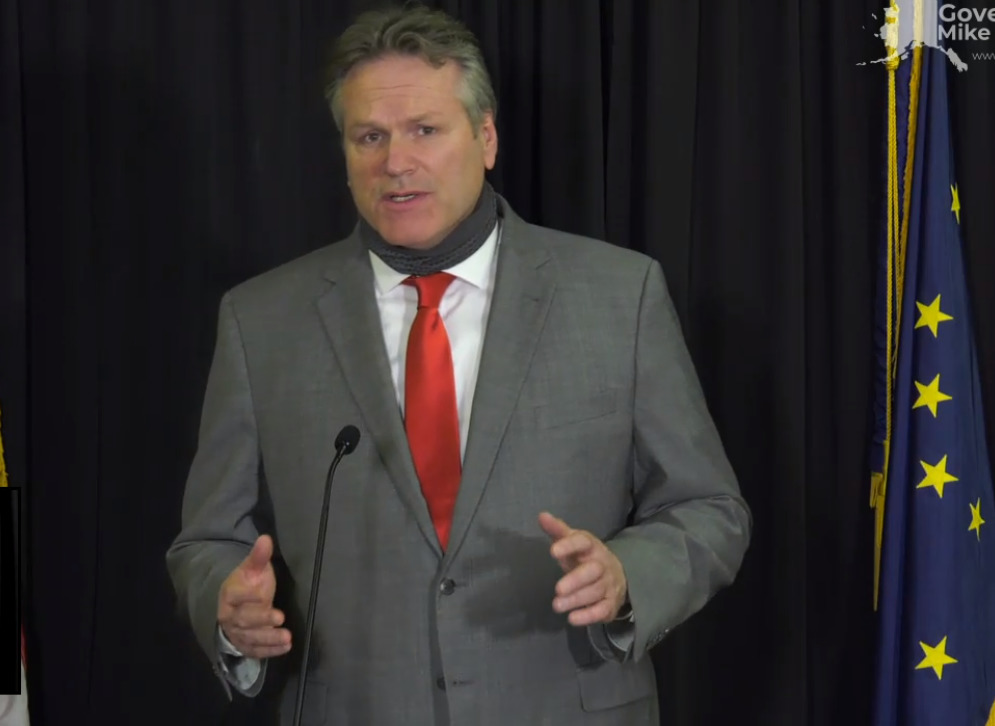
Gov. Mike Dunleavy speaks about his budget proposal, which would begin next July, during a news conference on Friday. (Screen capture of video stream from the governor’s office)
Alaska Gov. Mike Dunleavy on Friday proposed a budget that would cut state spending on government services, but would also pay out nearly $5,000 in permanent fund dividends.
It relies on drawing from the Alaska Permanent Fund’s earnings to both pay for most of state government and for two PFD payments. The total draw of $6.3 billion is more than twice the amount allowed under state law.
Dunleavy emphasizes the need to stabilize Alaska’s economy.
“We have thousands and thousands of Alaskans on unemployment,” he said. “We want to make sure that we’re not going to add to the unemployment rolls, but we’re going to do the opposite.”
The governor also proposed borrowing up to $350 million to upgrade the state’s roads, bridges, airports and other infrastructure.
The portion of the budget directly controlled by the Legislature — which is where Dunleavy’s budget will go next — would be $4.3 billion. It’s about $300 million less than this year’s budget.
His budget proposal would cut Medicaid by $35 million and public education by $21 million. It also would reduce spending on highways, aviation and transportation facilities by $13 million and includes a previously planned cut to the University of Alaska of $20 million.
Dunleavy said it’s important for the future of the state’s economy and the budget that Alaska develops its natural resources.
“There are folks that really don’t want that to happen,” he said. “They want Alaska to be one of the largest parks in the country.”
The governor’s budget includes full PFDs under the formula in state law, which would be roughly $3,000. In addition, it would pay out nearly $2,000 more, which is the difference between the amount under the formula and the amount Alaskans were actually paid this year. Dunleavy said the additional payment would put cash in the hands of Alaskans affected by the pandemic.
Dunleavy also proposed changing the dividend formula for 2022. Under the new formula, dividends would be roughly $2,300, which would be less than under the formula in current law, but more than Alaskans have received the last five years.
But Dunleavy said any change should be subject to approval in a vote by Alaskans. He also wants to amend the state constitution to require a public vote on any new taxes.
“If we really want to have a sustainable fiscal plan, you cannot ignore the people of Alaska,” he said. “You cannot ignore the very people that vote for us and send us here.”
Legislators from both chambers responded to Dunleavy’s proposal with caution.
House Speaker Bryce Edgmon, a Dillingham independent, said he thinks there will be support for a transportation bond. But he said there are time constraints when conducting a legislative session during a pandemic. That will limit the amount of time they have to consider Dunleavy’s proposals. He said he wishes the governor had approached lawmakers sooner.
“The Legislature in the upcoming session — because of the pandemic — is going to have one hand tied behind its pack,” Edgmon said. “It would have been very instrumental, I think, very helpful to have had discussions with the Dunleavy administration leading up to the unveiling of what appears to be a pretty ambitious agenda for what could be a highly compromised legislative session that’ll be very much focused on the budget.”
Sitka Republican Sen. Bert Stedman said it will take significant policy changes to reduce spending.
He said the Legislature should consider the effect of COVID-19 on Alaska’s economy as it weighs Dunleavy’s proposal. But Stedman also is concerned that the budget would draw more from the permanent fund’s earnings than the Legislature and the Alaska Permanent Fund Corporation have planned.
“We need to take a look at the budget in more detail,” he said. “But it does not go unnoticed that an overdraw of the permanent fund creates havoc on the fund itself, and it has impacts that go in perpetuity.”
The Legislature will consider the budget when it reconvenes, on Jan. 19.
Close
Update notification options
Subscribe to notifications
Subscribe
Get notifications about news related to the topics you care about. You can unsubscribe anytime.