Juneau Chilkat weaver, performing artist and fashion designer Lily Hope performs “One Square Inch in Chilkat Weaving” as part of the Red Carpet Celebration Sessions, a video series featuring Alaska Native artists filmed during Celebration 2018 in Juneau.
Presenter Prairie Rose Seminole talks with Samuel Johns following the “Voting Rights 1010: Achieving Equity in Civic Empowerment” break out session at the First Alaskans Institute Social Justice Summit at Centennial Hall on Monday, Sept. 25, 2018. (Photo by Annie Bartholomew/KTOO)
More than 150 people attended this week’s Social Justice Summit in Juneau hosted by theFirst Alaskans Institute. The two day gathering discussed identity, becoming an ally, decolonization and political activism through presentations and performances from leaders in the social justice community.

Prairie Rose Seminole is an educator and cultural leader enrolled in the Three Affiliated Tribes of North Dakota. She co-led a breakout session with Evan Anderson from the Alaska Center on voting rights that addressed historic policies and modern efforts to suppress voter turnout, like voter ID laws, gerrymandering and registration deadlines.
Seminole hopes participants leave with new strategies to engage Alaska’s youth and minority communities.
“It’s one thing to change hearts and minds about voting but we really have to start changing our practices as indigenous people and allies,” Seminole said. “How do we as allies gain more access for indigenous people, but how do we as indigenous people equip ourselves to go and get more people into the voting process?”
Organizers supported policies for voter empowerment, like the 2016 ballot measure that automatically registers Alaskans to vote when they apply for permanent fund dividends.
Seminole said she sees parallels between how rural communities in Alaska and North Dakota are marginalized from the political process.
“But on the other hand, candidates that have engaged indigenous communities often win, and they kind of hold this little secret in their pocket and use it when it’s to their advantage,” she said.
“The way that I have conversations with people, instead of saying ‘Me too,’ sometimes I’ll say ‘Same.’” Holtkamp explained.
She says the idea of the show happened out of conversations with her friends and colleagues who were angry that stories about gender-based violence weren’t being heard.
The show isn’t based on a script, like a play. There are 10 stories that will be 6-7 minutes each.
“If people are familiar with Mudrooms, it’s a lot like that. What makes it a little bit different than Mudrooms is every story is directed. So they’ll be prepared pieces, everyone will come in with a prepared piece. Some of them will be memorized, some of them will be read, some of them are poetry, some of them have theatrical elements,” Holtkamp said.
She says the staff at AWARE, a local shelter and support center for survivors of gender-based violence, helped guide her through one of the most important parts of the process – coming up with a good title.
“It was going to be called Bloodrooms…they [AWARE] steered me a little bit away from the scarier name, for a few different reasons, because it’s kinda scary subject matter to begin with, and also I wanted people to attend,” she said.
Actor Doniece Gott will read her own story as part of the performance. Gott is an experienced actor, but this project is different.
“I am excited, I’m scared, I hope I can get through it without crying, and I hope that I can reach someone in the audience to help them have that feeling of same, or that feeling of solidarity, then maybe healing,” Gott said.
Visual artist Christine Carpenter will also share her own story on Saturday. In addition, her artwork based on diary entries she wrote about her own experiences will be on display in the theater.
“I took those and used them as a way to share my story and a way to heal and a way to visually communicate my internal pain that I was feeling, and my internal healing process.”
The team has worked hard to make both the audience and performers feel safe as these real life experiences are shared on stage. Including making a representative from AWARE available to anyone who needs support immediately.
Ultimately Holtkamp wants the audience and performers to experience catharsis, hope, and a sense of togetherness by the end of show.
“Live theater…it is a lot like church. There’s so much healing that can come in live performance.”
“SAME: Local Stories of Gender-Based Violence” premieres this Saturday evening, September 22, 7:30pm on the Main Stage at Perseverance Theater. All proceeds from admission will benefit AWARE.
Correction: In an earlier version of this story, we indicated incorrectly that AWARE co-produced this show. AWARE services are completely confidential and they do not share any information with outside sources. They offered advice to the director about trauma informed practices and strategies to address secondary trauma, and support to the performers and audience members.
Actor and AWARE Equity Coordinator Austin Tagaban performs the anonymously submitted monologue “Consent” as part of the production Same. (Photo by Annie Bartholomew/KTOO)
Hear Juneau actor and AWARE Equity Coordinator Austin Tagaban perform the anonymously submitted story “Consent” from “Same.”
Listener warning: this audio clip contains explicit language and descriptions of sexual assault.
This version has been edited for explicit language, but does contain descriptions of sexual assault.
U.S. Poet Laureate Tracy K. Smith is making a stop in Juneau on Wednesday. It’s part of a national tour that’s bringing her to rural communities in Alaska, South Dakota, Maine and Louisiana.

She’s excited to take poetry to parts of the country where literary festivals don’t always go.
Smith won a 2012 Pulitzer Prize for her collection of poetry called “Life on Mars.” Here she is reading from her poem “The Weather in Space.”
Lead vocalist Alejandro Chavarria of the band Revilla performs at the KXLL Showcase during the 2018 Alaska Folk Festival at the Hangar Ballroom. (Photo by Annie Bartholomew/KTOO)
Alex Nelson of Juneau performs with Amish Robots, now known as Revilla, at the KXLL Showcase during the 2018 Alaska Folk Festival at the Hangar Ballroom. (Photo by Annie Bartholomew/KTOO)
Drummer Clae Good plays drums for a Juneau set with the Amish Robots, now known as Revilla at the KXLL Showcase during the 2018 Alaska Folk Festival. (Photo by Annie Bartholomew/KTOO)
Guitarist and songwriter Patrick Troll headlines the 2018 KXLL Showcase with the Amish Robots during the Alaska Folk Festival. (Photo by Annie Bartholomew/KTOO)
Amish Robots is a band with Southeast Alaska roots.
After their breakout set at this year’s Alaska Folk Festival in Juneau, they headlined a KXLL Showcase concert filling the Hangar Ballroom to capacity.
Now the band’s got a new EP and name change inspired by its members’ hometown of Ketchikan.
Hear guitarist and songwriter Patrick Troll talk about the band’s formation and latest release as Revilla:
Seattle’s Amish Robots began as Ketchikan teenagers Patrick Troll and Alejandro Chavarria’s musical duo.
The pair played under the names Baby Shower and Really Cool Guys before settling on Amish Robots.
After moving to Seattle and welcoming Juneau musician Alex Nelson into the fold, Troll said the group outgrew the Amish Robots sound.
“I’m kind of the sensitive one about the name change because I was the one who came up with Amish Robots,” Troll said. “Of course, once we changed it, it came out of the woodwork that people didn’t like the name Amish Robots — or not that they didn’t like it, they just thought it was too much of a gimmick.”
Their new name “Revilla” is inspired by Revillagigedo Island where Ketchikan is located on the Alexander Archipelago.
Their four-track EP is an homage to the trio’s first Alaska Folk Festival performance together in 2007, when they performed together as The North Sea.
Though based in Seattle, Revilla hasn’t forgotten their Southeast Alaska roots, calling on visual artist Matt Hamilton to create the group’s album artwork.
Listen to the North Sea EP and hear Patrick Troll Friday nights on KXLL as DJALTERNATIVE on his electronic music program Burger Church.
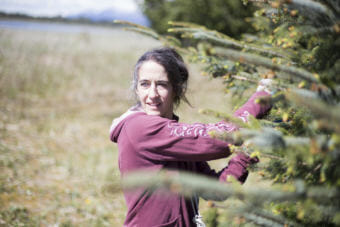
Cassie Parker collects spruce tips along the Gustavus beaches with her family on May 31, 2018. They pick as a group for bear safety. (Photo by Annie Bartholomew/KTOO)
Each spring in southeast Alaska the Sitka spruce tip harvest happens suddenly and only lasts about a week. With the flavor’s growing popularity and short harvest season, Alaska businesses have come to rely on a small town commercial operation to meet the growing demand.
On a blustery May afternoon, Molly Kelly and her family spread out along the Gustavus treeline near its sandy beaches. They’re picking spruce tips, the bright green nubs that grow on the branches of the coniferous Sitka spruce. The harvest has become an annual tradition in Gustavus that locals refer to as “spruce tipping.”
Molly Kelly collects a handful of spruce tips in Gustavus on May 31. This year pickers were paid $3 per pound of spruce tips. (Photo by Annie Bartholomew/KTOO)
With a bucket hung around her neck, Kelly grips the branch with a gloved hand and slowly drags down the limb, pulling away a handful of spruce tips. Kelly and her sister Cassie Parker say it can take anywhere from 5 to 20 minutes to collect a pound, depending on energy level and kid interruptions.
“I have not picked many at all, maybe 50 pounds,” said Kelly.
Parker says she’s only got maybe 75 pounds, nothing compared to their nephew Caleb who is nowhere in sight. He’s already already amassed a thousand pounds picking spruce tips both day and night.
Codi Kelly shows her bucket of spruce tips collected for Pep’s Packing on May 31, 2018. (Photo by Annie Bartholomew/KTOO)
The Gustavus “spruce tipping” season all started back in 2000, when the Alaskan Brewing Company approached the family owned fish processing plant Pep’s Packing to provide the spruce tips.
The Juneau brewery’s inaugural order of 500 pounds eventually became their seasonal Winter Ale, an English Old Ale style honoring the history of Captain James Cook who brewed spruce beer on his voyages to prevent scurvy.
At Pep’s Packing, families unload garbage bags full of spruce tips into special vacuum sealing bags that owner Pep Scott weighs and records.
“One of the families that has been picking from us from the very beginning now has three generations that’s been picking and now they have this rivalry where grandpa tries to pick more than his son,” said Pep.
She says around 50 people partake in the annual harvest, from small children to their oldest picker at 75 years old who used his past earnings to go to Mexico to have dental work.
“Another kid bought a lawn mower a couple years ago with his spruce tip money and then he mowed lawns the rest of the summer,” said John Scott.
With the season beginning right after the school year gets out, the Scotts believe it brings an economic boost to the town.
Because of a cold spring, this year’s spruce tipping season ran extra long, allowing that nephew, Caleb Warren, to collect more than 3,000 pounds in two weeks at this year’s price of $3 a pound. He was this season’s top picker.
After weighing, the spruce tips are packed in 50-pound fish boxes stored in the freezer. When they have enough to fill orders, Pep’s Packing charters a Cessna aircraft to move the product to destinations around Southeast.
Owners Pep and John Scott weigh spruce tips at Pep’s packing in Gustavus on May 31, 2018. The family owned fish processing plant provides spruce tips to buyers across southeast Alaska and the Lower 48. (Photo by Annie Bartholomew/KTOO)
Pep’s largest customer is still the Alaskan Brewing Company, but the spruce tips go to smaller outfits like Coppa ice cream in Juneau, and as far as Rogue Ales in Oregon.
Amalga Distillery co-owner Maura Selenak uses spruce tips in syrups, spruce tip soda and Juneauper gin on July 13, 2018. She says the business has been using spruce tips from Pep’s Packing since it opened a little over a year ago. (Photo by Annie Bartholomew/KTOO)
In Juneau, Amalga Distillery owner Maura Selenak says they’ve relied on Pep’s packing to provide the spruce tips for their syrups, spruce tip soda, and small-batch Juneauper gin that’s distributed across the state. She says the spruce tip taste is indescribable until you’ve tried it.
“People come in from out of town and they’re expecting a piney flavor, and it’s actually more of a bubble gum sweetness,” said Selenak. “A lot of times people will come in and say this gin tastes like Southeast Alaska or it tastes like the rainforest.”
The distillery could buy ingredients from growers in the Lower 48, but for them it’s a source of pride knowing their product was hand-foraged by Alaskans, creating economic opportunity in rural communities, and not to mention, a taste of Southeast in every glass.
Close
Update notification options
Subscribe to notifications
Subscribe
Get notifications about news related to the topics you care about. You can unsubscribe anytime.