Associated Press

Alaska appeals decision that would open Democratic primaries

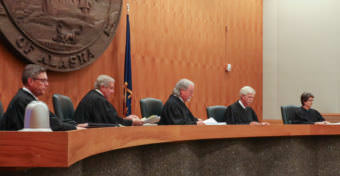
The state of Alaska is appealing a decision that would open Democratic party primaries to independents.

An appeal notice was filed Friday with the Alaska Supreme Court.

Attorney General Jahna Lindemuth disagreed with a superior court decision that found the state is restricting the party’s attempt to appeal to independent voters by not allowing unaffiliated candidates to participate in party primaries.

Lindemuth says the case presents constitutional questions the high court should decide.

The Alaska Democratic party challenged a state law requiring primary election candidates to be registered members of the party whose nomination they’re seeking.

Democrats wanted the law to be considered unconstitutional to the extent it restricts candidate participation to registered members, when party rules allow for non-member candidates. The state party adopted such a rule last year.

Tribal leaders call land-use bill step in right direction

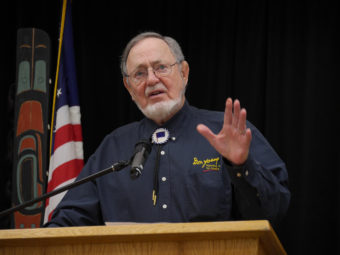
WASHINGTON — Tribal leaders backed a House bill Wednesday that would give tribes the ability to control more of their land, instead of having to get federal approval for virtually any use.

The American Indian Empowerment Act would let tribes shift federally controlled trust land to “restricted fee land,” a move that could save millions of dollars that tribes now spend on “burdensome regulation,” while restoring a level of tribal sovereignty.

While they called the bill a step in the right direction, however, witnesses said they are concerned about ambiguities in the thin, three-page bill that “could allow state or local governments to implement property taxes on tribal land,” among other issues.

Navajo Nation Vice President Jonathan Nez said that clarifying those issues is necessary for tribes who, “given our history with the federal government . are rightly concerned about any further loss of our lands.”

But with slight changes, witnesses said at a hearing of House Natural Resources subcommittee, the bill would greatly benefit Indian Country.

Currently, Nez said, even small tasks are laborious and expensive for tribes. He pointed to road repairs that the state can do “in days” in most of Arizona.

“But when it comes to dealing with road infrastructure on our nation, we have to wait for (the Bureau of Indian Affairs) on the regulations, we would have to go through environmental reviews, right-of-way applications,” Nez told the committee . “And it takes years sir, and a lot of resources.”

He said bureaucracy was in part to blame for problems with electricity and water, which he said “are not helped by the current requirement that we gain additional approvals from the Department of Interior for rights-of-way permits across our own lands.”

Those delays come with a cost: Nez said that of “the dollars that go to Indian Country to improve the roads, millions of dollars are utilized to go just to those clearances, and right-of-ways alone.”

Lummi Nation Council Member Henry Cagey said the current system “interferes with the sovereign authority of the tribal government to determine what is appropriate use of our own land.” By shifting trust land to restricted fee lands, which are “not considered owned by the United States,” tribal leaders have exclusive management rights for the land.

Cagey said the bill “streamlines land-use regulation and makes it easier to develop such things as housing or businesses.”

Eric Henson, an executive vice president for economic consulting company Compass Lexecon, said the bill is a “very positive move forward” but that there are “a few clarifying things” that need to be addressed to avoid unforeseen consequences.

One concern raised by Henson is the lack of specific language about taxation in the bill, which could open the door to other governments taxing the restricted fee lands. Henson, who works with the Harvard Project on American Indian Economic Development, said it’s “diminishing” to the sovereignty of tribal governments to dictate how they can tax their lands.

“We should treat Indian nations as nations,” Henson said . “You wouldn’t call France, and say, ‘Hey, don’t tax your citizens because we are going to do it instead. Why don’t you guys start exporting more baguettes?’ That would be crazy.”

Nez said the bill should also include language to let tribes “elect to revert land back to trust land from restricted federal land if they deem it in their best interest.”

Henson said tribes could decide to put land back into trust for any number of reasons, including unexpected taxes leveraged by state and local governments and other “unforeseen consequences.”

This is the fourth time Rep. Don Young, R-Alaska, has introduced the bill. No previous version has ever gotten out of committee.

But Cagey and other panelists said it’s time for the bill, that tribes are able to regulate themselves.

“What we’re asking the committee to do is what’s best for us,” Cagey said. “Not what’s best for the businesses, or the state or the county or the United States, but what’s best for the Indian people.”

FBI arrests ex-manager of Juneau’s historic Bergmann Hotel

JUNEAU — The FBI has confirmed that it arrested the former manager of Juneau’s historic and condemned Bergmann Hotel, who in March was fined for failing to abide by the city’s evacuation order.
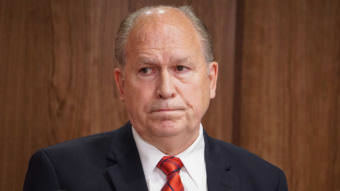
The Juneau Empire reports that Charles E. Cotten Jr. is accused of distributing methamphetamine four times this year between May 12 and June 7. The FBI on Friday served a search warrant for Cotten at the Baranof Hotel and arrested him.

He was indicted by a federal grand jury last week.

An attorney had not been named for Cotten as of Friday.

Cotten was hired to manage the Bergmann Hotel in August 2016. He was tasked with turning the image of the hotel around, as it has been tagged as a place for illegal activity.

Walker hopes to win over skeptical lawmakers on tax proposal

Alaska Gov. Bill Walker listens as Department of Revenue Commissioner Randall Hoffbeck discusses a compromise budget proposal with reporters in the cabinet room of the Capitol in Juneau on June 6, 2017. (Photo by Jeremy Hsieh/KTOO)

Gov. Bill Walker says he wouldn’t go through the hassle of calling another special session this year if he didn’t expect Alaska legislators to pass the bills on his agenda.

But Walker faces an uphill battle in selling skeptical senators on his new tax bill. The proposal is meant to help address a multibillion-dollar budget deficit that has persisted amid low oil prices.

After the House passed an income tax earlier this year, the Republican-led Senate rejected it. Members argued that the tax was ill-advised for a sluggish economy.

Senate President Pete Kelly, a Fairbanks Republican, says not much has changed.

Walker also wants lawmakers to consider revisions to a criminal justice overhaul when the special session starts Monday in Juneau.

Alaska gets reprieve as it works to implement REAL ID

JUNEAU — The state of Alaska says it has received a reprieve from national proof-of-identity standards as it works to comply with that law.

The Alaska Department of Administration says it has received a grace period from enforcement of the federal REAL ID Act until Jan. 22.

The department, in a release, says the state has sought an additional grace period until October 2020. That is when, it says, all Alaskans will need a REAL ID-compliant card or other acceptable form of federal identification for domestic air travel.

State legislation passed earlier this year lets Alaskans choose whether to get a compliant ID.

Alaska’s Division of Motor Vehicles plans to begin producing REAL ID-compliant driver’s licenses in January 2019.

Mayors urge Alaska Legislature to take action on deficit

JUNEAU — Mayors across Alaska are asking the Legislature to solve the state’s multibillion-dollar deficit during next month’s special session.

The Juneau Empire reports that the Alaska Municipal League and Alaska Conference of Mayors wrote the state Legislature on Wednesday asking for progress. This is the third year in a row that the mayors have pleaded to state officials about the deficit.

Fairbanks North Star Borough Mayor Karl Kassel said the mayors know that if the Legislature doesn’t act, costs will be passed to their cities and boroughs. They, in return, will have to pass those costs via property taxes and sales taxes to residents.

Kassel said  this has already happened in some areas, particularly school debt reimbursement.

Site notifications
Update notification options
Subscribe to notifications