Casey Kelly

Assembly to consider cell tower moratorium, dog attack appeal

Beware of dog sign. (Photo by unsure shot/Flickr Creative Commons)

A moratorium on new cell phone towers, a pair of emotional appeals and a measure to stave off the city’s “fecal cliff” are on tonight’s Juneau Assembly agenda.

Last month the assembly voted to halt permitting of new wireless towers until adopting a cell tower master plan to regulate where and how they are built. An ordinance on tonight’s agenda would make the moratorium official. It would expire on May 19, around the time the assembly is expected to vote on the master plan.

The assembly will also consider hearing two appeals:

  • And Jody and Joyce Vick say they’re trying to save their pitbull-mastiff mix’s life after he fatally injured another dog last Thanksgiving. Juneau Animal Control labeled their dog Sushi a “dangerous animal.” After a failed appeal to the city’s Animal Hearing Board, the Vicks appealed to the assembly. The Vicks claim the designation will force them to put Sushi down. Animal Control says they could save Sushi with a homeowner’s liability insurance policy.
  • Juneau homebuilder Bicknell Inc. filed an appeal of the planning commission’s rejection of a rezoning request for its 82-acre lot near the airport. Current zoning limits development of the so-called “field of fireweed.” Bicknell wants most of it designated for commercial or industrial use.

The assembly also will vote on a contract with Waste Management to continue shipping the city’s sewage sludge to the Lower 48. The company was the only bidder for the service. The contract is for $1.1 million a year, and has no sunset date.

Juneau Public Works Director Kirk Duncan (a member of the KTOO Board of Directors) last month said the deal is an interim solution, until the city develops a long-term plan for disposing of its partially processed sewage, sometimes called biosolids.

“And it’s important to realize that we always need a Plan B,” Duncan said. “And so we will have the option of hauling biosolids south no matter what happens in the future.”

The assembly meeting starts at 7 p.m. You can listen live on KTOO-FM.
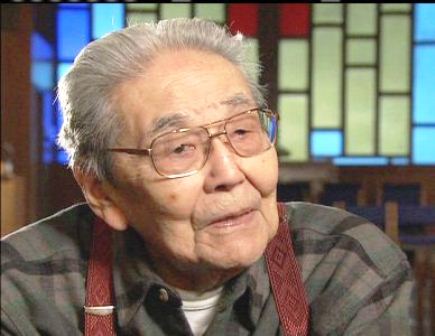
Walter Soboleff: “He fed the spirit of people from many walks of life”

Walter Soboleff
The Rev. Dr. Walter Soboleff. (File photo)

A bill to establish a Walter Soboleff Day in Alaska cleared a state House committee on Thursday, after lawmakers on the panel heard heartfelt testimony from the late Tlingit elder’s friends and family.

Alaska Native Brotherhood Grand President Bill Martin recalled listening to Soboleff’s church services on the radio as a child growing up in Kake.

“His delivery was low key and his message was simple: Love your neighbor, for love is God,” Martin said.

Soboleff was the first Alaska Native minister in Juneau, at a time when the town was segregated. He became a cultural and spiritual leader in the community and statewide, impressing both Natives and non-Natives with his teachings.

Selina Everson with the Alaska Native Sisterhood said Soboleff meant everything to the Native community in Southeast Alaska.

“He performed marriages of our people. He gave comfort when there was sorrow. He stood by us. How else can we honor him?” Everson asked.

All four of Soboleff’s children testified before the House State Affairs Committee. Son Ross said his father always told him to feed his spirit.

“I think he fed the spirit of people from many walks of life,” Soboleff said. “In his church and in his service, and sometimes as chaplain at this legislature.”

House Bill 217 would establish Nov. 14 as Walter Soboleff Day in Alaska. That was the day he was born in 1908.  Soboleff died in 2011 at the age of 102.

“He truly was a towering figure in the Native community, statewide through the Alaska Federation of Natives, through the early Native civil rights movement,” said Rep. Jonathan Kreiss-Tomkins, D-Sitka, prime sponsor of the legislation.

Kreiss-Tomkins envisions Soboleff Day as similar to Elizabeth Peratrovich Day, just celebrated on February 16th. It marks the day territorial Gov. Ernest Gruening signed the 1945 Alaska Anti-Discrimination Act, which Peratrovich championed.

“That’s noted in a lot of schools – the history of anti-discrimination legislation in the state or territory of Alaska,” Kreiss-Tomkins said. “It’s really how groups, schools, institutions, choose to honor or observe the person and what the person represented.”

There’s recent precedent for the legislation. Last year, lawmakers created Jay Hammond Day to honor Alaska’s self-proclaimed “Bush Rat Governor.” In 2011, the legislature established Ted Stevens Day, honoring the state’s longtime U.S. Senator.

HB 217 has several co-sponsors, including every House member from Southeast Alaska. After the hearing, State Affairs Committee Chair Rep. Bob Lynn, R-Anchorage, and Vice Chair Rep. Wes Keller, R-Wasilla, said they would sign on, too.

Municipal league supports pension infusion plan

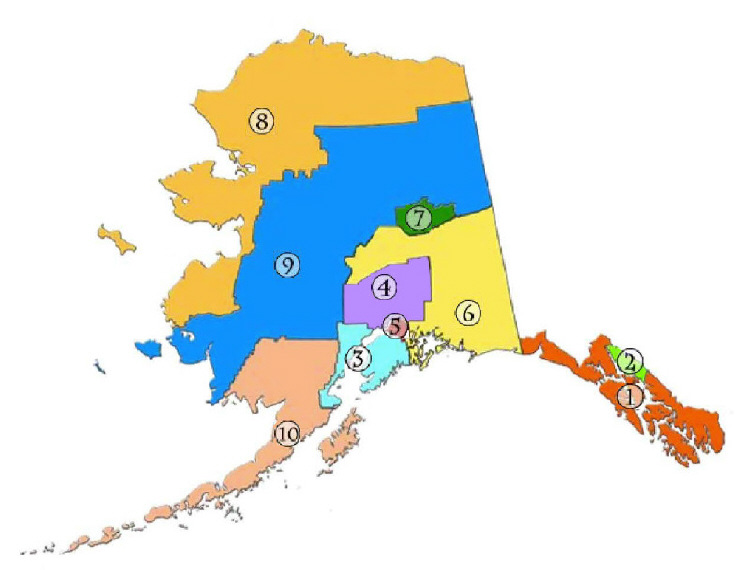
Alaska Municipal League District Map. (Image courtesy AML)

Alaska’s mayors and other local officials are worried their governments may be asked to pay more toward public employees’ retirement.

The Alaska Municipal League is backing Gov. Sean Parnell’s proposal to use $3 billion in savings to reduce an estimated $12 billion shortfall in state pension funds.  AML lobbies the state and federal governments on behalf of cities and boroughs.

Alaska communities and the state share the costs of the Public Employees’ Retirement System. Municipalities pay 22 percent of their payroll into PERS each year. Some also pay 12.5 percent into the Teachers’ Retirement System.

The state pays the rest of what’s needed to cover pensions in a particular year. That amount is determined by actuaries and set annually by the Alaska Retirement Management Board.

“Certainly it’s a good enough chunk that municipalities cannot afford for that to go up,” said Alaska Municipal League Executive Director Kathie Wasserman.

If nothing is done to address the PERS shortfall, Wasserman fears the local contribution could increase to 40 percent of payroll. She says the governor’s plan to transfer $3 billion from the Constitutional Budget Reserve to the retirement system would maintain the rate at 22 percent until the funds are solvent, whenever that might be.

“We really can’t define how many years, because it’s based on interest rates, it’s based on the market, it’s based on the baby boomers, when people die. There’s a lot of variability in that,” Wasserman said. “But, 22 percent, right now we can plan for.”

Kathie Wasserman. (Photo courtesy Alaska Municipal League)

Kodiak Mayor Pat Branson says local communities need predictability.

“If we keep it at those percentages, we’re now going to be able to do business and keep our infrastructure in place, keep police and fire operating, schools open,”  Branson said.

The Parnell administration estimates its proposal would reduce the state’s annual payment to PERS and TRS. Without the cash infusion, the governor’s office says the state would soon pay more than $1 billion a year toward the pension shortfall.

Deputy Administration Commissioner Mike Barnhill told municipal league members that doing nothing is not appealing.

“If the governor’s approach doesn’t pass, the status quo will persist,” Barnhill said. “We will continue to make actuarially required contributions, however they are calculated.”

The governor’s plan is part of his proposed operating budget.

Many states and communities in the Lower 48 have faced even bigger pension problems, leading to bankruptcies and cuts to retirement payments.

Supporters cheer Alaska Native languages bill

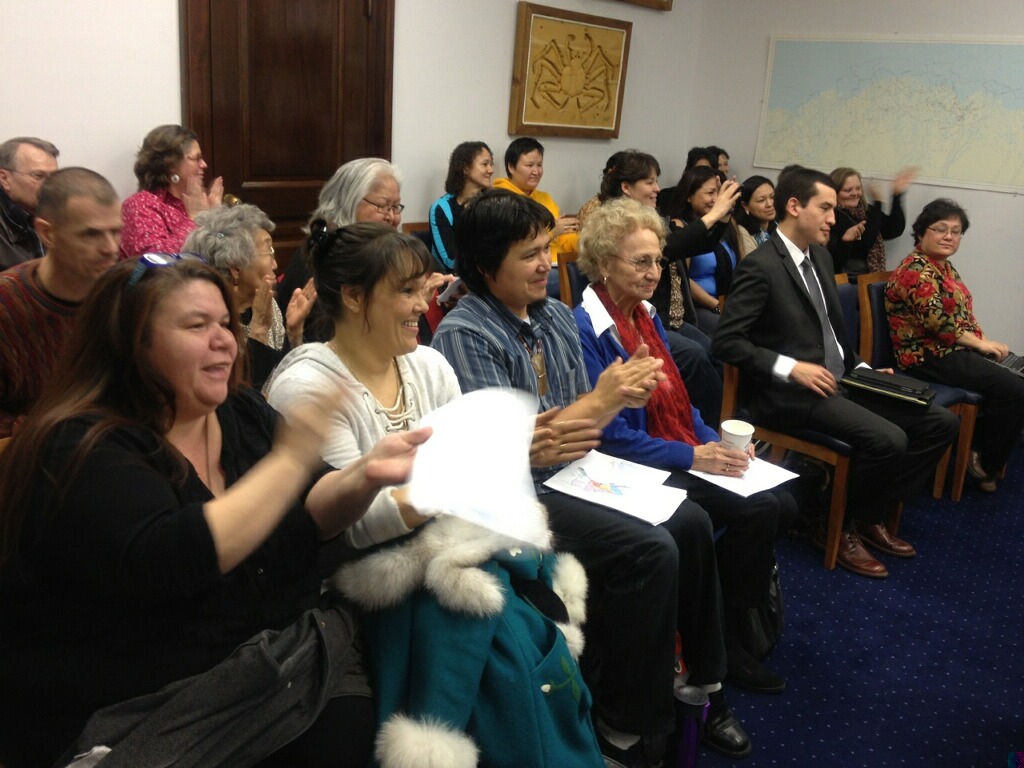
The Barnes Committee Room erupted in applause after an Alaska House committee advanced legislation that would make 20 Alaska Native languages official state languages. Photo by Kyle Schmitz/Gavel Alaska.
The audience of a House Community & Regional Affairs Committee erupted in applause after the committee advanced legislation that would make 20 Alaska Native languages official state languages. (Photo by Kyle Schmitz/Gavel Alaska)

The Barnes Committee Room at the Alaska Capitol erupted in cheers Tuesday morning, as a panel of lawmakers unanimously moved a bill that would make 20 Alaska Native languages official state languages.

Dozens of people testified in favor of the measure, House Bill 216.
University of Alaska Southeast Native Languages Professor Lance Twitchell greeted the House Community and Regional Affairs Committee in Tlingit.

While English is the only official language of Alaska, Twitchell said this is not an English-only state.

“For over 10,000 years there have been other languages here, and they are still here today,” Twitchell said.

He described a crisis point in the effort to save Native languages. The average Alaska Native tongue has fewer than 1,000 speakers, the vast majority of whom are over the age of 70. The last fluent speakers of Eyak and Holikachuk Athabascan died within past decade.

Twitchell said language loss is tied to a history of repression and discrimination against Alaska Natives.

“I see dying languages and escalating suicide rates, and think, how can those things not be connected? I see the end result of cultural genocide, and think, how can we just decide to accept this?” he said. “There is no magic solution for language loss. But there is the promise of unity and recognizing that solutions exist.”

He said House Bill 216 is one of those solutions.

“I sit here as your peer. I sit here as your equal. We may speak different languages, but mine is just as valuable, just as necessary, and just as useful as yours,” said Twitchell.

Bethel elder Esther Green taught Yup’ik in the Lower Kuskokwim School District before she retired. Green said learning a language is a form of cultural preservation.

“Language and culture go together and they cannot be separated,” she testified.

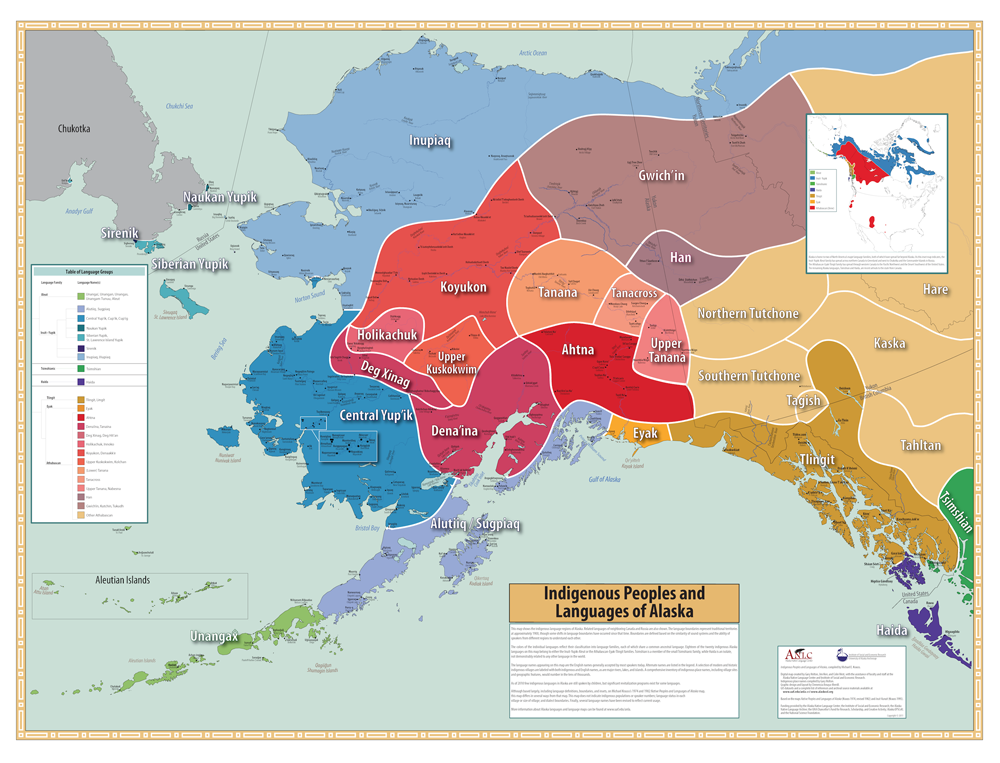
Alaska Native Languages map
Map: Native People’s and Languages of Alaska by Michael Krauss. Map courtesy of the Alaska Native Language Center. Click to enlarge.

Savoonga High School students Beverly Toolie and Chelsea Miklahook introduced themselves in Siberian Yup’ik. The language is no longer taught in their school, but the girls said they learned to speak it from their grandparents.

Nome Democrat Neal Foster asked if they would be interested in taking Native language classes.

“If the classes were to be reintroduced into the school, are those classes that you would want to take?” Foster asked.

“Yes,” the girls responded in unison.

Barrow Democrat Ben Nageak is the only member of the legislature who’s a fluent speaker of a Native language, Inupiaq. Fittingly, he made the motion to send HB 216 to the next committee.

Prime sponsor and Sitka Democrat Jonathan Kreiss-Tomkins said he was moved by the support for the bill.

“This is a bill that very much felt as though it’s of the people, belongs to the people who testified today, and belongs to people across Alaska who believe in the cultural importance of Native languages,” Kreiss-Tomkins said.

Nobody testified against the legislation. Its next stop is the House State Affairs Committee.

Watch Gavel Alaska‘s coverage of the hearing:

Save our Schools rallying cry heard on Capitol steps

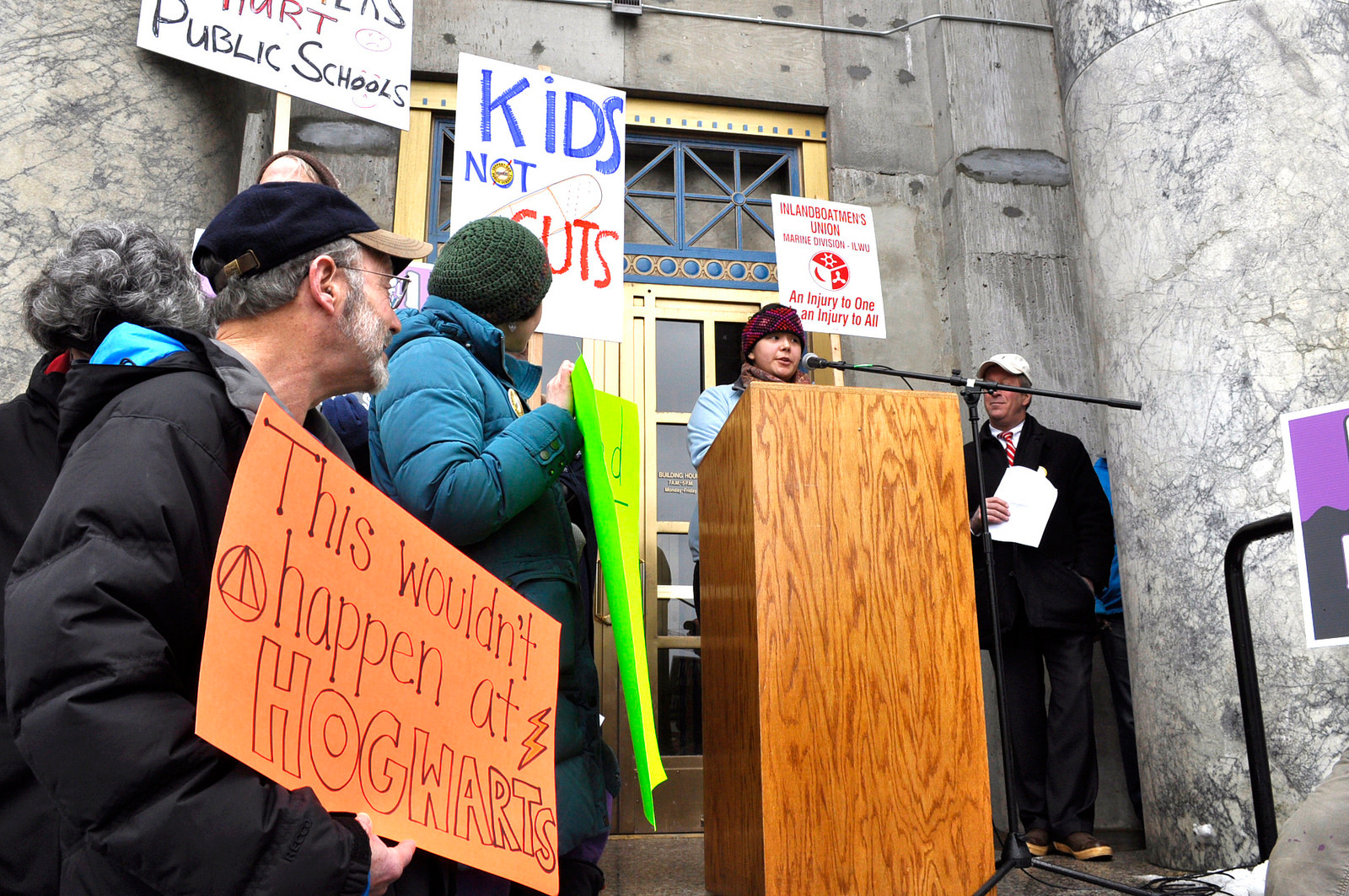
Holding signs saying “Kids! Not Cuts” and “Vouchers Hurt Public Schools,” about 200 people packed the Alaska Capitol steps for a “Save our Schools” rally Monday afternoon.

The crowd included parents, students, teachers and community members, as well as a handful of state lawmakers.

Juneau Douglas High School Senior Tori Talley talked about growing up in a low income, single parent home, before being adopted in the sixth grade. Through it all, she said, school was one of the few places she felt safe. She said teachers bought her school supplies, and school meal programs and counseling services kept her on track to graduate later this year.

“All the teachers knew exactly what my situation was,” Talley said. “And they always would stop me in the middle of class and they’d sit with me and talk to me if I needed it. And they were still there for me. So I’ve always had an extremely supportive, caring and motivational support group.”

Talley drew loud cheers when she said she plans to go to college to study psychology.

Other speakers argued for an increase in state spending on education, and against a proposed amendment to Alaska’s constitution that would allow public funds to be spent on private and religious schools.

Read the text and committee history of two pieces of legislation that would put to a public vote a proposed constitutional amendment to allow public funds for private and religious schools:
SJR 9, HJR 1
The amendment needs two-thirds support from the Alaska Legislature before it can appear on the ballot. Governor Sean Parnell and Republican lawmakers are pushing legislation that would put the issue to voters.

With two months left in the legislative session, Anchorage Senator Berta Gardner, a Democrat, said opponents feel confident the amendment won’t make it through.

“We believe that they don’t have the votes to move that forward,” said Gardner to loud cheers. But, she continued: “They haven’t started knocking heads together, twisting arms, making threats, all kinds of things, and we have to keep the pressure up. We’re ahead of the game. The public is absolutely with us. And we will not back down.”

Amendment supporters say it’s needed to provide parents and students more school choice.

Anchorage Democratic Rep. Harriet Drummond and the Great Alaska Schools coalition organized the rally.

Due to a lengthy floor session, many House members missed the event. Nearly all of the state senators in attendance were Democrats. The only Republican there was Soldotna Senator Peter Micciche, who’s considered a key vote on the proposed constitutional amendment.

Watch the coverage of the rally from Gavel Alaska:

PERS, education funding top Alaska Municipal League agenda

Local elected officials from across the state will be in Juneau this week for the Alaska Municipal League’s annual legislative conference.

The Alaska Conference of Mayors kicks off the meetings on Tuesday, with a discussion of energy issues taking up the bulk of the afternoon.

The municipal league meets all day Wednesday. Members will hear from U.S. Senator Lisa Murkowski, who gives her annual address to the Alaska Legislature later in the day. Governor Sean Parnell has also been invited to speak.

Then there’s a panel on the Public Employees Retirement System.

Wednesday afternoon, Anchorage Chamber of Commerce President Andrew Halcro will present the findings of a sustainable education task force. Halcro is a former state lawmaker, who’s been advocating for better planning when it comes to how the state funds public education.

Alaska Senate President Charlie Huggins and House Speaker Mike Chenault are expected to address the group Wednesday afternoon as well.

AML members typically take part of the conference to lobby state lawmakers as well.

Juneau Assemblywoman Karen Crane is currently president of the municipal league.

Site notifications
Update notification options
Subscribe to notifications