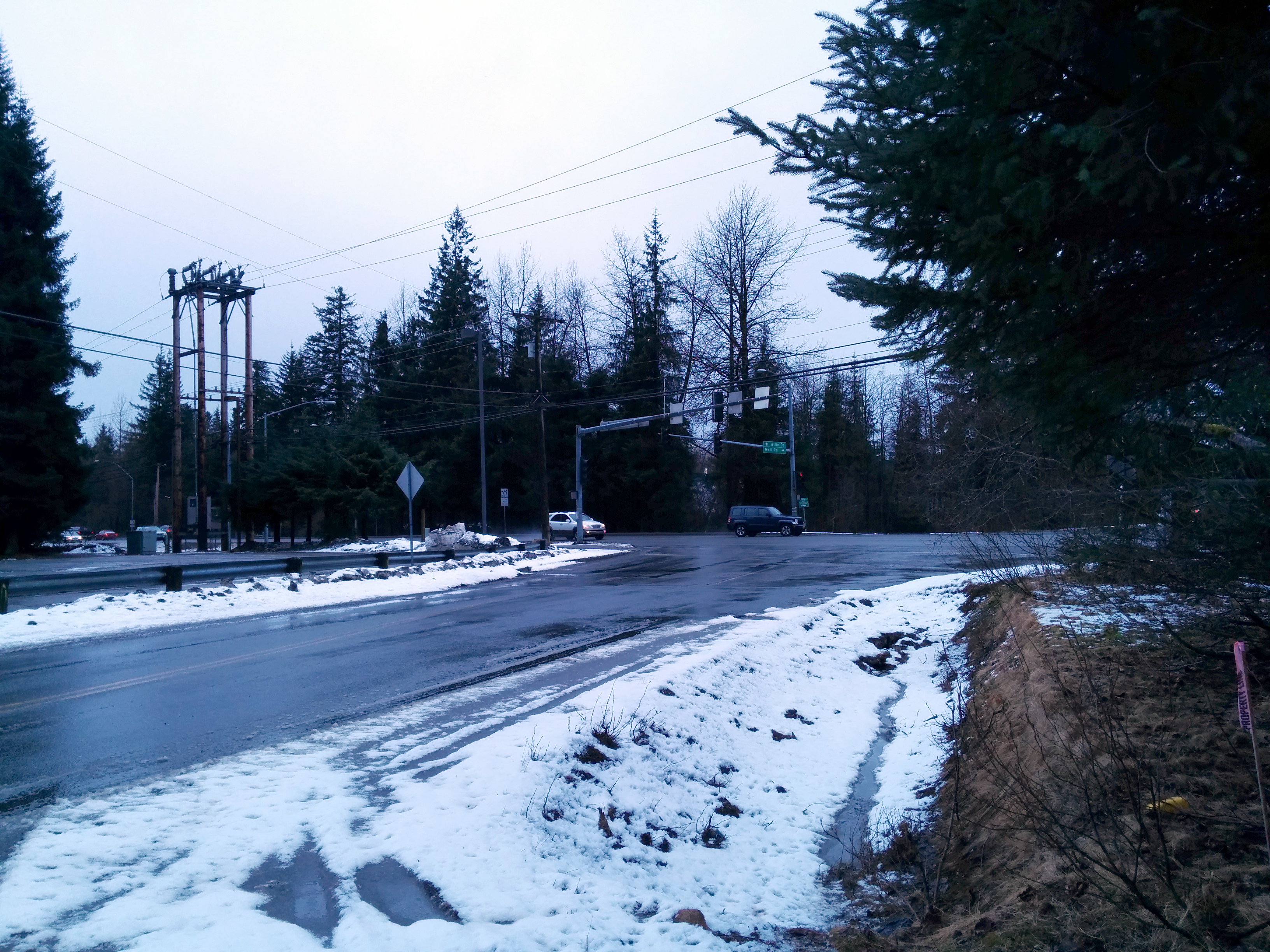
The view of the Mendenhall Loop and Atlin Drive intersection from the property’s driveway. (Photo by Heather Bryant/KTOO)
After nearly three years, the Juneau Assembly has granted a local developer’s wish to use his lot in a mostly residential Mendenhall Valley neighborhood for commercial purposes.
In a split 5-4 decision, assembly members last night approved Richard Harris’ request to have his 2-acre parcel on Atlin Drive rezoned from residential to light commercial. The change contradicts the recommendations of the Juneau Planning Commission, which had voted three separate times since 2011 to deny Harris’ rezone requests. It also goes against the desires of several nearby homeowners, who say commercial activity does not belong in their neighborhood.
But Assemblyman Jerry Nankervis, who served as presiding officer for Harris’ latest appeal, says allowing commercial activity on the property makes sense, because it’s near the busy intersection with Mendenhall Loop Road.
“We were looking at the maps and looking at what we thought was appropriate to do, and this group – the majority of this group – thought that that was appropriate to do that,” Nankervis said.
He says assembly members who voted for the zone change also felt it would allow for higher density housing to be developed.
The four members who voted against the change were Jesse Kiehl, Karen Crane, Loren Jones, and Kate Troll. They wrote a dissenting opinion to the decision issued by their colleagues.
Kiehl says the housing argument cited in the majority opinion doesn’t hold water, because Harris has said he would build fewer units under commercial zoning than under residential. Besides that, Kiehl says the decision completely discounts the work of the planning commission.
“Medium density residential has different uses than light commercial,” said Kiehl. “And the planning commission analyzed that thoroughly. They looked to the laws the assembly has passed and the plans the assembly has adopted. They made a very strong decision. It was not close.”
Harris has not said what he plans to build on the property other than that it would be good for some sort of mixed-use housing and commercial development. Under light commercial zoning he’ll be allowed to build anything from retail shops to a bar to used car lots.
Opponents of the rezone have 30 days to appeal the assembly’s decision in Juneau Superior Court.
The Juneau Assembly on Monday will consider a draft decision allowing this 2-acre parcel in a residential neighborhood on Atlin Drive to be developed for commercial uses. (Photo by Rosemarie Alexander/KTOO)
The Juneau Assembly is poised to grant a local developer more flexibility with his Mendenhall Valley property, over the Juneau Planning Commission’s recommendations and neighborhood residents’ concerns.
If the assembly approves the draft decision on Monday, Richard Harris could use his lot at the corner of Atlin Drive and Mendenhall Loop Road for commercial purposes. Harris purchased the 2-acre parcel from the U.S. Forest Service in 2010. He first applied for it to be zoned light commercial a year later.
“We’re pleased with the decision and we can now look at beginning to plan with more certainty what we may be able to do with the parcel,” said Harris, who’s developed several valley properties through his company, RH Development.
Nearby homeowners say the property should continue to be zoned for residential use, which is the case for most of the surrounding neighborhood. The Juneau Community Development Department and planning commission have agreed, denying three requests by Harris to have the lot rezoned.
Tim Banaszak lives in the neighborhood and is a vocal opponent of Harris’ rezone request.
“Essentially they’re negating all the recommendations of the neighborhood, the planning commission, and all the parties concerned,” Banaszak said of the draft decision before the assembly. “Really the only one in favor is the actual property owner.”
The draft decision says the planning commission failed to consider the “highest and best use” of Harris’ lot. It says the commission did not place any weight on the need for affordable housing in Juneau. Commercial zoning allows higher density housing than residential zoning.
Banaszak says the neighbors are not opposed to additional housing. The problem is that Harris has not revealed what he plans to build on the property. Commercial zoning could mean everything from housing to offices to restaurants, retail stores, even car lots.
“Once the property is converted to light commercial, it opens it up to all kinds of purposes in our residential neighborhood,” Banaszak said.
While Harris won’t reveal specific plans, he says the property is perfect for mixed-use development, which he argues is more compatible with commercial zoning.
“Flat land in Juneau, buildable land is hard to find. And it should be taken advantage of and maximized, not limited and obstructed,” Harris said. “It’s foolish to put a few small homes on a nice flat larger parcel, and especially not alongside a main thoroughfare. It’s common sense to put commercial in a visible area.”
Assembly members reached on Friday declined to comment, because their deliberations on the decision were held in executive session.
City Attorney Amy Mead wrote the draft decision. She expects assembly members to discuss the decision before voting.
The Atlin rezone request is one of several emotionally charged land use appeals to come before the assembly in recent years. If the assembly approves the draft decision, opponents of the new zone would have 30 days to appeal in Juneau Superior Court.
The Juneau Assembly meets at 7 p.m. You can listen live on KTOO-FM.
"Space Trucker Bruce" movie poster. (Photo courtesy Anton Doiron)
Karl Sears plays Space Trucker Bruce. (Photo courtesy Anton Doiron)
Writer/director Anton Doiron plays Max. (Photo courtesy Anton Doiron)
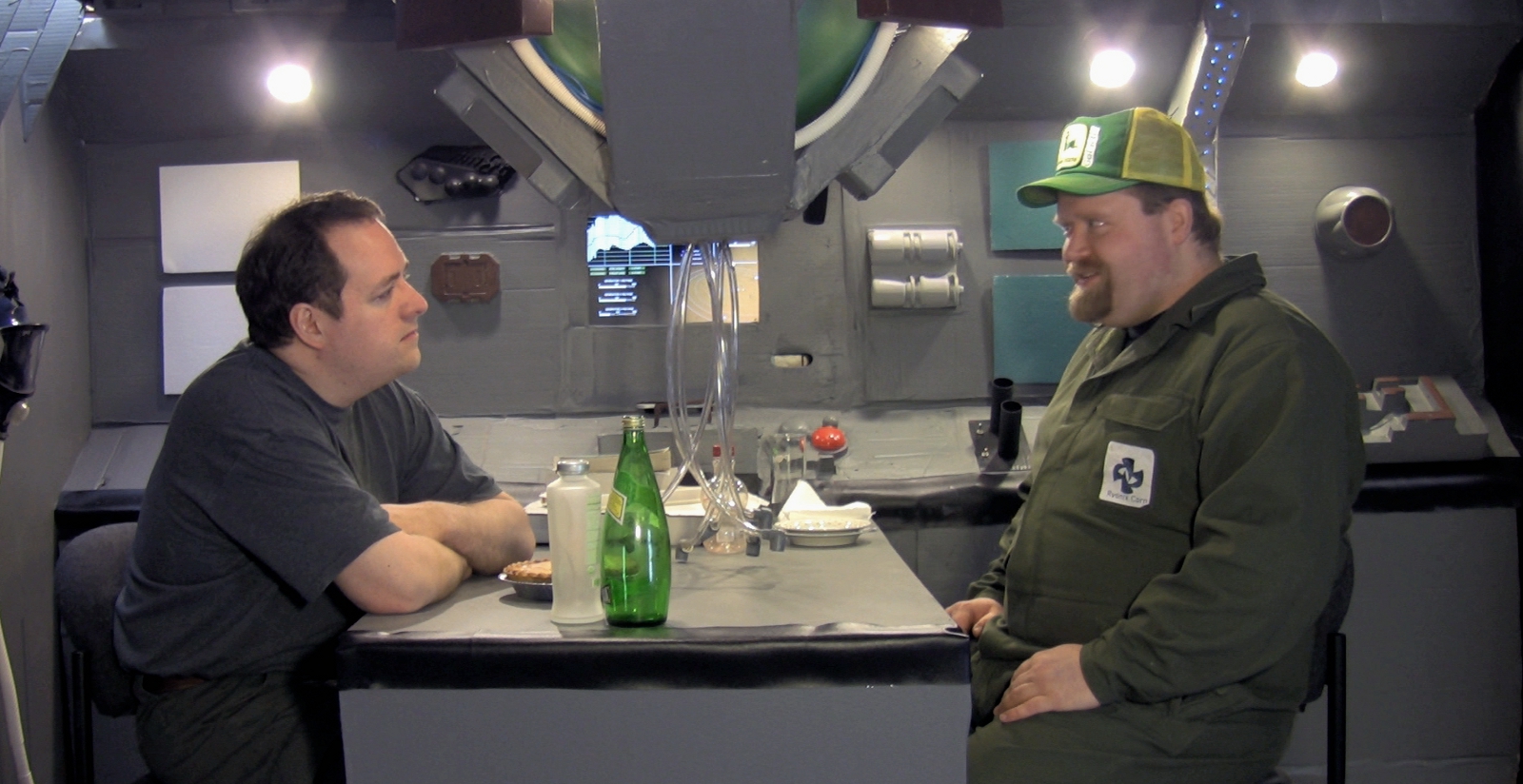
Bruce helps Max learn to relax. (Photo courtesy Anton Doiron)
The Nessus space shuttle. Writer/director Anton Doiron created the 3D special effects for "Space Trucker Bruce" using a free software program called Blender. (Photo courtesy Anton Doiron)
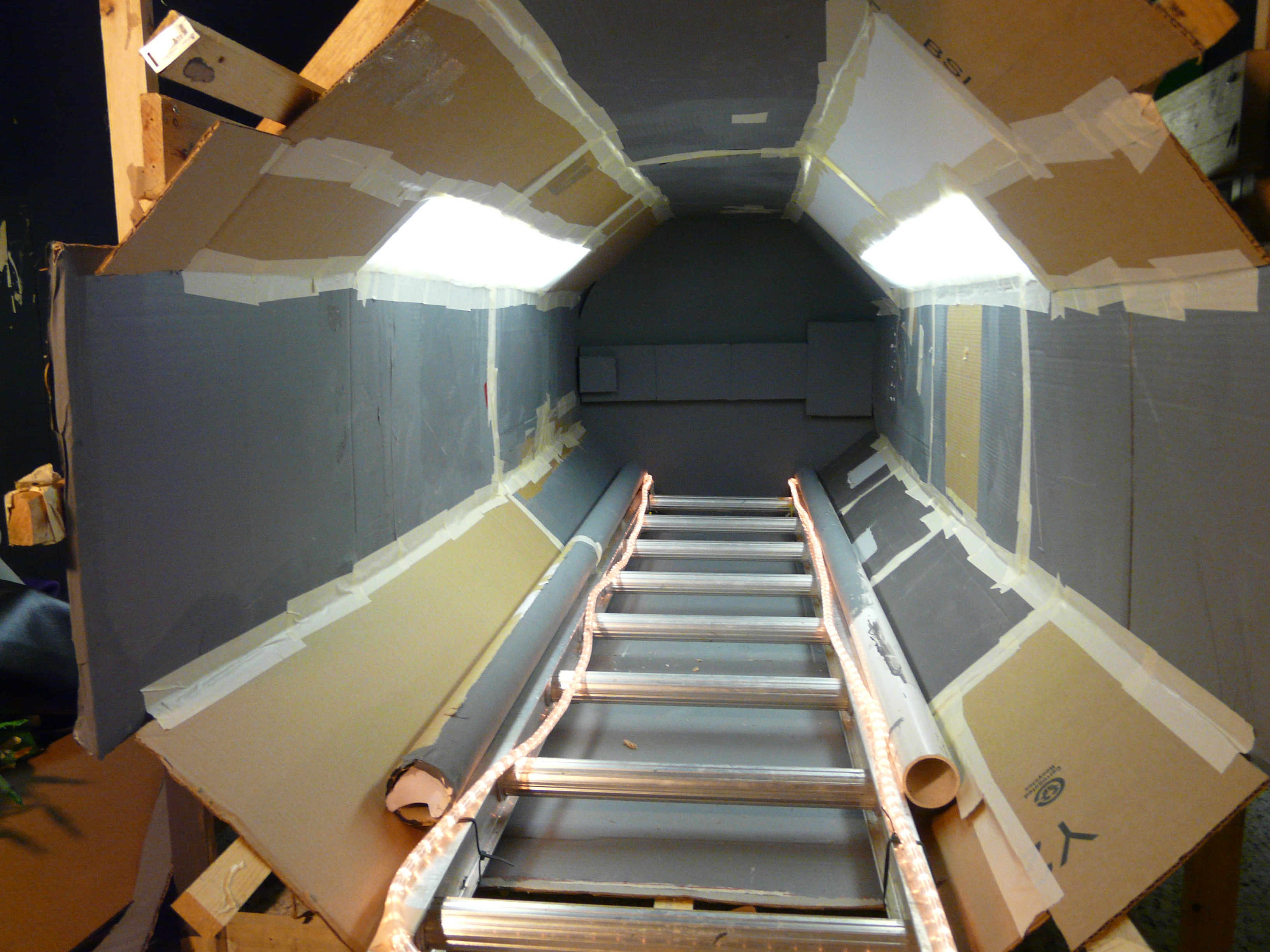
"Space Trucker Bruce" writer/director Anton Doiron built all the sets for the movie at his house. He used a variety of found materials, including scrap wood and cardboard. (Photo courtesy Anton Doiron)
In the not too distant future, a breakthrough in gravity control makes space travel incredibly cheap and wildly popular. The most valuable substance in the universe is hog fat, which is important to the operation of space stations that have sprouted up across the galaxy.
Made in Juneau over six years, the movie premieres Friday at the Gold Town Nickelodeon.
Karl Sears plays the lovably schlubby title character, who works the hog fat supply lines between Earth and Titan Station, orbiting Saturn’s largest moon. Bruce is mostly happy with his job, but gets lonely between hog fat deliveries. He uses Zen meditation to keep himself from going crazy on his ship, the Nessus.
On his way to Titan, Bruce picks up Max, whose shuttle breaks down in the middle of outer space. Bruce helps Max learn to relax. The story takes a sudden turn when Bruce and Max receive a strange transmission, leading to a collision course with a large unidentified object.
The movie also features a talking container of sour cream that craves murder and cocoa beans. There’s a mysterious woman named Jane Doe, found by Bruce floating through space, and Bruce’s love interest, a waitress named Katie who works at the Titan Café.
Anton Doiron plays Max. He also wrote and directed “Space Trucker Bruce.”
“I like science fiction that has a little bit of comedy in it. And in this case, with my budget being what it was and with the set quality and everything, it had to be a comedy,” says Doiron, 41, who grew up in Ketchikan and now works as a computer programmer for the State of Alaska.
“Space Trucker Bruce” started as a short film for the Juneau Underground Motion Picture Society. But Doiron says he wanted to make something longer than the 10-minute JUMP festival films.
“I wrote the original script for it in 2007, and I continuously revised it,” he says. “And when we would go to film a scene, I would look at the dialog and I would make sure that it made sense when spoken aloud. And we’d make little changes to it, and then that’s what we would end up filming.”
Doiron built all the sets for the film at his Mendenhall Valley home. He made Bruce’s sleeping quarters in his son’s bedroom.
“There are eight sets in the movie, the largest one being the 35-foot hallway, which I built in my backyard,” he says.
He gave himself a budget of $30 a week and figures he spent about $10,000 on the project. That includes a high definition video camera, a computer for editing, and promotional materials. He created the 3D special effects using a free software program called Blender.
The actors were friends and co-workers, who worked for free. Amelia Jenkins, who plays Jane Doe, did not have any previous acting experience, but says her day job as a children’s librarian provides plenty of opportunity to ham it up.
“Not an actress, but definitely comfortable acting big and silly,” Jenkins says.
She hasn’t seen the final product, but Jenkins thinks it’s impressive that Doiron completed the film. She looks forward to seeing how he edited scenes shot over almost four years.
“Hair was changing lengths, beards come and go, waistbands expand and shrink,” she says.
Doiron screened a cut of “Space Trucker Bruce” for a group of about 30 people in December, and used their feedback to make some changes. He says making his first feature film was a learning experience.
“It took me six years, but at first I was a little bit flaky and wasn’t working continuously on it,” he says. “At the end I was working on the film every day.”
He’s already started working on his next movie, tentatively called “A Girl, a Yeti, and a Spaceship,” which he hopes to complete in about three years.
“Space Trucker Bruce” premieres Friday at 7 p.m. at the Gold Town Nickelodeon, with an encore showing at 9 p.m. and matinees Saturday and Sunday at 2 p.m. After this weekend, Doiron hopes to make the movie available on-demand at www.spacetruckerbruce.com.
[youtube https://www.youtube.com/watch?v=4zpOzoMiIBo]
“Space Trucker Bruce” theme song “Supply Lines and Deadlines” by Mike Maas
The Smithsonian Institution’s National Museum of the American Indian in Washington, D.C. will be the site of an American Indian Veterans Memorial. A resolution supporting the memorial cleared an Alaska Senate committee on Tuesday. (Photo by cayusa/Flickr Creative Commons)
The Alaska Legislature could join the chorus of voices calling for an American Indian Veterans Memorial on the National Mall in Washington, D.C. An Alaska Senate committee on Tuesday passed a resolution supporting the project.
Since Alaska became a U.S. territory and later a state, Alaska Natives have served their country as well. During World War II, the Alaska Territorial Guard included more than 6,000 volunteer soldiers from more than 100 communities.
“American Indians have established a long and distinguished legacy of military service,” said Kalyssa Maile, an intern in the office of Sen. Bill Wielechowski, D-Anchorage. “Senate Joint Resolution 19 affirms the Alaska Legislature’s support of Alaska Native and Native American veterans, and recognizes their great sacrifices for our country.”
Sen. Bill Wielechowski, D-Anchorage, sponsored Senate Joint Resolution 19, which supports construction of an American Indian Veterans Memorial in Washington, D.C. (Photo by Skip Gray/Gavel Alaska)
“There were several people that came up from Florida to attend AFN and push for this resolution,” Wielechowski said. “I attended the Vietnam Veterans of America national conference in Florida last year and they were there. I spoke with people there. They were urging us to do this as well.”
Congress approved the Native American Veterans’ Memorial Act in 1994, but the project didn’t go anywhere. Stephen Bowers, a member of the Seminole Tribe of Florida and a Vietnam veteran, started lobbying Native American groups to support the memorial in 2011. Bowers says it’s long overdue.
“It’ll mean that finally someone is recognizing the fact that the American Indians fought for this country and against the European invaders back since 1492,” he said.
While Bowers says many supporters want the memorial to be built near the Vietnam Veterans Memorial, President Obama late last year signed legislation to place it at the Smithsonian Institution’s National Museum of the American Indian, two miles away. Bowers says the location isn’t as important as getting a memorial concept approved, a process he says will take several years.
“When they built the National Mall, they didn’t make it easy for organizations or for anyone to put a statue or a memorial on the mall,” said Bowers.
He expects the National Museum of the American Indian to sponsor a contest and form a committee to shepherd the project through the design phase.
Senate Joint Resolution 19 now heads to a vote on the floor of the Alaska Senate.
Deputy Commissioner of Administration Mike Barnhill speaks to retired public employees in Juneau about recent changes to the AlaskaCare health plan. (Photo by Casey Kelly/KTOO)
Retired public employees can still comment on changes to the AlaskaCare health plan through April 30.
Thousands of members are experiencing problems with Aetna and Moda Health, the companies that took over managing the plan for the state on Jan. 1. Many retirees also believe proposed changes will result in reduced coverage.
Mike Barnhill, Deputy Commissioner of the Alaska Department of Administration, insists the changes will not diminish benefits. But last week he apologized for the transition to new plan administrators.
“Quite frankly, our communication was not enough,” Barnhill told about 75 retired public employees at a town hall meeting in Juneau on Friday.
The Department of Administration also held meetings with retirees last week in Anchorage and Fairbanks. If the purpose was to clear up some confusion and concern, the meetings did not appear to work.
“For me the biggest concern is I have to have four cleanings a year for my teeth, because I’ve had problems with receding gum lines. The previous insurance companies always covered it. Now they’re telling me they will only cover two,” said Gary Miller, Southeast Alaska representative to the executive board of the Retired Public Employees of Alaska.
State retirement system benefits are guaranteed by the Alaska Constitution. The state Supreme Court has interpreted that to mean benefits can be revised, but not reduced.
“They did not have an actuary look at that and see if the additions equal the deductions,” Miller said. “And my guess is that when they reduced it, they reduced it far more than the additions.”
During the Juneau meeting Barnhill admitted the state has not produced its own comparison of the current plan booklet and proposed revisions. Until the new version is adopted, Aetna and Moda Health are supposed to be operating under the 2003 update, which has been amended several times, most recently on Jan. 1.
“I absolutely do not think that anything that we did on Jan. 1 is a diminishment. I absolutely think that everything we did on Jan. 1 is an enhancement that will save the plan costs and will save the members costs,” Barnhill said.
The state has sent a variety of information to AlaskaCare members on recent changes to their health care plan. (Photo by Casey Kelly/KTOO)
He said there’s no timeline for adopting the revised booklet, which many retirees have complained is full of confusing legal jargon.
Miller says Aetna and Moda Health do not appear to be following either version of the plan.
“Aetna and Moda seem to have pretty much free reign now to do what they want,” he said.
One of the more controversial changes to the plan steers members to health care providers in the Aetna and Moda Health networks. Members who go to another doctor or dentist could pay more out of pocket for things that used to be covered. Several retirees at the Juneau meeting pointed out that the network list includes doctors who no longer practice in town and providers not typically needed by retirees, such as midwives. Still, Barnhill defended the network system as a way to reduce premiums.
“I’m not going to dispute that it could be better,” he said. “We want to work to make it better, because that is the answer for this plan and for this state.”
Barnhill said the state will hold additional public meetings on the plan changes in April. Before then, he promised the state would release its own side-by-side analysis of the current plan and the revised version, which is out for public comment.
More than 67,000 retirees and their dependents are covered by AlaskaCare. Another 6,600 active state workers and their 10,000 dependents are covered by the plan as well. Most active state workers are covered by other plans.
Watch Gavel Alaska‘s coverage of the Juneau meeting on AlaskaCare changes:
After changes were made in January to the AlaskaCare Health Plan for retirees, the state Division of Retirement and Benefits and plan administrators received nearly 50,000 emails and phone calls. (Photo by Casey Kelly/KTOO)
The State of Alaska is trying to clear up mass confusion over recent changes to its retiree health care plan.
State officials this week have been holding public meetings on the revisions. A meeting in Juneau is scheduled for Friday at 2 p.m. on the 10th floor of the State Office Building.
More than 84,000 people are covered by AlaskaCare plans. That includes more than 38,000 retirees and 6,600 active state workers, as well as their dependents. Most active state workers are covered by other plans.
“There’s always some transition issues, but this seems to be more confusion than we’ve ever had before in my experience,” says retired University of Alaska employee Sharon Hoffbeck, who chairs a Retired Public Employees of Alaska committee dedicated to looking at health insurance benefits.
The most significant issue was Aetna’s refusal to cover medications from compounding pharmacies, which mix prescribed drugs suited to the unique needs of a patient. At first coverage was denied due to quality control problems at some compounding facilities. For now the state is telling Aetna to keep paying for those medications. A delay in mailing out benefit eligibility cards has been resolved as well.
But other problems persist. Hoffbeck says many retirees feel the plan has been changed to diminish their coverage. For instance, members are now steered to health care providers in the Aetna and Moda Health networks. Those who go to another doctor or dentist end up paying more of their own money to receive care. Moda, which is responsible for the dental portion of the plan, is new to Alaska. Hoffbeck says it does not have many providers in the state.
“They’re explaining it by saying that they’re trying to encourage dentists to come into the network,” she says. “I’m not sure what they’re thinking other than they want the retirees to try and convince their dentists to join the network, which we don’t think is our responsibility quite honestly.”
“The readability level of a document like this, according to the expert that we hired to do this plan comparison, should be somewhere between the fifth and eighth grade reading level,” Hoffbeck says. “This plan is easily post doctorate. It is extremely legal, extremely complex, very confusing.”
Reasons for the plan changes
State regulations require the Division of Retirement and Benefits to put the AlaskaCare plan out to bid every three to five years. Aetna previously administered the plan from 1982-1997 and again from 1999-2006.
Deputy Commissioner of Administration Mike Barnhill oversees the Division of Retirement and Benefits. He argues the basic structure of the plan hasn’t changed.
“This is a plan that provides coverage for medically necessary health care,” Barnhill says. “And the cost structure of that coverage remains the same. Retirees pay a $150 per person deductible. They have an $800 per year out of pocket maximum. And generally speaking the co-insurance – that’s the amount that the plan reimburses for the care – is 80 percent of a recognized charge.”
Barnhill says the plan will continue to pay 80 percent co-insurance for doctors’ visits and other routine care, even at facilities that aren’t part of Aetna’s network.
But he argues that steering members to in-network providers will reduce the overall cost of the plan.
“In the last three years, the retiree dental, visual, audio premiums have gone up an average of 7 percent per year,” says Barnhill. “When you’ve got what amounts to unmanaged care, meaning members can and do go to the highest cost dentist, the costs go up, and our members pay that.”
He agrees the revisions to the plan booklet are hard to read and says the state is working to make it more understandable. He defends the process, saying the booklet had not been significantly rewritten in more than a decade.
A public comment period on the changes originally scheduled to end Feb. 28 has been extended to April 30. Barnhill says about a hundred people attended a public meeting in Anchorage earlier this week, while more than 120 turned out in Fairbanks.
Lawsuit on the horizon?
The Alaska Constitution says the accrued benefits of public employee retirement systems “shall not be diminished or impaired.” Twice in state history, retirees have challenged proposed changes to their health care plan. In both cases, the Alaska Supreme Court ruled the state can reduce retiree benefits in one area as long it offsets the reductions with improvements in other areas.
“Our benefits are constitutionally protected. They can’t be diminished,” Hoffbeck says. “That doesn’t mean that they can’t be juggled.”
She says Retired Public Employees of Alaska is still reviewing all the changes to the plan, but at this point a legal challenge is “very possible.”
“I truly believe that the state is working within the parameters they feel they should be able to work. We’re disagreeing with that opinion,” Hoffbeck says.
Barnhill is a former attorney with the Department of Law. While he’d like to avoid a lawsuit, he says sometimes they are beneficial.
“Litigation can be really helpful in a variety of ways to help clarify the issues and get guidance,” Barnhill says.
In the meantime, he says the public comment period is a good opportunity for the state and retirees to talk through some of the issues and hopefully avoid going to court.
Close
Update notification options
Subscribe to notifications
Subscribe
Get notifications about news related to the topics you care about. You can unsubscribe anytime.