Jeremy Hsieh

Local News Reporter, KTOO

I dig into questions about the forces and institutions that shape Juneau, big and small, delightful and outrageous. What stirs you up about how Juneau is built and how the city works?
Newscast – Wednesday, March 9, 2022

In this newscast:

  • The value of Alaska’s investments in Russia nosedive
  • State transportation officials hear from four interested buyers of an iconic state ferry
  • The latest COVID-19 numbers
  • Haines shuts down its emergency operations center
  • The USDA says it will help pay for relocating  six Alaska communities threatened by erosion and flooding

Juneau Assembly OKs buying used gondola for Eaglecrest Ski Area

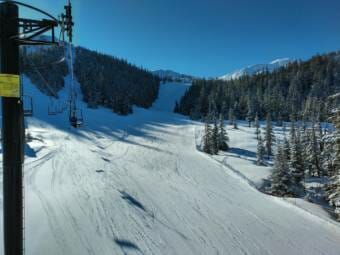
Looking up Log Jam and the west side of Eaglecrest Ski Area, seen on Wednesday 2/23/2022. (Photo by Mikko Wilson/KTOO)
Skiers and snowboarders ride up the Ptarmigan chairlift at Eaglecrest Ski Area on Douglas Island with views of the Log Jam run on the west side of the mountain on Feb. 23, 2022. An aerial gondola system could replace the Ptarmigan chairlift, or go to a new highpoint over the west bowl. (Photo by Mikko Wilson/KTOO)

In a 5-4 vote, the Juneau Assembly agreed on Monday to commit up to $2 million for the purchase of a used gondola system for the city-owned ski area.

Eaglecrest Ski Area officials say an enclosed mountain lift is the cornerstone of concepts for expanding summer operations and ending the need for local taxpayers’ support.

Assembly members on both sides have reservations about it. There were concerns about making a rushed decision, a lack of public buy-in, and unfairly leapfrogging other established priorities.

The Assembly’s action does not mean that the gondola system is a done deal for Eaglecrest.

“I have switched to a yes vote,” said Mayor Beth Weldon, who’s been skeptical of the concept. “But my vote is yes because I want to give you more time. Doesn’t mean that I’m going to pay for anything further. After buying a gondola, I may … tell you to sell it after we bought it. But I’m trying to give you more time.”

Eaglecrest General Manager Dave Scanlan laid out the timeline he anticipates for next steps. It’s all subject to change, and hasn’t been written up in a purchasing agreement yet.

First, as a down payment Eaglecrest must pay a third of the cost of the gondola system, about $450,000. At that point, no other buyer will be able to scoop it up.

After Eaglecrest closes for the season, Scanlan said he and some engineering consultants would go to the ski resort in Austria where the gondola is finishing up its final season there. They’d inspect the system in person. If it checks out, they’d make a second payment before it is dismantled. Scanlan says this would be in mid-April.

Scanlan said the final payment will be due when the system is loaded and ready to transport. Assembly member Maria Gladziszewski convinced most of her colleagues to add another review around this point. Eaglecrest officials must update the Assembly before spending money to transport it out of Europe.

“It gives us an opportunity to say, ‘OK, if some disaster happens, and it turns out to be — doesn’t fit on mountain, the pro formas turn out to have an error in them — ’ I mean, we’ve just done this really quickly. It will give us the chance to say, ‘OK, leave it over there, and sell it from there,’” Gladziszewski said.

There’d still be transportation and storage costs within Europe. Scanlan said putting it in storage in Croatia for a year would cost about $200,000, and make reselling it easier. Bringing it to Juneau would cost about $450,000. He thinks that decision must be made at the end of May.

Assembly members Greg Smith, Wade Bryson and Michelle Hale enthusiastically voted yes. Weldon and Gladziszewski voted yes with reservations.

Gladziszewski said pre-pandemic conceptual plans for different tiers of summer operations at Eaglecrest called for $20 million to $50 million in upfront costs.

“The amount of money on the table was astonishing,” she said. “And I just thought, the City of Juneau is never going to come up with that kind of money, there’s no way citizens of Juneau are going to spend that kind of money on Eaglecrest.”

She said securing this used gondola means the initial investment in summer operations is relatively small, and eliminates the need to find a deep-pocketed partner to share costs — and control — with.

Assembly member Carole Triem voted no. She said she doesn’t oppose summer operations at Eaglecrest, but, “This is the Assembly saying yes to summer operations at Eaglecrest before we’ve had that conversation with the public. And I really hesitate about that.”

After chairing the city’s Visitor Industry Task Force, she said she knows people have very strong feelings about summer operations at Eaglecrest. In public testimony before the Assembly vote, 10 people spoke in favor of the purchase and four against it.

Eaglecrest staff produced a report in 2019 with ideas for cashing in on summer tourism, most of which hinged on installing a brand new gondola lift. But the pandemic largely stalled follow-up discussions with the Assembly. Until now, the Assembly has never adopted a plan, in whole or part.

Barbara Wáahlaal Gíidaak Blake voted no because it felt like a piecemeal decision. She also said locals’ access to Eaglecrest isn’t universal.

“Our mountain is not accessible by every single demographic in Juneau,” she said. “You have to be of a certain wealth class in order to be able to ski. In order to buy a season pass was a struggle as a single mom, for my son. Thank goodness for some of the programs that the city does offer to get up on that mountain, get our kids up on that mountain.”

Assembly members Christine Woll and Alicia Hughes-Skandijs also voted no.

Assembly member Greg Smith chairs a task force on summer operations. He voted yes and said he thinks the purchasing timeline will give Eaglecrest officials enough time to resolve unanswered questions and get the public on board.

“And I will do the work to try to get that sense from the community that this is the right way forward. And if we get the sense from the community that this is not the way forward? Well, Mr. (City Attorney Rob) Palmer will be going to Croatia and selling a gondola,” he said.

Smith said it’s a bit of a leap of faith, but he doesn’t want to regret passing on this deal.

US Supreme Court nominee could be keynote speaker at Alaska lawyers’ convention

Ketanji Brown Jackson 2020
Judge Ketanji Brown Jackson speaks as an honoree at the Third Annual Judge James B. Parsons Legacy Dinner on Feb. 24, 2020, at the University of Chicago Law School. Before her nomination to the U.S. Supreme Court, Jackson committed to be the keynote speaker at the Alaska Bar Association’s convention in October 2022. (Creative Commons photo by Lloyd DeGrane)

Judge Ketanji Brown Jackson committed in December to be the headliner at the Alaska Bar Association’s annual convention. That was before her nomination to the U.S. Supreme Court

“So as of right now, we’re still very hopeful that she’ll be able to speak and be our keynote speaker,” said Danielle Bailey, executive director of the lawyers organization. “However, we understand that her schedule may have changed quite a bit.”

Bailey said the bar association is happy to find a way to make it work. 

Before the nomination, Bailey said the association had suggested a few topics for Jackson to speak about. 

“Her journey as both a mother and a judge. She also just has incredible experience, particularly with the sentencing commission that she was involved with,” Bailey said. “But I’m sure now we would love to hear about her evolution to potentially being the first Black woman Justice of the Supreme Court.”

If Jackson gets through the Senate confirmation process, she’ll be a full member of the Supreme Court by the time the bar association convention begins in Anchorage on Oct. 26. 

There is precedent for sitting justices to speak to Alaska’s legal community. Bailey said that Jackson could be at least the eighth Supreme Court justice to speak to the bar association since 2001. Past justices include Stephen Breyer in 2001, Antonin Scalia in 2003, Sandra Day O’Connor in 2005, John Roberts in 2007, Ruth Bader Ginsburg in 2008, Samuel Alito in 2009 and most recently Sonia Sotomayor in 2016.  

Generally, only members of the bar association can attend its events, though exceptions are possible. 

“I know in the past, we’ve opened up some of our programs to those beyond our legal community, particularly when they’re such large interest like this may be, so that’s something that we’ll consider,” Bailey said.  

For the judge, Bailey said the speaking engagement is not a paid gig. 

“Often, judges aren’t able to accept any compensation. And so all we do is pay for flights and accommodation,” she said. 

Jackson is currently one of 11 judges in the District of Columbia Circuit of the U.S. Court of Appeals. 

Newscast – Monday, Feb. 28, 2022

In this newscast:

  • Juneau rallies for Ukraine
  • Congressman Don Young works on a bill to seize Russian yachts and commercial vessels in U.S. waters
  • The U.S. Supreme Court announces it will hear several cases challenging the constitutionality of the Indian Child Welfare Act
  • Juneau lowers its pandemic alert level to minimal as case numbers trend down
  • A Canadian military vessel sails into Juneau
Juneau man says he was unarmed, waiting to meet police when they shot at him

Kodzoff Acres II, Art Whitney, slow children sign
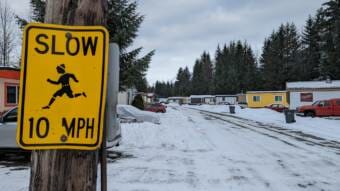
A sign warns drivers about children playing in the Kodzoff Acres II mobile home park in Juneau on Feb. 24, 2022. Resident Art Whitney said he was talking on the phone at the end of the second driveway on the left — orange paint from police investigators in the snow marks the spot — when a Juneau police officer shot at him. (Photo by Jeremy Hsieh/KTOO)

The man who a Juneau police officer shot at on Tuesday night said he’s home safe, and wants to share his side of the story.

The street in the Mendenhall Valley where a Juneau police officer fired his gun on Feb. 22 is lined with trailer homes.

On Thursday afternoon, the man who police shot at was standing on his porch, having a cigarette. There’s a light post nearby with a sign warning to watch for children.

“Yeah, my name is Art Whitney, and I’m pissed,” he said.

Whitney was at the end of the driveway when police started shooting.

An eyewitness said she saw exactly where an officer had fired from that night — it’s about 250 feet away.

Whitney is a Navy veteran. He’s small and gaunt with a long beard. He said he recently got home after spending two nights at Bartlett Regional Hospital, where police took him after the shooting.

“Maybe I saw a shrink? But nah, I think they were all counselors,” he said. “Just talking. … ‘How do you feel?’-ing, about every hour, and blood testing. Normal routine, I guess.”

Whitney said the night of the shooting, he was shopping online, and realized he had fallen for some kind of scam and lost thousands of dollars. He said he was suicidal. Or, at least, acting suicidal.

“It was just a desperate plea for help,” he said.

Police said their initial contact was a call from a family member who said a man was threatening to harm himself. The family member also told police he had a gun at home.

Whitney said he gave his gun to his roommate and waited outside to meet the police. He said he was talking on the phone with his daughter when he heard shouting at the far end of the street. At first, he didn’t know they were police.

“And then they lit me up with their flashlights. And all of a sudden, I hear this guy shout, ‘He’s got a gun!’ Bang, bang, bang.”

He wasn’t hit, but police said two occupied trailers were. Police said one shot went into a bedroom window; someone got a minor cut on broken glass.

Whitney dropped to the ground, and the police cuffed him. Somewhere in the mix, he said he heard neighbors repeatedly shout that he did not have a gun.

According to Whitney, he wasn’t armed and wasn’t doing anything threatening, just talking on the phone.

“They got to tell me how in the hell they could tell if I had a gun from what, at least 100 yards away, dark? You know, c’mon! … I mean jeez, I couldn’t even see them. … So anyway, it’s not quite true, all of it,” he said.

He said police searched his room in the trailer he lives in.

“And here’s the weirdest part: I could get my gun back,” Whitney said. “I didn’t have to surrender my weapon. That’s the bottom line. I did not have to surrender my weapon.”

His phone, however, was taken as evidence.

Whitney said he feels safe now, and is working on getting some follow up counseling. He also learned after the shooting that he may be able to recover the money he lost through federal deposit insurance. He said he’s not sure if he’s in any legal trouble.

Oh, and Whitney said there’s at least one more thing the police got wrong. They said he was 65 years old. He won’t be 65 until July.

Meanwhile, as of Thursday night, the Juneau Police Department had not followed through on identifying the officer who shot at Whitney. Juneau Police Chief Ed Mercer had said on Wednesday that the officer’s name would be released by now.

If you’re in a crisis, call the National Suicide Prevention Lifeline at 1-800-273-8255.

A man threatened to kill himself. Juneau police shot at him, and hit two nearby homes instead

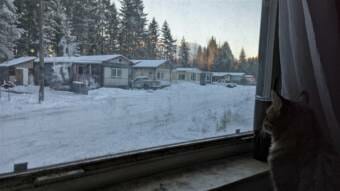
A cat named Milo looks out the window of Maggie Watson’s Mendenhall Valley home on Feb. 23, 2022 in Juneau. Watson said she was glued to the window the night before, when Juneau police officers showed up to reach a 65-year-old man who had threatened to hurt himself. An officer ended up firing at the man, missing him and hit two nearby homes instead. (Photo by Jeremy Hsieh/KTOO)

Some residents of a Juneau neighborhood in the Mendenhall Valley are rattled after a Juneau Police officer shot at a 65-year-old man, missed him, but struck two otherwise uninvolved trailer homes nearby on Tuesday evening.

Police say there was one injury: someone inside a trailer got a minor cut from broken glass after a bullet went through a bedroom window.

State and local authorities are investigating the shooting, which originated with a call about the 65-year-old man threatening to harm himself. Some details from early accounts of what happened are already hard to reconcile.

Maggie Watson was at home on Tuesday night when she heard several men outside her window yelling a man’s name over and over again.

“I was just glued to the window,” she said.

She said she didn’t hear the men identify themselves, though she has some difficulty hearing. She said it sounded like they were trying to convince someone to come outside. She couldn’t see who from her window.

“And one officer made it to the snow berm,” she said from her home in Kodzoff Acres near the Mendenhall Glacier. She pointed out a snow berm across across the street, a few doors down, where investigators later marked a few spots with bright orange paint.

“… And, took out his long gun, and pow! Pow! Pow! Pow!” Watson said. “And I knew exactly what that sound was. And I remember, just, I mean, my jaw dropped. … What the f— just happened?”

More police officers showed up, working the scene for hours. She didn’t get many answers that night.

On Wednesday evening, the Juneau Police Department held a press conference and put out a written account of the incident. Police said they reached the 65-year-old man on the phone before arriving on the scene, and he said he was going to hurt himself and he had a gun.

When they arrived, police said they announced themselves and “started a dialogue” with the 65-year-old man. In a written account, they said that during this brief exchange, “one or more of the officers believed the subject was pointing a gun at them.” That officer then shot at the man. 

Police Chief Ed Mercer described what happened just before the officer fired his gun a little differently.

“When officers attempted to contact him outside his residence, one of the officers received a threat from the man,” Mercer said.

After the shooting, the written account said the 65-year-old man “went to the ground.” They checked him for injuries and handcuffed him, and took him to the hospital for evaluation.

Mercer said police recovered a gun, but would not say who it belonged to. Mercer cautioned that the investigation is ongoing and that information was emerging as he spoke. He said recordings from officers’ body cameras will be part of the investigation.

He said two officers with the Alaska Bureau of Investigations, which is part of the Alaska State Troopers, arrived in Juneau on Wednesday morning to investigate the shooting. Mercer said it’s important that an independent party work the case.

“We take these things seriously,” Mercer said. “We want another set of eyes to look at the case, and provide input to us – and (The Office of) Special Prosecutions – a conclusion on what is decided based on our officer’s actions.”

Mercer said these investigations can take three to six months.

“We’ll try to get through this as fast as we can,” he said. “We would like to see some closure on this and at least, we’ll provide information to the public and continue to be transparent with what happened after yesterday.”

Mercer said the police officer who fired his gun was put on administrative leave. He didn’t identify him by name, but said the department would by the end of Thursday.

This is the third police shooting in Juneau since 2016. Officer James Esbenshade killed 34-year-old Kelly Michael Stephens in December 2019 when Stephens advanced on the officer, yelling threats.  State officials concluded the shooting was justified. The family sued, and eventually dropped its case.

And in December 2016, Sgt. Chris Gifford shot at a man who pointed an axle as if it were a long gun at the police. The man survived wounds from debris, and the shooting was deemed justified.

“I can tell you, in my 22 years working for this police department, we haven’t had many officer-involved shootings in our community,” Mercer said. “It’s mostly, within the most recent last five years that we’re seeing a little bit more of this happen in our community, unfortunately.”

Deputy City Manager Robert Barr said police shootings affect more than the immediate parties.

“You know, I think the important thing to note here is that anytime one of our officers feels the need to discharge his or her weapon in the course of their duties, that is a tragedy,” Barr said. “It is tragic for all of the individuals involved, it’s also tragic more broadly for our community.”

If you’re in a crisis, call the National Suicide Prevention Lifeline at 1-800-273-8255.

Site notifications
Update notification options
Subscribe to notifications