Jeremy Hsieh

Local News Reporter, KTOO

I dig into questions about the forces and institutions that shape Juneau, big and small, delightful and outrageous. What stirs you up about how Juneau is built and how the city works?
Watch: Sen. Lisa Murkowski addresses Alaska Legislature at 11 a.m. Tuesday

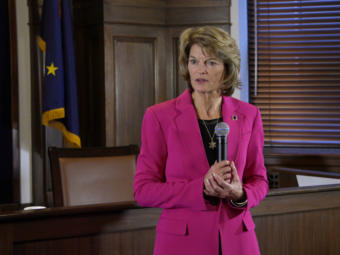
U.S. Sen. Lisa Murkowski is set to deliver her annual address to the Alaska Legislature in the Capitol at 11 a.m. Tuesday.

Murkowski is Alaska’s senior senator, serving since late 2002. She is up for re-election this year.

She’s a Republican, though she’s often at or near the center of close Senate votes and debates. Last year, the statistics-heavy website GovTrack.us ranked Murkowski as the most left-leaning Republican in the Senate. On the site’s spectrum, she was a hair to the left of conservative Democrat Joe Manchin of West Virginia.

Murkowski is also one of few Republican members of Congress who’s been openly critical of the national Republican Party for characterizing a House panel investigating the Jan. 6 insurrection at the U.S. Capitol last year as “persecution of ordinary citizens engaged in legitimate political discourse.”


You can watch live Gavel Alaska coverage here, on the KTOO Roku app or on KTOO 360TV. In Juneau, you can also listen on 104.3 FM.

Eaglecrest Ski Area officials want $2M to buy a used, aerial gondola system

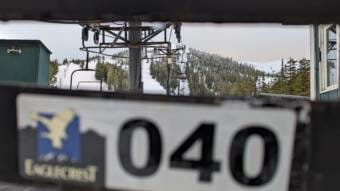
The Ptarmigan chair lift, pictured here on Feb. 12, 2022, has been in use at Eaglecrest Ski Area on Douglas Island since the ski area’s season that began in 1976. Eaglecrest officials are eyeing a used, aerial gondola system that could replace or supplement Ptarmigan. (Photo by Jeremy Hsieh/KTOO)

The leadership of Juneau’s ski area is asking city officials for $2 million to buy a used, aerial gondola system that could operate in the winter and summer. Scooping it up could save tens of millions of dollars compared to buying new. It could also shave years off of a plan in development to cash in on summer cruise ship visitors and eliminate the need for local taxpayer support to run Eaglecrest Ski Area.
Eaglecrest officials want the Juneau Assembly to act quickly, before the window closes to buy the rare gondola system they’re eyeing. But several Assembly members are uncomfortable with the tight timeline for vetting.

The Juneau Assembly decided on Monday to give Eaglecrest officials two more weeks to flesh out their pitch to buy a used gondola system. At the end of the month, the Assembly intends to hold a public hearing and final vote on the $2 million request.

The ask first came to the Assembly during a committee meeting on Feb. 2. For the Assembly to make a final decision in less than a month is unusually fast for this kind of business.

“We are really scrambling in a incredibly advanced timeline for a government body to analyze something,” said Deputy Mayor Maria Gladziszewski. “Why is this such an emergency right now?”

Eaglecrest General Manager Dave Scanlan said opportunities to buy used gondola systems that suit the ski area’s needs and ambitions are very rare. He found one on the market now. It’s in Austria and still in use, but will be dismantled and replaced with a higher capacity lift beginning in April.

“So we have a short window to secure this lift before it goes to another buyer, or has a different fate,” Scanlan said.

If approved, Scanlan said there are many decisions ahead about how exactly to use the gondola system. It could be used to replace the aging Ptarmigan chairlift. It’s been operating since 1976, the ski area’s second season.

Wear and tear on some parts of the Ptarmigan chair lift at Eaglecrest Ski Area on Douglas Island, pictured here on Feb. 12, 2022, is evident. It’s been operating since the ski area’s second season began in 1976. (Photo by Jeremy Hsieh/KTOO)

Or the gondola could be an additional lift that goes to the top of the ridge. That would make more terrain accessible in the winter. It’s also a cornerstone for lots of ideas to expand summer activities on the mountain while keeping tourists out of the weather.

“And what’s unique about it is it has much, much lower operating costs, much lower maintenance costs,” Scanlan said. “And it’s a very simple, basic machine, yet it’s able to do what we need it to do in both summer and winter seasons.”

He estimated the installation would cost another $6.5 million and said it should be able to run without major maintenance for another 20 years.

Before getting to installation, officials would have to figure out where the gondola would actually go. That means getting geotechnical work done and collecting wind data at different sites. The pros and cons of different alignment options would be weighed out with more public input and without rushing.

One option for the enclosed gondola system is to replace the Ptarmigan chairlift in its current footprint, pictured here on Feb. 12, 2022. Another is for it to run to the top of the ridge on the right, where it would open up more terrain in the winter and give tourists panoramic views in the summer. (Photo by Jeremy Hsieh/KTOO)

That didn’t sit well with Assembly member Carole Triem on Monday.

“What I am hearing tonight and from the board meeting on Friday is we are being asked to buy it, and then have the public process,” Triem said. “I don’t think that’s the appropriate way to do this.”

Triem and Alicia Hughes-Skandijs voted against moving the measure forward.

“I’m really starting to see the vision and I appreciate the work of the Eaglecrest Board,” Hughes-Skandijs said. “But I think at this point, it’s too fast, it’s too out of order with — we have community goals, community priorities. And I sort of feel like this is jumping the line.”

Assembly member Wade Bryson is not a skier. Though he is a businessman, and he hasn’t always supported funding for the ski area. But he’s a fan of the gondola plan and expanding summer operations.

“When it comes down to it, the community’s going to say, ‘No, you’ve got to keep Eaglecrest open,’” Bryson said. “And this is the least expensive way that we can ensure the future of Eaglecrest.”

Scanlan has put together a financial model that predicts how different cruise ship tourism numbers and spending habits would play out for a barebones gondola experience in the summer. He estimates that with about 300 visitors a day, Eaglecrest could keep operating as it does now, with the city kicking in about $1 million a year for operations and capital projects.

Scanlan said it’s reasonable to expect higher visitor numbers that would eliminate the ski area’s need for local taxpayer support. That’s what Bryson likes.

“Let’s put our business hats on, and let’s see if we can’t make some money. It’s not against the rules for Eaglecrest to be profitable,” Bryson said.

If the Assembly opts out of buying this particular gondola system, Scanlan said a comparable new one would likely cost something like $22 million, plus spending two or three years on a manufacturer’s waitlist.

As for the Ptarmigan lift, Scanlan said replacing it would cost about $2.5 million. Upgrading it to a high capacity quad-chairlift would be about $4 million.

If you want to weigh in, you can email the Juneau Assembly. The  Assembly plans to take public testimony on Feb. 28 before its final vote on the gondola purchase. The Eaglecrest Summer Operations Task Force also plans to meet to discuss it at 6 p.m. Tuesday.

Correction: An earlier version of this story misspelled Maria Gladziszewski’s last name. An earlier version of this story also misstated that the Ptarmigan chairlift was purchased used and that it began operating at Eaglecrest in 1975. With the possible exception of a backup engine, old correspondence between city officials and the contractor Riblet Tramway Company indicate the system was installed new. The contract called for the system to be completed and ready to use in time for the 1975-1976 ski season, but it wasn’t completed until the fall of 1976.

Watch: 2022 State of the Judiciary Address

Chief Justice Daniel Winfree
Daniel Winfree was elected chief justice of the Alaska Supreme Court in 2021. (Photo courtesy of the Alaska Court System)

The head of Alaska’s court system is set to deliver the annual State of the Judiciary Address from the Capitol in Juneau at 11 a.m. Wednesday.

This will be Chief Justice Daniel Winfree’s first. His peers elected him chief justice last year after Joel Bolger retired.

Winfree joined the court in 2008 after being appointed by then-Gov. Sarah Palin.

You can watch live Gavel Alaska coverage here and on KTOO 360TV, or listen on 104.3 FM.

Juneau Assembly OKs ‘Peratrovich Plaza,’ controversial rezone and $20M in hospital debt

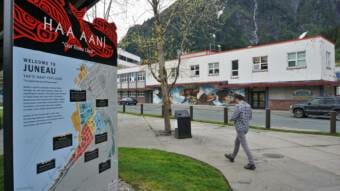
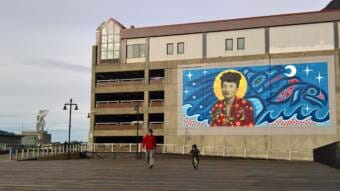
Pedestrians walk Juneau’s Seawalk past a mural of Alaska civil rights leader Elizabeth Peratrovich on Oct. 21, 2021. The Juneau Assembly renamed this waterfront lot “Peratrovich Plaza” during a meeting on Monday. (Photo by Jeremy Hsieh/KTOO)

Juneau officials have officially renamed a piece of waterfront property “Peratrovich Plaza” after an Alaska Native civil rights leader.

The property is along Juneau’s Seawalk and sits in front of a three-story mural of Elizabeth Peratrovich. The renaming is a nod to Peratrovich’s contributions to Alaska and a practical thing to help people get around Juneau’s waterfront.  Officials previously referred to it by its legal description, which was not widely known.

In other news from Monday’s Juneau Assembly meeting, the Assembly approved a controversial rezoning of a 15-acre property along North Douglas Highway. Developer Travis Arndt filed his original rezoning request more than a year ago. Since then, planning officials, the Assembly and the city’s Systemic Racism Review Committee have all struggled with it for different reasons. Concerns have ranged from road congestion to the impact on housing stock, to public opinion, to economic inequities.
Without the change, the vacant lot could have hosted multi-family housing and some limited commercial activity. But Arndt told the Assembly on Monday that the economics of that was unlikely to work out.

“There’s some misconceptions out there that are pretty big,” Arndt said. “This isn’t an all or nothing thing. We’re not asking to rezone it so we can build only boat condos. We’re not asking for it so we can only build anything. We want one more tool in the toolbox for flexibility to make the economics and the cost work.”

With the rezoning, more housing and more commercial activity is allowed. He said he’s likely to build commercial boat storage and housing.

The Assembly voted 6-1 to approve the rezoning. Alicia Hughes-Skandijs voted no. Assembly members Wade Bryson and Carole Triem were absent.

Assembly member Barbara Wáahlaal Gíidaak Blake was one of the yes votes.

“If what is actually being presented to us is in fact true, all of those savings would then be passed on to community members to attain affordable housing, as I see it,” she said.

The Juneau Assembly also authorized Bartlett Regional Hospital to sell $20 million in bonds for new infrastructure. The money will go toward building a crisis stabilization center and renovating the emergency department. The debt will be repaid over 20 years with hospital revenue.

Watch: Juneau Assembly considers Peratrovich Plaza rename, North Douglas rezone and hospital debt

Erick Heimbigner keeps an eye on his son, 4-year-old Emmett Heimbigner, as he practices riding his bike at the Archipelago Lot along Juneau’s Seawalk on Oct. 21, 2021. Juneau Docks and Harbors officials want to rename the lot “Peratrovich Plaza” after the Alaska civil rights leader and the subject of the mural behind them. (Photo by Jeremy Hsieh/KTOO)

The Juneau Assembly has its regular meeting scheduled for 7 p.m. Monday. Its agenda includes renaming a prominent piece of waterfront property, a public hearing on a controversial rezoning request and authorizing $20 million in bonds for a new facility at the hospital. 

Assembly members will consider renaming an area along Juneau’s Seawalk for Alaska Native civil rights leader Elizabeth Peratrovich. She’s also the subject of the three-story mural overlooking the area. 

There is also a hearing on a developer’s request to rezone 15 acres along North Douglas Highway. The developer says he intends to build boat storage. 

Planning officials, the Assembly and the city’s Systemic Racism Review Committee have all struggled with this for different reasons. Concerns have ranged from road congestion to the impact on housing stock, to public opinion, to economic inequities.

The Assembly is also expected to make a final decision on whether to let Bartlett Regional Hospital take out $20 million in debt to help build a crisis stabilization center and renovate the emergency department. If approved, the debt would be repaid over 20 years with hospital revenue. 

You can watch and participate through the city’s Zoom videoconference. Streaming video is available on the city’s Facebook page. KTOO also broadcasts Assembly meetings live on 104.3 FM. 

Alaska electric utilities are proposing new rates for fast charging stations for electric cars

EV charging station at Fred Meyer in Juneau 2022 02 03
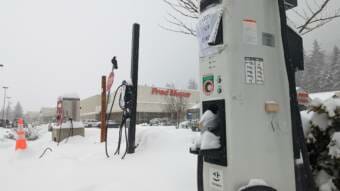
Fred Meyer’s gas station in Juneau hosts two kinds of charging stations for electric vehicles: two level 3 fast chargers like the one in the foreground, and two level 2 chargers like the one in the midground, pictured here on Feb. 3, 2022. The retailer lets the public use them for free, even though the fast chargers can lead to hefty bills under Alaska Electric Light and Power Company’s current rate schedule. (Photo by Jeremy Hsieh/KTOO)

In the Alaska community with one of the highest electric vehicle ownership rates in the country, there are a grand total of four publicly available fast charging stations.

Because of Juneau’s limited road system, there may not be much demand for them compared to slower, more common alternatives.

That’s not stopping Alaska Electric Light and Power Company and other utilities around the state from working on updating how they bill customers that run fast charging stations, and other changes that will make it easier to operate any type of EV charging station.

Right now, Fred Meyer in Juneau is AELP’s only customer that would be billed differently if new rates take effect. The retailer runs a gas station with a bank of electric vehicle chargers, which it lets the public use for free. Two of them are fast charging stations.

Unlike the other two fast chargers in town — there’s one at the Downtown Transportation Center parking garage and one near the Alaskan Brewing Company’s tasting room — Fred Meyer’s are on a dedicated meter of their own, so AELP knows exactly how often they’re used. When they’re working properly, the utility said it averages out to about an hour and five minutes a day. This means you’d have to be pretty patient or pretty lucky to catch someone plugging there.

Someone like Xiao-Yue Han.

“I’m a resident of Portland, Oregon, and I went up to Juneau to visit a friend for a wedding and check out some whales,” Han said.

He got familiar with all four fast chargers in town this past summer because he rented a Tesla Model S and didn’t have a place to charge it where he was staying.

“Because we rented the Model S, we had to return it with, like, a reasonable amount of fill. And it was difficult,” he said.

His Turo rental car host ended up giving him a break on the recharge. But it’s not unusual for EV owners, including me, to be in Han’s situation. EV owners who can’t charge at home are sometimes called “garage orphans.”

AELP and other utilities are proposing two significant changes for EV charging. First, they clarify that EV station operators are OK to resell electricity. 

Alaska’s rules about this were unclear until state regulators made an exception in October. There were workarounds. For example, pricing according to time connected. The city also runs a few charging stations in paid, public parking garages. But otherwise, all of the public chargers in Juneau are free to their users.

Of course, their operators do get billed, and it’s up to them if they want to pass that cost on to their users or try to turn a profit.

Fred Meyer did not respond to requests for comment about whether it plans to start charging to charge up. But Han, who also drives a Tesla in Portland, said when businesses offer free charging, it’s an attraction. Now he frequents a spot about an hour’s drive outside the city where he can charge for free.

“You know, we discovered this winery because it was on the Tesla Supercharging network. And so it was a little bit like a business development thing for the winery,” Han said. “For effectively, like $2 worth of electricity, I spend two hours there. I get great charge. … And you know, spend anywhere from $100 to $300 worth of, you know, wine and food and things like that.”

The other change utilities want to make is to simplify the billing for customers with fast charging stations. This would only apply to fast chargers that are on their own dedicated meters.

“They deliver power at a very high rate, but only for a very short period,” said Alec Mesdag, vice president and director of energy services and metering with the utility.

Fast charging is great for EV drivers but hard for an electric utility to build and operate a grid around. That’s because utilities have to build the infrastructure to accommodate the highest loads at any given moment, even though the system will run far below capacity most of the time.

From a utility’s perspective, it’s much more efficient for EV drivers to recharge slowly over several hours than in irregular, 20-minute spurts that some fast chargers make possible.

Across Alaska, big commercial customers and smaller customers with especially spiky electricity demands get charged differently than typical residential customers. They pay for the total amount of electricity they use each month, plus an extra fee called a demand charge. It’s based on the single biggest spike of electricity use each month. AELP’s meters capture this by recording the highest throughput in any 15-minute period over a month.

Now, remember how AELP tracks how often Fred Meyer’s fast chargers are in use? That’s key to understanding a pricing problem utilities and regulators want to sort out.

EV fast chargers are not steadily used. Last year, Railbelt utilities said they are typically idle 95% to 99% of the time.

When too few people plug in, that can lead to some bonkers bills under current rate structures. For example, Chugach Electric Association mathed out some hypothetical scenarios with different kinds of fast chargers. In its examples, it could cost about $45 to fully charge a Chevy Bolt — or it could cost $660!

It’s not as extreme, but versions of that play out with AELP’s rate schedule, too.

Utilities and policymakers do want to make it easier for more people to switch to electric cars.

“‘Cause overall, we recognize that electric vehicles are a good thing,” Mesdag said. “They have benefits that they provide to the system overall. But we still have this issue of not wanting to inequitably recover costs from different users.”

It’s a balancing act. As things are, it’s really unappealing to set up fast chargers. If utilities lower rates for EV stations and overcorrect, then everyone could be paying for the people who use the charging stations.

State regulators decided that utilities should have new, fixed rates for EV fast charging stations and drop the fee that makes high idle time so problematic.

It’s up to each utility to propose their own rates, and it’s up to the Regulatory Commission of Alaska to decide if they’re fair. State lawyers with the Regulatory Affairs and Public Advocacy office can also weigh in on behalf of ratepayers.

AELP’s proposed rates vary seasonally. They’re higher in the winter when overall electricity demand is higher. They also vary by the type of customer. On the low end, it would cost about $8 to charge up a Chevy Bolt in the summer. On the high end, say for Fred Meyer or a for-profit charging network that tries to set up shop, it’d be about $15 in the winter.

Mesdag said AELP’s proposed rates are middle-of-the-road, compared to what other utilities are proposing.

AELP and other utilities’ new rates could take effect in March if the commission approves them.

You can see different electric utilities’ EV fast charging rate schedule proposals in the library section of the Regulatory Commission of Alaska’s website. The commission is taking public comment on most of them through February.

Site notifications
Update notification options
Subscribe to notifications