Jeremy Hsieh

Local News Reporter, KTOO

I dig into questions about the forces and institutions that shape Juneau, big and small, delightful and outrageous. What stirs you up about how Juneau is built and how the city works?
Juneau Assembly to consider removing first hurdle to Norwegian Cruise Line’s dock

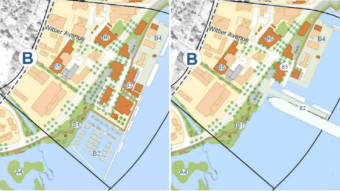
The image on the left shows the subport area of downtown Juneau in the city’s Long Range Waterfront Plan from 2004. (The city maps misidentify Whitter Street as Wittier Avenue.) The image on the right shows a concept in an amendment to the plan that city staff are proposing that would kill the marina concept and accommodate Norwegian Cruise Line’s goal to build a new cruise ship dock there.  (Composite image by Jeremy Hsieh/KTOO)

The Juneau Assembly will soon consider removing one of the first hurdles for a cruise line’s plan to build a new dock for its ships. 

For the last 17 years, Juneau’s Long Range Waterfront Plan has called for a new mixed-use neighborhood and marina between the U.S. Coast Guard facility and the mouth of Gold Creek. That’s also where Norwegian Cruise Line bought a nearly 3-acre piece of land known as the subport lot in 2020 for a whopping $20 million from the Alaska Mental Health Trust Authority. 

As is, it’s unclear if the city’s waterfront plan fits with Norwegian’s goal to build a new cruise ship dock there. It would be Juneau’s fifth parking spot for big ships.

The city’s plan on the books calls for a marina for smaller boats and a long, floating dock for visiting yachts, small cruise ships, the military and “other vessels.” It would likely obstruct a big cruise ship dock there. 

City staff are proposing an amendment to the existing waterfront plan that kills the marina and floating dock concept. Instead, there’d be a facility for one large cruise ship and the neighboring federal agencies, the U.S. Coast Guard and National Oceanic and Atmospheric Administration. 

Amending the waterfront plan wouldn’t clear the way for Norwegian to build. But it would be one less thing for the Juneau Planning Commission to parse when it considers granting Norwegian a permit to develop its property. 

“The amendment’s required as a first step,” said Alexandra Pierce, the city’s tourism manager.

She said the planning commission would still have other bread-and-butter urban planning issues to weigh. 

“The zoning in the area, parking and traffic requirements, things like that,” she said. 

Pierce presented the proposed changes to the waterfront plan last week and has been asking for public comment. She said so far, people have voiced strong support and strong opposition. 

“Haven’t seen a ton of comments yet, about a dozen,” she said. “I would say that it’s fairly similar to the types of comments that we received in the visitor industry task force.”  

A professional phone survey conducted last year showed that most Juneau residents support Norwegian’s development of the dock. 

To formally weigh in on the city’s Long Range Waterfront Plan amendment, email Alexandra Pierce. The comment period is open through the end of January. 

Pierce plans to update the Assembly in a committee meeting on Monday. The Assembly must also hold a public hearing before its final vote on the amendment, which will likely be in February. 

Besides the city’s waterfront plan and the planning commission permit, the cruise line has more public hurdles in its path. Norwegian still needs permission from the city to develop and operate in the city-owned tidelands around the property. And the Coast Guard and NOAA also must be satisfied if the development impacts their access to the water. 

That gives the city room to negotiate for conditions the city’s tourism task force recommended in 2020. That includes electrifying the dock so that cruise ships can plug into Juneau’s clean power grid while in port, instead of burning fuel to generate electricity on board. Another recommendation is to limit the use of the dock to one big cruise ship per day. 

No one earns less than minimum wage at Eaglecrest Ski Area anymore

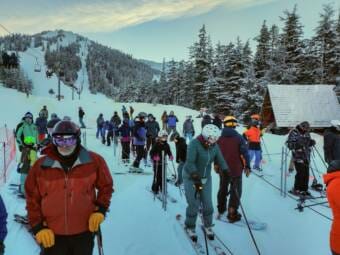
Skiers and snowboarders line up for chair lift rides at Eaglecrest Ski Area in Juneau on Jan. 17, 2022. A pay raise took effect for all Eaglecrest employees that day, raising some of the lowest paid workers above Alaska’s minimum wage. (Photo courtesy of Mikko Wilson)

As of Monday, all employees at Juneau’s city-owned ski area got a pay bump, and no one is earning less than Alaska’s minimum wage anymore.

Eaglecrest Ski Area officials adopted a slate of changes to their pay scale after an exceptionally strong opening to the ski season – and after getting a lot of guff from the public.

For years, Eaglecrest officials and the local elected officials who appoint them have publicly lamented how poorly paid some ski area workers are. Before Monday, entry-level workers could be paid as little as $8.50 an hour.

After a KTOO story about the ski area’s labor and pay issues in December, harsh emails lit up the inboxes of Eaglecrest’s leadership and the Juneau Assembly. Some long-time patrons were outraged and said they regretted their support for the ski area.

Eaglecrest Board Chair Mike Satre spoke to the Juneau Assembly Finance Committee about the pay issue on Jan. 5. He said there was a misunderstanding on his end about who had the authority to make changes.

“I think there’s been confusion on the board — and a lot of that lies squarely in my lap — about how we could specifically address pay plan adjustments,” Satre said. “We really believed, I believed, that it had to be solely be done through the budgeting process, and truly, you know, a collaborative effort, you know, with the manager’s office, finance team and the Assembly.”

While the Assembly has to approve Eaglecrest’s overall budget, the city’s Finance Director Jeff Rogers explained that the Eaglecrest board has the sole authority to set pay and compensation for the ski area’s employees. Assembly Finance Committee Chair Carole Triem said Rogers intended to bring the issue to her committee in February, but moved it up after KTOO’s story.

The day after the committee met, Satre’s board unanimously approved a pay bump for all employees that took effect with the new pay period on Monday. The raises vary depending on the position and an employee’s experience level, but the city’s Human Resources Director Dallas Hargrave estimates it works out to roughly 7.5% overall, or about $100,000 extra per year.

One entry-level position in the pay schedule still appears to begin below Alaska minimum wage, but another policy the board adopted says everyone will earn at least the state minimum wage. It’s $10.34 an hour right now and automatically increases with inflation.

After six years on the Eaglecrest board, member Stephanie Hoag said she’s thrilled the pay increases finally went through.

“It’s just way overdue, I am so glad,” she said.

Eaglecrest General Manager Dave Scanlan said it would take about a 22% pay increase overall to be competitive with other ski areas. For future ski seasons, he said Eaglecrest still intends to ask the Assembly for more financial support to help reach that target.

“This isn’t the end game for us,” he said. “This is really just a Band-Aid to address the immediate issue. And we wouldn’t be likely to be able to have this conversation, if it wasn’t for the success that we’re having at the ski area, which is only made possible by all the hard work from all my staff.”

The ski area’s finances tend to hinge on the weather and can be very volatile. Still, Scanlan said this partial step is financially sustainable. That’s based in part on the ski area’s finances last season and the strong opening this season.

“Just amazing — last year was a record revenue year, and here we go, we’re just cruising right along, far exceeding last year,” Scanlan said.

Through early January, the ski area’s total revenue was more than $1.5 million. That’s more than double the $730,000 it was up to this point in the season two years ago.

The pay increases are expected to help attract and retain staff. But the existing labor shortage means a lot of Eaglecrest employees continue to help in other roles.

“Everybody has pulled together as we’ve been really short on staff especially in lift operations,” Scanlan said. “We’ve had our vehicle mechanic out running chair lifts, and our snow removal guys running chairlifts. Everybody has just chipped in.”

Scanlan said he’s been filling in on some chair lift shifts, too.

“Done a top shack day or two myself, just to make sure we are giving people happy powder days without big lift lines,” he said.

Satre and other board members said expanding summer activities on the mountain is the key to making the ski area financially self-sustaining. As it stands, about $3 out of every $10 it takes to run Eaglecrest comes from Juneau taxpayers.

One piece of that plan is to install a new gondola system on the mountain, estimated to cost $6.5 million. The Eaglecrest board directed Scanlan to work with the Assembly on finding ways to pay for the project. It could come through the state’s capital budget, or local project packages voters approve and pay for with sales tax revenue.

Omicron wave prompts rationing of COVID medications in Alaska

Inside his car, Josh Walton receives an IV infusion with a monoclonal antibody treatment for COVID-19 at a clinic in Wasilla in June of 2021. (Photo courtesy of Josh Walton)

After learning he’d been around someone with COVID-19 last June, Josh Walton got tested at an urgent care clinic in Anchorage. He said he wasn’t too worried because he’s fairly healthy, had been fully vaccinated and didn’t have any symptoms – yet.

The test came back positive. He started feeling it that evening.

“My symptoms weren’t too bad,” Walton said. “I’ve had much worse fevers. … I felt like I was having trouble staying warm. But I wasn’t shivering, I didn’t break into sweats, I wasn’t aching. I was just tired and cold.”

The coughing began the next morning. By his third day sick, he had headaches, too. But he managed to get an appointment for a monoclonal antibody treatment at a clinic in Wasilla.

The clinic had him drive into a car canopy for his treatment. A worker in protective gear hooked up an IV bag to his arm, right through his car window. It took about an hour, plus an hour of monitoring time in case of a bad reaction.

“Wake up the next day and felt 100% better. Like, completely better,” he said with a laugh. “Which was amazing!”

If Walton had gotten sick today, it’s unlikely there’d be any treatments available to him. The specific product he thinks he got doesn’t work against the omicron variant. Among the effective treatments, supply constraints and a surge in cases mean there isn’t nearly enough to go around Alaska.

“Right now, the COVID therapeutics are a scarce resource, and we anticipate that that will continue to be the case in the foreseeable future,” said Jeannie Monk, senior vice president of the Alaska State Hospital and Nursing Home Association.

You might have heard that there’s only one monoclonal antibody treatment that works against omicron, and it’s in very short supply.

But as it stands right now, there are four products that the FDA has given emergency use authorization to that effectively treat omicron. In addition to the one monoclonal antibody treatment infused by IV, there are three are antiviral treatments: Two are taken as a series of pills, and the third is infused in a series by IV.

The antiviral medications interfere with how the virus replicates itself. The monoclonal antibodies are copies of particular proteins the immune system produces. They attach to the spikes on the coronavirus, keeping them from infecting cells.

Alaska confirmed more than 11,000 new COVID-19 cases in the last week. That doesn’t count cases found through home tests. Alaska’s latest weekly allotment of therapeutics would only cover 1,300 people. Part of that allotment includes treatments that don’t work against omicron. Another part is for an injected product that doesn’t treat someone who’s sick but is given before exposure to sick people to prevent infection.

According to state epidemiologist Dr. Joe McLaughlin, the state’s sampling indicates that omicron is causing 80% to 95% of Alaska’s COVID-19 cases. That means the treatments that do work against omicron are in extra high demand.

This situation is why the state has its Crisis Care Committee. It met Wednesday and is about to release clinical recommendations for who should get first dibs. Jeannie Monk participates in these meetings.

“So the Crisis Care Committee has been reviewing the scientific evidence, and trying to figure out what makes most sense for Alaska,” Monk said. “What they will do is provide prioritization tiers to outline who will benefit the most from this scarce resource.”

Monk said health care providers generally follow the committee’s guidance, which will be largely consistent with what a National Institutes of Health panel published at the end of December and what Bartlett Regional Hospital in Juneau announced it was doing with the one monoclonal antibody treatment that works on omicron, sotrovimab.

You’d think the sickest people would be first in line. But most of these treatments are not for them. The FDA’s emergency use authorizations actually warn that they may make them worse.

These medications are for people with mild and moderate cases — but at the highest risk of developing a severe case. First and foremost, people with compromised immune systems. Next, older people who aren’t up to date with their vaccines. Specifically, people age 65 and up with other health risk factors, or people 75 and up.
There are more tiers. But in a panel discussion on Wednesday, Alaska’s Chief Medical Officer Dr. Anne Zink said the supply is probably too limited to get to them.

The federal government foots the bill for these treatments and controls the supply. Zink said the state is working with the feds to get as much as possible.

“Lot of cases, not a lot of resources,” Zink said. “Short period of time, trying to do the most good for the most number of people in the space that we have.”

For most people, vaccines remain a safe and much more cost-effective way to prevent severe cases of COVID-19.

Correction: An earlier version of this story misstated that all four products that the FDA granted emergency use authorization to that are effective against omicron are for people with mild and moderate cases of COVID-19. One of the antiviral medications called remdesivir is for people with COVID-19 who are hospitalized. It’s given in a series of IV infusions, not pills. It is fully FDA approved for certain patients, but still under emergency use authorization for others.

No injuries after two buildings’ roofs collapse in Juneau

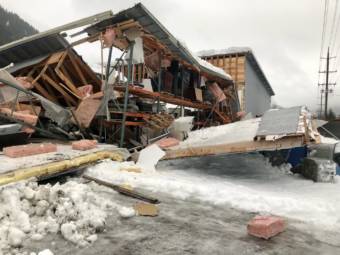
Capital City Fire/Rescue stands outside of a building where a roof collapsed in downtown Juneau. (Photo by Rashah McChesney/KTOO)

Juneau officials say the roofs of at least two buildings in Juneau have failed, apparently due to heavy snow loads as of noon Tuesday. Emergency responders confirmed both buildings were vacant.

One of the buildings is along Willoughby Avenue downtown. Property records show it’s a 7,200-square-foot commercial building owned by a trust based in California.

Its roof is caved in; beams are broken. The force of the collapse sent insulation up to 50 feet away.

Fire Chief Rich Etheridge said the arched roof was built with bowstring trusses.

“They can take a lot of structural load and it’s a cheap way to span long distances, but the problem is once they fail, they fail catastrophically like you can see here where they’re like, broken in half and just kind of shattered everywhere,” Etheridge said.

The water and electricity have been shut off. Etheridge said the city hasn’t been able to reach the building’s owner yet.

The other building is in the Lemon Creek area, behind Western Auto. It’s owned by a Juneau-based trust.

Juneau Emergency Programs Manager Tom Mattice had advice for property owners.

“Obviously, if you have a lot of snow on your structures, it’s a concern,” Mattice said. “But now is probably not the best time to be standing up on top jumping up and down on ‘em, either. So, these are difficult decisions to make.”

He said local firms with structural engineering know-how can give property owners a better idea of what to do.

“But, you know, if you’re hearing creaking and moaning? Good time to make sure you’re in a safe place,” he said.

Mattice said since the weather shifted, there have also been reports of nuisance flooding.

Josh Hunnel owns Aurora Maintenance Service. He says he’s got a waitlist with about 300 people on it who want help clearing their roofs. He says he hasn’t seen the roofs of any homes in town collapse – but he has seen some carports that have failed. 

Charlie Vice owns a three-bedroom, ranch-style house in the Mendenhall Valley. He says last week the house started making unfamiliar noises. He noticed new cracks going the length of his living room ceiling and in another room.

“You could hear the house settling, and it wasn’t the normal stuff with, you know, standard temperature changes,” Vice said. “It was – it was under a lot of stress. … So there was a lot of weight going on the trusses here, and it just kinda started to scare me.”

He cleared some snow off himself but ended up hiring help to finish ahead of the last storm. He says he paid two different sets of workers $600 total. 

The damage may not be limited to buildings. Juneau Harbormaster Matthew Creswell says two vessels sank last week due to weather, but none so far since the weekend storm and this week’s rain. He says his staff is keeping a close eye on all vessels and calling owners of boats riding low in the water.

Editor’s note: This story has been updated.

Newscast – Monday, Jan. 10, 2022

In this newscast:

  • Icy, hazardous conditions disrupt life all over Juneau
  • Another top-level Bartlett Reginal Hospital employee resigns
  • Juneau’s omicron wave of COVID-19 continues
  • The new COVID-19 variant is changing how the state gauges risk
  • Pre-filed bills aim to limit political campaign donations, limit legislators’ pay and change who runs the Alaska Permanent Fund Corp.
  • Alaska’s longest serving magistrate loses his job over writing partisan letters to the editor
  • Marine mammal biologists share lessons from their experience trying to nurse sick beluga whales back to health
Another winter storm could dump up to 2 feet of snow on Southeast Alaska

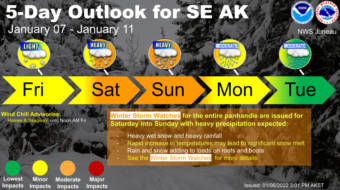
The Juneau office of the National Weather Service produced this image about upcoming weather from Jan. 6-10, 2022.

Another winter storm could dump up to two more feet of snow on Southeast Alaska this weekend. Then, the snowpack could get dangerously rain-soaked if the weather abruptly shifts as forecast next week.

Grant Smith is a meteorologist with the National Weather Service in Juneau. He said there are two weather systems converging in Southeast. Near the surface, we’ve been experiencing a cold and dry system. In the upper part of the atmosphere, a system from the south will bring warmer, wetter weather.

“So we’re going to have this fight between the warmer air trying to move in and move out, you know, the cold air that’s so settled in,” Smith said.

Forecasting how the two systems will interact comes with a lot of uncertainty. Ten to 24 inches of snow is expected to fall Saturday and Sunday. For the Juneau area, the transition to rain is predicted late Sunday or early Monday.

“And that’s gonna cause a lot of the snow in the area just to soak up all that moisture, and all that rain and water. And it’s going to add to structural integrity problems and potential flooding,” Smith said.

Flooding because drains all over are plugged up with older snow and ice. Juneau Emergency Programs Manager Tom Mattice said the city’s asking residents to help clear them out.

“Kind of like adopt a fire hydrant, you know?” Mattice said. “You know where there’s a drain in your neighborhood and you can get to it, make sure it’s free to process water, that’d be a good thing over the next few days.”

Juneau Streets Superintendent Greg Smith said it’s a time-consuming, labor-intensive process. He recommended using hand bars, shovels and chisels.

He said his office may also be able to help, though his crews already have their hands full.

The storm could also be a major problem for boat owners. Jeremy Norbryhn is the deputy harbormaster for Juneau Docks and Harbors. He said that snow this winter has already claimed at least one boat.

“So the one boat just got a bunch of snow on it. And uh, the owner was informed, and before he could get here, it sunk,” Norbryhn said. “It started to lean to the side, take on water, and it sunk in about 90 to 120 feet of water.”

He said harbor employees walk the docks periodically and will flag potential problems for owners, but owners should check and maintain their vessels themselves.

Meanwhile, hardware store employees in Juneau reported a run on snow removal gear, especially for snow rakes used to pull snow off of roofs.

“I’m sold out right now,” said John Joeright, an assistant manager at Ace Hardware in Juneau, as another phone ringing interrupted. “We’ve just had numerous calls all day long today.”

Weather-related shipping issues in the Seattle area have delayed restocking.

The city published some advice about assessing rooftop snow loads earlier this week. City officials maintain that it’s up to individuals to weigh the risk of shoveling their roofs against potential structural damage.

Nate Abbott is a building maintenance supervisor with the city. He said going into the weekend, his bigger concern is about water intrusion, rather than the sheer weight of snow on roofs. He said ice dams can form around roof drains and gutters, leading rain and snowmelt to reveal unexpected leaks.

Site notifications
Update notification options
Subscribe to notifications