Jeremy Hsieh

Local News Reporter, KTOO

I dig into questions about the forces and institutions that shape Juneau, big and small, delightful and outrageous. What stirs you up about how Juneau is built and how the city works?
Eaglecrest Ski Area is having a really tough time with staffing this year

Eaglecrest Ski Area lift ticket line
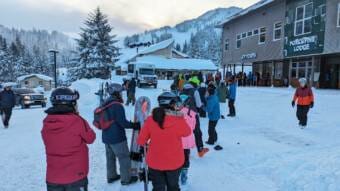
Skiers and riders line up for lift tickets and rentals at Eaglecrest Ski Area on Douglas Island on the morning of Dec. 11, 2021. Wait times were about an hour and a half, due in part to a staff shortage. (Photo by Jeremy Hsieh/KTOO)

On a Saturday in December, the line for lift tickets and rentals at Juneau’s city-owned ski area was about an hour and a half long. Eaglecrest Ski Area managers say there were several factors that likely contributed to the unusual line, including that they are short-staffed.

Labor shortages, especially for low-paying jobs, have been common this past year across many industries. On the mountain in Juneau, starting pay for lift operators, food service workers and others is below the state minimum wage.

On Tuesday, Eaglecrest Ski Area was closed. But there was a fresh dump of snow overnight and a few dozen cars were in the parking lot. A trickle of people came and went, with gear for skinning up the slopes while the lifts weren’t running.

“We just hiked to the top and wanted to get some fresh powder in,” said Jake Hamilton, who also worked as a lift operator at the ski area last season.

“I honestly didn’t know how much I was being paid when I started. … I didn’t ask,” he said with a laugh. “I just wanted to ski.”

Free skiing and free transportation to work are some of the job perks. But the lifts usually only run five days a week, his work week.

“I ended up quitting ‘cause I wasn’t skiing enough. I wanted to ski more.” Hamilton said. “The pay itself wasn’t enough to sustain a living.”

“Staffing has been an extreme challenge this year, much more so than previous years,” said Dave Scanlan, Eaglecrest’s general manager.

Scanlan and other city officials have been talking about the ski area’s unusual pay scale for months.

It begins at $8.50 an hour. That’s a $1.84 below Alaska’s minimum wage. The state minimum wage law doesn’t apply to government workers and Eaglecrest is city-owned. Eaglecrest does have to meet federal minimum wage, which is $7.25.

“So we do our best to fill people in higher positions as much as we can to be slightly competitive, but our entire wage scale is just so far below every other city department,” Scanlan said.

Like libraries, pools and other city services, the ski area’s budget doesn’t balance itself without taxpayer support. About $3 out of every $10 it takes to run the ski area comes from local taxes.

For the next ski season, Scanlan and his board of directors plan to ask the Juneau Assembly for enough money to bring entry-level pay up to the state minimum wage, and apply that same 22% increase up the entire pay scale. He said that would also bring Eaglecrest workers’ pay in line with industry norms around the country.

“So as you can imagine, there’s definitely a real financial impact to fixing this problem, and that’s kind of how we got into the position that we’ve been in,” Scanlan said.

For this season, board member Shawn Eisele said it’s possible there may be end-of-season bonuses if the ski area’s finances stay on the trajectory they’ve been on so far.

Eisele also spends a lot of time skinning and skiing on the mountain. He’s a little wistful about seasonal ski jobs.

“I mean, I think everybody who grows up skiing, like, thinks about being a ski bum at some point, right?”

He said that worked for a lot of people in the past, but times are changing.

“Particularly, like, you look at ski patrol, all the safety certifications they have to have and just – no matter which job it is, there’s a lot more responsibility that’s expected of people now,” Eisele said. “And so, it’s time to bring that up. And just with COVID, like, wages have risen everywhere in the last couple years, so you need to stay competitive.”

Eaglecrest’s leadership has also been working on big picture, long-term plans to expand operations on the mountain in a way that reduces or eliminates the burden on taxpayers. Ideas there include a lot of off-season activities, like lift-assisted mountain biking, ziplines and accessible activities for cruise ship visitors.

For the winter, Scanlan said there may be a way to operate seven days a week — which would also make living the ski bum dream a little more accessible.

COVID testing at Alaska airports to end after Jan. 31

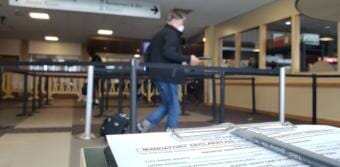
A traveler off of a flight from Seattle makes his way through a COVID-19 screening line at Juneau International Airport on June 26, 2020.
A traveler off of a flight from Seattle makes his way through a COVID-19 screening line at Juneau International Airport on June 26, 2020. (Photo by Jeremy Hsieh/KTOO)

The state is not renewing its contracts for COVID-19 testing at airports in Alaska. According to the Department of Health and Social Services, the last day for tests provided under these contracts will be Jan. 31.

The service is currently available at airports across the state. Earlier on in the pandemic, the state mandated testing for people coming to Alaska from out of state. At the end of April, testing became optional.

Since June  2020, the health department estimates that airport tests have detected more than 6,000 people with COVID-19.

A spokesperson said key department officials were out of the office and not immediately available for follow-up questions about why the contracts won’t be renewed.

Other comparable testing options are still available in communities, as well as home test kits, though those aren’t as sensitive as lab tests. At Ted Stevens Anchorage International Airport, for example, the health department started giving away home test kits to travelers on Nov. 30. Unrelated to air travel, Juneau has given away more than 14,000 home test kits.

President Joe Biden announced Tuesday that the federal government plans to buy 500 million at-home COVID-19 test kits and mail them to people who want them beginning in January.

The state health department said it does intend to continue offering free COVID-19 vaccines at airports through contractors. Through Tuesday, the department estimates 9,761 people have gotten vaccinated at Alaska airports.

Editor’s note: This story has been updated to clarify which agency provides home test kits at the Anchorage international airport. It is a program by the Department of Health and Social Services, not Ted Stevens Anchorage International Airport.

Newscast – Tuesday, Dec. 21, 2021

In this newscast:

  • No damage reported after a moderate earthquake strikes in Lake Clark National Park
  • A nonprofit report shows that federal COVID money pumped up federal grants to Alaska in 2020 by nearly a third
  • A Delta junction man accused of threatening to kill Alaska’s U.S. senators files paperwork to change his not guilty plea
  • Alaska’s top epidemiologist discusses the state’s status with the omicron variant
  • The Alaska Police Standards Council elects a chair without a law enforcement background for the first time in decades
  • The Alaska Wildlife Alliance publishes a report on people and dogs accidentally caught in traps
More than 14,000 home COVID-19 test kits have been distributed in Juneau

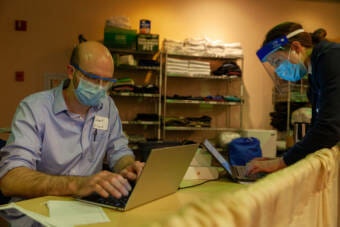
Juneau’s Emergency Operations Manager Robert Barr and Rebecca Embler, a member of Bartlett Hospital quality team during Juneau’s COVID-19 vaccine clinic at Centennial Hall in Juneau on Jan. 15, 2021. (Photo by Rashah McChesney/KTOO)

More than 14,000 home COVID-19 testing kits have been distributed in Juneau. But Deputy City Manager Robert Barr said the supply may be limited.

“This looks like enough to me, based on our burn rate, to carry us through the end of the calendar year,” Barr said. “The supply that we’re getting is kind of touch and go. We’re getting enough to basically keep our distribution sites up and running, but not really enough to feel super-comfortable about it.”

He said these kits, which each contain two tests, are generally provided by the federal government to the state, which then distributes them to local agencies.

Barr said these tests aren’t as sensitive as the ones done at the airport or at the city’s drive-thru testing site. So, if you have a COVID-19 symptom or are a close contact of someone who has tested positive and you test negative on your first at-home test, the guidance is to use the second one 36 hours later “to have that extra level of certainty,” said Barr.

On the other hand, false positives with these tests are very rare. He said people with symptoms who test positive can trust those results. At that point, the advice for what to do is familiar:

“Really, if you test positive for one of these, the advice isn’t any different than what it has always been if you test positive at all,” Barr said. “And that is to begin an isolation period.”

Newscast – Monday, Dec. 20, 2021

In this newscast:

  • Money from Congress’ bipartisan infrastructure bill is flowing to Alaska airports
  • Alaska Commerce Commissioner Julie Anderson is retiring in January
  • Boosters of the Alaska Native Claims Settlement Act point to NANA’s relationship with the Red Dog mine as a success story
  • An Alaska application is a finalist for federal grant money to boost marine farming and aquaculture
  • Juneau’s deputy city manager gives advice on how to use home COVID-19 test kits being distributed
  • The National Weather Service issues a winter storm warning and forecasts up to 7 inches of snow

The Alaska Legislature’s Capitol complex in Juneau has grown to a fifth city block

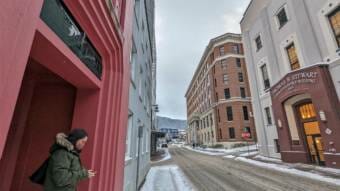
Assembly Building, Tom Stewart Building and Capitol
The Alaska Legislature now owns three of the four buildings at the corner of Seward and Fourth streets in downtown Juneau, pictured here on Dec. 17, 2021. The Juneau Community Foundation donated the Assembly Building, foreground left, to the Legislature in August. The Legislature also owns the previously donated Stewart Building on the right, and Capitol building itself down the street on the right. (Photo by Jeremy Hsieh/KTOO)

In Juneau, civic leaders are always wary of simmering sentiments to move the state capital. One strategy some organizations use to quiet those calls and to keep the legislative process running smoothly is to give downtown property away to the Legislature. 

Since statehood, the legislative branch’s footprint in downtown Juneau has gone from a single building to a five-block complex. Most of the additions were donations. The latest gift is a three-story building kitty-corner to the Capitol. 

The property is known as the Assembly Building. It has about 24,000 square feet of space plus underground parking. The Juneau Community Foundation bought it in August with its Juneau Capitol Fund. The local assessor’s office values it at nearly $1.5 million

Assembly Building
The Assembly Building, pictured here from an office in the Alaska Capitol, is three stories and has underground parking. (Photo by Jeremy Hsieh/KTOO)

Lawmakers think they can move some support offices there that are currently paying rent for space elsewhere. There’s also potential for apartments that would make finding temporary housing for legislators and staff easier. 

But before working on the particulars, a legislative committee had to vote to accept the gift. And during the discussion leading into that vote, of course it came up: some people don’t want the seat of state government to be in Juneau at all. 

“I don’t think we need an empire in Juneau,” said Sen. Lora Reinbold, a Republican from Eagle River. “I think that the road system is where the people are. And that the Legislature needs to have access to the people — I’m a big proponent of getting the Legislature out of Juneau and on to the road system.”

She had other concerns: Unknowns about the old building’s condition, unknown renovation costs, and her personal challenge of getting to and from Juneau after Alaska Airlines banned her

For Senate President Peter Micciche, a Soldotna Republican, the potential savings outweighed the unknowns. 

“This is a gift,” Micciche said. “We’re not agreeing to spend a penny. And without spending a penny, we could have substantial reduction in what we’re spending for other space right now.”

The capital complex is in Rep. Sara Hannan’s district. The Juneau Democrat said that adding the building won’t sway capital move supporters. But, she said, the potential apartments would make out-of-town legislators’ lives in Juneau easier, and quiet some of the gripes. There may be savings, there, too. 

“Now, when you translate it to specific dollars, it’s not a direct equation, apples to apples, because legislators currently get per diem to come here and find a place to stay,” Hannan said. 

Housing is particularly hard to find in Juneau when the Legislature meets outside of its regular sessions. 

The Legislative Council voted 10-4 to accept the property. 

Since then, Rep. Hannan has been leading a subcommittee working on the specifics of what to do with the building. It still has some rent-paying tenants with leases that expire next November. Hannan said significant changes or office moves are unlikely before that. 

KTOO has received funds from the Juneau Capitol Fund to support Gavel Alaska.

Site notifications
Update notification options
Subscribe to notifications