I dig into questions about the forces and institutions that shape Juneau, big and small, delightful and outrageous. What stirs you up about how Juneau is built and how the city works?
A view from the Goldbelt Tram of a Princess Cruises ship docked in Juneau on Aug. 31, 2021. (Photo by Jennifer Pemberton/KTOO)
Beginning next year, cruise ships must collect Juneau sales taxes for business that happens on board while they’re in Gastineau Channel.
That’s because the Juneau Assembly voted Monday to partially repeal a sales tax exemption for cruise ships in Juneau waters. City finance officials have said that if not for the exemption, the city would have collected an extra $1 million in sales tax revenue in 2019.
Juneau’s borders extend beyond Gastineau Channel, but city officials did not want to tax commerce aboard a ship that just happens to be passing through without actually making a stop in town.
The Assembly also passed a resolution intended for state lawmakers that says the city supports a sustainable fiscal plan that includes new taxes — but specifically opposes a statewide sales tax.
City officials think a state sales tax would pressure the city to lower its sales tax rate but make up for the lost revenue with higher property taxes.
Emissions from a Celebrity Cruises ship distort the air as it sails into Juneau in 2012. While docked, most cruise ships in Juneau have to keep burning fuel to generate electricity on board. (Photo by Ed Schoenfeld/CoastAlaska News)
Juneau officials have put a lot of time and effort into studying what it would take to let cruise ships plug into the local electric grid when they are docked in town. That way, the ships wouldn’t have to burn fossil fuels all day in the harbor to keep their lights on.
One privately owned dock was electrified 20 years ago. City officials think it’ll cost $25 million to electrify the two city-owned ones.
“Yeah, disappointed. Glad to see that so many of our Southeast neighbors were successful,” Schaal said.
The Department of Transportation did announce grants for similarly priced marine infrastructure projects in Cordova and Haines.
“I kinda just walked away in those three comparisons that the U.S. Department of Transportation chose to replace aging, failing infrastructure over improving new infrastructure, if you will,” Schaal said.
Still, Schaal thinks Juneau’s docks will be electrified, eventually.
“The value is pretty obvious, what it does for emissions and, you know, we have a very robust understanding of the fleet. And we know worldwide fleets are going more electrical,” he said.
The idea of assigning value to reduced greenhouse gas emissions is more than conceptual. For ranking purposes, the grant rules let communities calculate a dollar value for greenhouse gases that a project would offset. Schaal said that helped this project score well. And, it could be applied to other infrastructure grant opportunities to come.
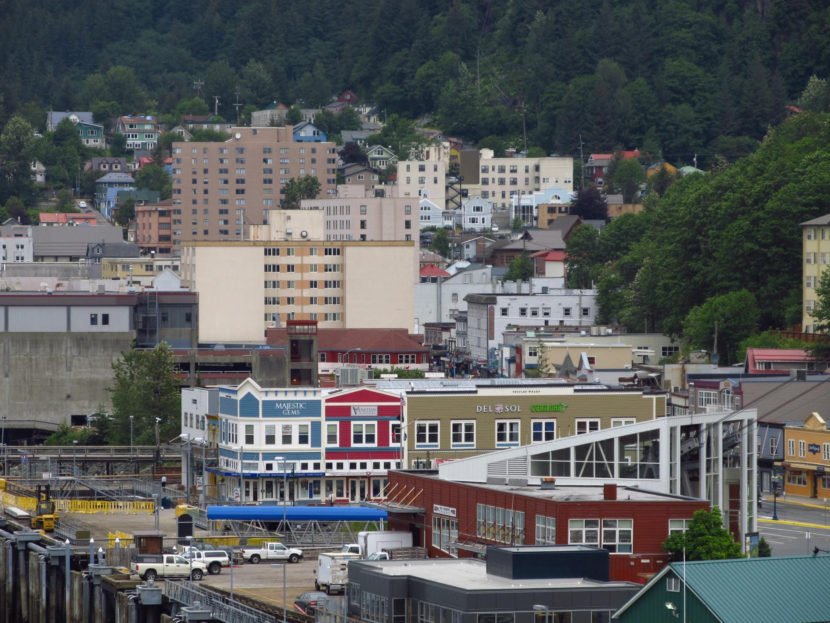
The view of South Franklin Street from aboard a cruise ship on June 20, 2011. (Creative Commons photo by Jasperado)
Panels of Juneau volunteers have heard appeals for 68 commercial property assessments this year. So far, the property owners have lost every case. Another 111 cases are unresolved.
The fight is mostly about whether the city assessor was legally justified to raise commercial land values in Juneau by 50% earlier this year. These values directly affect property tax bills and the balance of who pays for city services. Many of the property owners are committed to taking the fight to court.
A Juneau lawyer named Robert Spitzfaden is representing many of the commercial property owners contesting the jump in their land values. He’s been super-frustrated with the process, particularly with the time limits the city’s appeals panels have imposed on each hearing.
In one hearing on Oct. 21, a panel member tried to move the proceedings along when Spitzfaden ran out of time, and Spitzfaden objected.
“This is a constitutional issue! You are cutting us off before we can do our full testimony as you can clearly see,” Spitzfaden said.
A lot of Spitzfaden’s objections are specifically for the record; he’s talking to a judge in the future, who will hear the next appeal in state court.
At least twice, Spitzfaden has gone out of his way to insult the panels during the proceedings by calling them “a kangaroo court.” He’s essentially saying these hearings are just for show and impossible for him to win.
In at least one case, the appeal went extra bad for him. An internal review did reveal an error in the assessment. After it was fixed, Spitzfaden’s client owed almost $18,000 more in taxes on that property this year than if he hadn’t appealed at all.
Part of Spitzfaden’s frustration is that the panels are telling him he isn’t presenting enough evidence. His approach in these quasi-judicial hearings involves questioning expert witnesses, grilling the assessor’s office staff, and trying to find “gotcha” moments with questions referencing hundreds of pages of documentation. He said he isn’t getting enough time to get through his questions to get to that evidence.
In some hearings, lay property owners who presented their own appeals seemed to have more success with low-key, matter-of-fact explanations of why they think their properties were overvalued. At least one appellant was able to convince one of three panelists hearing his case to vote in his favor. Sharing otherwise private real estate or business records and highlighting apparent disparities between comparable nearby properties seems to resonate better with the panel members.
City Finance Director Jeff Rogers has watched a lot of the appeals hearings, which can run for several hours a night.
“My big takeaway from watching the hearings is that the public doesn’t well understand how a government assessment process works,” Rogers said.
That process is what Spitzfaden really wants to challenge. He wants to make a case that the assessor’s methodology that led to the mass increase in commercial land values was fundamentally flawed.
Earlier on, Spitzfaden and city officials discussed the possibility of holding some kind of group hearing for that argument. The city’s attorneys eventually decided that wouldn’t fit with city codes and it would be unfair to other appellants going through the regular process.
Rogers said it would also create practical problems. The city’s appeals panels are subsets of volunteers on what city and state codes call a Board of Equalization.
“It’s technically complicated under the law,” Rogers said. “So the BOE is required to produce a ruling and findings on every individually appealed parcel. So the question really for us on a mechanical basis was if we had a consolidated hearing, how would the Board of Equalization then make a ruling with findings on each individual parcel?”
Likewise, a group hearing would have muddied potential appeals to state court.
City officials maintain that the assessor’s methodology is sound, fits with state and professional standards, and is backed by decades of Alaska case law.
PeggyAnn McConnochie is a real estate expert, and one of Spitzfaden’s first clients to lose an appeal last month for a commercial building she owns. She’s also sort of a spokesperson for the group of property owners Spitzfaden is representing.
Property owners who lose these cases at the city level have 30 days to appeal to state court. As of Thursday, none had. McConnochie’s deadline is imminent. She said, “hell yeah” she’s going to court.
“There’s no way that I’m going to allow the Board of Equalization to limit the ability of the appellant to present a reasonable, cognizant case,” she said.
McConnochie’s extra taxes from this year’s assessment hike could easily be eclipsed by attorney’s fees.
“It’s not the short term that we’re looking at. It’s the long term,” she said.
City officials say this year’s increase in commercial land values is the first step toward correcting years of “neglect” in Juneau’s commercial property values. Next year, the assessor’s office intends to catch-up values for buildings and other improvements. For most commercial properties, neither had changed in a decade or more.
However, the values of other properties have increased in that time. Rogers said that means homeowners, for example, have been paying more than their fair share of the city’s taxes.
“I’m mad as hell,” McConnochie said. “As is many of us. It’s not going to be just a one-year fight. This is going to be a fight we’re going to take for two or three years.”
There is already a way to complain to the state assessor’s office about the local assessor’s process. That office hasn’t gotten any complaints about Juneau’s assessments this year.
Rogers said if all the property owners in the unresolved cases go through with appeals hearings, he expects the Board of Equalization may continue into February. Some cases, 31 so far, get resolved without hearings.
Disclosure: Reporter Jeremy Hsieh worked for PeggyAnn McConnochie’s business in the summer of 2012.