Jeremy Hsieh

Local News Reporter, KTOO

I dig into questions about the forces and institutions that shape Juneau, big and small, delightful and outrageous. What stirs you up about how Juneau is built and how the city works?

Juneau officials had to reject about 8% of all ballots they received for October’s local election

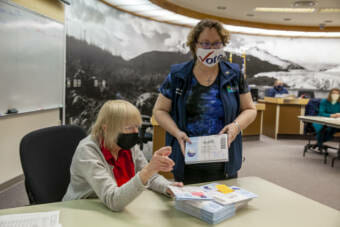
Deborah Behr confers with Juneau City Clerk Beth McEwen as the Canvass Review Board works to certify the local election on Oct. 19, 2021. The pictured ballots were mailed but not postmarked by the U.S. Postal Service and could not be counted. There were 359 of them at the time, but McEwen said more have trickled in long after the election was certified. (Rashah McChesney/KTOO)

Juneau election officials had to reject more than 700 ballots they received in the October municipal election.

Some ballots will inevitably be rejected in almost any election by mail because of human error, missed deadlines or other problems. But last year, issues with the U.S. Postal Service and local verification requirements led to the extraordinarily high rejection rate.

First off, the final tallies for all seven contests in Juneau’s October election were too lopsided for the rejected ballots to change any outcomes. The closest margin in any race was 916 votes, between Will Muldoon and Aaron Spratt in a school board race.

But for voters, or rather attempted voters like Breehia Mitchell, it still stings.

“So I voted in the election, my very first time with a mail-in ballot. Filled it out, double-checked it. I dropped it in the ballot box,” Mitchell said.

She said she’s voted in almost every election she’s been eligible for over the last 20-some years.

“Probably a couple weeks later, I got a letter saying that my signature didn’t match, could I please fill out this, that and this,”  Mitchell said.

That’s what election officials call a “cure letter.” These letters flag a disqualifying problem with a ballot and offer the recipient options to fix it. In Mitchell’s case, a pair of election workers trained in signature verification decided her signature on her ballot envelope didn’t match the one on file with the state Division of Elections.

Mitchell said she did the corrective paperwork and mailed it off. After the election was certified, she got another letter that said her ballot wasn’t counted because her signatures didn’t match. It’s not clear from the second letter if there was a problem with her most recent paperwork, or if election officials just didn’t get it in time.

“Uh, it made me feel pretty irritated. … What I really wanted to know was, how many other people got the letter?” she said. “You know, like, of the chunk of voters in Juneau, how many didn’t count, you know? 10%? 1%?”

City Clerk Beth McEwen heads up Juneau’s local elections. Data she provided shows election workers rejected about 8% of ballots.

“Very highly disappointing for both voters and for our office,” she said.

McEwen said more election mail kept trickling in long after the election ended, so the final numbers are a bit of a moving target. But in December, she broke down why each of the 700-plus ballots known at that time was rejected.

A handful came from ineligible voters: they were registered to vote in another community, or they sent in more than one ballot, or they weren’t registered to vote in time. A few envelopes were returned without a ballot inside, and a few more ballots were returned without the official election envelope.

About half were rejected because of a failure with the U.S. Postal Service. They showed up after Election Day without a postmark.

This happened to some ballots in the 2020 election, when voters paid their own postage in the city’s first election conducted by mail. But McEwen said it was a much bigger issue in 2021.

“Because our Assembly gave us direction that they wanted us to pay for the return ballots, this year (2021), we changed the envelopes so that it was business reply mail,” McEwen said.

That type of pre-paid postage normally is not postmarked. That’s because the main purpose of postmarks is to keep postage from being reused, like canceling a check. Business reply mail is pre-canceled.

However, a Postal Service spokesperson said there’s been a long-standing policy to postmark election mail, regardless of the type of postage on it, specifically because so many election laws rely on them.

What actually happened was some ballots got postmarked. A lot didn’t.

“But we didn’t learn that until after the fact,” McEwen said.

McEwen said she was in touch with local Postal Service officials before the election and didn’t expect it to be a problem.

The Postal Service referred questions to James Boxrud, a spokesperson based in Denver. In a written statement, Boxrud said, “We acknowledge that circumstances can arise that prevent ballots from receiving a legible postmark.”

He did not elaborate and did not respond to requests for an interview or tour of a local postal facility.

“Without a review of the actual mailpieces involved, the Postal Service is unable to comment further,” he wrote.

McEwen and the Postal Service said they are working together again to make sure the 2022 election goes more smoothly.

That still leaves another big bucket of 323 rejected ballots that were like Breehia Mitchell’s — ballots that had a problem with the voter’s signature or the piece of personal information used to confirm their identity. That’s a date of birth, an Alaska driver’s license number, voter ID number or partial Social Security number.

For comparison, election officials rejected about as many ballots statewide for those reasons in the 2020 general election — a tiny fraction of all ballots cast.

In Juneau’s election, at least 195 people included an incorrect personal identifier or left it blank on their ballot envelope.

State election workers don’t have to compare signatures with a signature on file. For local elections, the Juneau Assembly added that requirement before the city’s first election by mail in 2020.

It’s not clear why these were bigger problems in the city’s second one.

A state elections spokesperson said voters can request copies of documents with their reference signature and update it with a registration form or an absentee ballot application.

Breehia Mitchell said next time, she just plans to vote in person.

“I mean, I’m not, like, bitter or anything. But I wouldn’t vote like that again,” she said.

McEwen said she has some ideas to reduce the number of ballots rejected, like making more ballot drop boxes available. Other proposed election changes will eventually go to the Juneau Assembly for consideration.

Juneau’s indoor mask mandate is back amid latest COVID-19 surge

Carrs-Safeway in Anchorage sells disposable face masks on Feb. 1, 2021. (Photo by Hannah Lies/Alaska Public Media)

People in Juneau must mask up in indoor public spaces again. Masks must also be worn in outdoor public spaces when it’s crowded. 

That change comes after Juneau emergency officials on Monday raised the city’s COVID-19 risk level to “modified high” amid an ongoing wave of new cases. 

State health officials reported 190 Juneau residents and visitors tested positive for the virus from Dec. 29 to Jan. 2. Those case rates continue the trend city officials reported last week — and they don’t include cases detected through home test kits

Deputy City Manager Robert Barr said city officials made the decision to raise the risk level after seeing those numbers. He said the main concern for now is the effect isolating and quarantining are having on staffing. 

“Our hope is to curb transmission enough such that businesses, government services, and the hospital remain sufficiently staffed for operations during this particular wave,” Barr wrote in an email.

Two people are currently at Bartlett Regional Hospital with active cases of COVID-19. 

Schools remain closed this week to students for winter break. 

Juneau officials last changed the city’s COVID-19 risk level on Dec .13. At that time, they nudged the city’s risk level down to moderate, which suspended most indoor mask requirements for people who are fully vaccinated.  

Statewide, health officials reported 2,872 new COVID-19 cases from Dec. 29 to Jan. 2.

What Alaska’s move to more home COVID tests and fewer lab tests means for managing the pandemic

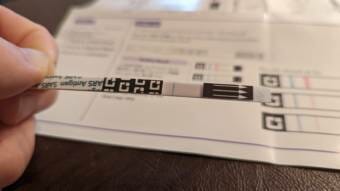
OTC at-home antigen test strip negative
A single blue stripe on a strip from a QuickVue At-Home OTC COVID-19 Test kit indicates that no proteins from the virus that causes COVID-19 were detected in a swab taken from someone’s nostrils. (Photo illustration by Jeremy Hsieh/KTOO)

As the omicron variant of the coronavirus spreads in Alaska, state public health officials say their systems for monitoring and responding continue to adapt to the latest science, the needs of Alaskans and the resources available. Deciding to end free, COVID-19 lab tests for travelers at airports was just one piece of that.

It’s part of a wider push to use more rapid, at-home test kits in general, which impacts other public health systems officials have been using to manage the pandemic.

“And so this is part of communicating and sharing with the public the transition that we are going through,” said Heidi Hedberg, the director of the state’s Division of Public Health.

She used the word “transition” seven times during our interview.

The upshot of home rapid tests is they’re faster, more convenient and much less expensive than lab tests. Hedberg said the cost of a lab test works out to about $62, while a two-test antigen kit costs between $15 and $25.

The downside is that these tests, also referred to as antigen tests, aren’t as sensitive. So you’re really supposed to use both tests in a given kit over 36 hours to be confident about a negative result.

Also, Hedberg said there’s no built-in way for the state to find out if one of these tests comes out positive; a case caught through a home test is only captured in the state’s pandemic data if it’s voluntarily reported.

That means case count data won’t necessarily be complete. But state epidemiologist Dr. Joe McLaughlin said lab tests aren’t going away, which do feed into state case counts. That data is still valuable to track case trends over shorter periods of time.

To assess risk, there is other data, which the state intends to keep reporting three days a week.

“The data on hospitalization and death really won’t change,” McLaughlin said. “That will still be robust data that we will still use to help also monitor morbidity and mortality rates.”

In Juneau, for example, the head of the city’s pandemic response, Robert Barr, said he’s putting more weight on how burdened the medical system is. Early on in the pandemic, high case counts necessarily meant higher hospitalizations and deaths. But at this point, more effective treatments are available, and vaccines and prior infections mean there are fewer severe cases.

In other words, communities can tolerate higher case counts now than they could in 2020.

The convenience of home test kits also comes with the responsibility of tracing one’s own contacts.

“We’re really relying heavily on Alaskans to do the right thing, with respect to self-isolation if you’re positive, following the guidance there,” McLaughlin said. “And then notifying their own close contacts if they do come up positive so that those close contacts can appropriately quarantine if they’re unvaccinated.”

The supply of home tests has shot up over the last year, but so has demand.

“But we also know that there’s going to be limited supply chain constraints on occasion,” Hedberg said. “You know, that’s just part of this pandemic and what we have been experiencing over the past two years. … I anticipate that that’s going to continue in 2022.”

Hedberg said retailers also have home kits for sale, and more market options may be coming.

“We’ve heard from a lot of the private sector that they’re really interested in really establishing their own business and offering these antigen tests at low cost,” Hedberg said. “Which is really great, from a public health standpoint. We want to ensure that there is access to testing.”

Meanwhile, the total confirmed count of COVID-19 cases caused by the fast-spreading omicron variant in Alaska is up to six, as of Tuesday afternoon.

“We’re bracing for an omicron wave,” McLaughlin said. “Many states in the U.S. are already dealing with a substantial omicron wave. … Our hope is to get through that wave as quickly as we can. The best way to prepare for it is to get vaccinated if you’re not already vaccinated. To get boosted, get a booster dose of the vaccine if you’re eligible.”

Health authorities say that vaccination and prior infection aren’t proving as effective at preventing infection from this variant, but they do still appear to protect against severe illness.

“People need to be pretty vigilant about masking, social distancing, avoiding crowds. I would say even more vigilant than we were with other variants,” McLaughlin said.

He said it’s also time to step up our masking practices.

“With masking, probably just a single-layer cloth face covering is not going to be good enough to help prevent infection,” McLaughlin said. “It might help a little bit, certainly when somebody is coughing or sneezing, it really does stop those larger respiratory droplets from getting out into the air. But it’s better to have a two-ply mask.”

McLaughlin said it’s important that masks fit well. The better the fit, the better the filtration. For crowded, high-risk situations, McLaughlin recommended N95 respirators, which are no longer in short supply.

There have been some indications that the omicron variant may be less dangerous than earlier variants. But McLaughlin said it’s too soon to conclude that.

“Some of the studies coming out of South Africa suggest that it may be a milder illness,” he said. “Some of the early studies out of the U.K. and Denmark suggest that it might actually be roughly equivalent to delta, with respect to hospitalization rates. So at this point, it’s really just too early to say. There are too many variables that really haven’t been teased out in the epidemiologic studies.”

At some point, McLaughlin said these coronaviruses will eventually become endemic.

“It will be a part of the whole group of respiratory viruses that we deal with on a regular basis. … We will eventually develop such a high level of prior immunity through vaccination and through prior infection, the virus will likely continue to morph and change over time,” he said. “The hope is that it changes in the direction of becoming less and less virulent over time.”

But for the foreseeable future, McLaughlin and Hedberg said the state’s emergency management systems are not scaling back, just transitioning.

Newscast – Tuesday, Dec. 28, 2021

In this newscast:

  • Wintry weather and omicron-related staff shortages lead Alaska Airlines to cancel hundreds of flights in and out of Seattle
  • Sealaska Heritage Institute gets a $2.9 million grant to help fund a totem pole trail along Juneau’s waterfront
  • KTOO’s Jennifer Pemberton recounts Juneau’s most impactful stories of 2021
  • Coast Alaska’s Jacob Resneck looks back at the fight over the Tongass National Forest’s Roadless Rule
  • Kodiak Island sets a record for the warmest December temperature in the state
  • A space technology company says Unalaska is a finalist for its satellite launch facility
At-home COVID-19 test kit supply running low in Juneau

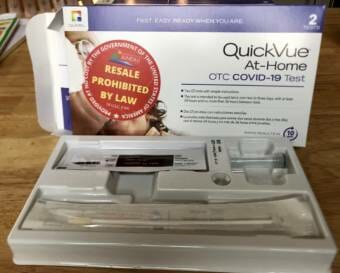
An opened box containing an at-home COVID-19 test. A plastic tray inside includes a long nasal swab, a small tube with liquid, and a test strip in a plastic sleeve.
An at-home COVID-19 test kit manufactured by Quidel and distributed for free by the City and Borough of Juneau in December 2021. (Photo by Jennifer Pemberton / KTOO)

The supply of at-home test kits that local health officials have been distributing for free around Juneau is running low. 

By Monday afternoon, all three branches of Juneau Public Libraries had run out. The Juneau Police Department, Juneau Public Health Center and cash office at City Hall all reported still having some kits on hand. Workers at the public health center and City Hall said they are likely to run out soon. 

Deputy City Manager Robert Barr said that demand has ramped up within Alaska and across the country for these kits, and the supply chain has not kept up. He said Juneau’s been getting a pallet or two of the kits a week from the state. Each pallet has 1,100 to 1,200 kits, and each kit contains two tests. The next shipment is expected later this week.

Newscast – Monday, Dec. 27, 2021

In this newscast:

  • The supply of at-home COVID-19 test kits being distributed for free in Juneau is running low
  • U.S. Attorney General Merrick Garland has temporarily appointed someone to be the U.S. attorney for Alaska
  • Coast Alaska’s Jacob Resneck recounts the Alaska Marine Highway System’s ups and downs this year
  • Two buildings’ roofs collapse in Delta Junction after a winter storm
  • The National Weather Service expects two winter storms to hit Southeast Alaska this week
Site notifications
Update notification options
Subscribe to notifications