Jeremy Hsieh

Local News Reporter, KTOO

I dig into questions about the forces and institutions that shape Juneau, big and small, delightful and outrageous. What stirs you up about how Juneau is built and how the city works?
Newscast – Monday, Oct. 25, 2021

In this newscast:

  • Juneau’s Systemic Racism Review committee has begun making formal recommendations
  • The latest local COVID-19 updates and numbers
  • Fairbanks Memorial Hospital sets up a mobile morgue
  • Alaska cold case investigators name another woman murdered by a notorious serial killer in the 1980s
  • Republican Nicholas Begich III challenges longtime Alaska Congressman Don Young
  • The federal files asks for public comment on another draft environmental impact statement for an oil and gas lease sale in Cook Inlet

Juneau committee reviewing systemic racism in new laws makes first recommendations to city

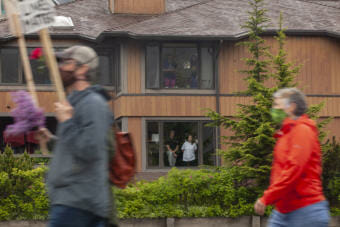
More than 400 people attended a rally in support of black community members and black people nationwide on the 11th day of protests against police violence and systemic racism following the death of George Floyd who was killed while being taken into custody by Minneapolis Police in late May. After marching from Marine Park to the roundabout on Douglas Island, demonstrators threw hundreds of flowers into Gastineau Channel during a rally on Saturday, June 6, 2020, in Juneau, Alaska. The event was not advertised and instead spread by word-of-mouth through the community. (Photo by Rashah McChesney/KTOO)
More than 400 people attended a rally in Juneau in support of black community members and black people on June 6, 2020, following the death of George Floyd in  Minneapolis. The Juneau Assembly created its Systemic Racism Review Committee in the aftermath of racial reckonings across the nation. (Photo by Rashah McChesney/KTOO)

The advisory committee that the Juneau Assembly put together to flag systemic racism in its legislation has begun making formal recommendations. So far, the committee has officially finished reviews of 11 pieces of legislation.

The committee hasn’t flagged anything actionable yet, but there are early signs that the group may be shaping how city policies get made.

The Juneau Assembly created the committee last year, amid the racial reckonings across the country. The six-person panel met for the first time back in April. Over the last six months, members went through a sort of crash course on what the City and Borough of Juneau does and what typical ordinances and resolutions look like. And it wrote a questionnaire for city staffers to help evaluate them.

The questionnaire asks things like, who would the legislation impact? What are some unintended consequences? Are there ways to gauge if there is inequality?

Now, the committee is reviewing the Assembly’s legislation as it comes up. It’s mostly been housekeeping measures that have to do with accounting.

One exception? The committee reviewed an ordinance to use $24,000 of grant funding to survey and inventory buildings in a particular downtown neighborhood. Planners from the city’s Community Development Department who worked on it took committee members’ questions.

“How was it that this area that we’re talking about was selected?” committee member Grace Lee asked.

The planners explained. There’s a long thread that eventually leads up to a Juneau Assembly goal to increase the availability of housing in Juneau. The building survey is required for an application to get the neighborhood added to the National Register of Historic Places. Which would give the owners of about 87 buildings new opportunities for tax credits and renovation grants. Which might nudge those owners to rehab vacant space in those buildings, and turn them into downtown housing.

“One thing that would be helpful in a situation like this is to see maybe the breakdown of the races of the homeowners,” Lee told the planners.

There is census data. But that’s for residents. There is no easy way to get race data for the property owners who would most directly benefit.

Planner Alex Pierce offered the committee one more unknown.

“It’s hard to know who the beneficiaries will be in the future, and how that might change the racial makeup of the neighborhood,” she said. “We don’t have good answers to that. But it’s certainly another consideration, and another piece of this to muddle through.”

Before, staffers and policymaking officials rarely discussed race and equity. Now, the Systemic Racism Review Committee forces city staffers to think about and discuss race and equity before the Juneau Assembly votes on something.

Lisa Worl, the committee chair, said the limited information gives her some concern and anxiousness.

“I would like to have a lot more data available. So hopefully that’s something we will continue to build on,” Worl said. “As we continue to work through, these are areas I can see that may be a challenge — not just this particular ordinance, but for many.”

The committee gave the ordinance a thumbs up. It also sent the Assembly a recommendation to gather more race data about neighborhoods affected by legislation in the future.

In related news, one of the Systemic Racism Review Committee’s original members resigned last month. David Russell-Jensen said he just had too many commitments to keep up with.

People interested in serving can apply through the city’s boards and commissions website.

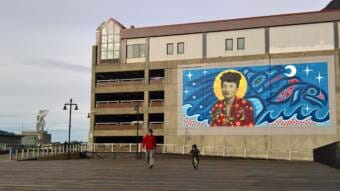
Juneau officials might rename this public space ‘Peratrovich Plaza’

Erick Heimbigner keeps an eye on his son, 4-year-old Emmett Heimbigner, as he practices riding his bike at the Archipelago Lot along Juneau’s Seawalk on Oct. 21, 2021. Juneau Docks and Harbors officials want to rename the lot “Peratrovich Plaza” after the Alaska civil rights leader and the subject of the mural behind them. (Jeremy Hsieh/KTOO)

On Thursday, 4-year-old Emmett Heimbigner was doing some wobbly laps on a bike that recently got pedals.

“I am Emmett, and I’ve learned to ride a bike, and I haven’t done it by myself,” he said.

His dad was keeping an eye on him, and so was Alaska civil rights leader Elizabeth Peratrovich — in the giant, three-story mural behind him. Emmett didn’t recognize her, but the decked-over lot along Juneau’s Seawalk could soon be renamed for her: “Peratrovich Plaza.”

Right now, this prominent public space is called “Archipelago Lot 2A.” Few people know it.

Officials with Juneau Docks and Harbors think Peratrovich Plaza is a better name that fits with the new public art. It would also help teach throngs of cruise ship visitors a little about Alaska civil rights history.

The archipelago name seems to come from a boring legal description of the property. Kirby Day, who’s worked for the cruise industry in Juneau for decades, said it’s not well known.

“When you say ‘Archipelago Lot’ no one really knows what that is or what that means,” he told the Docks and Harbors Board on Wednesday.

That checked out with people walking by during the lunch hour on Thursday. Emmett’s dad, for example, didn’t know the archipelago name but knew Peratrovich.

Docks and Harbors officials want to rename the lot, both to fit with the new mural that was finished in September, and to help people get around the waterfront better.

“There’s a natural flow to naming it Peratrovich Plaza, given the mural’s existence there,” said board member Mark Ridgway. “And we’re talking about people who are just walking off of a boat. I’d like it better than, say, ‘the Norwegian Nook’ or ‘the Carnival Corner’ or ‘the P&O Outlook.’”

A board committee voted 7-1 on Wednesday to recommend the Juneau Assembly formally change the name.

Paul Grant voted no. He said he’s an “unreserved admirer” of Peratrovich but thinks she’s already well-known and recognized in Alaska. And he said the public ought to be more involved in picking a name. The board did get one letter about the name change, asking that it be named for miners or fishermen.

Ray Wilson was also walking the waterfront on Thursday. The Lingít elder has lived in Juneau most of his life and wears a hat that says “Native veteran.”

Ray Wilson poses for a photo on Juneau’s Seawalk on Oct. 21, 2021. Wilson, who is Lingít, says including Elizabeth Peratrovich, the Alaska civil rights leader that is the subject of the mural behind him, in Juneau history would be a big step toward recognizing Alaska Native people. (Jeremy Hsieh/KTOO)

“I think for a long time, the City of Juneau hasn’t recognized Native people,” Wilson said. “And haven’t given them enough credit for what they do and what they put into the pot, so to speak.”

Wilson also has a fuzzy memory that he might be a distant relative of Elizabeth Peratrovich.

“To include Peratrovich in Juneau history is a big step towards recognizing Native people,” Wilson said.

Before the recommendation goes to the Juneau Assembly, the Docks and Harbors Board has to vote on it at one more meeting.

Correction: An earlier version of this story misstated Ray Wilson’s age. The Lingít elder will turn 89 in December.

Expect limited supply when COVID vaccine rolls out for kids age 5-11, Juneau officials say

Capital City Fire/Rescue career staff assemble for a pop-up clinic for COVID-19 vaccinations at the downtown fire station in Juneau on Dec. 17, 2020.
Capital City Fire/Rescue career staff assemble for a pop-up clinic for COVID-19 vaccinations at the downtown fire station in Juneau on Dec. 17, 2020. The vials of vaccine must be diluted with saline before injection. (Jeremy Hsieh/KTOO)

Updated — Wednesday, Oct. 20, 12:30 p.m.

Juneau officials say local COVID-19 numbers are still bad.

The delta variant-fueled wave had shown signs of falling a week ago. But during the COVID community update on Tuesday, City Manager Rorie Watt said it now appears to be plateauing at an uncomfortably high level.

“Our numbers are high,” Watt said. “If you look statewide, they’re lower than the rest of the state, but they’re not good numbers. They’re not numbers we’d have been satisfied with at any point earlier in the pandemic. They are quite high for our historical context.”

To date, officials report COVID-19 has killed 12 residents and put 132 people in Bartlett Regional Hospital. Four people are in the hospital with COVID-19 now. 

There is good news on the horizon. Officials said they expect federal authorities to expand vaccine eligibility to children ages 5 to 11 in early November. There are about 2,800 children in Juneau in that group.

Young children are less likely than adults to get severe cases of COVID-19. But they’re still transmitting the virus, especially within households.

The anticipated eligibility expansion is specifically for the two-shot, Pfizer-BioNTech vaccine. It will be delivered in smaller doses than adults get. The company says results of a large-scale trial show that it’s safe and effective for these younger children. Regulators are reviewing the data.

Deputy City Manager Robert Barr said to expect supply constraints when the vaccine first becomes available for younger children.

“We don’t expect to receive as much as we would request,” Barr said. “Right now at least, it looks like it’ll be a little similar to how adult vaccines originally rolled out.”

Barr said federal regulators may limit the expansion to higher risk children first. He said to expect the Food and Drug Administration and Centers for Disease Control and Prevention to share more on that next week.

April Rezendes is a nurse with the state’s local Public Health office. She said when the final approval comes, the roll out will be fast.

“It’s going to look a little different for kids because we know kids are different,” she said. “They don’t always want to walk through Centennial Hall, sit in a crowded space and just sit there for their shot. So a little bit more private space, comfortable settings.”

That means using schools, pediatricians’ offices and nurses who are used to vaccinating kids.

Emergency officials’ COVID risk assessment of Juneau remains at level 3, high, due to high case rates and other risk factors. The indoor masking requirements, social distancing and capacity limits have been in place since the end of July.


Original story — Tuesday, Oct. 19, 3:32 p.m.

A state Public Health nurse and the City and Borough of Juneau’s two top administrators will hold a COVID-19 community briefing at 4 p.m. today.

You can participate through the Zoom videoconference online or by calling 1-253-215-8782 or 1-346-248-7799 with the webinar ID 985 6308 5159. You can also watch here, or on the city’s Facebook Live page. The public can email questions in advance to COVIDquestions@juneau.org.

Emergency officials’ COVID risk assessment of Juneau remains at level 3, high, due to high case rates and other risk factors. The associated indoor masking requirements, social distancing and capacity limits have been in place since the end of July.

Vaccines are readily available in the community for people age 12 and up. Officials say that’s likely to change soon, after the federal authorities expand vaccine eligibility to children ages 5 to 11. There’s about 2,800 children in Juneau in that age group. The expanded vaccine authorization is expected to roll out in November.

To date, officials report COVID-19 has killed 11 residents and put 129 people in Bartlett Regional Hospital.

Officials certify Juneau election results just in time for school board meeting

Tami Burgett signs off on a set of ballots as the Canvass Review Board works to certify the local election on Tuesday, Oct. 19, 2021, in Juneau, Alaska. (Photo by Rashah McChesney/KTOO)

Getting sworn into office is a little trickier during a hybrid meeting that’s happening in person and virtually, but Juneau Superior Court Judge Amy Mead made it work for the newly elected and re-elected members of the Juneau Board of Education on Tuesday night.

Mead swore in new members Will Muldoon and Amber Frommherz, and Elizabeth Siddon, who was re-elected to her second term and will continue to be the board president.
The new members replace Kevin Allen and Paul Kelly, who did not seek second terms on the board.

Juneau officials had just announced the certification of the election results. The overall vote count in the official numbers are up 27 from the last count. The additional votes did not affect the outcome of any races. 

Two reelected incumbents and one new member of the Juneau Assembly will be sworn in on Monday.

Correction: The photo caption has been updated to correct the spelling of Tami Burgett’s last name.

For the first time in decades, a write-in candidate in a local Juneau election appears to have won

Will Muldoon is a write-in candidate for Juneau's school board.
Will Muldoon joined the race for Juneau’s school board as a write-in candidate and appears to have won. (Photo courtesy of Will Muldoon)

A write-in candidate appears to have won a local Juneau election for the first time in 29 years.

The latest unofficial election results that city officials published on Friday show Juneau Board of Education candidate Will Muldoon with a lead of 913 votes over the next closest candidate, Aaron Spratt.

More votes could be added to the final tally, but not enough to change the outcome of this race or any of the others that were on the ballot.

Meaning, incumbent school board President Elizabeth Siddon and newcomer Amber Frommherz still appear to have handily won their races for school board.

Likewise in Juneau Assembly races: Barbara Wáahlaal Gíidaak Blake and incumbent Michelle Bonnet Hale have insurmountable leads in their races. Incumbent Mayor Beth Weldon was uncontested.

So far, 78% of votes counted support extending some of Juneau’s sales taxes into 2027. The revenue is intended to pay for some core city services and city infrastructure.

The last time a write-in candidate won a local Juneau election was in 1992. Sally Rue successfully mounted an eight-day campaign for the Juneau Board of Education.

The 2,108 additional ballots added to the unofficial tally on Friday brings voter turnout to a 30.7%. That’s down 12 percentage points from last year’s 20-year high.

Another 300-plus ballots could potentially be added to the final tally. Those are ballots the city received, but that were missing a signature or some other validating piece of information. The people who sent these should have gotten a letter from election officials with ways to fix it. They have a deadline at 9 a.m. Tuesday to “cure” their ballots and have them counted.

The Canvass Review Board is scheduled to begin work certifying the election results on Tuesday. Final election results are expected within three days unless someone formally challenges the results.

Correction: An earlier version of this story misstated that Ibn Bailey was the candidate with the next closest votes to Will Muldoon. It was Aaron Spratt. Spratt overtook Bailey in the latest unofficial election results.

Site notifications
Update notification options
Subscribe to notifications