I dig into questions about the forces and institutions that shape Juneau, big and small, delightful and outrageous. What stirs you up about how Juneau is built and how the city works?
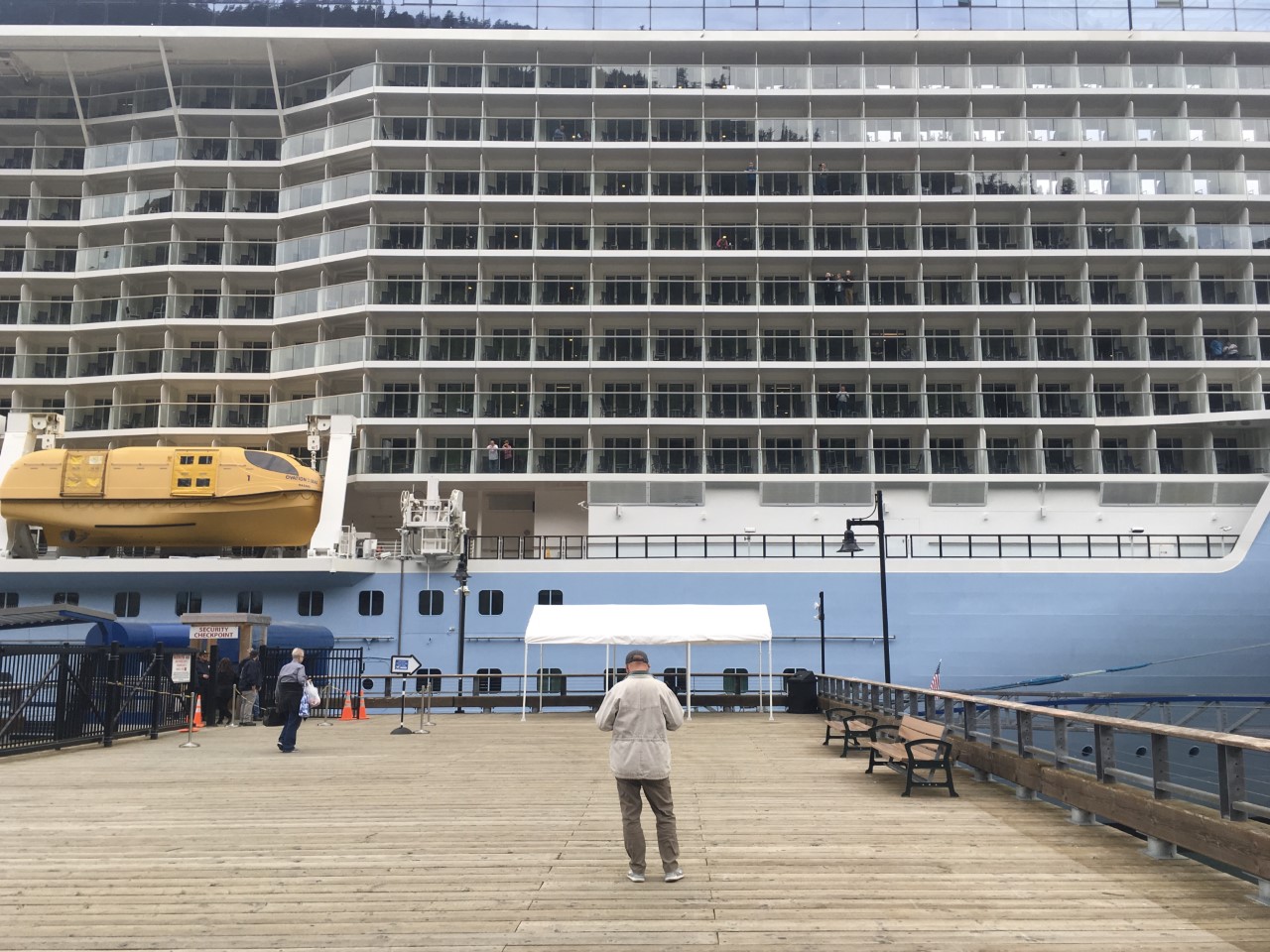
A passenger stands on the dock in Juneau near the Ovation of the Seas cruise ship on May 19, 2019. (Photo by Ryan Cunningham/KTOO)
Public opinion surveys on tourism in Juneau are wrapping up Friday and the results are likely to influence how local policymakers try to manage the visitor industry — big cruise ships especially.
Alex Pierce with the Juneau’s Community Development Department is working on the city’s Visitor Industry Task Force recommendations. This survey was one of them. She said the city used to do similar surveys more frequently in the 1990s and early 2000s.
“Recognizing that that data was really helpful for us, we resurrected the survey with the intent of some of the questions remaining the same so that we could compare data year over year,” she said.
Some of the holdover questions from older surveys are about people’s opinion on the industry’s impact on them. Overall, and in terms of crowding, vehicle congestion and noise.
The survey also asks fresh questions about hot-button cruise ship topics: possible limits on cruise ship traffic, Norwegian Cruise Line’s plan to develop a fifth large cruise ship berth. And, a possible ban on “hot-berthing” at the two big floating docks the city owns. Hot-berthing is when more than one ship uses a berth in a single day.
Pierce said the city paid McKinley Research about $34,000 to conduct the survey. Results should be released next month.
City officials could use survey results to back up decisions on Norwegian’s plan for a new dock. One leverage point has to do with an existing, long-term land-use plan that may not allow for Norwegian’s new dock. Pierce said after the survey results are out, city staff will draft changes to that plan for elected officials to consider.
“For whatever reason, we haven’t been as proactive as we could or probably should have been for the last decade and a half or so,” Pierce said. “So creating this position is really an effort to be more proactive and engaged in tourism management issues.”
The person is also expected to run with other visitor industry task force recommendations. Like taking a more active role in scheduling ship visits at city-owned docks, creating new rules for tour permits on city streets and sidewalks, and encouraging tour operators to stick to standards for environmental stewardship, sustainability and community impacts.
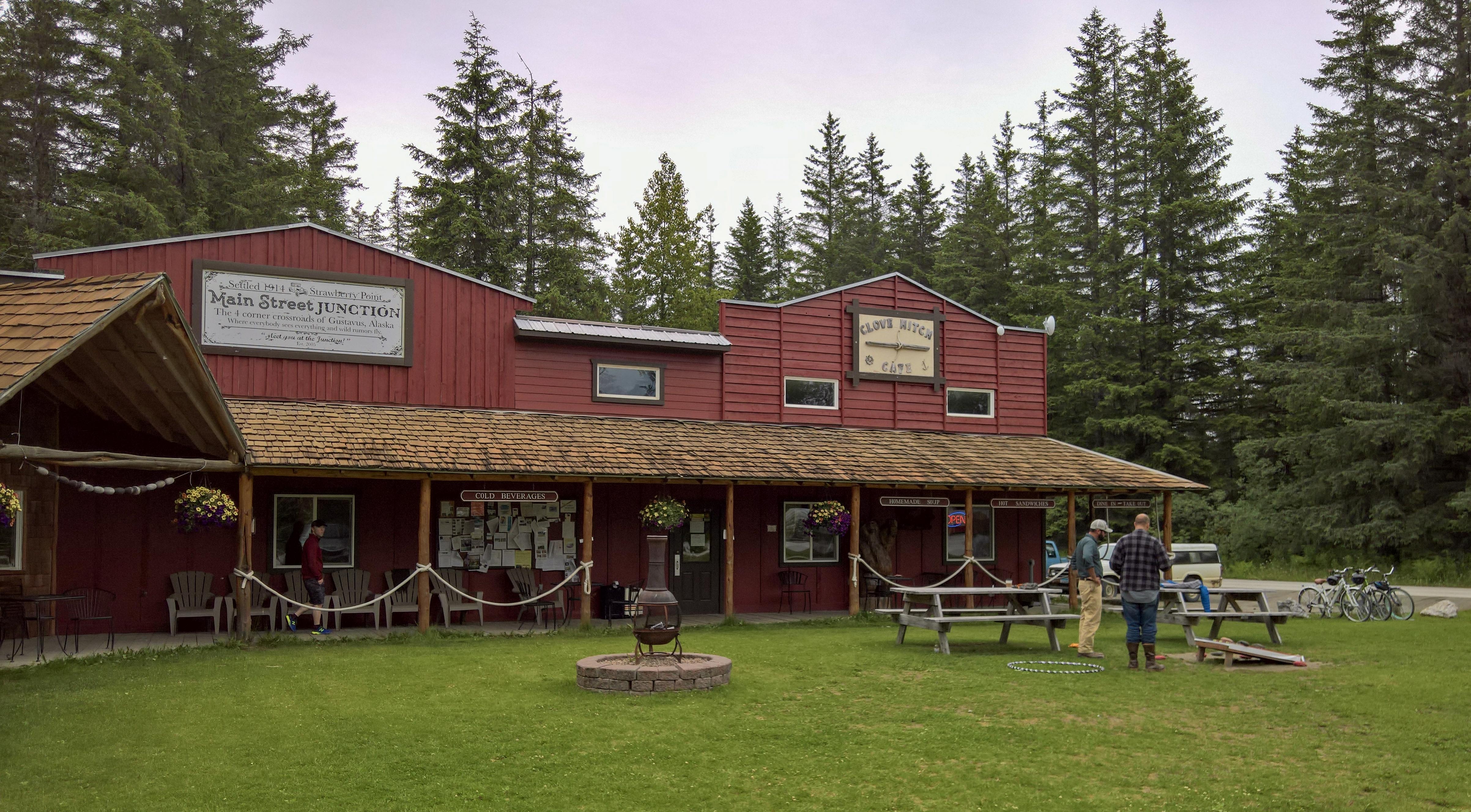
Four Corners, pictured here on June 29, 2017, is Gustavus’ most prominent intersection. Alaska Power & Telephone Co. will shut off power to most of the town on Wednesday so it can install a new switch at the intersection. (Photo by Jeremy Hsieh/KTOO)
Power is expected to be out across most of Gustavus on Wednesday as electric utility workers upgrade some infrastructure.
Alaska Power & Telephone Co. Operations Manager Darren Belisle said to expect power to be out from 8 a.m. to 8 p.m. while a new switch is installed that feeds the town. The work will be done at the Four Corners intersection.
The school, library, airport, post office and residents of Same Old Road will not be affected.
Belisle said the outage will be disruptive, but there was no alternative. He said the upgrade will improve reliability, and make restoring power after future outages quicker and safer.
City Administrator Tom Williams said landlines shouldn’t be affected, though mobile phone service and other communications may be.
“City Hall will be closed. We won’t have any power. So heat, lights, internet — will pick up service on Thursday,” Williams said. “We know this is infrastructure that has to be updated or repaired, so uh, part of living out here in the bush.”
Gustavus City Hall is normally closed on Fridays but will be open this Friday to make up for the outage day.
Gustavus emergency services will be running on backup systems.
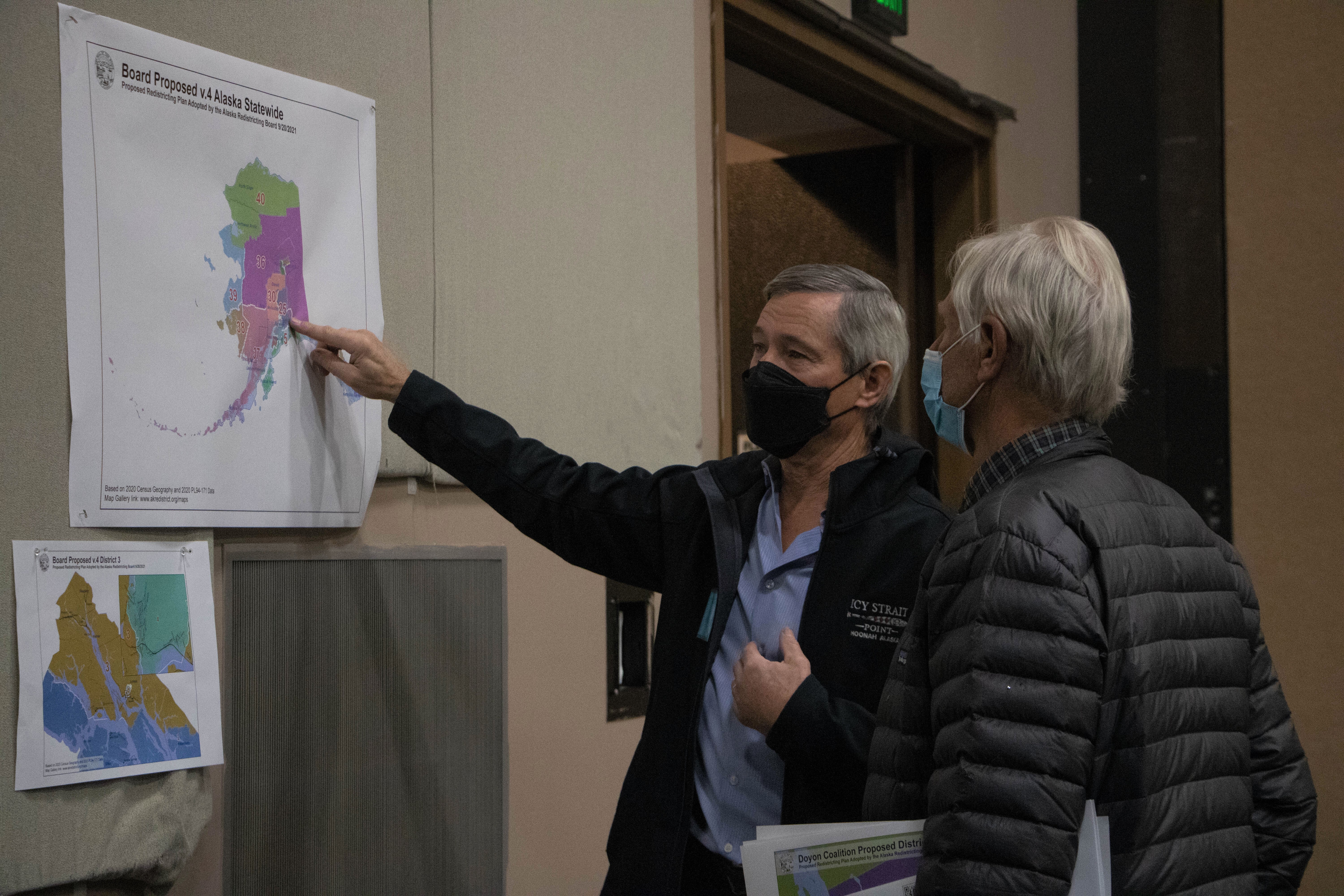
Alaska Redistricting Board Chairman John Binkley talks with Juneau resident Reed Stoops during a redistricting open house event at Centennial Hall in Juneau on Monday. (Photo by Lyndsey Brollini/KTOO)
Members of the state board in charge of redrawing Alaska’s legislative districts got an earful from Juneau residents Monday. It was the first in a series of public hearings around the state.
The appearance of partisan gerrymandering at the expense of local incumbent Democrats preoccupied much of the event.
The event was intended to be an open house, with lots of options for people to send the Alaska Redistricting Board comments without getting in front of a microphone for all to hear. But the board pivoted to the one-at-a-time format after asking the crowd for a show of hands on its preference.
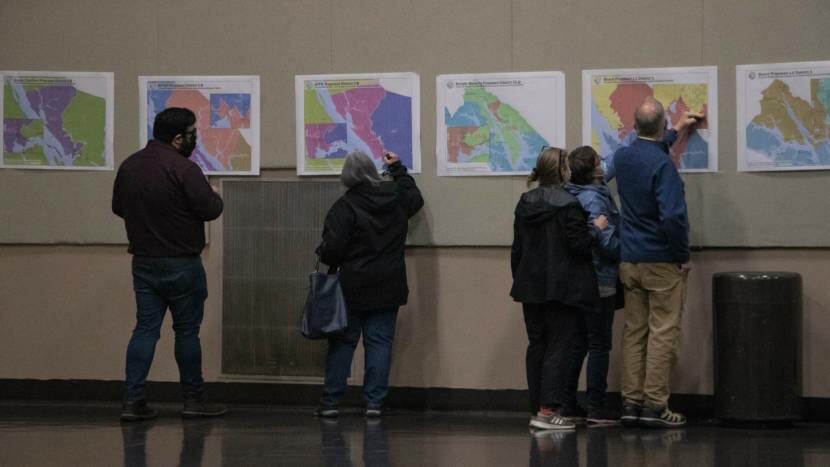
Juneau residents study proposals for new House district boundaries in the Juneau area at an open house event at Centennial Hall in Juneau on Sept. 27, 2021. The Alaska Redistricting Board pivoted to a town hall-style event later on, after attendees requested it. (Lyndsey Brollini/KTOO)
Alaska Redistricting Board members listen to Juneau resident Will Kronick, foreground right, testify about ties between Juneau districts and neighboring communities during a public hearing on redistricting at Centennial Hall in Juneau on Sept. 27, 2021. Also pictured, from left to right: Board Deputy Director TJ Presley, board chairman John Binkley, board member Budd Simpson, and board member Nicole Borromeo. (Lyndsey Brollini/KTOO)
Three board members attended the event at Juneau’s convention center, including the authors of two proposals. They all maintained that the proposed maps were made without political considerations. Four other proposals by third-party organizations were also on display.
The skepticism in the crowd was palpable — and audible.
“You said you’re not thinking about where people live, incumbency, things like that,” Juneau resident Pat Race said to board Chairman John Binkley. “So maybe you could explain the tentacle that then incorporates Andi Story’s house into Sara Hannan’s district?”
Story and Hannan are Juneau’s Democratic incumbents in the Alaska House of Representatives. One board-authored map lumps some homes around Auke Bay and Auke Lake into a district anchored by downtown Juneau and Douglas Island, where Hannan lives. What Race called a “tentacle” is a feature that awkwardly pokes out along Glacier Highway for about one mile past the Auke Bay roundabout. That tentacle is on the waterfront side of the highway — with the exception of two peculiar nubs. Rep. Andi Story’s home is in one of those nubs.
As others in the crowd shouted affirmatively, Binkley responded: “Yeah, it’s — that’s a valid point. And I only know about that because I’ve read the press reports about that. It really is not anything that we look at —.”
This statement prompted harrumphs and an “Oh, god,” from the crowd.
“There are a lot of different appendages that go in different directions. It’s based on census blocks,” Binkley continued. “So sometimes there are, uh, odd shapes. We try to smooth those as much as we can and that’s what we continue to try to do.”
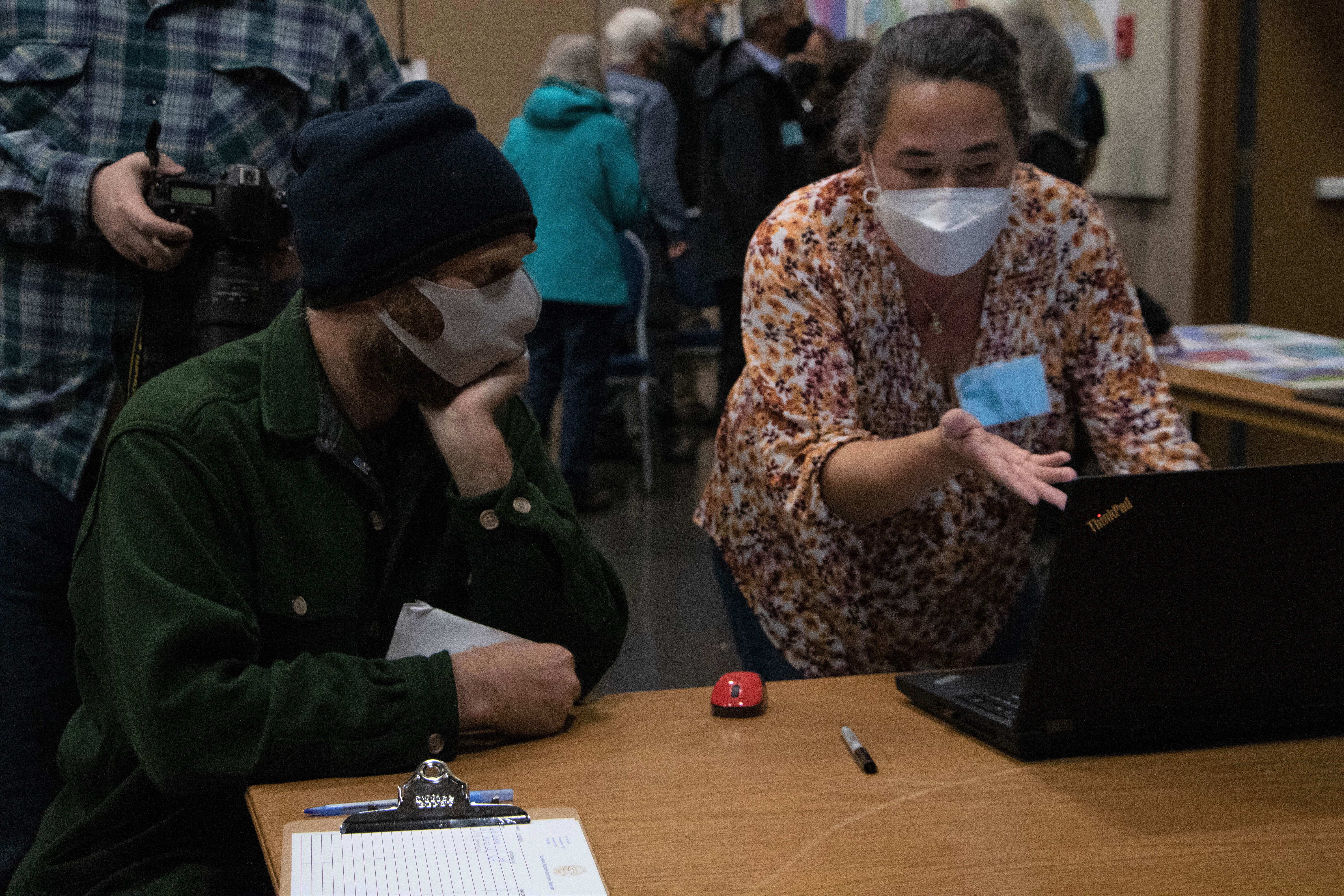
Race followed up with Juli Lucky, a staffer for the redistricting board. On a laptop, Lucky opened the software the board uses to make maps. Census blocks really are super irregular.
Alaska Redistricting Board staffer Juli Lucky shows Juneau resident Pat Race how the board’s software works, as well as some of its shortcomings during an open house event at Centennial Hall in Juneau on Monday. (Lyndsey Brollini/KTOO)
“We can show you, we got public testimony that one of the block lines goes right through someone’s house,” Lucky said. “So they’re like, ‘I don’t even know what district that I’m in.’ But we don’t know that until someone tells us.”
Board Deputy Director TJ Presley said it’s legal to split census blocks for redistricting purposes, but the courts discourage it. It would create a lot of practical problems with their software and data sets and for local governments that use the census and legislative district lines.
Board member Budd Simpson, who was appointed by Republican Gov. Mike Dunleavy, drew the map that was being scrutinized. He said he didn’t know specifically where Story lived until someone showed him at the event. He maintained he wasn’t gerrymandering.
Simpson said he read comments about the tentacle before this hearing and took another look at his map.
“To my eye, it didn’t look right,” Simpson said. “So I went back to the drawing board just today and tried another run at it, and I think may have solved the problem.”
Simpson said the guff the board got was understandable.
“And hopefully, we can move on from that,” he said.
The redistricting board members were appointed by different state officials. Three were picked by Republicans. One was picked by then-Alaska Supreme Court Chief Justice Joel Bolger, who’s politically undeclared. Nicole Borromeo was picked by a Democrat turned independent. She said that isn’t influencing her.
“Not at all, no,” she said. “I had a very candid conversation with the former speaker (Bryce Edgmon) when I accepted the position that I’m not looking to stack or crack any districts for a Republican, Democrat or independent. That I want to follow the constitution, federal and state law, both constitutions, and that’s going to be my guidepost throughout the process.”
“Stacking and cracking” or “packing and cracking” are specific ways to gerrymander that can distort political representation.
As far as her Republican-appointed colleagues, Borromeo said it’s early still. But so far, she said the board is working well together. On the tentacle, she’s satisfied with Simpson’s explanation that it was an accident. She doesn’t think he had partisan intent.
Borromeo drew the board’s other in-house map. It doesn’t appear to have any suspicious tentacles in Juneau. But it also lumps Juneau’s current House members into the same district. Her map carves a sort of donut hole district into Juneau made up of the Mendenhall Valley and Lemon Creek. The actual donut is the rest of Juneau — which includes both Hannan and Story’s homes — plus Hoonah, Gustavus, Skagway, Haines and Klukwan.
Gerrymandering concerns aside, one of Borromeo’s takeaways from the public hearing was that residents seem to want a clean split between downtown Juneau and the Mendenhall Valley.
Since Juneau’s population isn’t big enough to make up two full House districts on its own, Borromeo said she’s also looking for comments about which neighboring communities fit with Juneau’s districts.
In the big picture, it’s really difficult to analyze and summarize how each of the board’s maps and the other third-party plans could affect Alaska’s overall partisan representation. The blog The Alaska Landmine took a crack at it with the board’s maps. In both, the blog found varied partisan effects on House incumbents. Budd Simpson’s map does appear to disproportionately hurt incumbent House Democrats, but not exclusively. Nicole Borromeo’s map appears to pack an equal number of incumbent House Democrats and Republicans together.
The blog also went a step further to show the partisan leanings of the new, vacant House districts. That analysis suggests that it’s likely Democrats could have a net gain in House seats under Simpson’s proposed map.
The blog says a similar analysis of Senate districts is pending.
The redistricting board has until Nov. 10 to settle on a final plan.
The maps and a form for submitting comments are also available on the Alaska Redistricting Board website, www.akredistrict.org. Comments can also be emailed to testimony@akredistrict.org.
Since at least 1970, every time Alaska’s legislative district lines have been redrawn, lawsuits have followed and the courts have played a role in the final lines.
Disclosure: KTOO has occasionally hired Pat Race to produce art for KTOO products.
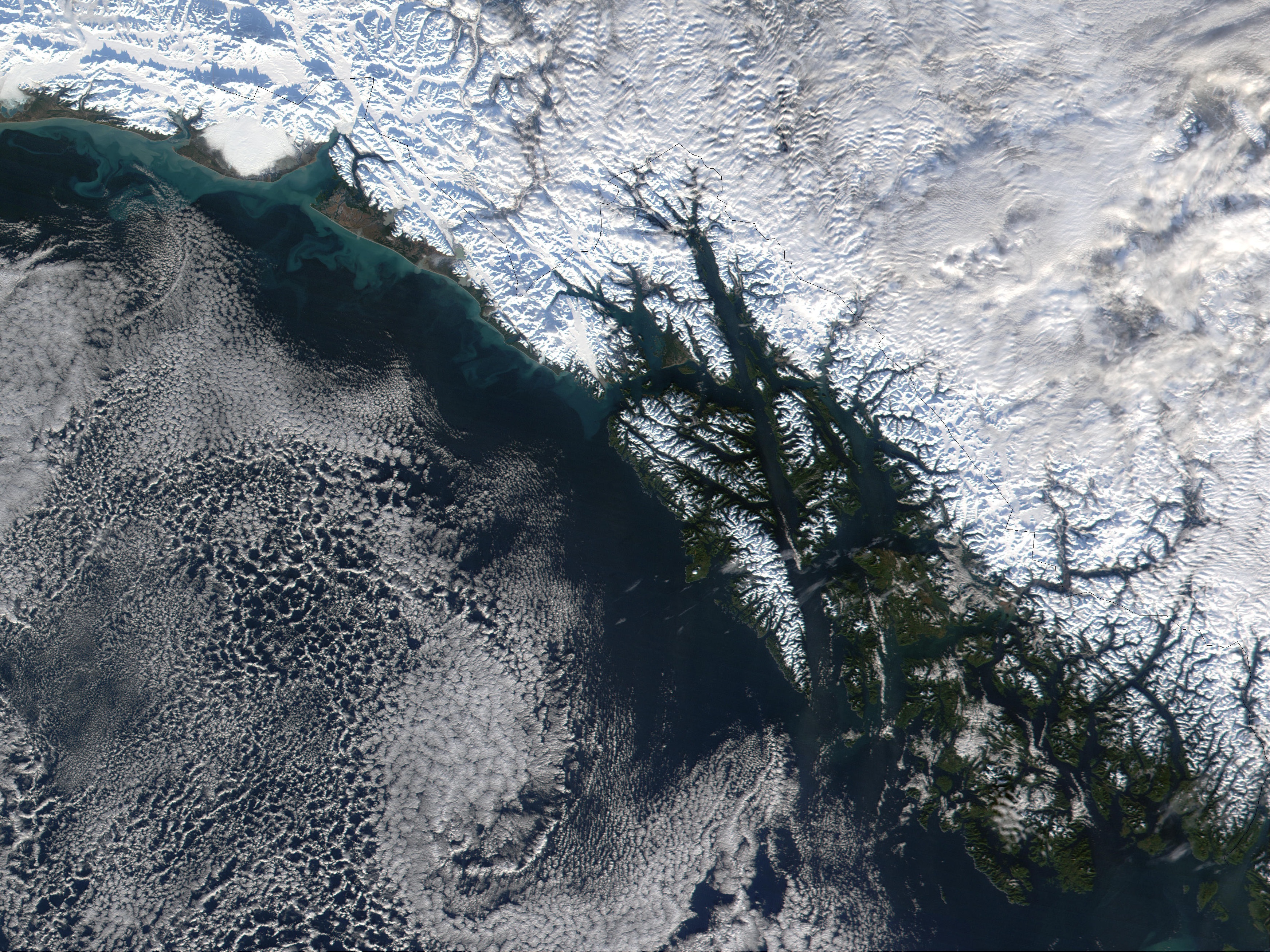
NASA satellite imagery shows Southeast Alaska in true color on November of 2001. The Alaska Redistricting Board must finish drawing invisible lines across the state that represent legislative districts by Nov. 10. (Public domain image by Jacques Descloitres/MODIS Land Rapid Response Team, NASA/GSFC)
The state board in charge of redrawing Alaska’s legislative districts is kicking off a series of open house-style public hearings on proposed maps on Monday in Juneau.
At Centennial Hall and future venues around the state, staff with the Alaska Redistricting Board will have easels set up with blown up maps showing six different proposals the board is considering. There will be many ways for people to formally share their opinions with the board: forms for writing by hand, recording devices for oral testimony, laptops and QR codes for smartphones.
TJ Presley is the deputy director for the Alaska Redistricting Board. He said the format is designed to encourage more interactivity and to be a safer alternative to traditional public hearings during the pandemic.
“It allows people to come and go as they please, look at a map, look at all six maps, give us their comments and leave,” Presley said. “As opposed to having, you know, 100 members of the community stuffed into one room, sitting in chairs right next to each other for a full two hours.”
Presley said the board is especially looking for comments in the context of its mission laid out in the Alaska Constitution.
“Speaking about compactness, contiguity and socio-economic integration, as well as, you know, equal population for each district — those are the factors the board has been drawing with and that they would probably appreciate hearing things in that context,” Presley said.
Monday’s hearing in Juneau is scheduled from 4:30 p.m. to 6:30 p.m. in Ballroom 3 of Centennial Hall. Open houses and public hearings are also scheduled next week in Haines, Sitka and Valdez. Many more all over the state will be held before the redistricting board’s Nov. 10 deadline to adopt a final plan.
The maps and a form for submitting comments are also available on the Alaska Redistricting Board website, www.akredistrict.org. Comments can also be emailed to testimony@akredistrict.org.
The board is sharing six proposed plans in these open houses. The board made two of them. The other four were submitted by third-party groups.
But Presley said the board’s final decision is not bound by these six proposals — it’s still free to go in another direction.
Since at least 1970, every time Alaska’s legislative district lines have been redrawn, lawsuits have followed and the courts have played a role in the final lines.
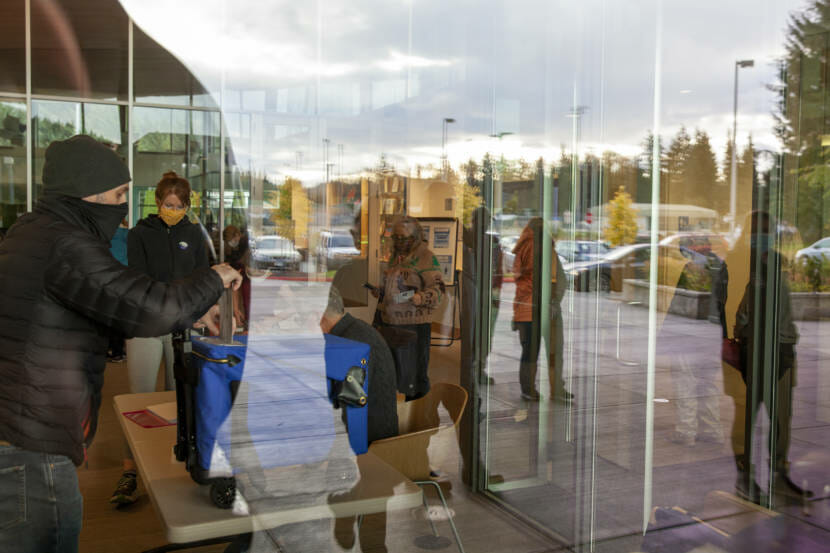
Voters stand in line at the Mendenhall Valley Public Library on election day, Tuesday, October 6, 2020. There are 14 candidates for Juneau Assembly and the Juneau Board of Education in the 2021 municipal election. Mayor Beth Weldon is up for re-election and running unopposed. (Photo by Rashah McChesney/KTOO)
Of the 14 candidates for seats on the Juneau Assembly and Board of Education this year, one person has a remarkable lead in fundraising. According to campaign finance filings, this candidate appears to have raised more money than all of the other local candidates combined.
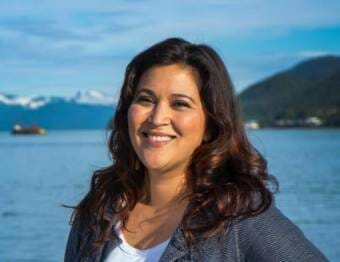
Barbara Wáahlaal Gíidaak Blake is a candidate for a District 1 seat on the City and Borough of Juneau Assembly. (Photo by Brian Hild/Courtesy of Barbara Blake campaign)
Juneau Assembly candidate Barbara ‘Wáahlaal Gíidaak Blake has raised just shy of $25,000, according to her Sept. 7 campaign finance report.
About half comes from Alaskans who don’t live in Juneau. It includes current and former state legislators, Alaska Natives leaders, Anchorage Assembly members and a lot of former coworkers from her time in Gov. Bill Walker’s administration. Walker donated, too.
Blake said she is blessed to have a strong network. She said Walker held a fundraiser for her over Zoom early on.
“We had over 40 people show up to that fundraiser, and every single one of them, they essentially just went around the room and just talked about how much they appreciated me and believed in me. I was crying like a baby through the whole process because I was just — I was overwhelmed. … It was a beautiful moment,” she said.
The scale of her campaign finances is more typical of a competitive statehouse race than for Juneau Assembly.
“You know, traditionally BIPOC people don’t raise as much as white people do in these races. And then my numbers just went through the roof. And I was like, ‘Well, you know, maybe I’m just an exception,’” she said with a chuckle.
Blake is Haida, Lingít and Ahtna Athabascan.
A lot of the money is going toward campaign signs. She said they’ve been popular, she thinks in part because of the attractive design by local artist Ricky Tagaban.
“So many people are like, ‘I want a sign! I want a sign!’ So many people want the giant signs, and like, those are crazy expensive! … They’re almost $400 a sign. … I’m sure I could have gotten it cheaper but I really wanted to support Juneau business and those are printed here in Juneau.”
Blake has two opponents in the District 1 Assembly race: Paul Kelly and Troy Wuyts-Smith.
Kelly said Blake’s campaign cash gives her advantages with staff, signs and last-minute outreach. But Kelly said he may have made up for it by starting his campaign early, putting in time at events and pounding the pavement.
“However I’m playing the long game. I have knocked on over 1,200 doors so far and I continue to knock on doors,” Kelly said. “I think it’s anyone’s guess as to whether that gives her an advantage overall.”
Troy Wuyts-Smith is mostly self-funding his campaign. He said it’s been difficult to build a team as a relative newcomer to Juneau and with a campaign focused on mental health issues. He said that without the previous government experience that Blake and Kelly have, people may think he’s unqualified.
“That’s not the case at all. I mean, you’ve seen this all around the country of Ilhan Omar, Alexandria Ocasio-Cortez — it’s not about who has the most experience … or the — whatever you deem are the best qualifications. It’s about who has a great voice, who can listen to the people and, you know, push Juneau in a forward direction,” Wuyts-Smith said.
Many candidates for local office never intend to raise or spend more than $5,000 combined. State law says, if you stay under that threshold, just file a letter saying so and you’re mostly finished with disclosures for the season.
In the Juneau Assembly District 2 race, incumbent Michelle Hale opted to do that. Her opponent for the District 2 seat is Kelly Fishler, who raised about $4,800 as of Sept. 7.
Of the eight candidates for Juneau Board of Education, all but one opted to stay below the $5,000 threshold. Wiljordan V. Sangster is the exception. Sangster is past due to file paperwork with the Alaska Public Offices Commission, the state agency that serves as the clearinghouse for campaign finances. Sangster did not respond to requests for comment and may be subject to fines.
Juneau’s local election is being held by mail. Ballots should have arrived in local mailboxes last week. Ballots must be dropped off or postmarked no later than Oct. 5. Ballots are also available in person at city vote centers through Oct. 5.
Disclosure: Two members of KTOO’s board of directors are among Barbara ‘Wáahlaal Gíidaak Blake’s campaign donors. The board isn’t involved in daily newsroom decisions.
Close
Update notification options
Subscribe to notifications
Subscribe
Get notifications about news related to the topics you care about. You can unsubscribe anytime.