Jeremy Hsieh

Local News Reporter, KTOO

I dig into questions about the forces and institutions that shape Juneau, big and small, delightful and outrageous. What stirs you up about how Juneau is built and how the city works?
USDA announces $8.7M in grants for sustainability projects in Southeast Alaska

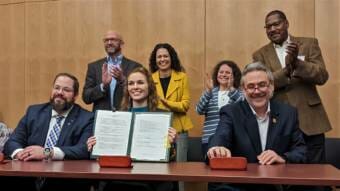
The Alaska heads of three different U.S. Department of Agriculture agencies pose for pictures with an interagency charter they had just signed that empowers a team to work on the Southeast Alaska Sustainability Strategy at the Andrew P. Kashevaroff Building in Juneau on March 31, 2022. Front row: Alan McBee with the Natural Resource Conservation Service, Julia Hnilicka with Rural Development, and David Schmid with the U.S. Forest Service. Back row: Deputy Under Secretary for Rural Development Justin Maxson, Under Secretary for Rural Development Xochitl Torres Small, Deputy Under Secretary for Natural Resources and Environment Meryl Harrell, and Under Secretary of Natural Resources and Environment Homer Wilkes. (Photo by Jeremy Hsieh/KTOO)

Officials with the U.S. Department of Agriculture announced $8.7 million in grants on Thursday for 25 different projects across Southeast Alaska.

The grants are intended to be an early step in a long-term commitment to foster lots of sustainable economic activities driven by locals. There’s support for Indigenous cultural programs, seaweed and shellfish farming, timber management and more.

The Alaska heads of three different USDA agencies also signed an agreement that establishes a permanent team that will work on sustainability goals in Southeast Alaska.

There’s also a new, permanent position tied to the team: Barbara Miranda, coordinator of the Southeast Alaska Sustainability Strategy.

Barbara Miranda, the U.S. Department of Agriculture’s new Southeast Alaska Sustainability Strategy coordinator speaks during an event at the Andrew P. Kashevaroff Building in Juneau on March 31, 2022. (Photo by Jeremy Hsieh/KTOO)

For now, SASS is a unique thing. The USDA doesn’t have other sustainability strategies for other parts of the country.

Miranda said in the past, tribes, local governments or other organizations in Southeast had to shoehorn their needs into existing federal programming. This new strategy has meant getting several different USDA agencies working together and listening to local needs.

“This is different,” she said. “We asked for input from our local organizations and received it. And now, federal agencies … we’re doing the work to struggle to fit those into our agency authorities. The shoe’s on the other foot with this.”

Miranda is based in Juneau. Until about a week and a half ago, she was the director of the Mendenhall Glacier Visitor Center, which the Forest Service runs. She’s also a former mayor of Gustavus, so she’s been on both sides of the table.

The USDA announced it was working on the strategy last July, along with a commitment to invest $25 million in Southeast Alaska. It complements the Biden administration’s efforts to end large-scale, old-growth timber harvesting in the Tongass National Forest and a renewed effort to limit new roads in the Tongass.

Alaska’s Congressional delegation opposes the Roadless Rule in the Tongass because they say it squelches economic activity and gets in the way of local stewardship.

Sen. Dan Sullivan said in a statement at the time that “$25 million doesn’t even come close to covering the economic damage that this administration’s policies will inflict on Southeast Alaska.”

On Friday, Sen. Lisa Murkowski’s said through a spokesperson that she is monitoring the strategy’s impact on Alaskans but still opposes a renewal of the Roadless Rule in the Tongass.

Xochitl Torres Small is the USDA’s undersecretary for Rural Development. She said the timber industry and the Roadless Rule are part of why Southeast Alaska is getting special attention.

U.S. Department of Agriculture Under Secretary Xochitl Torres Small speaks during an event at the Andrew P. Kashevaroff Building in Juneau on March 31, 2022. Also pictured: USDA’s Alaska conservationist Alan McBee with the Natural Resource Conservation Service, left, and Under Secretary of Natural Resources and Environment Homer Wilkes. (Photo by Jeremy Hsieh/KTOO)

“And so as you look at the changes in the timber industry — not strictly the Roadless Rule, but you look at court decisions, and you look at impact in terms of the challenges the timber industry faces now — combined with people who are responding to that by working more collaboratively together by coming up with new ideas for how to invest in the home that they love – that’s something that you want to invest in. That’s something that Rural Development, that’s something that USDA wants to be a part of,” Torres Small said.

Torres Small said the lessons the agencies learn in Southeast Alaska could be applied in other parts of the country.

“At this time, this is really a pilot. We’re forging new ground here,” she said.

USDA officials said they’re working on getting another $16 million in sustainability grants to Southeast Alaska in the next 6 months or so.

This story has been updated with comment from Sen. Lisa Murkowski’s office.

Correction: In an earlier version of this story, the names of USDA officials Julia Hnilicka and Justin Maxson were misspelled.

Goldbelt is interested in financing Eaglecrest’s gondola and other expansion plans

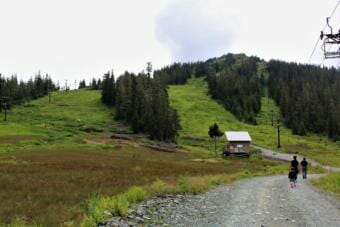
This summer, Eaglecrest announced a $35 million development plan with a slew of new summer attractions, topped by an $11 million gondola to bring tourists to the top of the mountain. (Photo by Adelyn Baxter/KTOO)
Eaglecrest Ski Area officials have lots of ideas for expanding summer operations on the mountain, most of which hinge on installing an aerial gondola that could run year-round. (Photo by Adelyn Baxter/KTOO)

Juneau’s urban Native corporation wants to help Eaglecrest Ski Area pay for its gondola project and expand summer operations.

Officials with Goldbelt Inc. could not be reached for comment, but city officials said the company is interested in backing Eaglecrest with up to $10 million. In return, Goldbelt wants a slice of summer ticket revenue. It’s unclear for how long.

“We can all keep our fingers and toes crossed,” Eaglecrest General Manager Dave Scanlan said to an Eaglecrest board committee on Thursday. “I think this potential partnership with Goldbelt is really, really exciting in many, many ways.”

The particulars of the deal would have to be negotiated, which requires action from the Juneau Assembly. The city manager could get permission to start those talks as soon as April 11. In a memo, City Manager Rorie Watt called the potential partnership a “remarkable turn of events.”

Last month, the Juneau Assembly narrowly voted to commit up to $2 million to buy a used gondola system in Austria. Eaglecrest officials said the gondola is the cornerstone of the plan for expanding summer operations.

But several assembly members were reluctant because they felt rushed, unsure about the public’s desire, and that they were unfairly leapfrogging other established priorities. The Assembly did not fund the installation of the gondola, which ski planning consultants recently estimated at an additional $5.5 million.

Scanlan said Goldbelt wants to finance more than a barebones gondola experience.

“The installation of [a] gondola, a small summit house and the mountain coaster are the things they want accomplished,” he said.

A mountain coaster is a gravity-driven ride, where people sit in one- and two-person carts attached to a rail or fed down a chute.

According to the estimates, that’s all doable with $10 million.

Eaglecrest and city officials were eyeing an upcoming local ballot question for possible funding of the gondola’s installation. In October, Juneau voters are likely to be asked to extend a 1% sales tax to cover debt financing for a package of city projects.

“I know a lot of our assembly members were very nervous about $2 million for the gondola because of the big price tag that followed behind it, and how are we going to handle that? If this partnership handles that, then it may create opportunity,” Scanlan said.

That means there could be opportunities for other Eaglecrest projects to go into the package. Scanlan suggested replacing the nearly 50-year old ski lifts. He even floated an idea for an employee dormitory, because the lack of affordable housing is often a deal breaker for potential seasonal employees. The ski area has been especially short staffed this season.

Newscast – Friday, March 25, 2022

In this newscast:

  • The Alaska Supreme Court says a new Senate district’s boundaries are an “unconstitutional political gerrymander”
  • Juneau officials are making a Lemon Creek multi-use path a priority
  • Goldbelt Inc. wants to help Eaglecrest Ski Area pay for its gondola project and expand summer operations
  • Officials in Haines and Skagway are raising questions about how a proposed mine will get its ore out of the Chilkat Valley
  • Kodiak’s Coast Guard base is getting a huge influx of federal infrastructure money
  • Democrat Elvi Gray-Jackson decides to end her run for U.S. Senate
  • Plans for a Alaska service for the late Rep. Don Young are set
  • Clear skies are lining up with a moderate aurora forecast this weekend

Newscast – Thursday, March 24, 2022

In this newscast:

  • The Juneau Police Department creates a missing persons web page
  • Researchers present findings and recommendations on managing landslide risk in Haines
  • Federal investigators release documents in their investigation of fatal sightseeing plane crash near Ketchikan in 2021
  • Alaska’s congressional delegation calls for a permanent ban on Russian seafood imports
  • The Anchorage Assembly will get a 12th member after redrawing district maps
Juneau’s main system for managing COVID-19 is shutting down

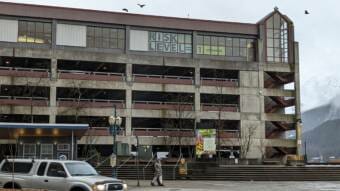
Signs at the downtown branch of the Juneau Public Library announce the community’s risk level on March 23, 2022. The risk levels and associated health mandates that scale up and down are a function of the city’s Emergency Operations Center, which is shutting down at the end of April. (Photo by Jeremy Hsieh/KTOO)

The main system Juneau officials have used to manage the COVID-19 pandemic is set to end at the end of April.

The Emergency Operations Center was created in March of 2020, shortly after the pandemic was declared.

Now, emergency officials have decided not to ask the Juneau Assembly for another extension of their pandemic policies. The city’s Emergency Operations Center is shutting down on April 29.

“That doesn’t necessarily mean that all of our COVID-related responses and all of our COVID-related activities will immediately go away, but some of them will,” said Deputy City Manager Robert Barr. “So our testing operations, the fire training center is a good example of one that we are demobilizing.”

The Assembly could overrule that decision, though Assembly member Michelle Hale told Bartlett Regional Hospital officials on Tuesday there is no plan to.

What that means for residents is there will be no more mandates about masking and crowd sizes. But individuals, businesses and organizations could still impose their own rules.

Local data reporting through the city’s COVID dashboard will also end.

Barr said the city does intend to continue giving out free home test kits and masks, as long as the federal government pays for them.

Coincidentally, federal funding for fighting COVID is drying up. Congress did not include COVID programs in its latest spending bill. This especially affects people who don’t have health insurance and the health care providers that rely on federal money to treat them.

As far as future COVID variants and case surges, Barr said city officials will keep monitoring for them and act accordingly.

“I think it is fair to say that COVID is here to stay, right? It’s not going anywhere, we are going to be living with it in one way or another, presumably for the rest of our lives,” he said.

He said that may mean seasonal test kit giveaways and COVID vaccine clinics, kind of like how the flu is managed.

In COVID-19 numbers, state data show 27 new cases were reported among residents and visitors to Juneau from Monday and Tuesday. That does not include results from home tests.

Bartlett Regional Hospital has 3 patients who are positive for COVID-19, with four of its health care workers are sick or quarantining.

Juneau schools are closed this week for spring break.

Juneau’s COVID-19 risk level remains at level 1, minimal.

Statewide from Monday and Tuesday, 573 new cases were reported among residents and visitors. State data also includes one death, preliminarily, over the last week.

Thirty-seven people who are positive for COVID-19 are hospitalized, including one person on a ventilator.

Newscast – Wednesday, March 23, 2022

In this newscast:

  • The main system Juneau officials have used to manage the COVID-19 pandemic is set to end next month
  • State officials lay out the timeline for special elections to fill Congressman Don Young’s vacant seat
  • The Ayaprun Elitnaurvik Yup’ik Immersion School in Bethel is expanding
  • Anchorage officials are negotiating a contract to build a large homeless shelter
  • Microgrants for tools to grow, hunt and store food are available for to address food insecurity
Site notifications
Update notification options
Subscribe to notifications