Jeremy Hsieh

Local News Reporter, KTOO

I dig into questions about the forces and institutions that shape Juneau, big and small, delightful and outrageous. What stirs you up about how Juneau is built and how the city works?
Shipping a gondola system from Austria to Juneau will cost more than double the initial estimate

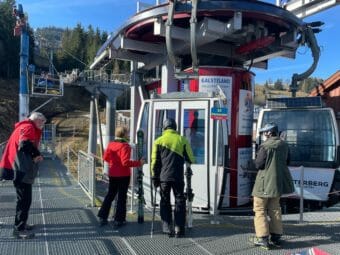
gondola in Galsterberg 04 2022
Eaglecrest Ski Area General Manager Dave Scanlan was at a ski area called Galsterberg in Austria in April to inspect this gondola system. Eaglecrest is buying the system and having it shipped to Juneau. (Photo courtesy of Dave Scanlan/Eaglecrest Ski Area)

Moving a used gondola system from Austria to Juneau’s ski area is going to cost a lot more than initially estimated.

On Wednesday, the Juneau Assembly narrowly approved spending an extra $500,000 to bring it to Juneau and awarded the transportation contract to Lynden Logistics.

Through much of the gondola purchasing discussions, Mayor Beth Weldon has been noncommittal. Wednesday’s special Assembly meeting was no exception.

“Since we now seem to own this gondola, what happens if we don’t pass this ordinance?” Weldon asked.

“We would be in a very difficult position, having spent a lot of money to purchase and own a gondola on another continent without the funds to move it,” replied City Manager Rorie Watt. “So, I don’t exactly know what we would do. … I cannot think of a good outcome.”

The city had solicited contracts to store the gondola in Europe for potential resale, an option the Assembly wanted in case it decided to abandon the project. But according to Eaglecrest Ski Area General Manager Dave Scanlan, no one bid on that contract.

The mayor ended up voting yes.

Assembly members Carole Triem and Alicia Hughes-Skandijs voted no. Hughes-Skandijs acknowledged her vote didn’t make sense given the situation.

“But even so, I can’t in good conscience put more public money towards a project that I don’t feel like we should have in the first place,” she said. “I feel like it’s a bad route for the city to go. I further feel that it was a bad process that we followed.”

Gondola in Galsterberg 04 2022
Each cabin has capacity for 15 passengers. (Photo courtesy of Dave Scanlan/Eaglecrest Ski Area)

Eaglecrest Ski Area officials asked for $2 million to buy the used gondola system in February, outside of the Assembly’s normal process for prioritizing competing requests for big-ticket projects. Eaglecrest’s general manager described it as a rare opportunity that would save millions compared to buying new, and shave years off of a goal to expand summer operations.

The contract to ship it from Pruggern, Austria, to Eaglecrest Ski Area will cost $845,000, more than double the initial estimate of $400,000. The contract award passed without objection. The system weighs several hundred tons and will take more than 25 truckloads to get up the mountain.

The loading process in Austria is expected to begin around May 20.

Eaglecrest officials say the gondola will serve winter and summer patrons. The tower placements being considered would make more winter terrain accessible for downhill and Nordic skiers.

Ski area officials foresee revenue from summer visitors eventually eliminating the ski area’s need for local taxpayer support.

There’s no funding in place yet for the gondola’s installation, though Goldbelt Inc. wants to make a deal to finance it. CEO McHugh Pierre recently told KINY that he’s at the very beginning of negotiating with city officials. Watt told the Assembly that he is very comfortable a deal will come together.

Crushing Juneau’s treated sewage waste before shipping it could save almost $1M a year

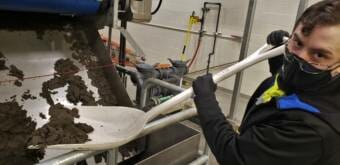
Senior wastewater operator Ryan Hosman shows what microbes that consume sewage look like after they’ve been partially dewatered through a belt filter press at the Mendenhall Wastewater Treatment Plant in Juneau on March 23, 2021. They go through a dryer to further reduce their volume and become biosolids. (Photo by Jeremy Hsieh/KTOO)

After sewage is treated in Juneau, there’s a byproduct left behind known as “biosolids.” And the City and Borough of Juneau pays about $1.4 million a year to ship containers full of it to a landfill in Oregon. City officials say that buying new equipment to crush these cakey biosolids down before shipping them could slash that bill by two-thirds.

The city pays for shipping per container, and that cost has been going up, according to Denise Koch, the city’s deputy director of Engineering and Public Works.

“We really need to – you know, I use the technical term, ‘pack it in,'” Koch told the Juneau Assembly’s Public Works and Facilities Committee on Monday. “We really want to get more volume into each conex because it’s so expensive to ship those conexes.”

Juneau Assembly member Wade Bryson put it like this: “We’re shipping a lot of air down south.”

Koch’s department is asking the Juneau Assembly to spend $2.5 million of wastewater user fees to buy a crusher. She estimates it would pay for itself in about two and a half years.

The Committee gave the concept the thumbs up. The full Assembly must hold a public hearing and vote on an ordinance to authorize the spending.

The city has spent tens of millions of dollars over the last 12 years disposing of its treated sewage. It used to burn what was leftover, but its sewage sludge incinerator failed in 2010.

At first, the city contracted with the local landfill operator to dispose of the sludge. But there was too much – hundreds of tons a month – and it made the landfill’s nuisance odor problems worse. The landfill didn’t want to renew its contract.

So then the city started shipping the sludge down south for disposal. But leakage and odor problems caused problems in the barging business. So the city bought 45 watertight shipping containers it used in rotation to keep the sludge moving. In 2015, it cost about $2 million to ship the sludge.

In 2016, the city committed about $16 million to build a dryer facility, which removes water from the sewage sludge and turns it into biosolids. It went online in 2019. City officials thought it would also treat the sludge enough to meet environmental standards for applying it to land, eliminating the need to ship it out of town.

But as the dryer was being brought online, public health experts and environmental regulators were researching and working on regulating various “forever chemicals” — PFAS, PFOS and PFOA. These chemicals are in Juneau’s biosolids at levels that prohibit land application. So, Juneau still ships its processed sewage out of town for disposal in a landfill.

Ironically, one known source of these chemicals in the sewage system is the wastewater that leaches down through Juneau’s landfill. Some of the water that leaches out is collected and piped into the sewage system for treatment.

Juneau Assembly seeks ballot question on exempting food from sales tax

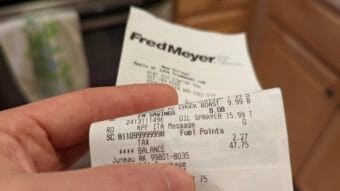
Fred Meyer sales tax receipt illustration
The sales tax rate in Juneau is 5%. Local voters are likely to be asked in the October election to exempt food from the sales tax if the summer seasonal tax rate goes to 6%. (Photo illustration by Jeremy Hsieh/KTOO)

Are Juneau residents willing to exempt food from sales tax if the sales tax rate goes up to 6% in the summer?

Some version of that question is likely to be on the municipal election ballot in October. After weeks of discussion, the Juneau Assembly on Monday asked city staff to draft an ordinance to pose that ballot question. Assembly member Greg Smith made the motion, which passed without objection.

The full Assembly still has to hold a public hearing and vote on that ordinance at a later meeting.

City Finance Director Jeff Rogers also shared an updated projection of the financial impacts of the changes. He estimated that the average Juneau household would have a net savings of about $143 a year, while the average summer visitor would spend about $1 extra. The city’s revenue would also be down $400,000 a year.

Mayor Beth Weldon had some reservations.

“You know, Mr. Rogers put it out that it’s $143 savings per household, so I don’t see it as a huge savings,” she said. “But for food and most of those folks that we’re trying to help probably are getting helped elsewhere, with SNAP and those kind of things. But I guess we won’t know what everybody else’s viewpoint is until we send it to the voters, so I guess we have to send it to the voters.”

The Greater Juneau Chamber of Commerce surveyed its members in March about various sales tax scenarios. The combination of a seasonal sales tax and food exemption was unpopular.

Weldon said she expects more discussion as the ordinance moves forward. To get a question on the October ballot, the Assembly must pass an ordinance by Aug. 4.

The committee also intends to continue work tightening or repealing other existing sales tax exemptions, separate from the ballot question.

Newscast – Thursday, April 28, 2022

In this newscast:

  • The Juneau Assembly considers exempting food from the city’s sales tax
  • Alaska public health experts discuss the latest COVID trends
  • Some Juneau Assembly members are questioning the police department’s plan to buy an armored vehicle
  • Bartlett Regional Hospital has named a permanent chief behavioral health officer
  • Gov. Dunleavy reiterates his push for Alaska Permanent Fund dividends of at least $3,700
  • A state judge sets a May 3 deadline for challenges to a revised redistricting plan
  • A heli-skiing guide dies in an avalanche near Valdez
  • Tonight’s weather and aurora forecasts line up for a good show
Juneau Assembly looks into exempting food from sales tax

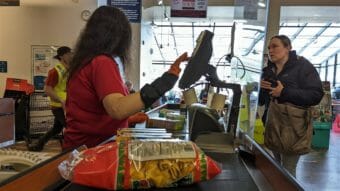
Sarah Young checks out at Foodland IGA in Juneau, Alaska. (Photo by Jeremy Hsieh/KTOO)

In Juneau, the city collects $6.2 million in taxes a year on the sale of groceries. Economists say that food taxes hurt the neediest people the most.

Exempting food from sales tax is a crowd pleaser. But many past assemblies have failed to make it happen, in part because the options for recouping the lost revenue are politically fraught.

Back in March, city Finance Director Jeff Rogers gave the Juneau Assembly his take on why exempting food from sales tax has repeatedly stalled out.

“When we look back and think about why it would appear that so many assemblies have aspired to do what this assembly aims to do and have never succeeded, I think choice overload is one of those problems,” Rogers said. “There’s just a lot of ways to skin that cat.”

For example, what is food? With past, unproductive debates in mind, the Assembly agreed to go with only foods covered by SNAP, the federally funded program that helps low-income households buy food. Grocers’ checkout systems are already set up to recognize these foods and exempt them from sales tax when someone buys them with SNAP benefits.

SNAP covers most basic groceries, but Assembly member Michelle Hale acknowledged the list isn’t ideal.

“… Things like hot chicken from the grocery store … pet food, diapers, you know, are not exempted. … I think they should be!” Hale said. “I think there’s a lot of those items that should be, and soda pop probably shouldn’t be a SNAP item, but it is.”

But she and the other Assembly members agreed to set those gripes aside, and go with the SNAP list for the sake of simplicity.

Now, the Assembly is wrestling with what to do about the loss of $6.2 million a food exemption would lead to for the city. Most Assembly members agree that they want to replace at least half of it — with something.

Deciding what that something is, is where it gets tough. In committee, the Assembly is considering repealing or tightening other existing sales tax breaks, each with its own fans.

For example, Mayor Beth Weldon suggested eliminating an exemption on sales by nonprofits. But Assembly member Barbara Wáahlaal Gíidaak Blake didn’t agree with that.

“I think the nonprofits that I’m considering, at least, just at the top of my head, provide a service to our community,” Wáahlaal Gíidaak said. “Social services, they provide education services for our youth. They’re helping our community and providing a service we might otherwise have to provide ourselves if they weren’t stepping up and helping our community.”

Deputy Mayor Maria Gladziszewski suggested restructuring a tax break for big-ticket items. Right now, sales tax doesn’t apply to the purchase price of a single good or service over $12,800. This means a buyer pays no more than $640 in sales tax on a single purchase, whether it’s for a used car or a luxury yacht.

Gladziszewski thinks that’s upside-down, that for big-ticket purchases, everything under a certain threshold should be tax-free. Rogers said he has no way to model the financial impact of that, and that it would be tricky to implement.

Mayor Weldon wasn’t a fan. She said the existing exemption helps businesses keep costs down that would otherwise be passed on to customers. As an example, she said Gladziszewski’s idea could make the sales tax due for buying a single dump truck go from $640 to more than $10,000.

The Assembly has not made any decisions on changing existing exemptions.

That leaves new taxes. Assembly members have floated the possibility of raising the sales tax rate — maybe just in the summer — or raising property taxes.

In 2019, Rogers ran some numbers to try to predict how a sales tax exemption on food plus a seasonal sales tax rate of 6% would affect local households, summer visitors, and the city’s bottom line. He estimated that local households would on average save about $143 a year, a summer visitor would pay about $1 extra, and the city would lose about half a million dollars in revenue.

In 2014, the Greater Juneau Chamber of Commerce supported exempting food and utilities, and to pay for it with an increase in the overall sales tax rate. It opposed a seasonal sales tax increase, saying it unfairly targets the visitor industry.

The chamber’s position has changed since then. Last week, it encouraged the Assembly pay for the food exemption without new taxes, in line with the results of a member survey in March.

Chamber Executive Director Craig Dahl said the city’s finances are in a much better position now, with a lot more cash on hand.

“When the chamber made recommendations several years ago, it was a kind of three-legged stool,” Dahl said. “There were several pieces to the recommendation and the Assembly only chose one of them. And so, those conditions don’t exist now the same way they did in 2014.”

While the Assembly can change the city’s property tax rate on its own, the city charter requires voters approve changes to the sales tax rate. To get a sales tax question on the October ballot, the Assembly must pass an ordinance by Aug. 4.

Newscast – Wednesday, April 27, 2022

In this newscast:

  • Masks are optional again in Juneau schools
  • Local vendors who cater to Filipino cruise ship workers gear up for the season
  • Gov. Mike Dunleavy announces court fights to assert state ownership of certain lands against the federal government
  • The Alaskan Republican Party shares its strategy for ranked choice voting
  • Defense Department inspectors flag five U.S. military bases in Alaska for failing to prepare for climate change
Site notifications
Update notification options
Subscribe to notifications