Jeremy Hsieh

Local News Reporter, KTOO

I dig into questions about the forces and institutions that shape Juneau, big and small, delightful and outrageous. What stirs you up about how Juneau is built and how the city works?
Experienced travelers say staff shortages and COVID-19 outbreaks are spoiling their Alaska cruises

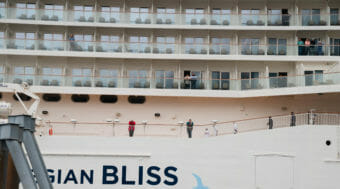
The side of a large cruise ship, with passengers visible on walkways
The first large cruise ship of the season arrived in Juneau on April 25, 2022. (Photo by Paige Sparks/KTOO)

Mohammad Palwala went on his first cruise last year. The cyber security engineer from Dallas sailed through Southeast Alaska aboard Royal Caribbean’s Ovation of the Seas.

“And I told my family, ‘It’s like, the best thing ever. You get a full-on vacation on the cruise,’” he said.

There was lots of entertainment on board and amazing experiences in Southeast Alaska communities. And, as far as COVID-19, it felt safe. Everyone had to test negative before boarding, just about everyone was vaccinated, and the ship was only at 30% capacity. That was in September.

Palwala wanted to share the experience with his extended family of 12. He booked another Alaska cruise on the same ship with almost the same itinerary. They sailed in May. This time, the ship was closer to full, with about 4,000 passengers. It wasn’t like before.

“Very understaffed,” he said. “We did not have shows on — we only had like, two shows on the whole of the cruise. Lack of entertainment, lack of entertainment for kids.”

There were long lines to disembark, facilities on board that were shuttered — even eating became disappointing. His whole family is vegetarian, and he was told the kitchen was too short staffed to cook up proper meals for them.

Day after day, “the SAME thing. I mean, yeah, not even a few things, the same things. So whatever we ate in lunch, we ate in dinner,” he said.

His family ate a lot of lentil soup with rice.

Immediately after the cruise, 10 out of 12 people in his party tested positive for COVID. They were far from alone.

Experienced cruisers say staff shortages mean they’re having less fun. But they were also surprised by how widely COVID-19 seemed to spread. They want the public to know that lots of passengers are getting infected, and that on board, they’re left in the dark as the risk level changes.

Palwala said there was a Facebook group with hundreds of passengers from that same sailing. At first, it was a fun space where people posted what to do in port and shared photos. After the cruise, it turned into an informal COVID tracking site with tips for dealing with Royal Caribbean customer service.

Lorna Bradley from Monterey, California, was on that same cruise, and in that same Facebook group.

“Somebody finally just posted a poll because so many people were reporting COVID,” Bradley said. “So, of the 400 passengers who happened to see the poll, 25% of those, 100 people, came in and said, ‘I’ve got COVID.’ … I would have had no idea if I weren’t in that Facebook group since I didn’t get sick. I would’ve had no idea there was that much COVID on board.”

She later learned through the group that she’d been in close contact with a cabin steward who had gotten COVID. She was never formally notified of it. Even general information about the ship’s COVID status was noticeably absent.

“And it would have been so easy for the captain’s morning announcements to just remind us, you know, ‘Oh, we have 20 passengers on board, you know, currently having COVID symptoms and you know, just a reminder, you might want to wear a mask,’” she said. “I mean, none of that happened at all, which I found surprising.”

Bradley is extra COVID-conscious because she has a medical condition that puts her at higher risk of complications. She also takes care of an elderly parent who’s at even higher risk.

“When there are COVID cases (on) board, on your floor, down the hall, with your cabin steward, passengers need to know so that they can make better choices for themselves,” she said.

Palwala said he wouldn’t have taken his family if he’d known more in advance.

“Definitely not, because of my wife mostly, because she is pregnant. … If I had known, I would have not gone,” he said.

Conditions vary from ship to ship, and from sailing to sailing.

For example, the Carnival Spirit made headlines for a badly managed outbreak when it was coming to Seattle to begin its season in Alaska this year.

Bruce Hogarth had booked the Spirit’s second Alaska sailing this season. He almost canceled his cruise when he heard about the outbreak. He had travel insurance, but it wouldn’t cover a cancellation for fear of COVID. He rolled the dice.

“And for the first four days, it was a wonderful time,” Hogarth said. “We enjoyed it. The service was good. The food was good. It was up to par in my mind. And then I came down with COVID, then three days later my wife came down with COVID.”

He thinks the cruise line could have done more to avoid people getting sick. His isolation went better than passengers’ on the earlier Spirit sailing.

“It was the opposite,” he said. “I had lost my appetite and I wasn’t eating a lot. They would check in and say, ‘Did you want to order anything? You haven’t ordered in awhile.’ So they were very gracious that way.”

Hogarth lives near Victoria, British Columbia, one of the stops on the cruise. He was able to arrange to disembark there and finish his isolation period at home, instead of at a hotel in Seattle. He said a Canadian government official who walked him through his isolation obligations told him 127 customers and 42 crew from the cruise were infected.

Passengers are relying on second hand information like this or Facebook polls because the cruise lines and public health authorities aren’t sharing the information they already have about COVID on cruise ships.

The Centers for Disease Control and Prevention did not respond to questions about its COVID-19 Program for Cruise Ships and data reporting.

The government of Canada addresses the risk with direct language on its cruise ship travel page: “The virus can spread easily between people in close quarters, such as on cruise ships. The chance of being infected with COVID-19 on cruise ships is very high, even if you’re fully vaccinated.”

Group seeking repeal of Juneau’s mandatory real estate sale price disclosures turns in signatures

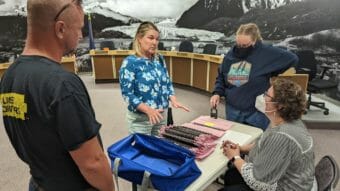
Traci Heaton and Victor Banaszak
Traci Heaton and Victor Banaszak turn in petition signature booklets to Juneau election officials Beth McEwen and Diane Cathcart at City Hall on Saturday. They want to get a question on the October ballot to repeal mandatory disclosure of real estate sale information. (Photo by Jeremy Hsieh/KTOO)

Organizers of a referendum want to repeal the mandatory disclosure of real estate sales prices. And they appear to have collected enough signatures to get the question on the October election ballot.

The Juneau Assembly adopted a pair of ordinances in 2020 and this past February that made it mandatory to share the sales price and other information with the city assessor’s office.

City staff said the information would improve the accuracy of property assessments. The referendum supporters say it’s an invasion of privacy that could lead to higher taxes.

To get the repeal question on the ballot, they needed to turn in signatures of 2,130 qualified voters. On Saturday, city election officials accepted signature books with just over 2,501. Election officials have until June 14 to check the signatures for duplicates and other potential disqualifiers.

If the organizers clear that hurdle, then the Assembly could repeal the ordinances. Otherwise, the referendum will play out in the October election.

Newscast – Monday, June 6, 2022

In this newscast:

  • Alaska’s health commissioner plans to end the COVID-19 emergency order on July 1
  • Gun safety advocates lobby U.S. Sen. Lisa Murkowski for gun safety legislation
  • A climber dies trying to summit Denali
  • The state has sold the ferry Malaspina to Alaska businessmen
  • Wrangell’s Trident Seafood plant will stay closed for the third year in a row
  • The average sale price of homes in Alaska rose nearly 9% last year
  • Organizers in Juneau turn in petition signatures for a referendum to repeal mandatory disclosure of real estate sales prices
  • Juneau voters may not get the final say this October on a plan to stop taxing sales of food
  • Trail users are concerned about how a proposed disc golf course around the Treadwell Mine Historic Site and Trail will affect them

Juneau Assembly may ask voters how to pay for grocery sales tax exemption

Fred Meyer sales tax receipt illustration
The sales tax rate in Juneau is 5%. Local voters are likely to be asked in the October election if they’d be willing to raise the sales tax rate or property tax rate to pay for exempting food from sales tax. (Photo illustration by Jeremy Hsieh/KTOO)

Juneau voters may not get the final say this October on a plan to stop taxing sales of food.

In committee last week, the Juneau Assembly set aside plans to ask residents a ballot question this fall to raise the sales tax rate. If voters authorized it, basic groceries would become exempt from the city’s sales tax, and the city’s overall sales tax revenue would be mostly intact.

But the Assembly is taking the discussion in a new direction. It now wants to put one or more advisory questions on the ballot that pairs the tax break with different tax increases.

Advisory questions are not binding — they are a way for elected officials to take the temperature of voters on an issue. Voters would still have to be asked a regular ballot question to actually raise the sales tax rate. However, the Assembly can act on its own to change the property tax rate during its annual budget process.

The Assembly is considering three separate ideas to recoup revenue:

  • Raising the year-round sales tax rate to 5.5%;
  • Raising the sales tax rate to 6% from April through September; and
  • Raising the property tax rate by 1 mill, which would effectively increase most property tax bills by 9.5%.

The tax burden would shift differently under each scenario. Under all three, lower income households are expected to save more than they would spend in new taxes. With a seasonal sales tax, visitors pick up much of the tab. With the property tax, only businesses and the community’s wealthiest property owners would pay more.

City Finance Director Jeff Rogers shared a new analysis of how the property tax option would play out for different households. By his estimates, the food tax break and property tax increase would cancel each other out for high earning households with property worth around $500,000 to $600,000.

“The only way that I can manipulate the table in such a way that it costs anybody more, is to presume that somebody has a very high property value,” Rogers said. “So obviously, once you get above 7, 8, $900,000? The property value is probably not one’s principal residence. It starts to be holdings of commercial properties or vacant land or whatever. So only in those categories does the math indicate to me that somebody comes out worse with tax-free food and a 1 mill increase.”

A March survey showed the property tax option was very unpopular in the local business community. However, even some of the Assembly’s most pro-business members found some appeal in the property tax after reviewing Rogers’ models.

“So the very families that we’re trying to benefit have a higher savings per year by adding the mill rate,” said Assembly member and businessman Wade Bryson. “So I would be in strong favor of the property tax on the advisory vote. Because if the community said to us, ‘We’re OK paying a little bit more for property tax to remove sales tax,’ I mean, that’s a solution and approval from the community.”

In future meetings, the Assembly plans to sort out which of the three advisory questions to send to voters. To get a question onto the local election ballot in October, the Assembly must pass an ordinance by Aug. 4.

Among Juneau’s three incumbent state legislators, only one drew an opponent

Reps. Andi Story and Sara Hannan accompanied by Sen. Jesse Kiehl, speak at a Native Issues Forum hosted by the Central Council of the Tlingit Haida Indian Tribes of Alaska in Juneau on Feb. 3, 2020. The trio, all Democrats from Juneau, gave a preview of things to come during the current legislative session and fielded questions from the audience. (Photo by Skip Gray/KTOO)
Juneau’s Rep. Andi Story, Rep. Sara Hannan and Sen. Jesse Kiehl discuss legislative issues at a forum hosted by the Central Council of the Tlingit Haida Indian Tribes of Alaska in Juneau on Feb. 3, 2020. All three incumbent Democrats are running for re-election, though only Hannan, center, has drawn an opponent. (Photo by Skip Gray/KTOO)

Juneau’s three incumbent Democratic state legislators are all running for reelection, but only one has any competition. Local political officials on both sides of the aisle shared some of their theories about why more people didn’t sign up to run for office.
The deadline for candidates to file to run in the August primary was Wednesday. Sen. Jesse Kiehl and Rep. Andi Story are running unopposed. Rep. Sara Hannan drew one opponent, Darrell Harmon.

Harmon’s party affiliation is undeclared. He could not immediately be reached for comment.

According to a financial disclosure document, Harmon worked three part-time jobs in 2021 related to truck driving. He was also a shareholder with Goldbelt Inc. and Sealaska Corp.

Until recently, Harmon’s Facebook page had public posts espousing COVID-19 misinformation, sympathies for Russia’s invasion of Ukraine, and disparaging Democrats and medical authorities — along with a lot of apolitical, do-it-yourself videos.

Incumbent Sara Hannan said they’ve never been in touch, whether as an opponent, a constituent or otherwise. She doesn’t recall ever meeting him.

Rep. Sara Hannan, D-Juneau, talks to a page in the state Capitol on Jan. 21, 2020. (Photo by Rashah McChesney/KTOO)

Hannan, who’s a retired public school teacher, is seeking a third term.

“The job takes longer to get up on step than I thought it would, you know?” she said. “And going into my third term, I finally — I feel like I’ve done some good work in the four years I’ve been in, but nowhere near through the to-do list that I wanted to see happen and make change.”

She understands why there aren’t many candidates for the job.

“I think that it’s pretty unattractive. From the social-emotional kind of side of it, you know, the vitriol?” she said.

Likewise, she said she was struck by how many of her colleagues are not seeking reelection. She said she thinks it was easier for legislators to tough it out when Alaska had more money to work with.

“You know, in the days when Alaska had money and you could deliver pork projects home to your district, there’s more attraction, and you’re willing to tolerate more chaos and ugliness,” Hannan said.

Murray Walsh chairs the Republican Party’s precinct that corresponds to Hannan’s recently redrawn House District 4. It covers downtown Juneau, Douglas Island, Lemon Creek and parts of the Mendenhall Valley. Walsh said he didn’t hear from any potential Republican candidates in either of Juneau’s House districts.

“The primary reason is the knowledge that the Democrats have been successful in election after election in both districts,” Walsh said. “In registration, everything. It’s just a strongly Democrat town, there’s just no getting around it.”

In the 2020 presidential election, Democrat Joe Biden beat Republican Donald Trump in both of Juneau’s House districts. It was an 11% margin in one district, and 40% in the other.

“I can hope someone rises up, and if they do, if they’re willing to wear the Republican mantle, we will do our best to help them out,” Walsh said.

That hypothetical candidate would have to run as a write-in candidate in the November general election. Alaska’s new election system doesn’t allow write-ins in primaries.

Cathy Muñoz was Juneau’s most recent Republican lawmaker. She was a moderate and is now deputy commissioner of the state Department of Labor and Workforce Development. She represented Juneau’s Mendenhall Valley in the House from 2009 until she was ousted by Democrat Justin Parrish in 2016.

State to transfer Telephone Hill to City and Borough of Juneau for redevelopment

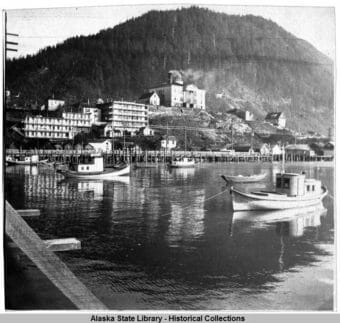
Telephone Hill circa 1920
Telephone Hill in Juneau, circa 1920, as viewed from Gastineau Channel near Willoughby Avenue. Before a telephone company set up shop on the hill, it was known as Courthouse Hill. (Photo courtesy of Alaska State Library Place File, ASL-Juneau-Views-Areas-Willoughby-Ave-06)

On a sunny afternoon, Maureen Conerton was lounging in a camp chair with her husband outside the home they lease on Telephone Hill. A plaque on the door claims it’s Juneau’s oldest home, built in the early 1880s.

Telephone Hill is a rocky ridge that juts out toward Gastineau Channel in downtown Juneau. The massive State Office Building straddles it. The Telephone Hill name stuck after a telephone company set up shop there in the early 1900s.

Conerton said she’s lived on Telephone Hill since 1989, calling it “the last little piece of old-time, rural Juneau” in the downtown area. She reminisced about epic, Alaska Folk Festival afterparties that the neighborhood used to host.

“It was wild. We had to take everything off the walls, all — everything, mirrors, pictures, everything,” Conerton said. “Moved the furniture into this side room back there because there were so many people in the — and every room was a different band. You know, the dining room was the Celtic band.”

One year, the festival’s headliner played harmonica — in the pantry.

“The walk-in pantry!” she said. “It was just like, ‘Wow, this is so amazing.'”

Those afterparties are long gone. And, according to a 1984 agreement between the city and state, her home and six others on Telephone Hill are also supposed to be long gone. The state and city intended to build a new Capitol complex on the hill and presumably raze the homes in the process.

Conerton and her neighbors don’t own their homes; the state does. Back in 1984, the state spent $4.6 million purchasing them. Some of them were just taken through a process known as eminent domain. The city pitched in $2 million.

When the City and Borough of Juneau built the Downtown Transit Center, it also built a small park on top of Telephone Hill that features this view of downtown Juneau, as pictured on May 21, 2022. (Photo by Jeremy Hsieh/KTOO)

Telephone Hill is one of the most prominent natural features of the downtown area, which is part of why experts and locals back in the day thought it would be the ideal place to eventually build a new Capitol complex. That plan never came together, and the state became the landlord indefinitely for residents of the historic homes there.

The 1984 agreement says that if the state had not redeveloped Telephone Hill by 1994, it was supposed to compensate the city with cash and land. That also hasn’t happened.

Now there’s a renewed push for the state to transfer Telephone Hill to the city for redevelopment.

In a 2019 report, state officials flagged Telephone Hill as an asset it should consider selling. The city applied to get the land and settle the debt. It’s a slow process.

The city doesn’t have a concrete plan for Telephone Hill. But according to the city’s application, it intends to develop it “to support the Capitol campus, state government, and private development.”

Last week, the Alaska Legislature passed a bill that nudges the administration to get on with it. It was 11 p.m. on the Alaska Legislature’s final night in session — literally the 11th hour — when Juneau Sen. Jesse Kiehl got an amendment through that directs the administration to transfer Telephone Hill to the city.

“Since we just a few years back, put, oh, I think it was $37 million in seismic and other upgrades into the state Capitol building, it seems pretty clear that we’re not pursuing a new state Capitol building anywhere in the next generation or so,” Kiehl said.

The bill with Kiehl’s amendment is bound for the governor’s desk.

“I believe that this land transfer would have happened eventually. So I think this just cuts some time and some uncertainty out of the process,” Kiehl said.

Conerton said uncertainty is ingrained into life on Telephone Hill. Over the decades, it’s discouraged the residents from investing in significant repair projects.  Things like roof replacements and fresh paint.

She said it feels like every time they’re ready to start working on something, there are new rumblings that they’ll finally be put out of their homes.

“Where they’ve said, you know, ‘This is the end. We’re going to do something,'” Conerton said. “And then they don’t. We’ve been lucky that way, because it’s a great place. And everybody, you know, we get along. It’s a real neighborhood.”

Ironically, the less-than-ideal condition of the homes is one reason the city and state say it’s ripe for redevelopment.

For now, city officials are waiting for the governor’s signature on the bill. After that, the Juneau Assembly will have some decisions to make about what to do with Telephone Hill.

An earlier version of this story was published with a historical photo taken from Telephone Hill. It’s been replaced with one of Telephone Hill.

Site notifications
Update notification options
Subscribe to notifications