Jeremy Hsieh

Local News Reporter, KTOO

I dig into questions about the forces and institutions that shape Juneau, big and small, delightful and outrageous. What stirs you up about how Juneau is built and how the city works?

Update: Searchers find man’s body in water near Skagway pier

missing person search Skagway Norwegian Jewel
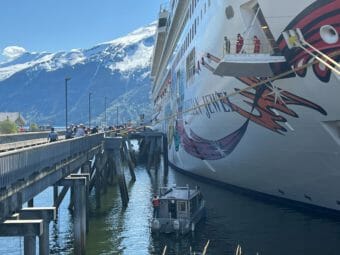
Authorities search the waters around the Norwegian Jewel cruise ship for a missing person in Skagway on May 20, 2022. An eyewitness reported seeing someone sink into the water. (Photo by Mike Swasey/KHNS)

Updated Post — May 21, 7:06 p.m.

Divers found the body of William Anthony Rodriguez, 32, of Miami, Florida on Sat., May 21, according to Alaska State Troopers. The man reportedly was swimming in front of a docked cruise ship on Friday afternoon when he began to have trouble and sank.

Divers from Juneau and search dogs from Southeast Alaska Dogs Organized for Ground Search arrived in Skagway on Saturday and found Rodriguez’s body, trooper say.

Original Post — May 20, 4:21 p.m.

A missing person search is underway in the waters around a docked cruise ship in Skagway. 

Friday afternoon, City Manager Brad Ryan said an eyewitness saw a man in the water near the inland-end of Skagway’s Broadway Dock.  

“And they saw him sink away into the water, and that’s as far as we know right now,” Ryan said. “So the individual’s missing, and we don’t know — we’re presuming he’s drowned, but we don’t know that for certain right now.” 

Ryan said vessels from the Skagway’s harbor department and the Norwegian Jewel cruise ship are participating in the search. The U.S. Coast Guard also sent a response boat from Juneau to help. 

There’s no word yet from the authorities about who the missing person may be. 

Juneau budget debate winds down; Assembly members pitch options for food sales tax break

A man walks into Foodland IGA in Juneau, Alaska. (Photo by Lyndsey Brollini/KTOO)

The Juneau Assembly’s annual debate over the city budget is  winding down. But it still hasn’t settled on how to exempt food from sales tax.

Most Assembly members want to exempt groceries from the city’s sales tax and come up with a way to make up for most of the foregone revenue. Last month, consensus appeared to be forming around tying the new exemption to an October ballot question. It would ask Juneau voters to approve an extra 1% seasonal, summer sales tax.

The city finance director estimates that on average, residents’ savings from the year-round food exemption would outweigh the extra sales taxes they would pay on everything else six months of the year by $143. And, thanks to summer visitors, the seasonal tax is estimated to make up for 94% of the lost revenue.

This week, Assembly members formally introduced several other options. Some of these ideas compete with each other, and some could work together.

Instead of universally exempting food from sales tax, Mayor Beth Weldon is backing a rebate program only for lower-income residents. It would be similar to an existing rebate program for lower-income seniors.

Weldon said the dollar value of the annual rebate is negotiable, but it’s intended to be about as much as a household pays in sales taxes on food.

Instead of a 1% seasonal sales tax, Assembly members Carole Triem and Maria Gladziszewksi are interested in a smaller, 0.5% year-round sales tax increase. It’s estimated to cover about three-quarters of the cost of exempting food. Gladziszewski said that might get more support from the business community.

Ending a tax break on sales by nonprofits is also on the table. The Assembly initially discussed all sales by nonprofits, but the ordinance the Assembly introduced this week specifically targets sales of tangible stuff; services and rentals by nonprofits would still be tax-free.

The sales tax issue has an unusual budget backdrop. In absolute dollars, the city is flush right now because of federal support from pandemic relief programs over the last two years. But it can’t count on that going forward. City Finance Director Jeff Rogers said if you strip away the one-time money, the city appears to be spending several million dollars more than it can reliably bring in.

For now, that doesn’t mean streets won’t get plowed or that school class sizes will balloon. The budget the Assembly settled on in committee on Wednesday isn’t going to make big changes to address the budget gap. Most members of the Assembly are OK with riding out at least the next fiscal year with savings.

And, even though City Manager Rorie Watt had recommended nudging property taxes up a little to 10.66 mills — the owner of a $400,000 home would pay $40 more a year — the Assembly voted to keep the property tax rate flat at 10.56 mills.

Assembly member Alicia Hughes-Skandijs had a notable dissent on the mill rate. To cover most of the cost of exempting food from sales tax, Hughes-Skandijs had a property tax hike in mind that would raise the property tax bill on that $400,000 home by $400. She recognized her idea was a nonstarter.

“I just think, we’re talking in tenths of mills, not my very unpopular idea of a mill to pay for the sales tax off of food,” she said.

Still, she said she thinks the honest, responsible thing to do is to cut back on city services or raise taxes.

Public hearings and the Assembly’s final votes on the property tax rate and city budget are scheduled for June 13.

The timeline for the sales tax proposals is fuzzier. The Assembly may be able to hash out what to ask voters to approve in time for that same June 13 meeting. Or, they might not. Versions of this have come up several times over the last three decades.

To get a sales tax question onto the local election ballot in October, the Assembly’s drop dead date to act is Aug. 4.

Industry and Pacific Northwest partners want cruising to go zero-emission by 2050

Celebrity Millennium cruise ship in downtown Juneau 2022 05 17
The Celebrity Millennium cruise ship docked at one of Juneau’s two city-owned cruise ship berths on May 17, 2022. Celebrity Cruises is a subsidiary of the Royal Caribbean Group, one of many cruise ship companies aiming to cut their greenhouse gas emissions to zero by 2050. (Photo by Jeremy Hsieh/KTOO)

The cruise industry and several Pacific Northwest ports announced Tuesday that they are working together to try to eventually eliminate greenhouse gas emissions from cruising in the region.

Lots of partners are signing onto the effort to develop the world’s first “green corridor” for cruise ships. It’s an early first step toward a goal they want to achieve by 2050. The idea is to work together to develop technology, infrastructure and best practices so that cruises no longer pump greenhouse gases that cause global climate change into the atmosphere.

Partners so far include the City and Borough of Juneau, the port authorities in Seattle and Vancouver, international shipping organizations and the operators of almost every big cruise ship in the region.

“When Port of Seattle first reached out to us about this concept, we were very excited and quite frankly, a little surprised,” said Jesse Fahnestock with the Global Maritime Forum, which works on maritime sustainability issues. “We didn’t anticipate as we were working on this that cruises would be one of the first mover segments on green corridors. But we very much agree that, having looked at the concept presented, that this is a really promising opportunity. If it can be done anywhere, it can be done here, in the Pacific Northwest.”

A single cruise ship can burn thousands of gallons of fuel a day.

Kelly Craighead leads the industry group Cruise Lines International Association. She said CLIA and many other stakeholders want the United Nations’ International Maritime Organization to develop a massive, $5 billion research and development fund.

“Carnival Corp., Royal Caribbean Group, Norwegian Cruise Line Holdings, MSC Cruises and many others are willing to invest deeply into these types of collaborative R&D funds, because it is going to take that level of investment to be able to develop the technologies that don’t currently exist,” Craighead said.

Jan Swartz is the president of the Holland America Group, a subsidiary of Carnival. She said her company already has its own R&D team working on new technologies to make cruise ships more efficient and to use alternatives to fossil fuels.

“We’re really excited to bring to the table our learnings … to share with others in the maritime sector and seek similar ideas from them so that we can accelerate our collective progress faster,” she said.

She shared some examples of technologies being researched or piloted:

  • Air lubrication systems that create a carpet of bubbles under a ship’s hull, reducing resistance and improving energy efficiency.
  • Using electric battery packs on cruise ships.
  • Dual-fuel systems that can burn liquefied natural gas.

The structure and scope of how the partners will work on this green corridor still has to be worked out. An official with the Port of Seattle Executive Director Stephen Metruck said he expects to get all of the partners together in the next 30 days to begin work on a charter for the group.

Alexandra Pierce is Juneau’s tourism manager. She said this partnership can be a model for the rest of the world.

“We were the first port in the world to have shore power, and I think it’s really appropriate that we lead the world in this, too, and continue to push the envelope on environmental policy and practice in the cruise world,” Pierce said. “Someone, somewhere needs to figure out what the roadmap looks like to get industry there.”

The green corridor partners announced their collaboration during a conference on ports and harbors in Vancouver.

Cruise ships report a lot of COVID data to the authorities, but very little of the information is public

first 2022 cruise ship passengers Norwegian Bliss 2022
The first passengers of the 2022 cruise ship season walk off the Norwegian Bliss and into Juneau on April 25, 2022. (Photo by Paige Sparks/KTOO)

One passenger on a recent Carnival cruise bound for Seattle claimed there were about 200 people sick with COVID-19 on board, and that the crew were overwhelmed. Carnival downplayed the situation with Seattle press, but wouldn’t disclose the case count.

That ship, the Carnival Spirit, is now cruising between Seattle and Southeast Alaska for the summer. If its crew are following protocol, the Centers for Disease Control and Prevention, the U.S. Coast Guard and the Alaska Department of Health and Social Services should all have good data about the COVID situation on board on any given day. But very little of that information is available to the public for the Spirit, or any of the ships operating in Alaska this summer.

This year, the cruise lines operating all of the big ships in Alaska committed to regularly report illness data by opting into the CDC’s COVID-19 Program for Cruise Ships. They’ve agreed to fill out and send a form every day for every ship so the CDC can track COVID-19 cases on board.

Individuals’ health information is protected. That hasn’t stopped state health authorities from publishing individual communities’ overall case counts, hospitalization figures, hospital capacity, deaths or other stats helpful for gauging COVID-19 risk. But the CDC isn’t doing that for cruise ships.

The CDC does publish and update daily a color-coded cruise ship status on its website for each ship. Green means they have no cases of COVID-19 or COVID-like illnesses.

The Carnival Spirit has been in the orange category. That could mean as few as seven passengers are sick — or it could be hundreds. The majority of the ships sailing right now are in that category.

“To be expected, I would say. COVID is kind of prevalent everywhere right now,” said Juneau Deputy City Manager Robert Barr. Nowadays, hospitalization rates are a key metric he’s keeping an eye on. “And thankfully, we’re not seeing hospital impact significantly, locally or more broadly.”

Over 90% of the passengers and crew on cruise ships are vaccinated. That’s higher than the populations of the communities they’re visiting. The CDC says that scientists monitoring the effectiveness of the vaccines have seen protection against infection wane over time, but protection from severe cases that lead to hospitalizations persists.

The CDC’s most severe category for cruise ships is red, which indicates the medical capacity onboard is overwhelmed. Some of the Spirit’s recent passengers described a poorly managed COVID-19 outbreak that did overwhelm the crew. However, Carnival told Seattle press that there were no serious health issues and that it maintained its health and safety protocols.

The CDC has not made anyone available for an interview about its cruise ship program.

Like last year, the cruise lines have made a lot of commitments to Alaska port communities to reduce the spread of COVID-19 and to manage cases themselves. Cruise passengers and crew aren’t supposed to burden local health care systems. Barr said the agreements this year say that medical facilities in the bigger ports like Juneau, Ketchikan and Whittier could help out if the need arises.

“But occasionally, occasionally we can assist,” Barr said. “In the event that we can’t, then each line is required in the agreement to transport impacted passengers and/or crew to Seattle.”

The CDC’s description of its cruise ship program also says the Coast Guard is supposed to get the most timely information about illness before ships arrive in a port. The Coast Guard has not made anyone available for an interview about this.

That leaves the Alaska Department of Health and Social Services. It’s been regularly publishing COVID-19 data statewide on online dashboards of its own since the pandemic began. The data can be narrowed to specific Alaska regions and communities. But it’s not helpful for teasing out cruise ships.

Department spokesperson Clinton Bennett said lots of factors affect how cases identified aboard a cruise ship operating in Alaska get published. And there is potential for cruise ship cases to cause spikes in different communities’ COVID-19 data that don’t reflect higher risk.

For example, a cruise ship passenger could spend a day in one community, get back on board, test positive at sea, then end up in the case counts for the next port of call — even though they would stay quarantined aboard the ship.

Bennett said cases caught in Alaska waters could also be geographically tagged as “at sea,” which isn’t searchable.

“Our overall takeaway,” Bennett wrote in an email, “is that the dashboard case counts announced in relation to the cruise industry shouldn’t be relied upon alone in understanding impact to local communities or the total size of an outbreak on a vessel.”

When Sue Schrader heard that, she was dismayed. She’s a longtime Juneau resident who’s been concerned about cruise ship labor practices, the industry’s impact on Juneau and the environment.

“For those of us living in the community who maybe want to avoid going into busy shops downtown when we’ve got a four or five cruise ship day because of potential exposure, you know, we don’t have the information necessary to make those decisions,” she said.

Schrader said the anecdotes she’s read suggest passengers and crew are in the dark about COVID-19 outbreaks too.

The industry group Cruise Lines International Association Alaska said its member lines are voluntarily complying with the CDC’s program and protocols.

“Much like last year, we anticipate a successful season where we do not burden shoreside facilities and ports we visit,” said Renée Limoge Reeve, vice president of government and community relations for the CLIA, in an email.

Schrader is skeptical.

“This lack of transparency — you know, I’m sorry, but for CDC to expect the cruise ships to honestly report? … These are the same ships in many cases that have polluted our waters and falsified their pollution records,” she said.

Carnival and its subsidiaries, which include Holland America and Princess, recently completed a five-year probation period for the environmental crimes Schrader mentioned.

“And we’re supposed to now believe them that they’re going to report how many potential crew and passengers have COVID?” she said.

For the state’s top health officials, the answer appears to be yes. Health Commissioner Adam Crum and Chief Medical Officer Dr. Anne Zink recently described the cruise lines as good stewards in protecting public health on board and in the communities they visit. They say the industry has demonstrated its desire to be transparent, good partners.

Delta is resuming year-round service to Juneau (again)

Delta at SeaTac
A Delta airplane at Seattle-Tacoma International Airport on Nov. 20, 2015. (Photo by Jeremy Hsieh/KTOO)

Delta Air Lines is bringing back year-round service to Juneau, and its competition with Alaska Airlines is driving airfares down.

Delta hasn’t made an official announcement, but confirmed in an email to KTOO. There’s one Delta flight scheduled every day between Juneau and Seattle beginning June 6, and continuing past its typical summer season.

Scott McMurren
Scott McMurren runs the newsletter Alaska Travelgram and has written a travel column in the Anchorage Daily News for decades. (Photo courtesy of Scott McMurren)

Alaska travel expert Scott McMurren shared the discovery with KTOO on Thursday. He runs the newsletter Alaska Travelgram.

“I track these fares to see how low they go, like, $200 round trip,” McMurren said. “And I was looking in October and November and the Delta flights were still in there! I’m thinking, ‘Well, usually, they’d make a big play of this.'”

In recent years, Delta’s seasonal service with a Boeing 737 has ended in September. Delta’s booking site shows flights will continue after Labor Day with a somewhat smaller, lower capacity Airbus plane.

“The fare to Seattle will stay low,” McMurren said. “And what it also means is travelers who want to fly internationally – to Paris, to Amsterdam, if we ever get to go back to Asia – then they’ll have, you know, one carrier to provide that service. It really opens up the world, particularly for off-season travel, for those folks in Juneau.”

Alaska Airlines had a unique advantage in Juneau for many years. It uses a technology it developed in the 1990s that lets its planes navigate Juneau’s tricky approach and land in weather conditions that other airlines couldn’t. However, the Federal Aviation Administration says Delta is also authorized to use a version of the technology in Juneau with Boeing 737s. Juneau Airport Manager Patty Wahto says that’s been the case since at least 2017.

Delta’s seasonal service through SkyWest Airlines to Ketchikan and Sitka will also resume on June 6 and end on Labor Day.

“I spend a lot of time checking fares,” McMurren said. “And what’s really been interesting, fares have been going up, up, up, up, all over the country; three sets of fares are going down. And that was Juneau-Seattle, Ketchikan-Seattle, and Sitka-Seattle, all starting on June 6 when Delta brings in their seasonal service.”

Delta’s service to Juneau has been on and off over the decades. In 1992, it scaled back to seasonal service. In 1996, it stopped flying to Juneau entirely. It resumed seasonal service in 2014 and tried year-round service in 2015, then went back to seasonal service in the fall of 2016.

Correction: An earlier version of this story misstated that Alaska Airlines had a “unique” technology advantage for navigating in and out of Juneau. It’s been updated to reflect that Delta uses a version of the same technology.

Ketanji Brown Jackson will not headline Alaska lawyers’ convention

Ketanji Brown Jackson at White House 2022 02
U.S. Supreme Court nominee Judge Ketanji Brown Jackson delivers remarks in the Grand Foyer of the White House, Friday, Feb. 25, 2022. (Photo by Adam Schultz/The White House)

The U.S. Supreme Court’s newest member will not be the keynote speaker at an annual convention of Alaska lawyers in October.

That’s according to a message on the Alaska Bar Association’s website. It says it’s disappointing news, though Justice-designate Ketanji Brown Jackson is optimistic about a future visit to Alaska.

Jackson committed back in December to headline the bar association’s annual convention. She was a U.S. Court of Appeals judge at the time. President Joe Biden nominated her to become a U.S. Supreme Court justice in February, and the U.S. Senate confirmed her in April.

Since 2001, at least seven sitting U.S. Supreme Court justices have spoken to the Alaska Bar Association through its conventions or other events. A new keynote speaker has not been announced yet.

Site notifications
Update notification options
Subscribe to notifications