I dig into questions about the forces and institutions that shape Juneau, big and small, delightful and outrageous. What stirs you up about how Juneau is built and how the city works?

A U.S. Postal Service worker loads up a truck at the Federal Building in Juneau on April 21, 2022. The Postal Service and other private couriers suspended service to Russia after it invaded Ukraine. (Photo by Jeremy Hsieh/KTOO)
Juneau’s elected officials have an anti-war message for Vladivostok, their sister city in Russia. But figuring out how to actually deliver the message is its own challenge.
On the Juneau Assembly’s direction, Mayor Beth Weldon wrote a letter addressed to the mayor of Vladivostok that says, “the criminal acts of the Russian President and Russian armed forces are wrong and should be condemned.” It also voices support for Ukraine and a hope that the two cities can eventually restore a cooperative relationship.
The city tried to send the letter on Monday through the U.S. Postal Service. But a Postal Service spokesperson said mail addressed to Russia will be returned to the sender.
The Postal Service and private couriers FedEx, UPS, and DHL all suspended service to Russia after it invaded Ukraine.
Mayor Weldon said she’ll try to resend it by email, if she can find an email address. She plans to ask Sister Cities International, the nonprofit that facilitates sister city relationships, for help.
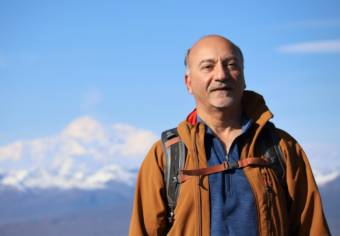
Les Gara is a Democrat from Anchorage running for governor of Alaska. (Photo courtesy of Kelly Blumer)
Democratic candidate for governor Les Gara was in Juneau last week campaigning. The candidate sat down with KTOO’s Jeremy Hsieh on Friday to talk about why he’s running, the state’s finances and how he thinks the new ranked choice voting system will play out.
Listen:
This transcript has been edited for length and clarity.
Jeremy Hsieh: Why don’t you just introduce yourself and say what you’ve been doing in elections this year.
Les Gara: It’s been interesting running for governor. It’s something I’ve wanted to do since I saw what this governor has been doing. And my view is based on how I grew up. My father was killed when I was 6, I grew up in foster care. And I just developed this view that everybody deserves an opportunity to succeed in this world. Everybody deserves a good education. Everybody deserves the ability to get a good paying job. I believe in a living minimum wage so that you can work full time and not live in poverty. Those things matter to me. And I just don’t see this state moving in a direction that gives anybody a chance to succeed unless you’re already born wealthy.
This governor has sort of ripped apart, ripped out the rug from under, I think, anybody born with any difficulty. I had my own hardship growing up, but most people have some sort of hardship growing up — it doesn’t mean that you don’t have the right to equal opportunity and the right to succeed in this world. And that’s really what’s motivating me to run against this governor.
And there are so many people in the state who have so much potential but so many roadblocks in front of them. And they don’t deserve the roadblock of public education that’s been cut to the point where it’s $120 million behind inflation since 2014, continual neglect of our public education, continual neglect of our construction budget, so that we don’t have jobs in the state. You know, people look at the state, parents say, “Look, there’s no commitment to public education. We don’t see a job future for our kids, we’re leaving.” And under this governor, 20,000 more people have left the state than have come up here. I mean, this is the biggest export Alaska has right now is people and, and that’s just not the way to run a state and, and my ethic says you need the opportunity to have a good job so you can work and succeed.
Jeremy Hsieh: Sounds like you’ve got a lot of issues with the current governor. Why did you feel this was a race you should step into, with some of these other candidates?
Les Gara: He’s had no plan, you know? I mean, he’s like — he’s the quintessential 1980s liberal: he proposes the spending but not the way to pay for it. And I would produce a permanent fund dividend people could bank on. And I would end this debate between, you either get a dividend or you get schools or you get a university or you get a marine highway. No, you get those things, right? Those are things you get, but we have to end this $1.3 billion in unjustifiable oil company tax subsidies. This governor has chosen to make us poor. I’ll put this state back on a road to prosperity again.
Jeremy Hsieh: Advocates for oil tax industry subsidies would say they’re needed to maintain flow in the pipeline, royalties that are derived from that and just that chunk of the economy, keeping it vibrant. Sounds like you think there’s still a lot of room there for the state and the people to get a bigger piece of it without jeopardizing that? Or is the end goal to try to transition off of oil? What’s your thought there?
Les Gara: You have to have a vibrant oil industry. I mean, you want to make sure the tax is fair to them. If we ended these oil company tax subsidies, what we would have is a 35% tax on oil company profits. We don’t have that. But if we ended these tax credits, that would be the effect, you’d have a 35% tax on corporate profits. And, look, you could adjust that up or down just a little bit, but it’s $1.3 billion we’re leaving on the table. And I voted to end those credits in the past. I’ll work with the Legislature to end them. Those people who want a bigger PFD need money to pay for a PFD, unless they’re going to keep making it a false promise. People who want education funding know that they need funding. People who believe in a marine highway system know that it needs funding. You have to build a coalition of legislators who want different things and say, “Look, it’s a false promise by all of you, if you if you don’t have the money to pay for it.”
This year, we have the money to pay for it because Russia is murdering people. That’s why we have money to pay for it this year. Hopefully Russia will not be murdering people next year and the price of oil will be back down. And when that happens, we’re going to need revenue again.
Jeremy Hsieh: A lot of the policy goals you laid out require acts of the Legislature. And the Legislature, it’s got some issues building consensus within it. How do you think you would cut through?
Les Gara: You know, I’m not a partisan person. I believe that you have to work across the aisle. I passed the largest foster care reform in state history in 2018. As a Democrat through a Republican Senate, and not only through Republican Senate, but the Senate president, the most conservative of them all, invited me on the Senate floor that day to watch that bill pass.
There are going to be at least 59 legislators I believe I can work with. You know, Rep. (David) Eastman by himself, he just votes no on everything reflexively. I’ll bring him into my office and say, “Do you want to be part of the team? Or should I just work with the other 59 people?”
Jeremy Hsieh: You’ve run for office many times, maybe not statewide, but what’s different about the new election system from a candidate’s perspective?
Les Gara: The big purpose of ranked choice voting was to let you vote for your favorite candidate, and not have to choose your second choice candidate. And it says, “Look, if you want your second choice candidate, put them second.”
In August, you only get one vote. Vote for the candidate you want to make it to November. The top four candidates then go to November.
And in November, then you rank your candidates. Rank your candidates the way you believe in them. If you’re worried about Mike Dunleavy being reelected, you can vote for me first, Bill Walker second. And Mike Dunleavy doesn’t get any of those votes.
In this case, I think, you know, Bill Walker, who will be my second choice, we’ll share votes. His voters will probably pick me as their second choice, my voters will probably pick him as their second choice. One of us will make it through.
Jeremy Hsieh: Capital move, capital creep, that’s always on the mind of folks in the capital city. I don’t know if you have any commitments or promises you can make about where you’ll physically be if you’re elected governor, and where your commissioners and, you know, various state employees will be.
Les Gara: Sure, Juneau is the state capital, right? I mean, you know, this whole idea of trying to secretly move the capital out of Juneau by sending employees out of Juneau is not something that I support. It’s the capital city. When I’m down here working with the Legislature, I want to have my commissioners down here working with the Legislature, not just two days a week, I’m going to need them all week. And if they don’t want to do that, then they’re not going to be my commissioner. This is the capital city. And I support that.
Jeremy Hsieh: At some point when Sen. Dennis Egan was still in office, he had been perennially pushing a public employees retirement overhaul. I don’t believe it passed.
Les Gara: No.
Jeremy Hsieh: Do you personally benefit from one of these retirement systems or not?
Les Gara: I came up to Alaska in 1988, and we still had what was the second version of the pension system, less generous than the first version. I worked in Fairbanks for a supreme Justice Court Justice Jay Rabinowitz, and then I moved to become an assistant attorney general on the Exxon Valdez oil spill case, in the civil prosecution. So I’m what’s called tier II. Tier III was less generous. And tier III is something that I think is quite affordable, something like tier III. So you know, we don’t have to give luxury pensions, but we should give a basic pension so people can retire. And so they have an incentive to stay here.
You know, I was in the Legislature when they ended the pension system. And I voted against ending it. I said, If you end this, people will have no incentive to stay in Alaska, we will have worker turnover, and people will not have an affordable way to retire. So I voted against ending pensions in 2006. I’m the only person running for governor right now, who when they were an office, moved to try to restore pensions. So I co-sponsored legislation to return to a cost-effective pension system.
I’ve always been there on pensions, ‘cause I believe that right now, we have too much worker turnover. We have worker turnover among teachers, among troopers, among police, among all sorts of public servants, among marine highway workers.
We spend the money training employees, and then at the five-year mark, then they move to another state that has a pension. So we’re just wasting money training people who leave — no business would do that. No business would say, “Hey, we’re going to train people for our competitors.” That’s what the state of Alaska does. We’re wasting money doing that.
KTOO will sit down for interviews with other candidates for governor when they campaign in Juneau.
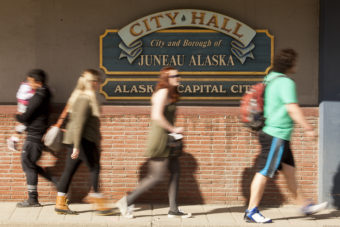
A group walks in front of Juneau City Hall on Tuesday May 10, 2016 in Juneau, Alaska. (Photo by Rashah McChesney/KTOO)
Juneau officials have formally begun the city’s budget planning for the fiscal year that begins in July. The starting point for that is reconciling the budget the Juneau Assembly passed last year with what actually happened.
The pandemic has not lent itself to predictable financial planning.
The plan last year was to spend $5.4 million out of savings to balance the budget. On top of that, the Juneau Assembly authorized about $19 million in additional, unplanned spending over the last 9 months.
“We’ve got really highly volatile numbers,” Juneau City Manager Rorie Watt told the Assembly on Wednesday. “It’s been very difficult to project revenues and expenditures. And it’s felt like everything has been a moving target.”
He said there’s been inflation, home values have skyrocketed and tourism numbers have been uncertain. In some cases, supply chain disruptions and labor shortages have meant the city couldn’t spend money it was supposed to.
For example, $4 million budgeted for payroll and other personnel costs didn’t get spent, mostly because of vacancies and pandemic-related closures of city facilities.
“It is a really unusual budget. It is really, really unusual,” Watt said. “Let’s acknowledge that uncertainty, let’s not overreact. I think the public appreciates that stable, deliberative governmental approach.”
Watt said it should be a goal to reestablish the city’s pre-pandemic budget discipline. That is, avoid taking up funding requests outside of the annual budget process.
“Definitely not our prior business practice,” Watt said. “Our prior business practice would’ve been, ‘Sounds like a great idea. Get back to us in April, and we’ll consider that in the context of all of our other budgetary issues.’”
Carole Triem, who chairs the Assembly Finance Committee, spoke up: “Yeah, you hear that, everybody?” She and the other Assembly members laughed. “Make note of that.”
Even though the city had a lot of unplanned spending, unplanned revenue was even higher.
“That is all federal money,” said City Finance Director Jeff Rogers. “No matter how you look at it, it’s federal money that is making that difference.”
Specifically, money from the American Rescue Plan Act. Because of the surplus, the Assembly decided last month that it’s comfortable committing another $19.9 million of its cash on hand to various city projects.
$500,000 for a consultant to begin work on upgrading the Juneau Police Department’s aging radio system, and
$250,000 for planning related to the North Douglas Crossing.
The Assembly may make changes to the manager’s list. For example, Assembly member Greg Smith said last month he wants to consider financial relief, particularly for needy and working class families.
“It maybe wouldn’t be spending. It would be slightly reduced revenue, and that might be something regarding the property tax, or some type of relief to citizens, just as we are seeing inflationary costs and costs for fuel and gas,” he said.
Smith said on Friday he’s still evaluating options.
The Assembly did decide to hold itself to the $19.9 million figure as a ceiling.
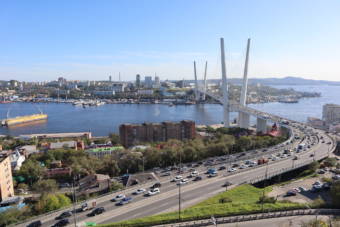
The Zolotoy Bridge crosses Golden Horn Bay in Vladivostok, Russia, pictured here on Sept. 20, 2019. (Creative Commons photo by porkandchicken)
Juneau and the Russian Far East city of Vladivostok have been sister cities since October of 1991. In recent years, the relationship has been largely dormant.
On Monday night, the Juneau Assembly considered formally suspending that relationship because of Russian President Vladimir Putin’s unprovoked war in Ukraine.
Since the sister city agreement was signed, locals have hosted visitors from Vladivostok. Students from Vladivostok qualify for in-state tuition at University of Alaska schools. The last Russian student to use the perk at the University of Alaska Southeast was in 2009, according to academic exchange and study abroad coordinator Dashiell Hillgartner. The student was from Yelizovo, a sister city with Homer. Juneau residents have gone to Vladivostok on educational, business and cultural exchanges too.
During the July 4th concert, the band covered The Beatles’ 1968 song “Back in the U.S.S.R.” They played with the lyrics in a way that hasn’t aged well.
“Well the Ukraine boys really knock me out
They leave the West behind
And the Moscow boys, they make me scream and shout… ”
“Obviously, this is not going to end the war in Ukraine. It’s a pebble. And if it helps a few people in Vladivostok think twice about what’s happening in Ukraine, and if they talk to their friends about it, and they think twice about it, perhaps eventually they could be moved to action,” Gladziszewski said.
Gladziszewski’s resolution also would have condemned Russian President Vladimir Putin and voiced support for Ukraine and its people.
The Assembly voted the resolution down, 4 to 5. Gladziszewski, Michelle Hale, Wade Bryson and Greg Smith voted yes. Beth Weldon, Carole Triem, Alicia Hughes-Skandijs, Christine Woll and Barbara Wáahlaal Gíidaak Blake voted no.
Some members said suspending the sister city status defeated the purpose of the arrangement in the first place: to promote peace and prosperity through citizen diplomacy.
“This is meant to bridge and build connection with our sister city in a way that allows for two-way communication,” Wáahlaal Gíidaak said. “Suspending that and saying we’re no longer going to communicate with you, cancels our ability to do that and also cancels their ability to communicate back to us.”
“This is not a war that’s being led by the Russian people,” said Leroy Allala, president and CEO of the nonprofit. “It’s a war by Putin and the military and, you know, I think everyone is on the same page when they say that this war was unprovoked by Ukraine and the Ukrainian people.”
Over the years, several elements of the original sister city agreement have been neglected. It calls for at least one annual official visit from each city to the other, and a free flow of information and ideas between residents. The agreement says each city will allow freedom of communication and association in sister city activities, which now seems impossible in Putin’s Russia.
Assembly member Alicia Hughes-Skandijs said the public emailed support and opposition.
“But some of the emails we received in favor of this resolution shocked me, and only convinced me that voting against this would be the right thing to do,” she said. “They were extreme in their characterization of the Russians as a people. And it reminded me of exactly what I don’t want us to do, which is to go into a sort of Red Scare situation.”
After the resolution failed, the Assembly asked Mayor Beth Weldon to send a letter to her counterpart in Vladivostok that conveys the Assembly’s condemnation of Putin and the war, and its support for Ukraine.
Gladziszewski said she hopes the discussion renews interest in Juneau’s Sister Cities Committee.
“Our relationships with our sister cities wax and wane depending on who’s on that committee,” Gladziszewski said. “It was super strong in the early ’90s. There were people super interested in Vladivostok. As you heard, people — Vladivostokians, if that’s a word — came to Juneau. And it’s waned in recent years. It just has. So this, ironically, could reinvigorate that, and I hope that it does.”
For several months, the volunteer committee responsible for nurturing relationships between Juneau and its sister cities hasn’t had enough members to operate. Four out of seven seats on the committee are vacant.