I dig into questions about the forces and institutions that shape Juneau, big and small, delightful and outrageous. What stirs you up about how Juneau is built and how the city works?
Sen. Dennis Egan, center, chats with his legislative staffers Sorcha Hazelton, left, and Peter Naoroz, right, and former staffer Jesse Kiehl, far right, at the Juneau Moose Lodge on May 31, 2018. He was there to speak to the Juneau Chamber of Commerce in one of his last public engagements before retiring from public office. (Photo by Jeremy Hsieh/KTOO)
Alaska Sen. Jesse Kiehl does a pretty good impression of one of his old boss’s signature lines.
“Oh GOD, it’s YOU,” Kiehl snarled.
If Dennis Egan greeted you like that, Kiehl said that’s how you knew he liked you.
“If you ever walked in his office and he said, ‘Oh, I’m glad you’re here. Please sit down, we have things to discuss’ — panic, right?” Kiehl said. “He put people at ease with that gruff manner.”
Kiehl worked for Egan when Egan was a Democratic state senator representing Juneau, Haines, Skagway and Gustavus from 2009 to 2018. Kiehl is also Egan’s immediate successor in the seat. He’s one of many friends, politicos and radio listeners mourning Egan this week, after his death on Tuesday at age 75.
In addition to being a state senator, Egan was also a Juneau mayor and radio host. He was well-known and well-liked for his fairness, gruff voice and mischievous personality. Rep. Bryce Edgmon, a former House Speaker, called him “the best curmudgeon around.”
Dennis Egan was born and raised in Juneau when Alaska was a territory. His father, Bill Egan, led Alaska’s constitutional convention in the 1950s and in 1959, became the new state’s first governor.
Dennis Egan would have been 11 years old when the family moved into the Governor’s Mansion. He was a prolific mischief-maker and prankster.
A young Dennis Egan poses for a family portrait with his parents, Neva Egan and Bill Egan, circa 1959. Bill Egan was the state of Alaska’s first governor. (Photo courtesy of University of Alaska Fairbanks, Ralph J. Rivers Papers 1956-1966, UAF-1972-49-161)
“Sometimes, those pranks happened to be on the front doorstep of a sitting legislator,” Kiehl said. “And boy, his father made him make apologies quite formally.”
Egan shared several stories about his childhood in the Governor’s Mansion with Alaska’s News Source in 2017, including brewing beer in the basement and running a pirate radio station in the attic.
Radio turned out to be a big part of Egan’s life. In the 1960s, he went to radio operation engineering school and graduated from an Army communications school. He used his radio skills while serving in the Alaska Army National Guard from 1967 to 1974.
In the private sector, Egan worked for KINY in Juneau, eventually becoming part owner of the station and its general manager. His gravelly voice became particularly well-known in the region after hosting “Problem Corner” for decades. That’s the station’s long-running, live swap meet show.
“Yeah, he was great at it,” said Pete Carran, a retired news director for KINY. “There was just no replacing Dennis Egan on that program.”
In 1989, Egan was elected to the Juneau Assembly. He became mayor in 1995 when then-Mayor Byron Mallott resigned to lead the Alaska Permanent Fund Corp.
“What was really amazing is when he served as mayor, and he still managed the radio station, he would be forthcoming, accessible and still make sure that the competition, like you guys (KTOO), the (Juneau) Empire, were treated equally, too,” Carran said. “I didn’t get exclusives because he was the mayor.”
In 2009, Egan was appointed to the state Senate, after the Obama administration hired away Juneau’s sitting senator, Kim Elton.
“We have to be nice to everyone, we have to work with everyone, whether you are an R or a D … you know, you have to get along, or you don’t get anything accomplished. Perfect example is $140 million for SLAM,” he said.
That’s the state libraries, archives and museum building in Juneau that was completed in 2016. Egan had worked for years to secure state funding for the facility.
“You have to get along with people. That’s the only way you have at least some opportunity of getting things accomplished,” Egan said.
Sen. Dennis Egan, D-Juneau, addresses the Juneau Chamber of Commerce at the Juneau Moose Lodge on May 31, 2018. (Photo by Jeremy Hsieh/KTOO)
At the time, the Democrat had announced his retirement from the Senate and joked that he could get away with saying whatever he wanted to his conservative-leaning crowd.
“What can you do to me? Fire me?” he asked, before talking about his support of a statewide income tax and reducing permanent fund dividends to support state government.
Gov. Mike Dunleavy vetoes out $780 million from the state budget bill and signs it
A 13-year-old girl is hospitalized after a being hit by a car in downtown Juneau
Former Juneau mayor and state senator Dennis Egan dies at age 75
Juneau residents rally against the U.S. Supreme Court’s overturning of Roe v. Wade
The cruise ship that hit an iceberg in Alaska is skipping port calls and returning to Seattle
The state Supreme Court says Republican Tara Sweeney won’t be on the August special election ballot for U.S. House
Ketchikan’s local Republican Party chapter censures Congressional candidate Sarah Palin over her reversal as governor on the so-called “bridge to nowhere”
A float plane with seven people crashes in Lake Iliamna
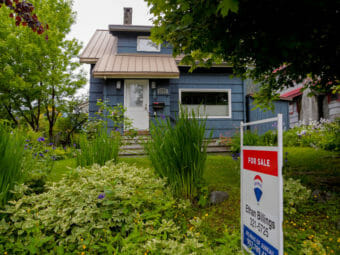
A sign marks a home for sale in the Flats neighborhood of Juneau on June 14, 2022. Real estate buyers have been required to disclose the price to the city assessor’s office since October 2020. (Photo by Paige Sparks/KTOO)
Juneau officials say the group seeking to repeal the mandatory disclosure of real estate sale prices doesn’t appear to have enough signatures for their question to reach the October ballot. But they’re not done validating them.
“As of right now, they have not given us a total number, as they’re still certifying half the books,” said Ann Sparks, a local real estate agent working on the repeal effort, on Wednesday afternoon. “So they’ve only made it halfway through. And so we don’t have an exact number to tell anyone.”
She said it sounded like the group was behind by “a small margin.”
The group initially submitted 2,501 signatures to the city. That was more than they needed. But the signature validation process is still ongoing, and so far, the city says they’re coming up short. The group will get 10 extra days to collect more signatures.
The signature validation process isn’t going according to schedule. The group submitted the signatures on June 4. The city clerk’s office intended to complete its review by Tuesday to meet a 10-day deadline in the city charter.
City Clerk Beth McEwen said Tuesday her office has been working extra hours to get through the process. McEwen said she didn’t have an estimate for when they would finish and would not be providing public status updates.
City Attorney Rob Palmer would not concede that the deadline had passed.
“So the timing is a little squirrelly,” he said. He declined to comment further on the issue.
The deadline language does appear to have some ambiguity when there are too few signatures.
The referendum group wants to repeal a pair of ordinances the Juneau Assembly adopted in 2020 and this past February that made it mandatory to share the sales price of real estate and other related information with the city assessor’s office.
Real estate professionals say mandatory disclosures are an invasion of privacy that will lead to higher tax bills and pave the way for city officials to enact a real estate transfer tax, which is common in states with mandatory disclosure laws.
The Assembly has not discussed creating such a tax in its public meetings.
City finance officials and government assessors say that mandatory disclosure leads to more accurate assessments and a more fair distribution of the property tax burden.
The Alaska Legislature’s nonpartisan research service examined the issue in 2014. In a report, the researcher said that without mandatory disclosures, the highest value properties tend to be under-assessed compared to more typical homes, which means the owners of large custom homes and commercial properties tend to benefit from nondisclosure.
To date, Juneau Assessor Mary Hammond said no one has been fined for failing to disclose. But the city assessor’s office intends to begin levying fines at the end of June.
The last petition process that led to a question reaching the local ballot was in 2011. Voters were asked to create a tax of 15 cents per plastic shopping bag used at major retailers. Voters rejected it by more than 2-1.
The city’s election rules give the group an extra 10 days to collect more signatures to meet the threshold of 2,130. Sparks and the city attorney said they expect that clock will start running on Friday, when additional signature gathering books are ready. Sparks said her group’s goal is to collect 500 more.
Close
Update notification options
Subscribe to notifications
Subscribe
Get notifications about news related to the topics you care about. You can unsubscribe anytime.