I dig into questions about the forces and institutions that shape Juneau, big and small, delightful and outrageous. What stirs you up about how Juneau is built and how the city works?
The Juneau Chamber of Commerce issued a statement Friday distancing itself from the U.S. Chamber of Commerce’s political advertisements in Alaska.
The statement says:
“The Juneau Chamber of Commerce is independent from the U.S. Chamber of Commerce and has no affiliation with its political ads. We do not endorse candidates, nor do we contribute to the U.S. Chamber’s election related activities.”
It was signed by Juneau Chamber President Max Mertz.
The U.S. Chamber has been running television attack ads in Alaska targeting incumbent Democratic Sen. Mark Begich and supporting Republican candidate Dan Sullivan.
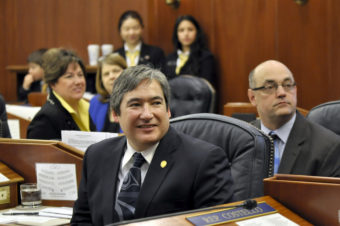
Sam Kito lll looks toward the House gallery shortly after being sworn in as the new representative for House District 32. (Photo by Skip Gray/Gavel Alaska)
The Alaska Legislature’s most junior member says this year’s 95-day legislative session shows lawmakers can take on only a few big issues in the 90 days mandated by voters.
Rep. Sam Kito III says he’s interested in returning to a 120-day session.
“I think that it’s important to — for me — to think about how we might be able to try and maybe think about going back to a 120-day session,” Kito says.
It’s a politically touchy subject. Voters narrowly mandated the shorter session through a ballot initiative in 2006. It was sold as a way to save money and attract more candidates for elected offices.
While politically fraught, it’s legally moot. The 120-day language in the state constitution trumps the 90-day voter initiative law.
The Juneau Democrat says he was proud to work on House Bill 278, a package of funding increases and wide ranging education policy changes. Disagreements over school funding were the key reason for the five extra days in session. The bill didn’t clear the legislature until day 95.
“There were still issues that I had with the bill, but when we got down to the end, it was a fairly good compromise,” Kito says. “I think there’s definitely a lot of work that needs to be done, again, next year. But I was pretty pleased with the end product.”
Kito has mixed feelings about the funding. The package includes increases above the governor’s proposal, but not enough to prevent staffing reductions in Juneau and other school districts facing budget shortfalls. And, much of the new money is not enshrined in the state’s education funding formula.
Another concern is a requirement on the Department of Administration to propose a statewide school salary schedule. Kito says such a schedule could bypass local union negotiations.
House Bill 278 also creates tax credits for donations to private nonprofit and religious schools, which Kito believes are unconstitutional.
Kito’s first legislative session was short. He was sworn in on day 37 to replace long-time Juneau Rep. Beth Kerttula. She resigned midterm to take a fellowship position at Stanford University.
Coastal Caucus Sens. Dennis Egan, Bert Stedman and Donny Olson (left to right) talk on the floor of the Alaska Senate just before debate on Senate Bill 138, the natural gas pipeline bill, March 18, 2014. (Photo by Skip Gray/Gavel Alaska)
Democratic Sen. Dennis Egan says he thinks the next legislature will try to resurrect a bipartisan caucus to lead the Alaska Senate.
“I think there was a lot of dissatisfaction this year on the way things were run. I think that there may be some change in the next legislative session,” Egan says.
Since 2013, the Senate’s been controlled by a band of 13 Republicans, Egan, and Democratic Sen. Donny Olson from Golovin.
Sticking up for coastal interests is part of why Egan says he and Olson caucused with the Republican majority, where Railbelt interests would otherwise dominate.
For example, Egan credits the majority’s coastal caucus with a major amendment to Senate Bill 138. That’s the bill that empowers the state to partner with industry to build a massive natural gas pipeline. That bill, which is on its way to the governor, now includes a provision diverting some of the state’s natural gas revenue to energy projects in communities the pipeline won’t directly serve.
“We came at the end with a fairly significant voice in trying to get our things through,” Egan says.
Meanwhile, Egan worries that cuts in the state operating budget will hit the capital city especially hard. Exactly how those dollar reductions on paper translate into reality isn’t clear yet. The capital budget was a different story.
“We fared very well,” Egan says. “We obtained nearly $100 million in capital project funding for District P. And that doesn’t include the $37.5 million for SLAM.”
SLAM is the State Library, Archives and Museum building under construction in downtown Juneau. The money set aside for it this session should be enough to complete it. SLAM is slated to open in 2016.
A pack of 18 youths walked the halls of the State Capitol, April 16, 2014, in a silent demonstration asking for more education funding. Bridget Galvin, a junior at Steller Secondary School in Anchorage and founder of Students With a Voice organized the event. (Skip Gray/Gavel Alaska)
A pack of 18 youths walked the halls of the state Capitol on Wednesday in a silent demonstration asking for more education funding.
Most of the legislators, staffers and lobbyists they encountered in the narrow hallways and stairwells made way, watched for a few moments, and then went back to business as usual.
The youths held signs that said, “WE ARE THE FUTURE” and “BSA 400-125-125.”
“BSA” means “base student allocation.” It’s the $5,680 the state of Alaska annually pays public schools per pupil, plus or minus a number of adjustments.
Bridget Galvin, a junior at Steller Secondary School in Anchorage, organized the demonstration.
“I took a few days to come down here and talk with different legislators and make sure students have a voice in this issue,” Galvin said.
Galvin and the group she founded, Students With a Voice, want the BSA to increase by $400 this year, followed by two annual increases of $125.
A bill to address funding shortfalls for a state hazardous spill cleanup program died in a legislative committee Monday.
For years, an existing 4-cent per barrel surcharge on oil producers hasn’t covered the Division of Spill Prevention and Response’s costs. And the division has nearly exhausted its savings.
The legislature can keep the spill division whole in the future with one-time budget fixes, or by bumping the surcharge up to 7 cents through House Bill 325. But the bill never got the support it needed in committee, and proponents know they’re out of time.
Rep. Paul Seaton, Feb. 27, 2014. (Photo by Skip Gray/Gavel Alaska)
“There’s not much time left in this legislature. I mean, nobody is thinking we’re going to zoom through both sides of the legislature, on a bill that is — especially one that is, is talking about tax,” said Rep. Paul Seaton.
The Homer Republican was speaking to the House Resources Committee. He and Rep. Cathy Muñoz, R-Juneau, carried the bill.
Rep. Mike Hawker, an Anchorage Republican, wouldn’t support the bill because he thinks the program’s management is lacking and that the existing surcharge is unfair.
Rep. Mike Hawker addresses the Alaska House of Representatives, March 25, 2014. (Photo by Skip Gray/Gavel Alaska)
“I don’t see an analysis that’s matching costs and expenses, which is what we need to be doing here. I still remain really concerned that this approach does simply say, ‘Tax the guys with the deepest pockets,’” he said.
That tax burden is almost exclusively on crude oil producers, though the revenue is used for any type of hazardous spill from any industry or even private citizens.
Hawker called the spill fund a department “slush fund” in 2013, the last time Seaton tried to raise the tax.
The latest version of the bill that Muñoz and Seaton offered would have spread the tax burden by creating an additional half penny per gallon surcharge on refined petroleum products, like heating fuel.
Spill Prevention and Response Division Director Kristin Ryan said just this weekend, the division responded to a spill from a vandalized fuel storage tank at a Juneau hotel.
“We were there, you know, we got called out there I think in the middle of the night Saturday night, because people smelled, you know, they smelled the petroleum. So we went out there with sensors with the fire department,” Ryan said.
They cleaned up what they could and will send the hotel a bill.
This is another cause of the division’s budget shortfalls. Theoretically, the party responsible for a spill must reimburse the division. But in reality, there may not be a responsible party, or the party the state thinks is responsible doesn’t agree. Historically, the division has only been able to recover about half of what it seeks. In some cases, it can take years and court battles.
The committee held the bill and instructed the division director to continue refining her spill accounting for the next legislature. Seaton and Muñoz say they want to keep the idea percolating in the interim, and will reintroduce the bill next year — if they’re re-elected.
A ridge of crumbling masonry near the top of Alaska’s Capitol, April 3, 2014. (Photo by Skip Gray/Gavel Alaska)
Detail of brick façade exposed during renovation of Alaska’s Capitol, April 3, 2014. (Photo by Skip Gray/Gavel Alaska)
Much of the second phase of repairs and renovations will be focused on the Main Street-facing side of the Capitol. (Photo by Skip Gray/Gavel Alaska)
The legislature has approved $5.8 million in additional repairs and renovations to the Capitol building.
“Go forth, fix the Capitol,”said Rep. Mike Hawker, R-Anchorage. He chairs the Legislative Council, which authorized a contract with Dawson Construction on Thursday. The council manages the legislature’s in-house administration.
This is the second phase of the project. The need for major repairs of the facade and earthquake retrofits has been well documented, punctuated by occasional chunk of falling masonry. Building manager Jeff Goodell recently took some time to preempt a potential drizzle of stonework on 60 of the building’s most important tenants; legislators lined up out front for a group photo Wednesday.
“Our building manager spent the weekend taking loose chunks of concrete off the parapets that were so loose, that they had a very real chance of falling and hitting someone while we were taking that picture,” Hawker said.
Outside the Capitol, Goodell points out where he’d worked along a lip of crumbling brick near the roof. He says masons recently told him the pace of deterioration is shifting.
“You know, this golden girl is 83 years old. It took a long time to get to this point, but now, things really get accelerated,” Goodell says.
Deteriorating masonry scraped off the facade of the Capitol by building manager Jeff Goodell. (Photo by Jeremy Hsieh/KTOO)
In the Capitol’s maintenance section, Goodell pulls out a 5-gallon bucket and cardboard box filled with crumbly bits and chunks of masonry.
“There are big parts down in here. Of course, this is just little stuff you’re seeing at the top. But there’s big stuff in there,” Goodell says.
He’s keeping it “as evidence.”
“This is for people to see, to know that we’re not monkeying around,” Goodell says.
Workers completed the first phase of Capitol repairs and renovations last fall. That phase included repairing the granite front steps, reinforcing the marble columns, replacing the plumbing and draining systems and cleaning up the crawlspace beneath the building.
With the contract approval, work will resume this summer.
Close
Update notification options
Subscribe to notifications
Subscribe
Get notifications about news related to the topics you care about. You can unsubscribe anytime.