Jeremy Hsieh

Local News Reporter, KTOO

I dig into questions about the forces and institutions that shape Juneau, big and small, delightful and outrageous. What stirs you up about how Juneau is built and how the city works?

Cell phone tower ordinance to be reworked, again

SueAnn Randall, Spuhn Island hat
SueAnn Randall of North Douglas testified at Monday’s Juneau Assembly meeting wearing a hat representing Spuhn Island and its lit cell phone tower. She says the light is like an unwelcome guest who never leaves. (Photo by Jeremy Hsieh/KTOO)

Last night, the Juneau Assembly sent back to committee its long-awaited ordinance to regulate what cell phone towers look like and where they can be put.

The Assembly had the ordinance slated for final vote but that went awry after what could have been the ordinance’s final public hearing.

SueAnn Randall of North Douglas wore a green hat to the Assembly meeting with a spoon attached to it just above her forehead. On the crown of the hat, there was a stand of trees dwarfed by a wireframe tower pointing to the ceiling. The tower was topped with a little red light.

It’s a dig at the cell phone tower on Spuhn Island, which her home on North Douglas Highway faces.

 “Since Friday, Sept. 6, 2013, it has been challenging to find respite from the unrelenting flashing light in my home, my gardens and my bed,” she told the Assembly.

That’s when the light on the Spuhn Island tower first went on. That tower and all other existing towers in Juneau would have been grandfathered in under the ordinance the Assembly considered.

Here’s Mary Irvine, another North Douglas Highway resident who’s been following the ordinance.

“The planning commission talked about, ‘Do we give them 1 year to come into compliance? 3 years? 10 years?’ They really delved into it,” Irvine said. “And then, based on one redrafting of the plan … it comes back and the existing cell towers are simply grandfathered in. They never have to come up to conformance to the standards in this plan. It’s astonishing to me.”

Grandfathering was one of several issues that drove the ordinance back to committee. There were also legal technicalities, industry objections to specific rules for being overly broad, and wordsmithing suggestions to better align language with intent.

Kim Allen, a lawyer representing AT&T, noted a few specific parts of the proposed ordinance that imposed great costs to industry. For example, a requirement to mail notices to all property owners within 3 miles of every proposed tower.

Allen said demand for wireless services was up 50,000 percent since 2006.

 “We want to bring that service to your community and we want to do it with as little visual impact as humanely possible,” Allen said. “But we also would like a fair and efficient process to do it.”

There was also objection over a recent change on how to communicate what a proposed tower will look like. The latest version requires before and after photo mockups of a given site from multiple points of view. An earlier version instead required flying a bright balloon at the height of the proposed tower in its location for 72 hours.

Allen said the photo route is easier, more accurate and follows what other Pacific Northwest communities are doing.

Community members asked, why not do both?

After about half an hour of critical public testimony, Assemblyman Jerry Nankervis said it was clear the ordinance wasn’t ready for adoption and needed to go back to committee for more work.

Mayor Merrill Sanford chided the Assembly to be better prepared to make changes in committee and for missing past opportunities to do so.

“So we don’t continue things on forever and ever here,” he said.

City officials have been working on a comprehensive cell phone tower plan on and off since about 2009.
Housing tops Juneau’s economic concerns

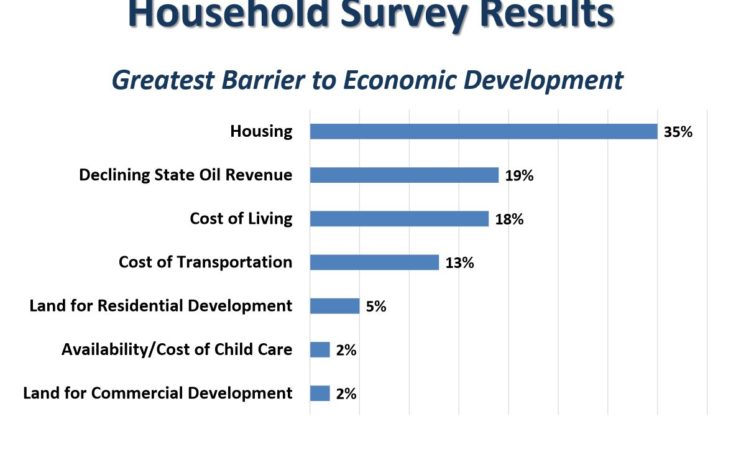
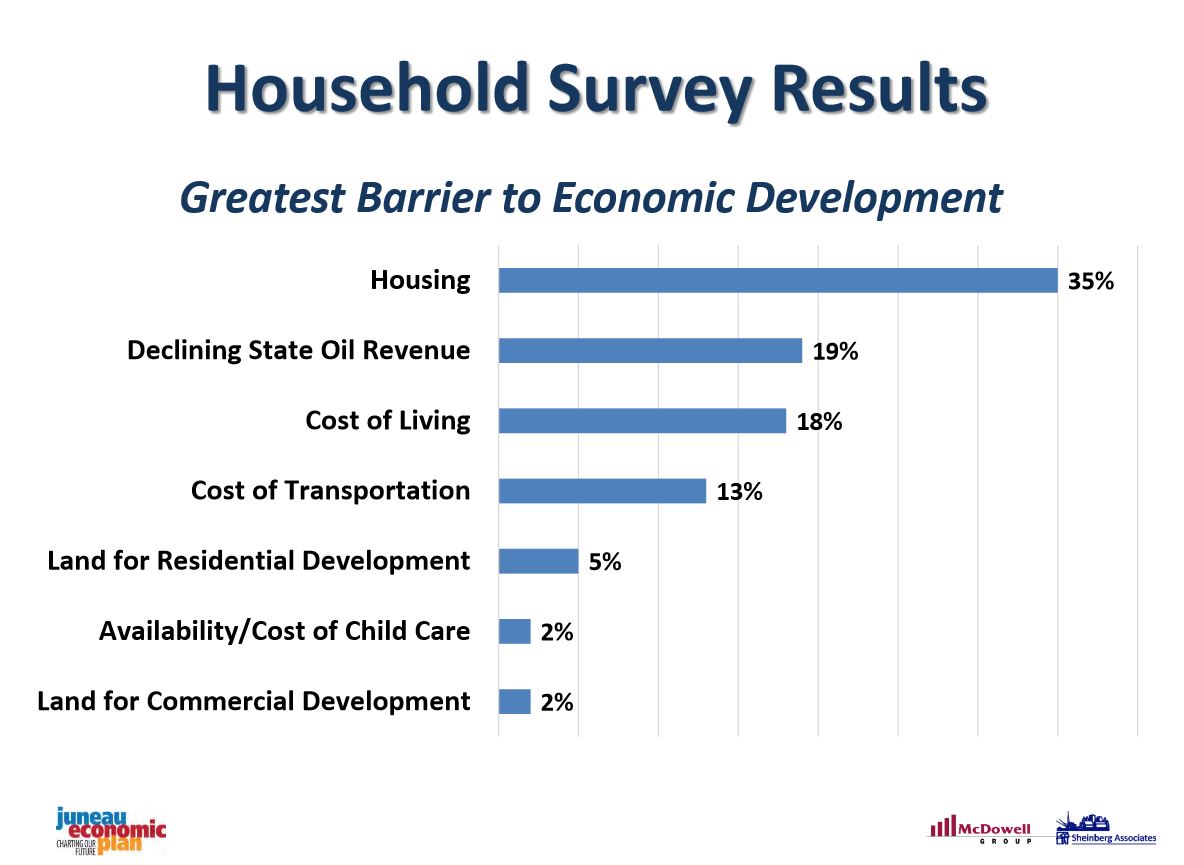
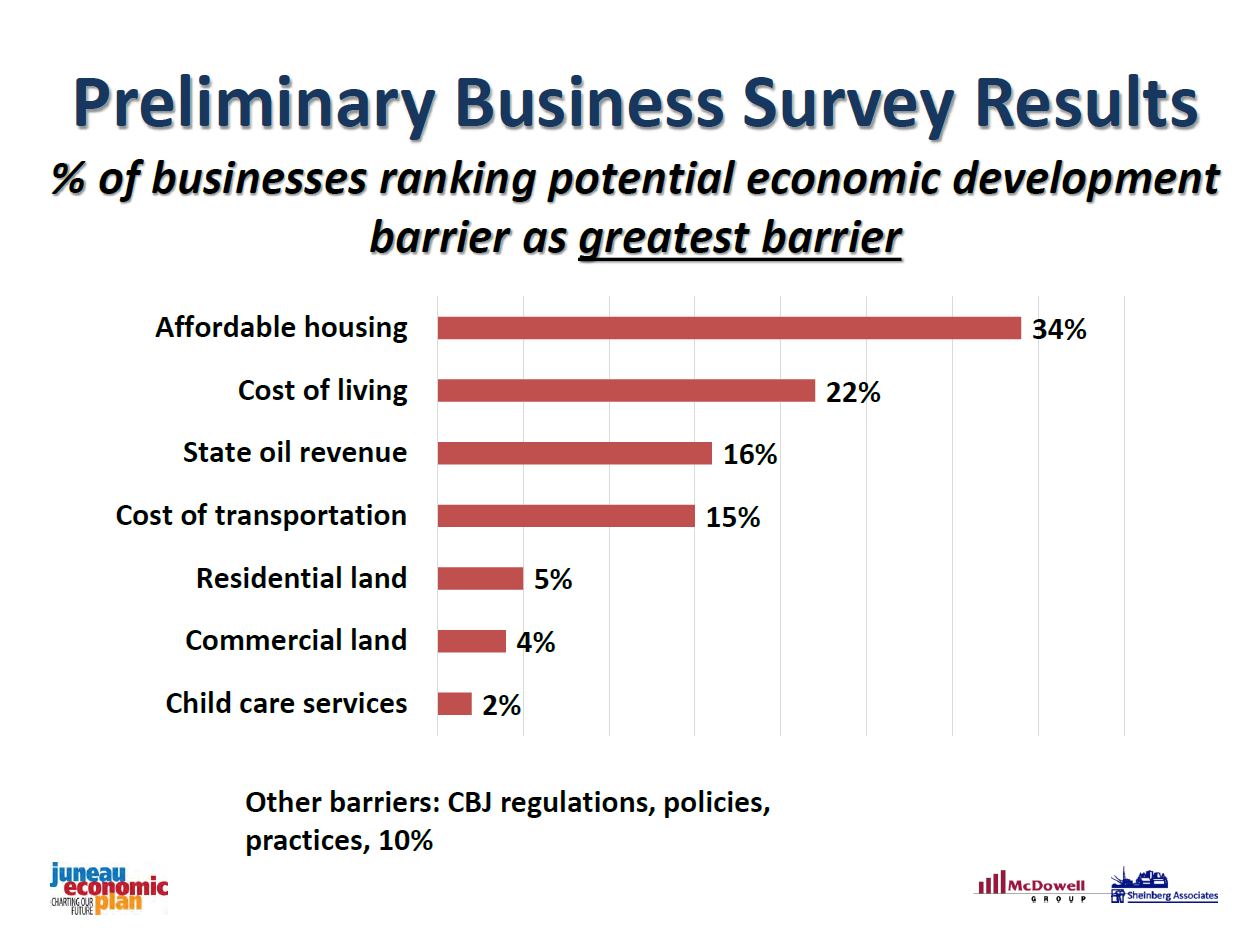
Respondents to a household telephone poll and an open online survey of local businesses identified housing as the greatest barrier to economic development in Juneau.

“Housing, housing, housing is the message,” said Jim Calvin, president of the McDowell Group, speaking to a Juneau Assembly committee Monday.

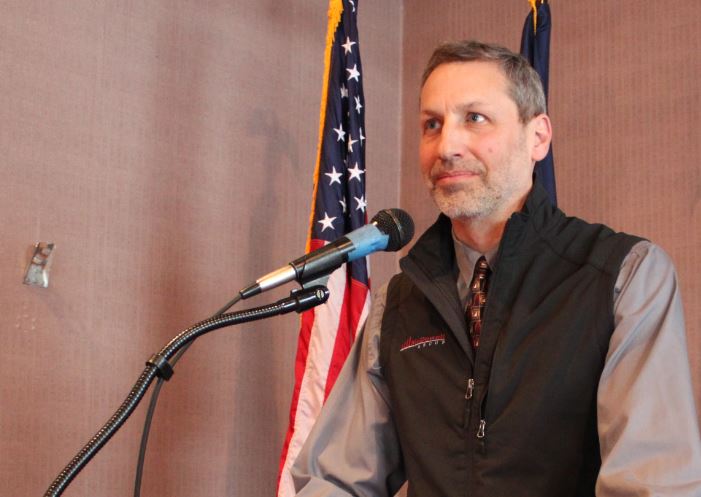
Jim Calvin, economic analyst for the McDowell Group. (Photo by Lisa Phu/KTOO)

The Assembly hired the research firm for $100,000 to develop an economic plan due to be complete in December. The surveys were part of establishing a baseline to plan and measure against.

Calvin also presented analysis of economic data identifying many 10-year trends.

“Our economy is growing in terms of jobs, in terms of sales, in terms of population. Yet, our tax base has not been keeping pace with that growth,” he said.

Property tax revenue is keeping pace with inflation, but sales tax income is not. There are several reasons, including an aging overall population taking advantage of the city’s senior sales tax exemption, and a $375 cap on the sales tax due on a single transaction that hasn’t been adjusted for some years.

Calvin reiterated other 10-year trends he had highlighted for the Juneau Chamber of Commerce in March; Juneau’s getting grayer, the private sector is growing while the government sector is shrinking, and nonresidents are filling more and more of Juneau’s jobs.

The Assembly plans to hold an in-depth work session with Calvin in July to set priorities for the remainder of the plan, including identifying economic development strategies.

“Part of what we’re doing with this plan is looking at some return on investment, cost-benefit kind of things,” he said.

“Where can you get the biggest bang for your buck whether you invest in economic development infrastructure or initiatives, where can you get the most year-round jobs or the greatest tax revenue? … What steps enhance our housing market most?”

More reports and information about the Juneau Economic Plan are available at juneaueconomicplan.org.

Should e-cigarette vapors be treated like tobacco smoke?

e-cigarette closeup
Robert Rodman, owner of Percy’s Liquor Store, shows how an e-cigarette works. (Photo by Jeremy Hsieh/KTOO)

The Juneau Assembly is considering a ban on e-cigarette vapors in nearly all indoor public spaces.

The local chapter of the National Council on Alcoholism and Drug Dependence led the push at an Assembly Committee meeting Monday. Kristin Cox, a naturopathic doctor and the council’s tobacco prevention program coordinator, argued that the new tobacco alternative is being marketed to youths and misrepresented as harmless.

“So e-cigarettes: They’re new, they’re blue, but will they still kill you?” Cox asked.

She didn’t exactly say yes – the research world is playing catch-up with the products as more parties enter the marketplace and innovate – but Cox did warn that the widespread claims that e-cigarette vapors are harmless and an effective way to help someone quit smoking are both scientifically unproven, and may be entirely wrong.

Researchers at the University of California, San Francisco, recently published a review of 84 e-cigarette studies in a peer-reviewed journal of the American Heart Association. They found a chaotic marketplace filled with a range of unsubstantiated claims and quality control issues with the products themselves.

Results of trials comparing the toxicity of various e-cigarette vapors to traditional tobacco smoke varied wildly. For example, one study of a particular brand discovered toxic metals at levels higher than in regular cigarette smoke, likely coming from the e-cigarette’s metal heating elements. Other studies bore out claims that e-cigarette vapors were less harmful than tobacco smoke, but not harmless.

“You know, middle school kids think they’re harmless. They’re using these devices, they think they’re really harmless. There’s harmless water vapor is what their inhaling. And that’s not the case.”

Cox says big tobacco companies have been pumping a lot of money into buying e-cigarette companies and beefing up their advertising campaigns with youths in mind. E-cigarette juice, vaping liquid or e-liquid, is being made in candy and fruit flavors.

Cox says it’s an initiation tool to introduce youths to nicotine addiction and tobacco use.

“This is a really, really serious issue. It’s re-normalizing cigarette smoking in public. Little kids can’t distinguish between what’s a traditional cigarette and what’s an e-cigarette,” she said.

Under the ordinance the Assembly is considering, the vapors would be treated the same as tobacco smoke, which Juneau banned from virtually all indoor public spaces in 2008.

If the Assembly adopts the ordinance, Cox said, “It’s going to signal to people that these are dangerous, they’re not harmless.”

A few blocks away from City Hall, Robert Rodman has sold e-cigarette products for about a year in his store, Percy’s Liquor.

Robert Rodman
Percy’s Liquor Store owner Robert Rodman has been selling e-cigarette products for about a year. (Photo by Jeremy Hsieh/KTOO)

He’s more or less indifferent about the possible ban.

“I don’t think it’s a huge issue one way or the other,” he said.

Rodman keeps an e-cigarette for himself in the shop to demonstrate how it’s used. His looks like a fat pen. One end houses a battery and heating element. The other end has a vial with the e-liquid in it. The liquid he uses has no nicotine.

“Yeah, I’m not a smoker. I have no interest in nicotine,” Rodman said.

Then, Rodman used one of the lines Cox was worried about.

“It’s just flavored water, basically,” Rodman said. “You know, in that case, you know, there’s no harm.”

In fact, the base in most e-liquids is a common food additive the Food and Drug Administration says is safe to eat, though researchers warn drawing it into your lungs as an aerosol isn’t the same and can cause respiratory problems.

Rodman pushed a button and breathed in. A moment later, he puffed out wisps of a white, scented vapor that hung in the air a few moments before dissipating.

“You’re not really inhaling it. So, I dunno, it’s just a pleasurable sensation,” Rodman said. “You know, you get a little bit of mouth feel with it, you know, in your throat. And with the flavors, you know, you get some taste. I mean, this is coffee. You know, it’s kind of a cool thing.”

The Assembly will hold a public hearing on the e-cigarette vapor ordinance at its next meeting, June 30.

Fry bread: An Alaska Native treat with a mysterious origin

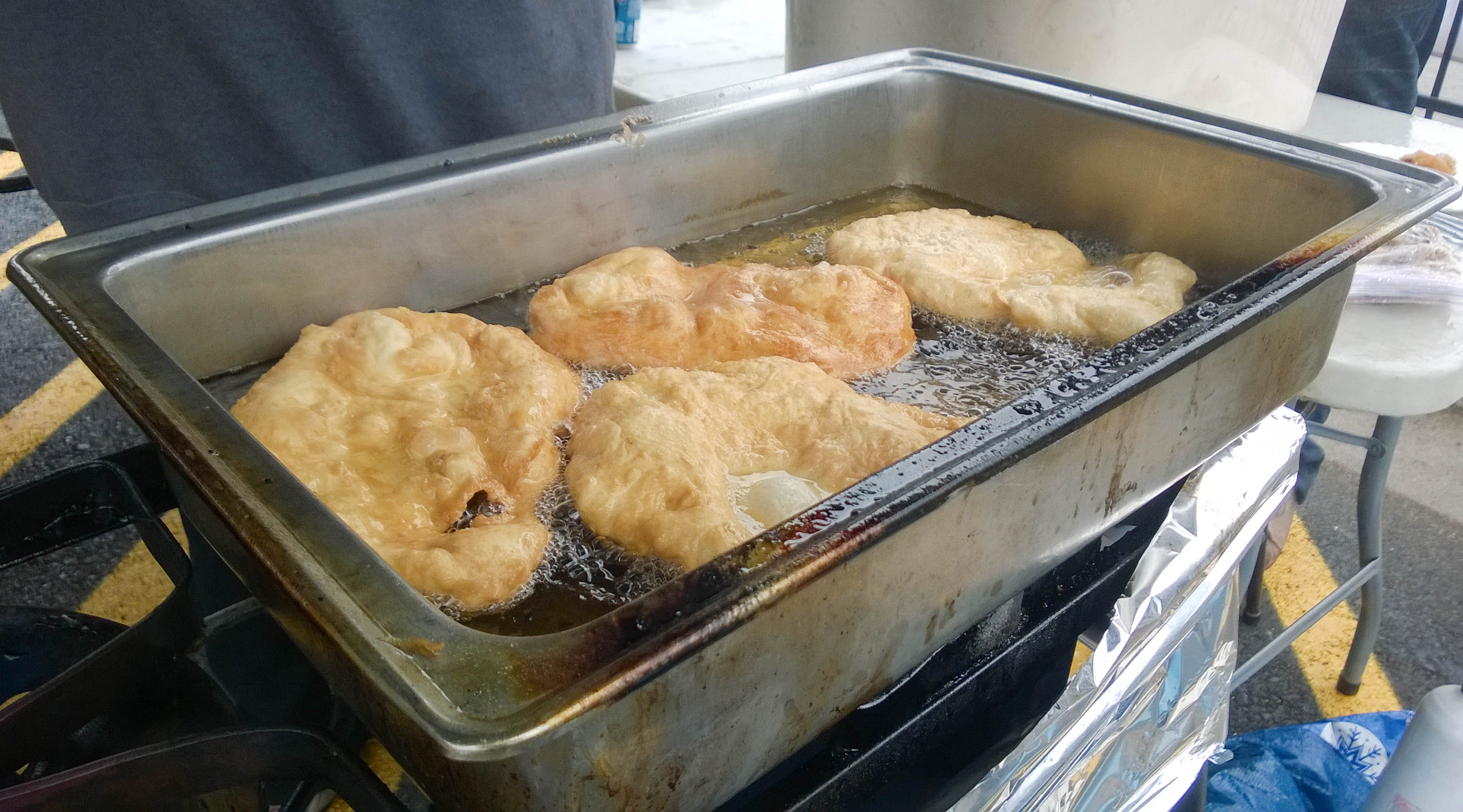
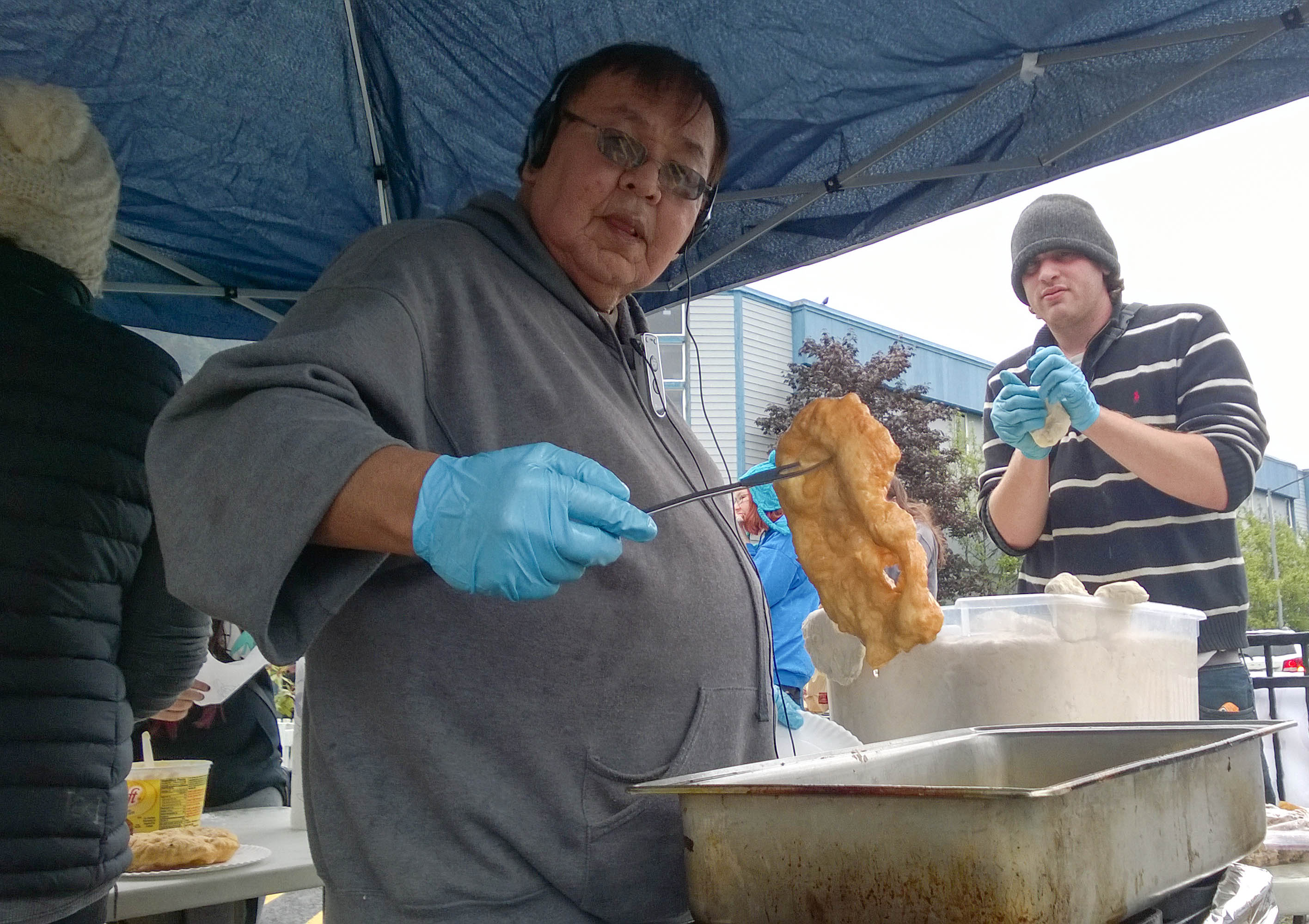
Hot canola oil pangs off a stainless steel tub under the watch of a local fry bread master. Some people say it’s magic that turns a hand-stretched disc of dough into a puffy — but-not-too-puffy — piece of golden, delicious fry bread.

Fry bread, that high calorie treat that can go savory or sweet, has generations of history in many Alaska Native families, where the untraditional food has become a cultural fixture.

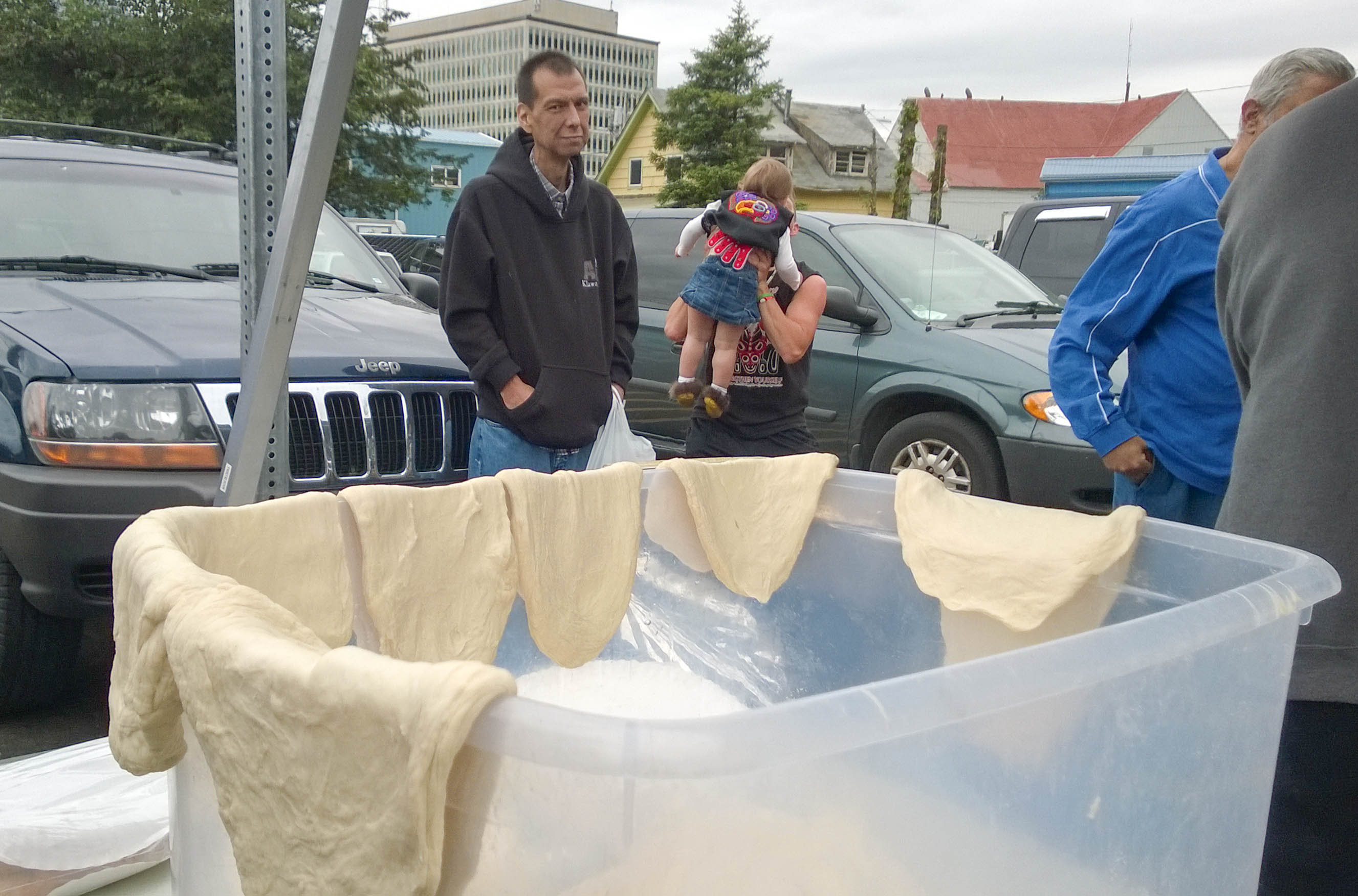
Garfield Katasse is the big guy under the tent by the Garfield’s Famous Fry Bread banner. On days like this during a big Native cultural convention, Katasse spends hours on his feet, patiently working the dough and frying it up piece after piece after piece.

He goes through 175 pounds of dough a day, all mixed by hand.

“You know, my day starts (at) 4 o’clock in the morning, and doesn’t end ‘til 10:30 at night,” Katasse says. “Because I have to run around and get all my ingredients and get ready for the next day.”

There’s a funny squeal coming from the headphones Katasse wears, plugged into a gadget clipped to the collar of his hoodie. He’s got severe hearing loss, and it helps him get by.

He says his disability makes it tough for him to work a regular job, but it also lets him travel and sell fry bread to thousands during events and festivals. Katasse has been setting up shop in the Juneau and Anchorage areas for about a decade. He grew up in Juneau, but lives in Albuquerque and Anchorage most of the year.

Even without four walls or a roof over his business, he’s become a local institution.

Carmen Plunkett, who’s from Juneau but now lives in California, was carefully packaging up eight pieces of the plate-sized treats.

We love our fry bread, as you can tell,” Plunkett says. “I now take it back and I freeze’em, take it back and I can have’em later. Cause there’s no — I can’t cook it myself.”

The fry bread she can buy in California just isn’t the same.

Even in the rain, Katasse’s customers keep queuing up in the parking lot where he’s set up for a few days.

“I love Garfield’s fried bread. He does the best fry bread,” says Bettyann Boyd.

By the end of Katasse’s first week in town, she’d eaten four pieces.

It’s light and it’s big, and he always has good conversation while you’re getting it,” she says with a cheery chuckle.

Boyd, Plunkett and many others in line are Tlingit. They remember their first time eating fry bread made by their parents and grandparents when they were young children.

And yet, Smithsonian Magazine and popular lore attribute fry bread’s origins to the Navajo. Katasse, who’s Tlingit but spent a lot of his adult life in the Southwest, says his recipe came from a Pueblo friend. Sometimes, he sells fry bread topped with Mexican ingredients as an “Indian taco,” though he personally enjoys it with salmon and green chili.

Many Native American groups around the country have variations of fry bread. How it’s come to be so closely associated with Alaska Native cultures is a bit of mystery.

Boyd says she doesn’t know much about its history in Alaska.

I just know it brings a lot of people together,” she says.

Plunkett says she never thought about it.

“I never questioned it because it was part of our, you know, what we ate,” Plunkett says. “Now, you have me questioning it.”

Dwayne Lewis, a Navajo and owner of the restaurant Sacred Hogan Navajo Frybread in Phoenix, says he doesn’t have any theories about how it got to Alaska. He remembers his grandma saying fry bread was first created when the government was rationing food to the Navajo.

Like matzah is a symbol of Jewish persecution, Navajo fry bread has a lot of history, symbolism and emotion kneaded into it.

In the 1860s, the U.S. government forced the Navajo and other Southwest Native American groups to relocate to a doomed settlement called Bosque Redondo Indian Reservation. Traditional foods grew poorly there. Starvation led the government to provide canned goods, flour, sugar and lard, which led to fry bread.

For Katasse’s customers in Alaska, fry bread doesn’t appear to have that baggage. Darrin Austin doesn’t have a trace of ambivalence while he eats.

“Pretty good, I like how he makes them big, too. Has that big tub,” Austin says between bites. “Sweet, you got sugar on there, the butter, you know, it’s buttery. And it’s crispy, fresh out of the oil.”

Katasse keeps his recipe under wraps, but does share one key additive.

“I say my prayers … every time I do 10 pounds of dough, for everybody that walks across my booth, buys bread, that they would be blessed and nourished,” Katasse says.

When people ask him, “What’s your secret?” he says that’s it.

“There’s no magic about this,” he says.

Alaska tops corruption rankings in policy journal

Alaska tops state rankings for public corruption in research published in the latest issue of a peer-reviewed journal.

Least Corrupt States by Population

  1. Oregon
  2. Washington
  3. Minnesota
  4. New Hampshire
  5. Utah

Most Corrupt States by Population

  1. Alaska
  2. Mississippi
  3. Louisiana
  4. North Dakota
  5. South Dakota

Least Corrupt States by Number of Public Employees

  1. Oregon
  2. Washington
  3. Minnesota
  4. Nebraska
  5. Iowa

Most Corrupt States by Number of Public Employees

  1. Mississippi
  2. Louisiana
  3. Tennessee
  4. Illinois
  5. Pennsylvania
  6. Alabama
  7. Alaska

Source: The Impact of Public Officials’ Corruption on the Size and Allocation of U.S. State Spending, Public Administration Review

Alaska was No. 1 for corruption-related convictions of federal, state and local public employees and elected officials, averaged over the state’s population. When averaged over the number of public employees per state, Alaska ranked seventh. Convictions were counted from 1976 to 2008, based on data from the U.S. Department of Justice.

The rankings were just one item the researchers fed into their statistical analyses testing for connections between corruption and state spending.

Four theories were tested:

  1. The more corruption there is, the bigger the budget;
  2. Corruption skews spending toward capital spending, construction and highways;
  3. Corruption skews spending toward salaries, wages and debt financing; and
  4. Corruption skews state spending away from social sectors, such as education, welfare and health.

Their analyses backed all four theories. The researchers also presented a statistical model that suggests if Alaska had merely “average” corruption, the state could save more than $900 million a year.

The researchers warn that policymakers should be wary of public money used “for private gains of the few,” though spending on capital, construction, highways and debt is not problematic in itself.

Cheol Liu of the University of Hong Kong and John L. Mikesell of Indiana University published their paper, The Impact of Public Officials’ Corruption on the Size and Allocation of U.S. State Spending, in Public Administration Review.

Police propose big hikes to traffic, animal control fines

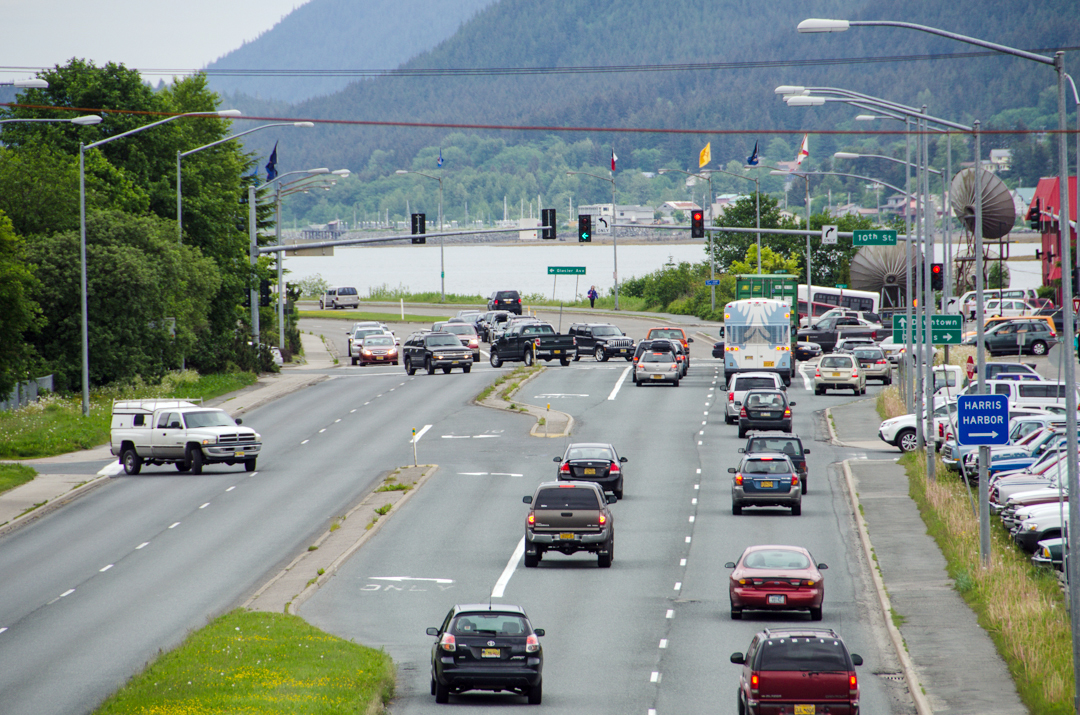
Traffic fines could be going up in Juneau.  (Photo by Heather Bryant/KTOO)
Traffic fines could be going up in Juneau. (Photo by Heather Bryant/KTOO)

If you run a red light in Juneau and a state trooper fines you for it, you could be hit with a $150 ticket.

If the officer worked for the Juneau Police Department instead, the most you’d be fined is $55.

That fine is one of dozens for municipal traffic and animal control violations that the Juneau Police Department wants to raise. Some of the proposed increases double, triple or nearly quadruple existing fines.

“We tried to be reasonable, we’re not proposing any of them that are higher than – we won’t be setting new ground above what other jurisdictions are doing,” said Police Chief Bryce Johnson.

Johnson was briefing a Juneau Assembly committee about the ordinance proposing the changes on Wednesday. He said it’s not intended to bring in more revenue, but to make sure the fines keep their sting and deter bad or unsafe behavior.

“The goal is to have fines match what will deter people from violating those traffic ordinances,” Johnson said.

Johnson said the proposal will modernize the fine schedule, and the figures are in line with peer jurisdictions. Most of Juneau’s current fines fall far below what Anchorage, Fairbanks, and Ketchikan charge, as well as the state of Alaska and Washington, according to figures the police department compiled.

Johnson’s briefing only solicited one comment from the committee. The full Assembly is expected to hold a public hearing and final vote on the ordinance June 30.

Site notifications
Update notification options
Subscribe to notifications