
Jeremy Hsieh

Local News Reporter, KTOO

I dig into questions about the forces and institutions that shape Juneau, big and small, delightful and outrageous. What stirs you up about how Juneau is built and how the city works?
Mayor proclaims June LGBT celebration month

At its meeting Monday night, the Juneau Assembly recognized the LGBT community, approved a major rezoning of Pederson Hill, failed to approve a smaller one on an Atlin Drive lot and doubled its filing fees for appeals.

Supporters pose with Mayor Merrill Sanford after he read a proclamation declaring June 2014 as Juneau Pride 2014. It's a celebration of LGBT people and their contributions. (Photo by Jeremy Hsieh/KTOO)
Supporters pose with Mayor Merrill Sanford after he read a proclamation declaring June 2014 as Juneau Pride 2014. It’s a celebration of LGBT people and their contributions. (Photo by Jeremy Hsieh/KTOO)

Mayor Merrill Sanford got a little choked up Monday night proclaiming this month Juneau Pride 2014. It’s a celebration of lesbian, gay, bisexual and transgender people and their contributions.

With a microphone and proclamation in hand, and a quaver in his voice, he read: “On behalf of the City and Borough Assembly, (I) do hereby proclaim June 2014 as Juneau Pride 2014 and encourage the Juneau community to celebrate the diversity of Alaskans.”

Local LGBT groups plan to hold a week of cultural events beginning next Monday.

Pederson Hill rezoned

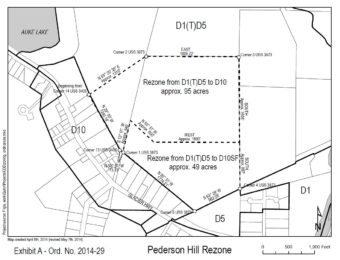
The Assembly unanimously approved a major rezoning of 152 acres of city-owned land near Auke Lake that could, eventually, lead to hundreds of new homes. The rezoning of Pederson Hill is about a tenfold increase in density. Officials hope it will relieve some of the demand and high costs in Juneau’s tight housing market.

Nearby resident Dave Hanna was the only person to speak during the public hearing before the vote. He said he supported the change.

“I say it with kind of the heavy heart, because I used to roam around in those woods when I was a kid, and, you know, you always hate to see those places go away, so to speak,” Hanna said. “But on the other hand, this does serve a need that the community has.”

Absence stalls Atlin Drive rezone

Assemblyman Jerry Nankervis’ absence from Monday’s meeting meant a controversial rezoning of a 2-acre lot on Atlin Drive was short a vote.

Owner Richard Harris wants the property rezoned from a residential designation to light industrial, which would give him more flexibility. He has not disclosed his plans for the property.

The lot has been through more than three years of vetting and appeals through the Planing Commission and Assembly. The Planning Commission denied the rezoning, but the Assembly narrowly reversed that decision on appeal in March, 5-4. Monday’s vote to rezone the property should have been a formality, but with only four yeas, it failed.

Opponents say putting light industry in the area is a bad fit, conflicts with long term planning documents and conflicts with efforts to promote affordable housing.

Mayor Sanford, who voted yes, said the failed vote is temporary; through a procedural action, the rezoning measure will be resurrected at the Assembly’s next meeting.

Filing fee for appeals double

It’s been 18 years since the cost of filing an appeal to a city board or commission’s decision has gone up. Monday, the Assembly approved doubling the $250 filing fee.

“It costs anywheres from $350 to $1,600 — estimate — just in copying for most appeals,” Sanford said. ” We should be recouping our expenses, too.”

Karen Crane and Jesse Kiehl were the no votes in the 5-2 vote.

Crane said raising the fee would discourage appeals, which she could justify if the city had a problem with a frivolous cases. But it doesn’t.

“I think we’re just making it more difficult for people to interact with local government by doing that,” Crane said.

Kiehl said the appeals process shouldn’t be thought of as a business.

“It seems that the $250 level we have now is  enough to beat back the oh-why-not-give-it-a-shot appeals, when you consider that we’re, we’re never going to recoup our costs for this.”

Final vote on Pederson Hill rezone before Assembly

A map of the proposed Pederson Hill rezoning. The change could lead to hundreds of new homes. (Courtesy CBJ)

Update | June 9 at 2 p.m.

Lee Kadinger, The Walter Soboleff Center’s project manager with Sealaska Heritage Institute, says it will delay its appeal. Kadinger says he thinks most of the issues can be resolved through discussions with the assessor’s office.

Original Post | June 9 at 12 p.m.

The Juneau Assembly is expected tonight to take its final vote on a major rezoning that could lead to hundreds of new homes near Auke Lake.

The rezoning of Pederson Hill is about a tenfold increase to the density of homes that could be built on 152 acres of city-owned land.

The Assembly also plans to decide whether or not to hear an appeal from Sealaska Heritage Institute about the property tax status of The Walter Soboleff Center. The nonprofit institute thinks its Front Street building should be 100 percent exempt, while the city assessor maintains it should only be partially exempt because it will not be exclusively used for charitable and educational purposes.

The Assembly will also consider doubling the $250 filing fee for appealing city board and commission decisions and $1.2 million contract award to North Pacific Erectors for Centennial Hall renovations.

The long agenda calls for the introduction of 17 new ordinances. Some of the items of interest include

  • water and sewer utility fee increases,
  • a slew of increases to city fines for traffic and animal control violations,
  • cell phone tower regulations,
  • extending the city’s smoking ban to e-cigarettes,
  • and a $22 million appropriation of mostly federal money for airport runway rehabilitation.

If none of the Assembly members object, the new ordinances will be referred to committees.

The Assembly meets at 7 p.m. Monday at City Hall. The meeting is broadcast live on KTOO.

Indignant JDHS alum rallies Stanford campus around rape case

Sarai Gould and Chelsea Green at a rally on the Stanford University campus raising awareness about sexual assault and supporting Leah Francis. Thursday, June 5, 2014. (Photo courtesy Sarai Gould.)

Until this week, Leah Francis was probably best known as an Alaska distance running champ from her days at Juneau-Douglas High School.

That all changed after she went public saying she was forcibly raped by a fellow Stanford University undergraduate while in Juneau.

Leah Francis came out as a rape survivor, and as an activist indignant over Stanford University’s in-house adjudication process.

“No one wants to do the Alternate Review Process, it’s super-traumatizing. I mean, it, it, it drags out, it’s mishandled.”

The university panel formally concluded the male student did sexually assault Francis. The decision was based on a university investigation and statements from both sides, according to university documents via The Stanford Daily.

The university has kept the male student’s name confidential, and Francis declined to name him; she wants to keep the focus on the bigger issues.

Like the university’s consequence for rape. The panel recommended 40 hours of community service, a sexual assault awareness education class and a five quarter suspension. That suspension wouldn’t take effect until the summer, which Francis says, is after her assailant graduates.

An online petition calling on Stanford University to reform its policies around sexual assault.

It’s a slap on the wrist, she says, that “invites my rapist back to campus” for grad school.

“In the end, you have a sense of futility. Like, you’ve, you’ve spent, you know, months of your life, reliving one of the worst nights of your life and you don’t get anything out of it.”

She emailed out her story on Tuesday, and has been riding the wave of support since. Thursday night, she said, “I haven’t eaten today, and haven’t slept in 48 hours.”

Earlier, Francis had led hundreds of students in a campus rally and protest to raise awareness about sexual assault and to demand reforms. They want mandatory expulsion for sexual assault, as well as better resources for victims.

Students yelled in unison for administrators to “Stand with Leah.” They plastered campus surfaces with posters and signs incorporating the #StandWithLeah hashtag, and blew it up on Twitter.

“This was awesome, I mean, today was more healing for me than anything that’s happened since I was raped.”

And, she’s gotten a lot of media attention.

“So I communicated with BuzzFeed, with Huffington Post, with the New York Times … I just can’t even keep track of them all. … L.A. Times, Palo Alto Weekly, Stanford Daily.”

Francis says a criminal case is also open with the Juneau Police Department; the incident happened in Juneau early on New Year’s Day. She says she was in no condition to consent when it began — drunk and unconscious. Police could not be reached for comment by deadline.

Officials celebrate Juneau seawalk improvements

The single busiest spot in Juneau during the summer cruise ship season may be South Franklin Street in front of the Mount Roberts Tramway building. Up to five of the massive ships can be in town at once, each unloading and reloading thousands of crew and passengers in a few hours. There are buses, container trucks, float planes, and aerial tram cars all coming and going within a few hundred feet of each other.

And, it’s surprisingly orderly.

On Friday, there was also a ribbon cutting ceremony there attended by about 45 city and state officials, contractors and local business owners. They celebrated new pedestrian and parking improvements on the busy cruise ship waterfront.

The tourists footing much of the bill went about their sightseeing and shopping, while liberal thanks were paid to the officials and workers involved.

“As an engineer, I do really appreciate concrete, asphalt, curb and gutter,” said Juneau Rep. Sam Kito III. “I mean, the things that people might not necessarily appreciate have a lot of aesthetics to me. The efficiencies of moving pedestrians and moving vehicles is underappreciated. I’m enjoying being here, on concrete, near asphalt seeing this whole project work.”

It wasn’t always so orderly. Kirby Day remembers back in 1993, before much of this stuff was here.

“Looking out here, this was all just dirt. There was no tram, there was not much anything. And at that time when we lined buses up, we tried to lime the lines, and then it’d rain, and, you know, it disappeared. And then we put (out) barrels,” said Day, who is the director of shore operations for Princess Cruises and longtime point man for cruise ship relations in Juneau. “We’d come out at night and set the barrels up, and that’s where the buses were supposed to go, and then they’d come the next morning, and the operators really didn’t like it there, so they’d just move them. So, this will be a little bit better for all, I hope.”

The improvements are part of a long-term city plan to create a continuous, mile-and-a-half long seawalk from the Juneau-Douglas Bridge to the AJ Dock, the cruise ship berth farthest from downtown.

Patricia Stancil, visiting from Pensacola, Florida, was sitting on a bench nearby during the ceremony. She wasn’t sure what the ceremony was about, but was in the ballpark.

“It sounds he was trying to raise funds to improve the city or whatever it is,” Stancil said.

Stancil, and millions of other visitors like her over the years, have paid millions toward Juneau’s public waterfront infrastructure through cruise ship passenger fees the city and state collect.

Friday’s ribbon cutting specifically celebrated the completion of a $3 million contract for reconfiguring a bus and pedestrian staging area, and a nearly complete $3.4 million contract to extend the seawalk.

Water and sewer fees poised to increase 31 percent

water spigot
(Photo by Fedi/Pixabay)

The municipal fees we pay for clean tap water and sanitary sewage disposal are poised to sharply increase.

In a 5-4 vote Monday, a Juneau Assembly committee backed a plan to hike up sewer and water fees about 31 percent over the next three years. If the full Assembly approves the committee’s plan, then monthly fees for typical residents would go from about $90 now to $118 in fiscal year 2017.

“At one point in time, the mayor … made the statement that we have — that the Assembly has funded everything that the utilities had asked for,” said Public Works Director Kirk Duncan (Disclosure: Duncan is also a member of the KTOO board of directors). “He was correct. And what I should have said is, we didn’t ask for enough. We are now asking for what we think we need.”

The proposed fee hikes would partially commit the city to a 10-year Public Works plan. The department wants to turn around the two utilities’ deficits and bank a lot of cash. Through 2024, Public Works anticipates spending roughly $90 million on 175 water and sewer projects. They range from $20,000 pavement and pipe improvements all over the city, to $16 million to build a new facility that would address Juneau’s partially processed sewage problem.

The committee vote was split for a several reasons. One major division was whether the Assembly should look short or commit to the long-term plan.

Mayor Merrill Sanford said he was wary of further burdening the community based off of engineers and planners’ guesses about the future.

 “If you look at wastewater capital improvement projects when you start getting out there in 2018, 19, 20, and on up, you’re looking at guesstimates. And estimates that are based on a yearly thing,” Sanford said. “But when you start going out more than 3 years, you’re — we’re guessing. We’re all guessing. Might be a good guess, but it’s a guess.”

How’d they vote?
The Juneau Assembly’s Committee of the Whole forwarded a proposal to raise water and sewer fees by 9.5 percent in fiscal years 2015, 2016 and 2017. The Public Works Department wants to double the fees by 2024 to pay for roughly $90 million in water and sewer projects.
Loren Jones, Jerry Nankervis, Carlton Smith and Kate Troll voted yes.
Jesse Kiehl, Randy Wanamaker, Mary Becker and Merrill Sanford voted no.
The Assembly’s next meeting is May 19.

Assemblyman Loren Jones took the opposite tack.

“I could see getting into some pattern, that, instead of doing some steady funding and some forward thinking and putting the money in the bank, and trying to decide while it’s there, we get into this bounce up and down based on capital projects and I — I don’t think you like to plan that way, and I certainly would like not to plan that way,” Jones said.

Jones made the motion to commit to the first three years of fee hikes in the 10-year plan.

Assemblyman Jesse Kiehl sided with Jones, “Because it’s always very easy for a future Assembly to come in and say, ‘You know, we’re doing great. The grants are really flowing in, or the infrastructure is really lasting well, let’s reduce this.’ But it’s very painful to come in and say, ‘Golly, we’re short again. And I know we told you all we were going to start funding our depreciation, but we only kind of half-way did it, cause we got this one-time thing.’”

But Kiehl ended up voting no for two reasons. He wanted a longer commitment to give the community more predictability, and he wanted to offset the first few years’ fee hikes with an incoming grant from the state capital budget.

Kiehl said he may offer amendments when the full Assembly takes up the water and sewer fees.

School funding tops Juneau Assembly committee agenda

Class sizes in the capital city will grow next year, unless the Juneau Assembly can muster another $769,000 for schools.

That’s according to Juneau School Board President Sally Saddler in a written appeal to the Assembly. An Assembly committee is reviewing the request Monday.

For years, the city has spent as much as state law allows it to on education. Part of an education bill the governor is expected to sign into law will raise the upcoming budget year’s local contribution cap. The school board’s request falls within the new cap.

The Assembly committee’s other business on Monday includes:

The Juneau Assembly’s Committee of the Whole meets at 6 p.m. Monday at City Hall.

Site notifications
Update notification options
Subscribe to notifications