Katie Anastas

Local News Reporter, KTOO

Bartlett Regional Hospital board picks interim CEO

Bartlett Regional Hospital, photographed on Aug. 2, 2023. (Katie Anastas/KTOO)

Bartlett Regional Hospital Executive Director of Business Development and Strategy Nathan Rumsey will serve as interim CEO.

The hospital board unanimously voted to appoint him at a meeting Tuesday night.

Rumsey joined Bartlett last July. Before that, he worked as an engineer in the U.S. Coast Guard. Most recently, he led the Coast Guard’s civil engineering program in Alaska.

Interim hospital CEO Nate Rumsey. (Photo courtesy of Bartlett Regional Hospital)

“I appreciate the board’s confidence in me and the senior leadership team,” Rumsey said in a statement. “I want to continue to support the great care this organization delivers to the community and create and sustain a work environment that enables our employees to thrive.”

Earlier this month, Bartlett CEO David Keith and CFO Sam Muse abruptly resigned. The resignations happened a week after board member Dr. Lindy Jones told the board that staffing and management problems had led to inadequate care of behavioral health patients. Muse cited personal reasons. Solomon-Gross didn’t provide reasons for Keith’s departure in an email to Bartlett employees, though Keith later said he was retiring.

In a statement, board President Kenny Solomon-Gross said the board appreciated Keith’s “willingness to tackle the hospital’s challenges head on” in his business role.

“Under his leadership the hospital achieved a significant financial turnaround and brought on much-needed post-acute care services,” Solomon said. “We have confidence Nate will continue to focus on achieving long-term sustainability and strategic growth so the hospital can meet the growing health care service, access, and convenience needs of our patients.”

Rumsey holds a bachelor’s in civil engineering from the U.S. Coast Guard Academy and masters’ in civil engineering and business administration from the Georgia Institute of Technology.

According to hospital spokesperson Erin Hardin, Rumsey will serve as acting CEO starting Aug. 21. The hospital is seeking applicants for the CFO position.

Correction: This story has been updated to reflect that the first part of Solomon-Gross’ statement was about outgoing CEO David Keith. It has also been updated to reflect that, after the announcement of Keith’s resignation to hospital employees, he announced that he was retiring.

Child care grants aim to expand access for Juneau families

Childcare workers interact with infants at Gold Creek Child Development Center in Juneau on May 11, 2018. State rules require certain square footage and staffing levels, which limit this center's infant care capacity to 10. New state rules being proposed may force that capacity down to 8.
Child care workers interact with infants at Gold Creek Child Development Center in Juneau on May 11, 2018. (Photo by Jeremy Hsieh/KTOO)

The Southeast Alaska Association for the Education of Young Children is giving out $120,000 in grants to increase the number of licensed child care spots in Juneau. 

Blue Shibler, the association’s executive director, said existing child care providers and those looking to open new centers can both apply. The funding is left over from the city’s child care provider subsidy program.

Shibler said it’s an opportunity for Juneau residents to make a difference for local families and the workforce.

“We’re having worker shortages at the school district and in medical fields and sort of all over the place, and a lack of child care is often pointed to as one of the reasons,” Shibler said.  “When you’re considering starting a child care program, you’re contributing to the overall health of the community.”

Shibler said Juneau child care centers only have capacity to meet about half of the demand. Two centers closed this winter, and one reopened in the spring.

Child care centers have a maximum number of spots depending on the type of license they have. Expanding costs money – it might require more supplies, more employees or even minor construction. But it’s one way Juneau could get more child care slots.

“A home provider who’s licensed by the state of Alaska is only allowed to have eight children,” Shibler said. “If they wanted to expand, they could expand – still in their home – to what’s called a group home status, and that would mean they could have 12 children and an employee.”

Shibler said they’re especially interested in hearing from larger employers or churches that have space they’d like to convert into a child care startup. Grant funding could help pay for upfront costs like equipment and furniture and help pay operational costs for the first few months as business owners build up enrollment.

Letters of interest are due to SEA-AEYC by 2 p.m. on Oct. 27. The form is available on their website.

Juneau homeowners can apply for state assistance, stabilize riverbanks after flooding

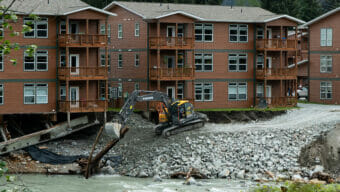
Workers removed debris and added rock fill along the bank at Riverside Condominiums on Aug. 8, 2023. (Andres Javier Camacho/KTOO)

Juneau residents whose homes were lost or damaged during last weekend’s flooding can now apply for financial assistance from the state. The deadline to apply is Oct. 9.

Individual assistance helps homeowners cover property damage, cleanup work and other costs associated with the flooding. It may also pay for temporary housing if homeowners were displaced.

Those who need to stabilize their land along the Mendenhall River can do so right away, without getting a permit in advance. But property owners should let the city’s Community Development Department know about any bank stabilization work as soon as they start, so staff can begin the permitting process. 

Homeowners will still need to apply for grading permits and floodplain development permits within a month. Those forms are available on the city’s website.

The city has condemned eight buildings, meaning they’re not safe for occupation. Deputy City Manager Robert Barr said reopening those buildings will require approval from city property inspectors. Letting the city know about bank stabilization efforts right away will help that process go smoothly, he said.

“As property owners work on stabilizing their foundations and banks, our inspectors will go out there and do that work,” Barr said. “The goal is to be in the loop at the same time so that people can start the work quickly.”

The National Weather Service expects wind and rain to increase the risk of falling trees along the Mendenhall River this weekend

Barr said homeowners should talk to a planner at the Community Development Department if they’re concerned about potential bank erosion. Generally, he said, people still need to get permits before doing bank stabilization work unless there’s an immediate safety issue.

“But every situation is unique, and the bank is extremely unstable right now due to the flooding event,” he said.

Juneau residents can apply for state assistance online or by calling (844) 445-7131. The state recommends a five-step process for documenting damages before submitting an application.

Homeowners interested in emergency bank stabilization can contact senior planner Teri Camery at (907) 586-0753 ext. 4129 or teri.camery@juneau.gov.

Other resources are listed at this KTOO webpage.

Juneau planning commission approves Huna Totem’s $150 million waterfront project

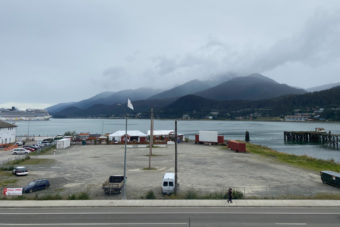
A large, mostly empty waterfront lot with Gastineau Channel in the background
Part of the Juneau waterfront area known as the subport on Aug. 23, 2022. (Photo by Claire Stremple/KTOO)

Juneau’s planning commission has approved a $150 million development on the waterfront.

In addition to a new cruise ship dock, Huna Totem Corporation’s Aak’w Landing project will include a culture and science center, retail space and underground parking.

Last month, the commission approved Huna Totem Corporation’s permit application to build a new cruise ship dock. At the time, they stopped short of permitting the uplands development, saying they wanted more information – and public input – about the proposed amenities.

On Tuesday, the commission got that public input, and it was mostly in favor of the project.

Kerry Crocker, who leads the local International Longshore and Warehouse Union, said it could expand job opportunities for the union’s workers. They moor and unmoor ships at the docks downtown.

“These are good-paying jobs,” he said. “They’re living wage jobs. They provide a pension, benefits, healthcare. The additional work opportunity with this project is considerable for us.”

Norwegian Cruise Lines purchased the property in 2019 and gave it to Huna Totem in August 2022. 

Huna Totem’s Micky Richardson speaks at the planning commission meeting on Aug. 8, 2023. (Photo by Katie Anastas)


Huna Totem’s original proposal included underground parking, retail space, restaurants and a park, with the use of one area still undecided. The new application proposed filling that space with a 40,000-square-foot culture and science center, built with help from Sealaska Heritage Institute and Goldbelt.

During a nearly four-hour meeting Tuesday night, 21 people spoke during the public comment period. Most were in favor, saying year-round amenities that promote local art, businesses and Alaska Native culture would be a welcome addition to the waterfront. 

“This project, and the partnership between NCL and Huna Totem, holds transformative potential beyond cultural preservation,” said Carla Casulucan, a Huna Totem shareholder. “It lays the foundation for economic empowerment and sustainable development not just for the city of Juneau and its residents, but also within our indigenous community.”

Those who spoke against the project were concerned about pollution and even more visitors. The city could still enforce its five-ship limit if Huna Totem builds Aak’w Landing, but cruise ships themselves are getting larger. 

“The basic problem facing us now as citizens is not that tourism is wrong or bad, but that there’s too much of it, and we’ve neglected to manage it in a reasonable way,” downtown resident Steve Krall said.

Juneau residents attend a planning commission meeting on Aug. 8, 2023. (Katie Anastas/KTOO)

But Fred Parady, Huna Totem’s chief operating officer, said the project would help with that management.

“Shifting 125,000 people from one side of town to the other is significant in terms of pedestrian traffic flow,” Parady said.

Commissioner Erik Pedersen said the project would help lower tourism’s impact on the downtown area because buses could mostly avoid downtown on their way to the Mendenhall Glacier — which reached its tour capacity halfway through the season.

“It basically provides a great way to unload a ship,” he said.

Housing remained a concern for some commissioners. The zoning of the area allows developers to build both housing and commercial space. But Parady said housing was an option, not a requirement.

The commission voted to approve the conditional use permit application in a 7-1 vote. The only vote against came from Chairman Michael LeVine, who said he wasn’t convinced the project met the requirements of the property’s zoning without housing.

Meanwhile, Juneau resident Karla Hart has filed an appeal for the conditional use permit related to the dock. In her appeal, Hart said the public outreach and environmental analysis were inadequate. The Juneau Assembly will determine whether to accept or reject the appeal at its next regular meeting, on Aug. 21. Public comment on the appeal will not be accepted. 

Even if the project moves forward, the Assembly would still need to approve a lease of the city-owned tidelands before Huna Totem could build a dock.

A federal rule that saves the state millions is at the heart of its dispute with the Juneau School District

The Juneau School District office on Aug. 8, 2023. (Katie Anastas/KTOO)

A piece of federal law that saves Alaska millions of dollars in state education spending is at the root of a dispute between the state education department and the Juneau School District.

Earlier this year, the Juneau Assembly gave the school district $2.3 million to resolve deficits – some of which had been growing for years – related to transportation, child care and community classes.

Then, days before the end of the 2023 fiscal year, the Alaska Department of Education and Early Development sent a letter to the district saying the money was not allowed because it fell outside what’s called “the cap” — a limit on city funding set by the state.

“Labeling funds as ‘outside the funding cap’ and identifying the allocation to a special revenue fund does not make it compliant,” DEED School Finance Manager Lori Weed wrote. “It is not acceptable for a municipal school district to circumnavigate the local contribution funding calculation.”

Juneau School Board members pushed back in a letter sent July 28. They said after-school child care and community classes are community services that aren’t part of providing free K-12 education. Therefore, they argued, those programs aren’t subject to the state’s cap.

Board president Deedie Sorensen said the district has received supplemental funding from the city for decades, and it’s never come up as an issue in the audit process. She called the letter from DEED “provocative.”

“It’s implying that there’s something afoot, and there’s not,” Sorensen said.

District leaders are still waiting on a response from DEED. But whether or not that money applies to Juneau’s local contribution cap, the state’s reason to limit outside-the-cap funding is twofold. On one hand, it ensures that school districts are funded as fairly across the state as possible. On the other, it allows the state to avoid paying millions of dollars to schools — through a practice used by no other state in the country.

Statewide fairness

The law at the heart of the dispute involves two things: federal impact aid and the disparity test.
Federal impact aid goes to school districts where students live on federal property or “Indian lands.” In Alaska’s case, that includes military bases and Alaska Native Claims Settlement Act land. The impact aid is meant to help school districts make up for lost tax revenue, because federal land is exempt from property taxes.

The disparity test measures whether a state’s school funding is shared evenly among all school districts. Alaska passes that test if there’s less than a 25% funding difference between the highest- and lowest-funded districts, after taking out the top and bottom 5%.

Passing the test doesn’t just indicate fairness – it helps reduce state spending on schools. The state has to give school districts a certain amount of money each year, but if the state passes the disparity test, the federal government lets the state put 90% of Alaska districts’ federal impact aid toward that amount.

That’s a good thing for districts that aren’t eligible for federal impact aid – it means they have a chance to get some of that money. That’s because, instead of going directly to just the districts eligible for it, federal impact aid goes into a pot of money distributed to all districts in the state.

That distribution follows Alaska’s school funding formula. The formula gives more money to districts if they have students with intensive special needs, offer vocational and technical training or meet other variables that might make it more expensive to run schools.

Alaska Senate Education Committee member Sen. Jesse Kiehl, D-Juneau, said the intent is to help districts across the state meet the unique needs of their students rather than simply disbursing the federal money to districts with federal lands.

“The formula money that the Legislature puts into education is distributed in a formula that aims at statewide fairness,” Kiehl said. Without the formula, he said, “The impact aid money is going to go to districts just based on federal presence in those districts, not based on what it costs to educate kids there. Not based on how tough it is to build a kid’s future there.”

The state has fought to keep the state compliant with the disparity test in the past. Alaska initially failed the disparity test in fiscal year 2022, when the federal government included state transportation money in its calculation of districts’ revenue. DEED successfully appealed, and since then, the federal government hasn’t included transportation in the disparity test because needs vary so widely across the state. 

Juneau school district leaders say if the state is excluding transportation money from its disparity test, districts should be able to exclude it from their local funding cap.

“There is no reason for disparate treatment of locally funded pupil transportation versus state funded transportation in federal law because the source of funding does not change the geographical isolation basis for the exemption,” Sorensen and board clerk Will Muldoon wrote.

In a letter sent to all districts in July, Weed said that if districts continued to use funding outside the local cap, the state would reduce its funding in order to pass the disparity test.

“If it is determined that local funds continue to be applied to special revenue funds to circumvent the local cap and are not refunded appropriately, then state aid will be reduced to maintain compliance with the federal equalization,” she wrote.

A smaller check

Keeping money within the formula helps ensure that it’s distributed fairly. But passing the disparity test also “means the state writes a smaller check,” Kiehl said.

In fiscal year 2022, that check was $73 million smaller.

The loss to affected districts varies. In the Anchorage School District, for example, the state deducted more than $5 million in federal impact aid from its funding contribution. It deducted $7 million from its Fairbanks North Star Borough School District contribution and $10 million from the Lower Yukon School District.

In other districts, like the Matanuska-Susitna Borough and Juneau, the state doesn’t deduct any impact aid.

“I have not seen a session go by in 25 years where there isn’t a training session on the education funding formula, and the education funding formula walkthrough always includes this step about deducting 90% of impact aid,” Kiehl said. “Legislators with significant federal presence in their districts say, ‘Wait, you do what?’ And legislators without major federal infrastructure in their district go, ‘Mm-hmm, what’s the next step?’”

The fiscal year 2024 disparity test is based on audits from 2022. That year, Alaska had a disparity of 24.13%. That means Alaska can count federal impact aid as state aid this year. Weed didn’t respond to an inquiry about whether she expected Alaska to fail the 2025 and 2026 disparity tests based on the budgets districts submitted last year and this year.

According to the U.S. Department of Education, Alaska is the only state that counts federal impact aid as state funding. In 2021, the governor of New Mexico signed legislation to end the practice there, freeing up more than $60 million in federal money for eligible districts. A separate, annual allocation of $67 million was meant to ensure that no districts in the state would face financial harm from the change.

“Money designed to offset the impact of federal property in a district should go in full to that district without adversely affecting its state funding,” Gov. Michelle Lujan Grisham said in a statement when she signed the bill into law.

Kiehl said the risk of failing the disparity test could have been avoided if Gov. Dunleavy hadn’t vetoed half of the school funding increase approved by the Legislature. Kiehl said all of the districts would have gotten the funding boosts they needed – not just the ones that get more money from their city governments.

“The old saying is, ‘A rising tide floats all boats,’” he said. “But that veto leaves the kids who are in a dinghy to start with bailing as fast as they can, and they might get swamped by this thing.”

This story has been updated with deductible impact aid data from fiscal year 2022.

Juneau Assembly considers increasing grants for mother-in-law apartments

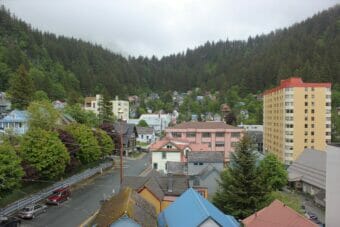
Homes in downtown Juneau, photographed on June 6, 2023. (Katie Anastas/KTOO)

The Juneau Assembly is considering updating a grant program that helps Juneau residents build accessory dwelling units — new housing units like mother-in-law apartments, built on lots that already have a house. If approved, the size of the grants would more than double.

The city defines accessory apartments as being no more than 1,000 square feet or half the size of the main house on the lot — whichever is smaller. They can be standalone structures or part of an existing house. 

The previous program, which expired at the end of June, offered $6,000 grants. Applicants had to wait three years after building a new apartment to use it as a short-term rental. Since July 2016, the city has issued 41 of those grants.

Joseph Meyers, the city’s housing and land use specialist, told Assembly members in April that $6,000 was no longer a strong enough incentive for Juneau residents to build accessory apartments. At the start of the program, it could cover nearly a quarter of the construction cost. In 2022, it covered about 10%.

“While funding has been distributed and ADUs built, the $6,000 grant in many cases has not been a deciding factor in development of an ADU; rather a small bonus after the development decision has been made,” he wrote in a memo.

The updated program, if approved, would offer $13,500 grants. Like the original program, recipients couldn’t rent the unit as a short-term rental for three years. Applicants would have to be Juneau residents, and the new units would have to be occupied within two years.

Assembly members are still considering adding a second tier with much larger grants, though they’ll continue discussing that in committee. Tier 2 recipients would get $50,000, and short-term rentals wouldn’t be allowed for 10 years. 

Apartments built with Tier 2 grants would also have to be affordable for people who make 60% of the area median income. Right now, that would mean rent would be capped at $1,284 for an efficiency unit, $1,375 for a one-bedroom and $1,650 for a two-bedroom.

But at a committee meeting on Monday night, City Manager Rorie Watt said it would be time-consuming for city staff to monitor things like the rent property owners charged and their tenants’ income. 

And he said staff worried that property owners would just rent affordable units to friends and family rather than making them available to the broader community.

“We couldn’t figure out a way to ensure that that kind of program wouldn’t be misused,” he said. “If somebody added a unit with an affordability component, that they might not make that available to the public or there might be some kind of an inside deal.”

The Assembly Committee of the Whole will continue to discuss a potential second tier. The updated $13,500 grant program next goes to the full Assembly for a final vote.

Site notifications
Update notification options
Subscribe to notifications