Katie Anastas

Local News Reporter, KTOO
Newscast – Monday, July 31, 2023

In this newscast:

  • Survivors can now track evidence kits used in their sexual assault cases through a new Alaska Department of Public Safety system
  • The first opening in the summer king salmon troll fishery saw more chinook land than expected
  • The state ferry board’s 20-year plan includes three new ferries in the next four years
  • Phytoplankton are causing red-colored blooms in tidal waters near Ketchikan

Curious Juneau: Why does Alaska’s Capitol building have a ground floor?

Alaska’s Capitol has a ground floor and a first floor. It’s relatively uncommon in American buildings. (Katie Anastas/KTOO)

When Americans walk into a multi-story building, they’d usually say they’re on the first floor. Not in the lobby of Alaska’s Capitol building.
“It has a very European feel to it,” tour guide Kirk Smith said on a recent morning tour. “Right now, you are not on the first floor, you are on the ground floor. And the reason for that is that, as a multi-agency federal building, it was required to have a post office in it.”

Kirk Smith leads a tour of Alaska’s Capitol building. (Katie Anastas/KTOO)

Smith said visitors often wonder why that is. KTOO listener Sylvan Robb asked us to find out for this installment of Curious Juneau.

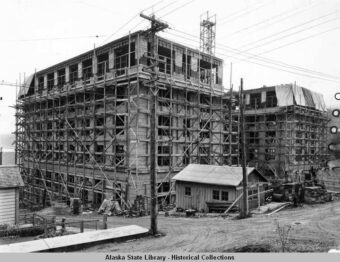
The Capitol was built in 1931. That was before statehood, so it was built to serve as a federal and territorial building. The post office was on the second of six stories, but Juneau’s steep streets still made it possible to put entrances and loading docks on that floor — on the uphill side, on 5th and Seward Streets. So the architects called that the first floor and called the one below it the ground floor.

“In order to meet the post office’s requirements of having a first floor street entrance, they had to call this the ground floor,” Smith said in the lobby.

The doorway to Seward Street is still there, though the post office is long gone. When Alaska became a state in 1959, the building became the state Capitol. In the years that followed, the post office and other federal offices moved to the newly constructed Juneau Federal Building.

“There’s nothing of it left,” Smith said. “It would be nice if there was an antique post office box or a teller window or something, but there’s really nothing there. It just looks like a hallway. It’s too bad.”

This used to be the employee entrance to the post office. Now, it’s just another hallway in the Capitol. (Katie Anastas/KTOO)

One lingering sign of the building’s history, though, is its art deco style. 

“I like to refer to the architectural style that’s in use here as ‘early 20th century American post office,’” Smith said.

Like many other federal buildings and post offices built during that time, the Capitol was designed by the Treasury Department’s Office of the Supervising Architect.

That office’s designs have come in handy for local architect Wayne Jensen. He’s been involved in many projects at the Capitol over the years, including renovations of the House and Senate chambers and remodels of committee rooms. Most recently, he oversaw seismic upgrades throughout the building, which took years of work between legislative sessions.

That’s when Jensen saw one remnant of the old post office. 

“When we did the demolition, we found a door that was kind of closed into one of the walls,” he said. “I don’t remember if it said ‘post office’ on it, but that was the one thing we did find.”

This 1930 photo shows a rear view of the Capitol under construction. (M272-2 Alaska State Library Manuscript Collection)

Jensen has studied the original architects’ ink-on-linen drawings. He said putting the post office on the first floor makes sense – that floor is bigger than the ground floor, and it has better street access.

“The ground floor isn’t as large as the other floors,” Jensen said. “It goes back into the mountain, back into the hill, so it’s truncated a little bit. Plus it has the boiler rooms and all those things that are not really occupiable spaces. But the first floor has access on the back side of the building and on Seward Street.”

According to the building’s original floor plans, the door to Seward Street was an employee entrance and the one to 5th Street was the public entrance. The post office lobby and work room took up the entire east wing of the first floor. Postal workers would sort the incoming mail in the workroom and feed it into post office boxes.

“I know stories from people who lived here in the ‘50s, ‘60s – they would go there every day to get their mail and it became a social area,” Jensen said.

This door, which goes out to Seward Street, was once the employee entrance to the post office. The steep street allows for a street entrance into the second story of the building. (Katie Anastas/KTOO)

Jensen said the history of the Capitol building is worth remembering. Before construction started, Congress only allocated enough money to pay for half of the block where the building stands today. Juneau residents raised the rest of the money and then gave the property to the federal government.

“The community got together and said, ‘Well, if the feds can’t do it, we can do it ourselves,’” Jensen said. “It’s very Juneauite. Over the years, we’ve done a lot to keep the Capitol here and support the Capitol, and that was one of the first efforts to do that.”

The post office may be a nearly-forgotten piece of the building’s history. But it’s why today’s visitors need to pay extra attention to what floor they’re on inside the Capitol.


Curious Juneau

Are you curious about Juneau, its history, places and people? Or if you just like to ask questions, then ask away!

As Mendenhall Glacier hits tour capacity, Juneau visitors are opting for the city bus

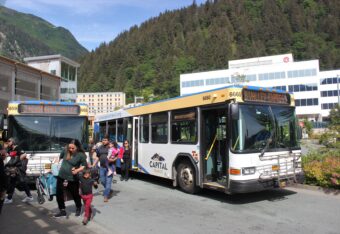
Tourists get off a city bus at the Capital Transit Center on Thursday, July 20, 2023. More than a dozen tourists had taken the bus from the Dredge Lake Road bus stop back to downtown. (Katie Anastas/KTOO)

For Ron Verheul and his wife, Lucy, the Mendenhall Glacier was a must-see. The question was how to get there.

“I wanted to take the city bus because I wanted to save some money. Lucy wanted to take a tour bus. So we were still kind of on the fence about which way we were going to go,” Verheul said. 

When they got off their cruise ship and went to the visitor center at the dock, the decision had already been made for them.

“They told us the tour bus was not running,” he said. “So there was no other option.”

More than a dozen other visitors joined the couple, who were visiting from Vancouver, Canada, on the 2:30 p.m. bus from the Dredge Lake Road bus stop to downtown on Thursday. 

With tour bus visits to the Mendenhall Glacier sold out halfway through the season, tourists are increasingly using the city bus to get to and from Juneau’s top destination.

Pushed to the limit

Industry leaders expected this season to be bigger than ever, as cruise ships returned to pre-pandemic capacity. And so far, Juneau’s top destination has been feeling the squeeze

The U.S. Forest Service allows 517,650 people to visit the glacier on commercial tours each tourist season. That limit is based on an environmental analysis of the area, including of the infrastructure at the glacier. Once tour companies get their allocated number of permits, they start selling tours.

“In the past, the largest provider has not used all their permits, and they’ve been able to redistribute permits in the mid-to-late season,” said Alexandra Pierce, the city’s tourism manager. “But this year they’re using all their permits.”

That means there aren’t extra permits to redistribute to other companies who sell day-of tours at the dock. Now, unless visitors booked tours in advance, they can’t take tour buses to Juneau’s most popular attraction.

“These other operators sold out, anticipating a redistribution that isn’t going to happen,” Pierce said. “We’re in a situation now where a large number of visitors who want to visit the glacier won’t have the ability to.”

Pierce said the Forest Service has an extra 50,000 permits it saves until later in the season. But even if they distributed those to tour companies, it wouldn’t be enough to meet demand.

“It’s a drop in the bucket of what we actually need,” Pierce said.

The Forest Service is also considering expanding its facilities, which would allow for more permits. The proposed project includes more parking, a new welcome center and new trails.

A Capital Transit bus bound for the Mendenhall Valley parks at the downtown transit center. (Katie Anastas/KTOO)

Resident use and tourist demand collide

As tourists’ demand for the city bus increases, Juneau residents are feeling the impact. 

If buses are too full, drivers have to pass people by at stops. It’s happened at least 40 times since May, according to data compiled by Capital Transit staff. In a spreadsheet Pierce shared with the Juneau Assembly on Thursday, the number of people left behind at one time range from one to 29 at stops throughout the route. 

For example:

  • On May 8 at 2:17 p.m., 10 people were left at the Yadaa.at Kalé Juneau-Douglas High School bus stop.
  • On June 2 at 6:50 p.m, 11 people were left at the Fred Meyer stop. 
  • On July 12 at 9:40 a.m., 25 people were left at the downtown transit center.

Juneau Assembly member Michelle Hale has ridden Capital Transit for more than a year. At an Assembly meeting earlier this month, she said availability of public transportation was vital for many of its regular riders.

“Often, the people that ride the bus are some of our most poor citizens – not always, of course – and might not have access to even figure out who to make that complaint to,” she told the Assembly. 

If the city has spare drivers, it can add them to in-demand routes. But with a statewide driver shortage straining both Capital Transit and tour companies, that can’t happen often enough to meet the demand.

Pierce said she’s heard stories of residents unable to get on a bus from Fred Meyer with their groceries or missing flights because they couldn’t take the bus to the airport. But the city can’t prevent tourists from taking public transportation.

“If you or I go to New York and ride the subway or go to London and ride the Tube, we wouldn’t get a little stop on the turnstile that says, ‘You don’t live here,’” she said. “Our duty as a local transit authority is to provide transit to everybody.”

A sign at the downtown Capital Transit center warns tourists that taking the city bus to the Mendenhall Glacier means a longer trip and a 1.5 mile walk. (Katie Anastas/KTOO)

A hack for tourists

Capital Transit is a considerably cheaper alternative to tour buses, and tourists know that. While city bus tickets are just $2 for adults, tour companies charge around $50 to $70 per person.

“On the travel blogs and forums, the city bus is kind of presented as a hack,” Pierce said.

But if time is money, Capital Transit might not be such a steal. A sign at the downtown transit center warns visitors that the bus rides can take about two hours total. The bus doesn’t go all the way to the visitor center parking lot – the closest bus stop is 1.5 miles away.

“Expect the trip to take at least 4-5 hours round trip from downtown,” the sign reads, pointing out later that “private tour buses only take about 30 minutes each way.”

Verheul said, between the stops along the bus route and the walk from Dredge Lake Road, the trip took up most of their time in Juneau.

“The bus is a bit of a milk run,” he said.

The shortage of glacier tours has driven visitors to other activities, like the Mount Roberts tram and whale watching. Cheryl Zachary, who was visiting Juneau on Thursday from Ohio, was taking Capital Transit from downtown to Glacier Gardens, a botanical garden near Fred Meyer.

“Whenever I travel, I like to use public transportation,” she said. “I feel like you get to meet local people and you get a feel of what it’s like to actually live in a place.”

The price was right, too. Zachary was staying at a hotel near the airport.

“If we Uber back to the hotel, it’s like $30,” she said.

The view of the Mendenhall Glacier from the Kaxdigoowu Heen Dei trailhead on Friday, July 21, 2023. (Katie Anastas/KTOO)

‘Too many people’

The city is doing what it can to provide other ways for tourists to see the glacier on tours. They’ve issued additional permits for the parking lot at the Kaxdigoowu Heen Dei Trail, which has views of the glacier.

The city has hired a consultant to look at Juneau’s public transit system. Pierce said the city originally hired them to help plan a new bus route that could help tourists spread out in downtown. Now, they’re also working on what Capital Transit might do to remain available for both residents and tourists during the season.

She said both projects point to key challenges Juneau faces when it comes to tourism.

“We have a shore excursion supply and demand problem in Juneau,” Pierce said. “We’ve always been a destination where there’s a lot of options and a lot to do, but we just have too many people now.”

Pierce said they should have recommendations for the Valley bus route ready for city leaders next month. In the meantime, she wants Juneau residents to know the city is working to find a solution.

“I think we’ll see a busier downtown with more people wandering around,” she said. “We’ll get through this season and have a lot of winter project work to do.”

Juneau’s new assisted living complex helps meet senior housing need

Betty Marriott, 83, plays her baby grand piano at Riverview Senior Living. (Katie Anastas/KTOO)

When 83-year-old Betty Marriott moved out of her Douglas home into the Riverview Senior Living facility, she asked if she could bring her baby grand piano with her.

“I’ve been playing piano since I was 10,” she said. “I just love it. It’s my emotional release, you might say. You’re happy, you’re sad or whatever. It just comes out in your music.”

On a recent Monday afternoon, she played a cheery melody called “Snowbird,” a song she picked out to play during happy hour in the dining room. Marriott had lived at Riverview for about a month, and she was enjoying it so far. 

“It’s brand new, so it’s very clean,” she said. “I like the people who work here. They’re all very friendly and helpful.”

Finding housing in Juneau is hard. It can be even harder for seniors who want to stay in Juneau but need a bit more care. Alaska’s population of older adults is growing rapidly, and in Southeast Alaska, nearly one in four adults are 60 or older, according to state data. As local seniors seek to age in place, Riverview provides a new place to do it.
A needed model

The facility is located in the Mendenhall Valley. It has 58 assisted living apartments and 29 memory care units, and they’re filling up fast: about 70% of apartments have been claimed by people intending to move in in the next three months.

“We expect to be 80% full in the next four to six months, if not 100% full,” said Carrie Pusich, Riverview’s community relations director. “The interest that we have gotten from the community has been overwhelming.”

The apartments have their own wheelchair-accessible bathrooms and kitchenettes with a refrigerator, microwave and sink. Riverview is an assisted living facility, meaning there are staff there to help with daily activities like taking medications, getting dressed or using the restroom. New residents are screened by a nurse to determine the level of care needed from the nurses, medical technicians and caregivers on staff.

Monthly rent starts at $6,000 for a studio and $7,500 for a one-bedroom apartment. That includes all meals cooked by the community’s chef and activities, like field trips to the Mendenhall Glacier and the Jensen-Olson Arboretum. Additional monthly care fees start at $650 and go up in $400 increments depending on the level of care required. Pusich said the prices are in keeping with the national average.

“I know it seems high to some people, but it’s not,” she said. “We want to make everybody comfortable. We want them to feel like their apartment is theirs.” 

The first residents moved in in mid-May. Pusich said others are moving in in stages so the facility can hire staff as needed. 

Riverview Senior Living welcomed its first residents in mid-May 2023. (Katie Anastas/KTOO)

Years in the making

Riverview has key differences from other housing geared toward older adults in Juneau. Wildflower Court is a long-term care facility meant for people who need more extensive medical care. Trillium Landing and Fireweed Place are apartment communities. The state-run Pioneer Home offers its 49 residents multiple levels of care like Riverview does – with monthly rates starting at $3,458 including room and board – but it has a long waitlist.

That’s what inspired Pusich’s mom, Sioux Douglas, to try to bring another option to Juneau. She was president of the nonprofit Senior Citizens Support Services, Inc.

“Some people who needed assisted care, but weren’t on the Pioneer Home list or would have to wait way too long, found that the only thing they could do is move out of state or move up to Anchorage,” Douglas said. “We lost several good senior citizens who were longtime community members who had to go elsewhere for the care and the housing they needed.”

In 2012, the nonprofit held an open house at Nugget Mall to hear from Juneau residents about the need for assisted living in Juneau. Douglas said she talked to individuals who were “desperate” for assisted living options and families preparing to move out of state with aging grandparents.

“We already knew in our hearts that this was needed, but having that public forum convinced us to go forward,” she said.

The nonprofit spearheaded the search for a developer who could create an assisted living community in Juneau. 

“That took several years,” Douglas said. “It took a lot of meetings with the city and with two or three developers. And when Torrey Pines Development decided to invest in Juneau, it was the answer to our dreams.”

A perfect partnership

Torrey Pines, a California-based developer, owns Riverview. It’s operated by North Star Senior Living, also based in California. The City and Borough of Juneau provided some incentives to help Torrey Pines see the project through, including property tax abatement and a lease structure that helped reduce upfront costs for the developer.

“I refer to this as the perfect kind of public-private project that communities should have,” Douglas said. “There’s an appropriate role for government – a small role – and it incentivizes private development.”

Juneau Assembly member Michelle Hale agrees. She’s the Assembly liaison to the Juneau Commission on Aging. She said the city’s work with Douglas’ nonprofit and Torrey Pines shows the city can make meaningful contributions to the housing market without constructing a city-run facility.

“The city does a huge amount in this community. We own our hospital, we own our docks and harbors, we own Eaglecrest, we own our airport,” she said. “I don’t think the answer is for the city to take on new roles, but rather to find those nonprofits and other entities to partner with to help make things work.”

Along with helping longtime Juneau residents stay in the community, Hale said more housing options for seniors could help open up the local real estate market. The number of people aged 65 and older living alone more than doubled from 2015 to 2020, according to the Juneau Economic Development Council.

“That’s actually one of the reasons pointed to for the housing shortage – where you might have had a family of four or five in a house, you might be down to just one person,” Hale said.

Helping Juneau residents stay in town as they age is important to Hale. She’s 61, and her mother lives with her and her partner. They’ve watched friends and neighbors leave Juneau as they get older. 

“One of the things that has been the most heartbreaking for me over the years is having very dear friends who, once they retire, move south,” she said. “That always seems so sad to me – that we lose them in our community when they’ve been such a vital and vibrant part.”

Riverview represents a new part of Juneau’s community. As Betty Marriott performs on her baby grand for her friends and new neighbors, it’s clear she’s found her place in it.

Betty Marriott, 83, smiles in her new apartment at Riverview Senior Living. (Katie Anastas/KTOO)

Juneau elementary school students will have early dismissal on Mondays next year

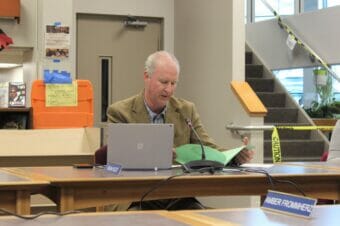
Juneau school board member Brian Holst reads from a meeting packet on July 11, 2023. (Katie Anastas/KTOO)

Juneau elementary school students will end the day a half hour early on Mondays next year.

According to a plan approved by the Juneau School Board on Tuesday, elementary schools will release students at 2 p.m., and optional programs will get out at 2:30 p.m. The early dismissal will give teachers an hour-long block of time every Monday to work collaboratively. 

District leaders say it will help elementary school teachers meet the new requirements of the Alaska Reads Act, which include teacher training, student testing and contact with parents.

The school board previously discussed having students at all grade levels start half an hour later on Wednesdays. But many parents said the late start in the middle of the week would disrupt their work commutes and kids’ sleep schedules.

School Board member Brian Holst urged fellow board members to limit the early dismissal to elementary schools.

“I think it’s an important step in supporting the Alaska Reads Act that doesn’t go as far as changing the schedule for all of our students,” he said.

Juneau’s new Superintendent Frank Hauser said the new schedule won’t increase transportation costs, as long as all elementary grades participate.

“When we look at scheduling the buses to make sure it’s feasible and there is no additional cost, it has to be the whole school,” Hauser said.

Board members had also wanted to ensure kids could still attend RALLY, the district’s afterschool child care program, during the extra half hour of teacher work time. Administrative Services Director Cassee Olin said RALLY staff begin work at 11 a.m., so they’ll already be there when students get out early on Mondays. That also means parents won’t be charged for the additional half hour of child care.

Board member Elizabeth Siddon said the decision balanced teachers’ needs for time to meet Alaska Reads Act requirements with parents’ needs for childcare.

“I think that this solution is a much more targeted solution to the problem we were trying to address,” Siddon said. “My hope is that this is sort of a win-win-win for everyone.”

Loren Jones to replace Carole Triem on Juneau Assembly until October

Loren Jones, July 30, 2015. (Photo by Jeremy Hsieh/KTOO)

Former Juneau Assembly member Loren Jones is headed back to city hall. The Juneau Assembly appointed him to temporarily fill the seat left vacant by Carole Triem’s resignation on Monday night. He’ll serve until the Oct. 3 municipal election.

Jones represented District 1 for three terms, from 2012 to 2021 — the maximum number of consecutive terms allowed. Before running for office, he worked for the Alaska Department of Health and Social Services.

When Jones first ran for the Assembly in 2011, he cited shrinking landfill space, affordable housing and health care services as top priorities. At a workshop for prospective municipal candidates last month, he stressed the importance of making thoughtful decisions on behalf of all Juneau residents, whether or not they voted for him.

“Most city functions have a very direct impact on every citizen in this town,” he said. “You turn on your tap in the morning, it’s a city function. You flush the toilet, it’s a city function. You turn on electricity, some of the rates are a city function.”

Triem announced her resignation late last month. She’s leaving to care for a family member with medical needs in Australia.

“The last five years have been pretty incredible,” Triem told her fellow Assembly members on Monday. “It’s been an honor to work with you guys, and I’m going to miss you a lot.”

Triem chaired the finance committee and represented the Assembly on the Bartlett Regional Hospital board. Assembly members Christine Woll and Michelle Hale will take over those roles, respectively, until October.

There will be four Assembly seats up for grabs in the October municipal election, two of which will be areawide. The full, three-year term will go to the candidate with the most votes, and the candidate with the second most votes will serve the remaining two years of Triem’s term.

The candidate filing period opens at 8 a.m. on Friday, July 14, and closes at 4:30 p.m. on July 24.

Site notifications
Update notification options
Subscribe to notifications