Katie Anastas

Local News Reporter, KTOO

From finances to the ‘Foodland factor,’ Juneau officials share advice with future candidates

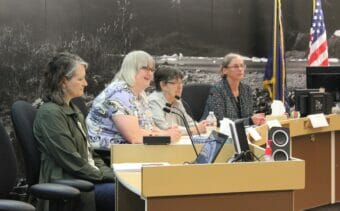
Juneau School District Chief of Staff Kristin Bartlett, Mayor Beth Weldon, school board president Deedie Sorensen and former Deputy City Manager Mila Cosgrove speak at a workshop for prospective municipal candidates on Saturday, June 24, 2023. (Katie Anastas/KTOO)

Current and former members of the Juneau Assembly and school board offered their advice to prospective candidates at a workshop on Saturday.

Mayor Beth Weldon said she hopes it inspired some of the attendees to run in October.

“I’m glad to see some new faces,” she said. “I’m always hoping for more, but it’s good to see new faces.”

The city, the League of Women Voters and Friends of the Juneau Public Library have hosted the annual workshop for nearly a decade. Organizer Peggy Cowan said about 30 people had registered this year. It’s a handful more than last year, but still far fewer than used to sign up.

“Our registration in the last two years has been a fraction of what it was pre-COVID,” she said.

Last year, three Assembly members and two school board members ran unopposed. This year, three Assembly seats and two school board seats will be up for grabs. One of the three Assembly seats won’t have an incumbent, since Deputy Mayor Maria Gladziszewski can’t run again.

Weldon hopes all the open seats will have multiple candidates.

“I know it’s great to run unopposed, but it’s disappointing for the public that they don’t have a choice,” Weldon said.

Cowan said most people at the workshop were interested in running for the Assembly or school board. Two or three wanted to learn how they could support someone running for office.

“I think local government, local office, is one of the ways you can be the most effective in changing the world around you,” former deputy city manager Mila Cosgrove told the attendees.

That’s what made Nano Brooks think about running for an Assembly seat. He’s been researching the city charter and getting to know the Assembly’s committees and boards. Brooks thinks his experience with finance as a local business owner would serve him well on the Assembly.

“I thought that this would be the next greatest step in helping the community,” he said. “It’s what I’m all about.”

During their panels, past and present officials offered some common pieces of advice. One was to be ready to work on a range of issues once elected, not just those central to their campaigns. 

That point stood out to realtor Joann Wallace, who attended the workshop to learn about running for the Assembly.

“I liked how they said you go into it with an opinion, but you also have to have an open mind,” Wallace said. “We all have to be learning all the time.”

She said the workshop also gave her a greater sense of the time commitment required. Several officials mentioned what they called the “Foodland factor” — getting stopped by constituents at the grocery store.

“It’s both this great opportunity to talk to the community, and also you have to remember that though you are one of seven, you have zero authority in Foodland to make any sort of decision,” said school board member Elizabeth Siddon. “And be very careful not to promise anything. It’s hard. Juneau is a small town.”

In May, the Assembly voted to make mail-in elections the default in Juneau. Former Assembly member Loren Jones said it was important for candidates to keep that timing in mind and get their message out quickly.

“Eighteen days prior to Oct. 3, some of the people you’re talking to have already voted,” he said. 

The candidate filing period will open at 8 a.m. on July 14 and close at 4:30 p.m. on July 24. Write-in candidates must file a form with the city clerk’s office at least seven days before the election. Election Day is Oct. 3.

Juneau legislators discuss school funding shortfall, budget wins at town hall

Rep. Andi Story and Sen. Jesse Kiehl speak at a town hall meeting at Yadaa.at Kalé Juneau-Douglas High School on June 22, 2023. (Katie Anastas/KTOO)

School funding was a top concern at a town hall meeting held Thursday by two members of Juneau’s legislative delegation. This week, Gov. Mike Dunleavy vetoed half of the $175 million one-time public school funding increase approved by the Alaska Legislature.

That veto brought Chris Niemi, one of about 25 attendees, to the town hall at Yadaa.at Kalé Juneau-Douglas High School. Niemi is a former teacher and has three grandkids who will attend Juneau schools. She hopes Alaskans reach out to their legislators, especially those in the House, and ask them to support an override.

“This affects families. It affects the children who are our future in this state,” Niemi said afterward. “If they really care about children and families, then they can’t not pass it.”

The veto leaves the Juneau School District with a $758,000 shortfall, and there isn’t enough in the district’s savings to cover that deficit.

Rep. Andi Story acknowledged during the town hall that an override requires a lot of support – 45 out of the 60 votes in the Alaska Legislature.

“It’s a high bar,” Story said. “But I know as we speak, people are burning up the phone lines and working on that.”

Even if an override doesn’t happen, Story said, the veto has kept education funding in the spotlight. Both the Alaska House and Senate bills that would permanently increase per-student state funding through the base student allocation, or BSA, ended the session in the House Finance Committee.

“That means, when we start in January, House Finance will be taking up the BSA bills, and they will be looking at them, getting updates from our districts, hearing from people,” she said. “We are very hopeful that we should get, in statute, a BSA increase.”

Story and Sen. Jesse Kiehl, both Democrats, also celebrated several items in this year’s budget. Kiehl said he’s “extremely proud of” $7.5 million in grant funding for child care centers.

“That is a breakthrough,” he said. “After COVID, we saw with federal supports going away, child care wages dropping in an industry where you cannot attract enough people to do the work. This isn’t a parent issue – this is a workforce issue, it’s an economy issue.”

The budget also funds inmate transportation to and from Juneau as construction continues at Lemon Creek Correctional Center, which Kiehl said will help ensure that people arrested in Juneau can appear in court there. There’s also $175,000 for a study on how the Department of Corrections can reduce suicides among incarcerated people.

“The Department of Corrections is the largest provider of behavioral health services and mental health services in the state of Alaska,” Kiehl said. “We have a serious problem with suicide inside our correctional institutions.”

Along with education funding, Kiehl and Story said giving public service workers the option to pay into a pension is an ongoing priority.

Juneau’s third legislator, Rep. Sara Hannan, was unable to attend Thursday’s town hall.

Newscast – Thursday, June 22, 2023

In this newscast:

  • The 50-year-old state ferry Columbia is out of service for at least a week due to maintenance issues
  • A quarter of Petersburg’s Dungeness crabbing fleet is skipping the season because they expect low prices
  • Gov. Mike Dunleavy has vetoed funding for research on the chinook and chum salmon crisis in Western Alaska
  • Voting is underway in Alaska’s artistic license plate competition

Dunleavy’s education funding veto leaves Juneau School District with budget gap

A school bus full of preschoolers, their parents, caregivers and advocates pulled up to the Capitol building on Monday to hand out Valentine’s Day cards to state legislators on Feb. 13, 2023. (Katie Anastas/KTOO)

Gov. Mike Dunleavy has vetoed half of a one-time increase in public education funding approved by the Alaska Legislature.

Now, Juneau school district leaders are grappling with a budget deficit just weeks before their budget is due to the state.

“To constantly be hitting a wall around adequate and timely and sustained funding is really frustrating,” said Superintendent Bridget Weiss. “It’s exhausting.”

Juneau School District leaders built a budget around an assumed $430 increase to the base student allocation, the formula that determines how much money school districts get from the state. Dunleavy’s veto makes the one-time boost just $340 per student.

The veto leaves the Juneau School District with a $758,000 shortfall, Weiss said. And there isn’t enough in the district’s savings to cover that deficit.

“Even if we said we’re going to use every penny of fund balance that we have so that we don’t have to make any further cuts — which you don’t want to do because that’s your buffer — we still wouldn’t quite have enough,” she said.

The Legislature needs 45 out of 60 votes to override a veto from the governor, which would also be enough votes to call itself into special session. 

Juneau Sen. Jesse Kiehl said the Senate likely has more support for a veto than the House does.

“I think an override is very difficult, but it is possible,” he said. “I think what it takes is education advocates around the state calling their legislators, saying, ‘This is not ok, this is hurting Alaska’s future, Alaska’s economy, Alaska’s kids.’ The votes aren’t there today, but what it takes to change legislative votes is citizen action.”

Meanwhile, with the district’s budget due on July 15, Juneau’s school board has less than a month to decide what to cut.

“Options are pretty minimal in how we do that, because we’re already pretty thin,” Weiss said.

In March, Weiss said the district might have to increase the pupil-to-teacher ratio — essentially making class sizes bigger — if state funding didn’t increase significantly.

The district was already bracing for less funding in fiscal year 2025, when pandemic aid runs out. This year’s budget includes $1.6 million in American Rescue Plan Elementary and Secondary School Emergency Relief, or ESSER, funds to pay for some teachers and online classroom materials.

Weiss and other school district administrators and teachers advocated for a permanent increase in school funding this session. She said there seemed to be a greater statewide understanding of the importance of public education.

“Hopefully that will be momentum going forward,” she said. “But for the moment, wow, it feels pretty deflating.”

Kiehl said legislators would continue to advocate for public school funding. He said the need is urgent.

“We’re going to have to get those resources into the schools, or we’re going to see outmigration, we’re going to see economic stagnation, we’re going to see unhealthy communities,” he said.

Short-term rental owners push back against Juneau Assembly’s registration plan

Homes in downtown Juneau, photographed on June 6, 2023. (Katie Anastas/KTOO)

Short-term rental owners in Juneau voiced their opposition to a proposed registration program this week. City staff said the program would help them collect sales tax and get better data on Juneau’s short-term rental market. 

The Juneau Assembly was set to vote on the program at its Monday meeting. But after hearing from rental operators, they decided it needed more work.

Several speakers, like Douglas resident Maryann Ray, said the additional paperwork would be onerous.

“There’s a lot of control in here that is being applied to, what ends up being in most cases, just small mom and pop operations,” Ray said.

The program would assign a unique number to each short-term rental unit and require owners to include that number in online listings. They’d face a $25 fee each time they list rentals online without proper registration. 

Assembly members began discussing further regulations at a meeting earlier this month, looking to communities like Sitka and Wasilla as examples. Sitka requires short-term rental owners to live on the property for half of the year, while Wasilla issues just 75 permits per year.

Dawn Dulebohn, who also lives in Douglas, has been an AirBnb host since 2019. She said regulating short-term rentals went against efforts to support local businesses.

“I’m local, I live here year-round, I work here year-round,” she said. “But when the city takes steps to hinder my income, which is necessary to live in such an expensive city, it reminds me of the actions the city has taken to put seasonal people first by supporting the cruise industry.”

Throughout the country, the increase in short-term rentals has left housing markets with fewer, more expensive options. But on Monday, several operators said the solution to Juneau’s housing shortage was to open up more land for development, not restrict short-term rentals.

In an interview, Assembly member Michelle Hale said the amount of muskeg and elevation changes on city-owned land makes it harder to develop than the public might realize.

“Very little of the city land that is out there is easily developable,” she said.

Three people spoke in support of the registration program. Hanna Davis runs an AirBnb out of her duplex. She said she understood the city’s need to collect data on short-term rentals while housing continues to be scarce.

“The city deserves metrics on our current housing issues,” she said. “If we are lucky enough to own property in this wonderful city, then it is our job to be transparent with the city as well.”

The Assembly voted 5-3 to send the ordinance back to the Committee of the Whole. Member Wáahlaal Gíidaak was absent.

“I think we can bring this back in a package that the public will understand, that the users will be able to comply with,” said member Wade Bryson. “Let’s make sure we get this right.”

Site notifications
Update notification options
Subscribe to notifications